Head-to-head
Seiko vs Rolex
The honest answer to 'is Seiko better than Rolex' is that they are not in the same league, and were never trying to be. Here is why the question keeps getting asked.
By Stephen V. · Updated Sep 3, 2026 · Published Aug 8, 2026
“Is Seiko better than Rolex?” is one of the most-asked watch questions and one of the least useful, because the honest answer is that the two are not competitors. They sit in different leagues at different prices for different reasons, and neither is trying to be the other. A Rolex costs something like ten to twenty times what the Seikos on this page do; it is Swiss luxury with an in-house movement, a waiting list and a resale market that often holds at or above retail. A Seiko — here the Prospex SPB117 and the Turtle SRPE99 — is the value end, offering real in-house mechanical watchmaking for a small fraction of the money. This page explains why the question keeps getting asked, and what the gap between the two actually contains.
| Axis | Seiko (SPB117, Turtle) | Rolex |
|---|---|---|
| Price tier | Entry to value | Ten to twenty times as much |
| Movement origin | In-house mechanical (6R35, 4R36) | Swiss in-house |
| Finishing | Competent for the price | Hand-finished, luxury-grade |
| Water rating (example) | 200 m, ISO 6425 | Professional dive-rated |
| Resale | Modest; strongest on named models | Very strong; often at or above retail |
| Availability | In stock | Waiting lists on popular models |
| What you buy | Real mechanical watchmaking, cheaply | Swiss luxury, status and resale |
The honest answer
They are in different leagues, and comparing them head to head flatters neither. Rolex is a luxury manufacturer whose watches are priced for the brand, the finishing and the market position as much as for the engineering; Seiko is a value manufacturer that prices nearer to cost plus a margin. Ask “which is better” and the answer depends entirely on what “better” means to you: better finished and more prestigious, in which case the Rolex wins by a distance it should at that price; or more watch per unit of money, in which case the Seiko wins just as clearly. What you cannot honestly say is that one is simply superior. They are answering different questions with different budgets.
Why the two get compared at all
Mostly because of the homage trope. Seiko has, over the years, made watches whose proportions and dial layouts echo famous Rolex sports models, and the enthusiast internet has spent a decade framing certain Seikos as “the poor man’s” version of a particular Rolex. That framing is where “Seiko versus Rolex” comes from, and it is half-true and half-misleading. It is true that a Seiko can scratch a similar aesthetic itch for a tiny fraction of the money. It is misleading because it implies the Seiko is trying to be a cheaper Rolex, when it is really its own thing: an in-house mechanical watch at an entry price, which happens to look, from a distance, like something far more expensive. Buying one as a Rolex substitute sets it up to disappoint against a standard it was never built to meet.
What ten to twenty times the price buys
A great deal, and it is worth being fair about it rather than defensive. At Rolex money you are paying for a Swiss in-house movement built and finished to a luxury standard, case and bracelet finishing that is genuinely a step beyond what happens at Seiko’s prices, and a brand with the kind of resale strength where popular models sell at or above retail and carry waiting lists to buy new. You are also buying status, plainly — a Rolex is legible as a Rolex across a room, and for many buyers that recognition is a real part of the value even if no spec sheet lists it. None of that is fake, and none of it is cheap to produce. The price is high, but it is not buying nothing.
What Seiko gives you that actually matters
The thing that makes the comparison interesting at all: Seiko offers real, in-house mechanical watchmaking for a fraction of the entry cost of Swiss luxury. The Turtle SRPE99 is a 200 m dive watch certified to ISO 6425, on the 4R36; the SPB117 steps up to a 39.5 mm sapphire diver, 200 m and ISO 6425, on the 70-hour 6R35. Both are manufactured movements from a company that makes its own hairsprings — not bought-in calibers dropped into a case — and both cost a small fraction of anything Swiss luxury sells. You do not get the finishing, the resale or the status. You do get a genuine mechanical watch with a real depth rating and a movement with decades of field history behind it, which is a lot of watch for the money. See why Seiko watches cost what they do for how they hit those prices.
The status question, and whether it is for you
The part of the gap nobody likes to say out loud is status, and it is worth saying plainly because it drives more of these purchases than any spec. A Rolex is recognized as a Rolex across a room; a Seiko, however good, mostly is not. For some buyers that recognition is a large and legitimate part of what they are paying for, and no amount of in-house Seiko watchmaking substitutes for it, because it is not a technical property at all. For other buyers status is precisely what they are happy not to pay for, and a Seiko that quietly does the mechanical job for a twentieth of the money is the more satisfying object for exactly that reason. Neither instinct is wrong. But being honest with yourself about which one you have will predict whether a Seiko leaves you content or quietly wishing you had stretched.
Where the comparison is unfair to each
Held to Rolex’s standard, the Seiko loses on finishing, on the smoothness of the brand experience, and on resale — and it is unfair to expect a watch at a twentieth of the price to match any of that. Held to Seiko’s standard, the Rolex looks like an extravagant way to buy a mechanical watch that keeps time no better than a certified 6R35 does — and that is unfair too, because most of what a Rolex buyer is paying for was never about telling the time. The useful framing is not “which wins” but “which problem are you solving.” If the problem is wanting a good mechanical watch, Seiko solves it cheaply. If the problem is wanting luxury, finishing and status, Seiko does not solve it at any price, because it is not selling it.
The resale gap, and why it exists
Resale is where the two brands separate most starkly, and it is worth understanding rather than just noting. A Rolex, particularly a popular sports model, occupies an unusual position for a manufactured good: demand outruns supply, waiting lists form to buy new, and the secondary market often prices used examples at or above retail. That is not normal, and it is a large, quiet part of why people buy the brand — the watch is a store of value as much as a thing to wear. Seiko sits at the ordinary end of that spectrum. Named references like the Turtle hold their value better than most watches at their price and sell quickly secondhand, but they depreciate the way nearly everything does; you will not recover what you paid, let alone more. Neither behavior is a verdict on the watches themselves. Rolex resale is a function of brand, scarcity and decades of cultivated demand; Seiko resale is a function of being an honestly priced tool that plenty of people want used but nobody is speculating on. If you treat a watch purely as something to wear and eventually move on from at a modest loss, the Seiko is the rational buy. If part of the appeal is owning an asset the market will hold up, that is a Rolex argument, and it is a real one — just one that has very little to do with how either watch performs on your wrist.
The cons, honestly
On the Seiko side, the honest limits are real: the finishing is competent rather than remarkable, the Turtle’s Hardlex scratches and its 45 mm case is a lot of watch, resale is modest next to Swiss luxury, and neither Seiko carries the status a Rolex confers. On the Rolex side, the drawbacks are the ones that come with luxury: the price is high, the popular models can be hard to buy at all thanks to waiting lists, and much of what you pay for is intangible — brand, finishing, resale — rather than any measurable performance the Seikos lack. Neither set of drawbacks is a scandal. They are just the trade-offs of the league each watch plays in, and knowing them stops you buying either for the wrong reason.
Buy the Seiko if
You want a genuine mechanical watch with a real depth rating and an in-house movement, and you would rather spend a fraction of luxury money to get it. The Turtle is the value certified diver and the SPB117 the more refined one — see the Seiko dive field and the full Turtle reference. If the appeal was ever “a Rolex look for far less,” buy the Seiko for what it is rather than what it resembles — the Rolex alternatives roundup takes each famous archetype in turn and names the Seiko that does the same job.
Consider a Rolex if
Finishing, brand and resale are what you are actually buying, and you have the budget for Swiss luxury rather than value. That is a legitimate purchase — just a different one, at ten to twenty times the price, for reasons that mostly are not about keeping time. If you are weighing whether Seiko itself counts as luxury, the is Seiko a luxury brand guide draws that line, and the line hierarchyshows where Seiko’s own high end sits.
The watches on this page
Specifications are transcribed from Seiko’s published documentation. Prices come from Amazon and carry the date they were verified. We have not handled these watches — here is what we did instead.
No buyable offer at the last check (October 23, 2026). We show nothing rather than a stale number.
#ad · we may earn a commission from this link to Seiko Prospex SPB117
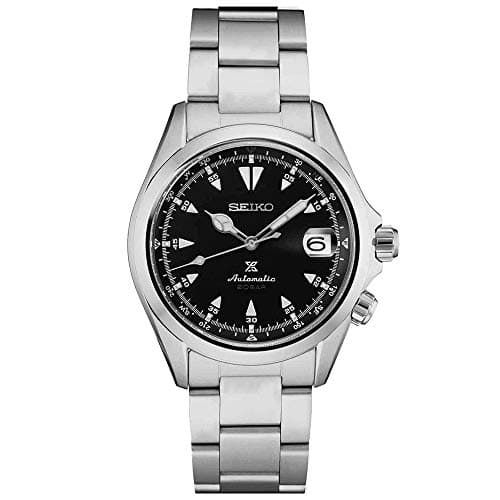
Seiko Prospex SPB117
SPB117J1Best for: The best-proportioned Seiko diver, if the budget stretches
The 62MAS-lineage diver: 39.5 mm, sapphire, and the 70-hour 6R35. This is where Seiko stops compromising, and the price step reflects it.
- Spec completeness for the price
- 9.3
- Movement relative to bracket
- 9.2
- Case proportions
- 9.6
- Strap flexibility
- 9.2
- Availability
- 7.9
What it gets right
- 70-hour power reserve — leave it off over a weekend and it is still running
- Sapphire, and a tighter stated accuracy spec than the 4R family
- 39.5 mm with a 46.4 mm lug-to-lug is the most universally wearable diver Seiko makes
What it gets wrong
- Roughly double the price of a Turtle
- 6R35 is still a 21,600 vph movement, so the seconds sweep is no smoother
- 20 mm lugs on a diver feel narrow to some
Skip this one if: your budget is doing other work. A Turtle is the same water rating and the same 6-beat sweep for half the money; what you buy here is sapphire, the power reserve and the proportions.
| Case diameter | 39.5 mm |
|---|---|
| Lug-to-lug | 46.4 mm |
| Thickness | 12.4 mm |
| Lug width | 20 mm |
| Crystal | Sapphire with anti-reflective coating |
| Water resistance | 200 m, ISO 6425 rated |
| Crown | Screw-down |
| Caliber | Seiko 6R35 |
| Type | Automatic, hand-winding and hacking |
| Beat rate | 21,600 vph (6 beats/sec) |
| Jewels | 24 |
| Power reserve | Approx. 70 hours |
| Stated accuracy | -15 to +25 sec/day |
| Complications | Date |
No buyable offer at the last check (October 23, 2026). We show nothing rather than a stale number.
#ad · we may earn a commission from this link to Seiko Prospex Turtle SRPE99
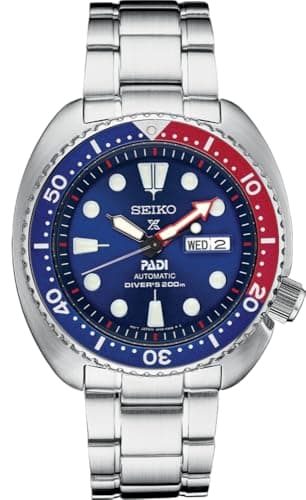
Seiko Prospex Turtle SRPE99
SRPE99K1Best for: An actual dive watch you can also wear daily
A real 200 m ISO-rated diver with a screw-down crown, in the cushion case that wears far smaller than its 45 mm suggests.
- Spec completeness for the price
- 9.0
- Movement relative to bracket
- 8.5
- Case proportions
- 8.8
- Strap flexibility
- 9.5
- Availability
- 8.6
What it gets right
- Genuine ISO 6425 diver, not a diver-styled sports watch
- 47.7 mm lug-to-lug means it fits wrists that 45 mm suggests it should not
- Screw-down crown at 4 o'clock keeps it off the back of your hand
What it gets wrong
- Hardlex on a watch at this price is the recurring Seiko complaint
- The 45 mm figure scares people off before they try one
- PADI co-branding on the dial is not for everyone
Skip this one if: you have a wrist under about 6.5 inches. The lug-to-lug is forgiving but the case is still visually wide, and the smaller SRPG references exist for exactly this reason.
| Case diameter | 45.0 mm (cushion case) |
|---|---|
| Lug-to-lug | 47.7 mm |
| Thickness | 13.4 mm |
| Lug width | 22 mm |
| Crystal | Hardlex (hardened mineral) |
| Water resistance | 200 m, ISO 6425 rated for scuba diving |
| Crown | Screw-down, at 4 o'clock |
| Bezel | Unidirectional elapsed-timing bezel, PADI red and blue |
| Lume | LumiBrite on hands and markers |
| Bracelet | Steel, three-fold clasp with push-button release |
| Caliber | Seiko 4R36 |
| Type | Automatic, hand-winding and hacking |
| Beat rate | 21,600 vph (6 beats/sec) |
| Jewels | 24 |
| Power reserve | Approx. 41 hours |
| Stated accuracy | -35 to +45 sec/day |
| Complications | Day and date |
The one-line version
If you want a good mechanical watch, buy the Seiko and enjoy it for what it is; if you want luxury, finishing and status, save for the Rolex and do not expect a Seiko to stand in for it. The mistake in both directions is treating them as rivals on one ladder. They are not — they are different products at different prices for different reasons, and the Seikos on this page are among the best arguments that you do not need luxury money to own a genuine, certified mechanical watch. Whether you eventually want more than that is a question only your own priorities answer, and the luxury-brand guide is the place to keep reading.
Questions
Is Seiko better than Rolex?
Neither, in the abstract. They are different leagues: Rolex is Swiss luxury at ten to twenty times the price, with finishing, status and strong resale; Seiko is value, offering real in-house mechanical watchmaking cheaply. “Better” depends entirely on what you are buying a watch for.
Why do people compare Seiko to Rolex?
Because some Seikos echo the look of famous Rolex sports models, so the internet frames them as a “poor man’s” version. It is half-true: a Seiko can scratch a similar aesthetic itch for a fraction of the money, but it was never built to be a cheaper Rolex.
Does a Rolex keep better time than a Seiko?
Not in a way most owners would notice against a certified Seiko movement like the 6R35. Most of a Rolex’s price pays for finishing, brand, resale and status, not for timekeeping the Seiko cannot match.
Is a Seiko a good alternative to a Rolex?
As a mechanical watch with a real depth rating, yes, and for far less. As a substitute for the finishing, status and resale of a Rolex, no — those are not things Seiko sells at any price. Buy it for what it is.
Why is a Rolex so much more expensive?
Swiss in-house manufacturing to a luxury finishing standard, brand and status, and a resale market that often holds at or above retail with waiting lists to buy new. The price is high, but it is not buying nothing.
Sources
- Seiko Prospex collection — official specifications
- Seiko Watch Corporation — US catalog and specifications
- ISO 6425 — Horology, divers' watches (standard listing)
Specifications are transcribed from manufacturer documentation and published standards. Where a manufacturer does not publish a figure, this page says so rather than estimating one.
Read next
- Is Seiko a luxury brand?Where Seiko sits relative to Swiss luxury.
- Best Seiko dive watchesThe divers on this page, in context.
- Seiko Turtle referenceFull published specifications for the value diver above.
- Why Seiko watches cost what they doHow Seiko reaches its prices, and what the gap to luxury is made of.