Roundups
Best Seiko field watches
Legibility, a modest case and a movement that will not quit. The field watch is the least fashionable and most wearable thing Seiko makes.
By Stephen V. · Updated Sep 29, 2026 · Published Aug 8, 2026
Quick picks
| # | Watch | Key spec | Score | Price |
|---|---|---|---|---|
| 1 | 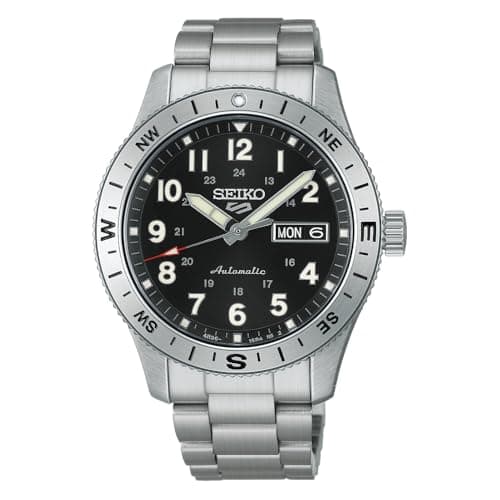 Seiko 5 Sports Field HDB006HDB006 Seiko's current 5 Sports Field: a 41 mm case with a lumed rotating bezel on the familiar 4R36. The field reference the line had been missing. | 41mm · 100m | 8.7out of 10, compiled from published specifications | |
| 2 | 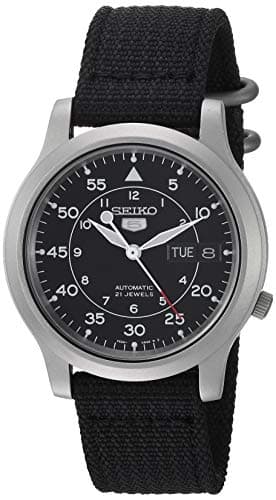 Seiko 5 SNK809SNK809K2 The classic small field Seiko: 37 mm, 7S26, canvas strap. It does not hack and it does not hand-wind. Now discontinued — the 7S26 went out of production in 2019 and Seiko's US catalog no longer lists it — so remaining stock is priced by scarcity, not by Seiko. Check the live price against a 4R36 reference before paying it. | 37mm · 30m | 7.3out of 10, compiled from published specifications | |
| 3 | 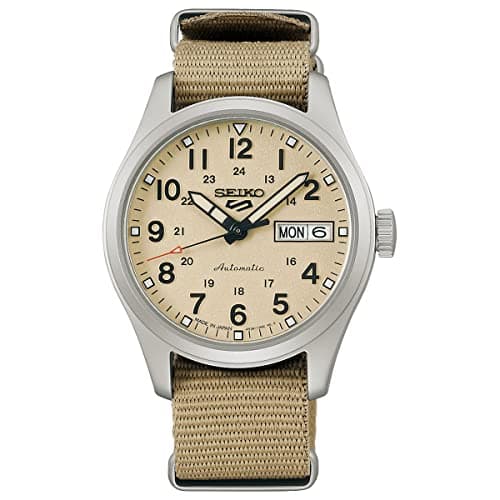 Seiko 5 Sports Field SBSA199SBSA199 A Japan-market 5 Sports field reference on nylon, and the smallest 4R36 field case Seiko lists anywhere: 36.4 mm across, 44.4 mm lug to lug. | 36.4mm · JDM | 8.3out of 10, compiled from published specifications | |
| 4 | 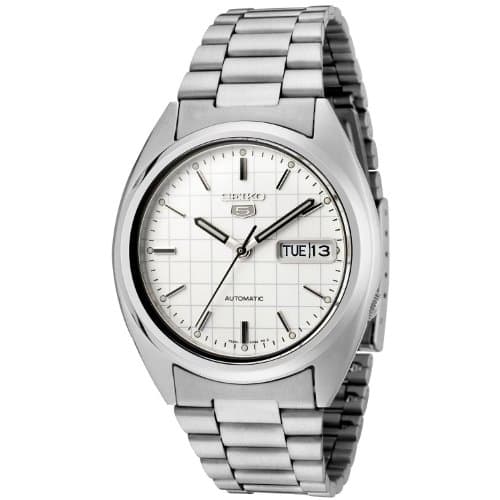 Seiko 5 SNXF05SNXF05K1 A white-dial Seiko 5 on a steel bracelet at 37 mm and 11 mm thick. The plainest mechanical watch Seiko ever sold in volume, and still findable under $200. | 37mm · 30m | 7.9out of 10, compiled from published specifications |
4 picks · Prices last verified October 23, 2026. Where no live price came back we show “Check price” rather than a number we cannot stand behind. How we pick.
A field watch is defined by what it leaves out. No rotating bezel, no date complication to fuss over, no styling that dates — just a legible dial, a case small enough to disappear under a sleeve, and a movement rugged enough that you stop thinking about it. It is the oldest wristwatch template there is, drawn straight from the trench and infantry watches of the early twentieth century, and Seiko builds the least expensive good ones on the market.
The criteria that matter here are narrow and worth stating up front: legibility in any light, a modest case that sits flat, durability you can ignore, and a strap-friendly build that invites swapping. Nothing on this page is trying to be a dive watch or a dress watch, and the moment a field watch starts adding those ambitions it stops being a field watch. Everything below is judged on how quietly it does the core job.
A template that has not needed changing
The field watch is the rare design that peaked early. The infantry watches of the First World War established the whole grammar — Arabic numerals, a railroad minute track, high-contrast hands, a case small enough to survive a sleeve — and almost nothing essential has been added since. That is why a good field watch dates so slowly: it was solving for legibility and durability rather than fashion, and those requirements do not move. Seiko’s field references are direct descendants of that template, which is most of why they look right in a way a trend-driven watch will not a decade from now.
It is also why the category rewards restraint. The moment a field watch grows a rotating bezel, a date magnifier or a chunk of case, it stops doing the one job cleanly, and every pick on this page is judged on how little it gets in its own way rather than how much it offers on paper.
The exception worth knowing about is the one field watch Seiko deliberately complicates: the Alpinist, which adds a compass bezel, sapphire and a three-day movement at several times the money here. The Alpinist roundup ranks that bracket, and the Prospex guide explains why a Land reference is rated to 20 bar when nobody is diving in it.
The small-case advantage
Field watches are where Seiko’s smaller cases live, and that is not a limitation — it is the point. A field watch was never meant to dominate a wrist; it was meant to tuck under a cuff and be read at a glance. The classic SNK809 and SNXF05, both at 37 mm, are normally proportioned watches by any historical standard, and the modern 5 Sports field references sit at a still-modest 39.4 mm. If a 42 mm sports watch has always felt like too much watch, this is the category built for you, and the small-wrist roundup goes deeper on fit.
The catch is that a small case wears its lug-to-lug honestly. The SNK809’s short lug-to-lug is what makes it fit a genuinely small wrist, while the 5 Sports field cases pair their modest diameter with a longer lug-to-lug that carries a little more length across the wrist than the diameter implies. Measure across the top of your wrist before you assume the smallest number wins.
Thickness deserves a mention alongside diameter, because a field watch is supposed to sit flat under a cuff. The classic references are notably slim, and the modern 5 Sports field cases are slimmer than Seiko’s sports divers even where they match them on width, which is a large part of why they wear so easily. A field watch that perches tall on the wrist has missed the point of the category, and this is one of the few places in Seiko’s range where the numbers and the intent line up cleanly.
The movement split at this end
This is the one technical decision the category forces, and it splits cleanly. The classic Seiko 5 field references — the SNK809 and the SNXF05 — run the older 7S26, which is a genuine automatic that neither hacks nor hand-winds: to start a stopped one you shake it or put it on, and you cannot stop the seconds hand to set it to a time signal. The newer 5 Sports field references — the HDB006 and the Japan-market SBSA199 — run the 4R36, which does both.
The internet inflates this difference; be precise about it. Both movements beat at the same rate, so neither sweeps more smoothly, and both drift by a broadly similar amount per day. What the 4R36 adds is convenience — hand-winding a watch you rotate, and syncing it to the second — not accuracy or a nicer sweep. If you wear one watch daily and never set it against a clock, the 7S26 references are honest watches for less money and the older case shapes are, to many eyes, prettier.
| Reference | Diameter | Movement | Water rating |
|---|---|---|---|
| SNK809 | 37 mm | 7S26 | 30 m |
| SNXF05 | 37 mm | 7S26 | 30 m |
| HDB006 | 41.0 mm | 4R36 | 100 m |
| SBSA199 | 36.4 mm | 4R36 | 100 m |
The Japan-market question
One reference here, the SBSA199, is a Japan-market watch: Seiko sells it domestically in Japan and it reaches buyers elsewhere as an import. That is a magnet for people who care where a watch comes from, so it is worth being clear-eyed about what it buys. By Seiko’s own specification the internationally sold equivalents are built to the same tolerances, so a domestic reference is a provenance preference rather than a measurable quality jump. It is a legitimate thing to want and it is not a spec advantage, and pretending otherwise would be the kind of fabrication this site avoids.
What it does change is the paperwork. An import arrives with a Japanese warranty and a longer returns path, which our JDM guide covers in full. For most buyers the practical takeaway is simple: choose the reference on its dial, size and movement, and treat the market it was sold in as a tiebreaker rather than a headline. If that provenance genuinely matters to you, the SBSA199 is there for exactly that reason — and at 36.4 mm it is also the smallest field case here.
The honest limitations
Two of them, and neither is a defect — they are what the category is. First, every watch here uses Hardlex rather than sapphire, so the crystals will pick up fine scratches over years of wear; that is the trade for the price, and it is the recurring Seiko caveat. Second, the classic 7S26 references are rated to only 30 m, which under the standard means hand-washing and rain, not swimming. A field watch historically never needed more, but if yours will see a pool or a shower, the 100 m 5 Sports field references are the only safe picks on this page. The winner leads for exactly that reason: it keeps the modest field-watch size while adding the water rating and the convenience movement, which is the most versatile combination in the category even though it gives up the smallest cases and the vintage charm the classics still own.
The picks in full
Specifications are transcribed from Seiko’s published documentation. Prices come from Amazon and carry the date they were verified. We have not handled these watches — here is what we did instead.
Price as of October 23, 2026. Prices move — Amazon's is the one that counts.
#ad · we may earn a commission from this link to Seiko 5 Sports Field HDB006
Seiko 5 Sports Field HDB006
HDB006Best for: A field watch with a rotating bezel and a mechanical movement
Seiko's current 5 Sports Field: a 41 mm case with a lumed rotating bezel on the familiar 4R36. The field reference the line had been missing.
- Spec completeness for the price
- 8.6
- Movement relative to bracket
- 8.5
- Case proportions
- 8.4
- Strap flexibility
- 9.3
- Availability
- 8.6
What it gets right
- Rotating bezel with its own LumiBrite, which the older field references did not have
- 20 mm lugs, the most common aftermarket size
- The 4R36 hacks and hand-winds
What it gets wrong
- 41 mm with a 48.5 mm lug-to-lug — bigger than the 39.4 mm field references it follows
- Hardlex, not sapphire
- 13.2 mm thick for a field watch
Skip this one if: you wanted the small field Seiko. This is the 41 mm replacement for that idea, and its 48.5 mm lug-to-lug is a different proposition from the 39.4 mm SRPG references, which Seiko has now sold out of.
| Case diameter | 41.0 mm |
|---|---|
| Lug-to-lug | 48.5 mm |
| Thickness | 13.2 mm |
| Lug width | 20 mm |
| Crystal | Curved Hardlex |
| Water resistance | 100 m (10 bar) |
| Bezel | Rotating, with LumiBrite on the bezel as well as the hands |
| Dial | Glossy black |
| Magnetic resistance | 4,800 A/m |
| Case back | See-through, screw case back |
| Clasp | Three-fold with push-button release |
| Caliber | Seiko 4R36 |
| Type | Automatic, hand-winding and hacking |
| Beat rate | 21,600 vph (6 beats/sec) |
| Jewels | 24 |
| Power reserve | Approx. 41 hours |
| Stated accuracy | -35 to +45 sec/day |
| Complications | Day and date |
$359.009% off
Price as of October 23, 2026. Prices move — Amazon's is the one that counts.
#ad · we may earn a commission from this link to Seiko 5 SNK809
Seiko 5 SNK809
SNK809K2Best for: A genuinely small mechanical watch, if the remaining-stock price is still sensible
The classic small field Seiko: 37 mm, 7S26, canvas strap. It does not hack and it does not hand-wind. Now discontinued — the 7S26 went out of production in 2019 and Seiko's US catalog no longer lists it — so remaining stock is priced by scarcity, not by Seiko. Check the live price against a 4R36 reference before paying it.
- Spec completeness for the price
- 8.0
- Movement relative to bracket
- 7.4
- Case proportions
- 9.2
- Strap flexibility
- 7.8
- Availability
- 4.0
What it gets right
- 42 mm lug-to-lug fits genuinely small wrists
- Exhibition back on a watch at this price
- Legible 24-hour inner track
What it gets wrong
- 7S26 will not hand-wind and will not hack — you cannot set it to the second
- 30 m rating means keep it out of the shower
- 18 mm lugs are a narrower strap market than 20 or 22 mm
- Discontinued and sold from remaining stock — the price is whatever the seller asks, and it no longer tracks the bracket this watch defined
Skip this one if: the live price is at or above a 4R36 Seiko 5 Sports. This was the value pick of its bracket when Seiko still made it; sold from remaining stock it frequently is not, and the SRPD93 or the 36.4 mm SBSA199 give you hacking and hand-winding for the same money or less. Skip it too if setting the watch precisely matters to you — without hacking you cannot stop the seconds hand to sync it.
| Case diameter | 37.0 mm |
|---|---|
| Lug-to-lug | 42.0 mm |
| Thickness | 11.1 mm |
| Lug width | 18 mm |
| Crystal | Hardlex (hardened mineral) |
| Water resistance | 30 m — hand-washing only, not swimming |
| Display back | Yes — exhibition caseback |
| Caliber | Seiko 7S26 |
| Type | Automatic. No hand-winding, no hacking |
| Beat rate | 21,600 vph (6 beats/sec) |
| Jewels | 21 |
| Power reserve | Approx. 41 hours |
| Stated accuracy | -20 to +40 sec/day |
| Complications | Day and date |
Price as of October 23, 2026. Prices move — Amazon's is the one that counts.
#ad · we may earn a commission from this link to Seiko 5 Sports Field SBSA199
Seiko 5 Sports Field SBSA199
SBSA199Best for: A Japan-market field automatic for a genuinely small wrist
A Japan-market 5 Sports field reference on nylon, and the smallest 4R36 field case Seiko lists anywhere: 36.4 mm across, 44.4 mm lug to lug.
- Spec completeness for the price
- 8.2
- Movement relative to bracket
- 8.5
- Case proportions
- 9.1
- Strap flexibility
- 8.2
- Availability
- 7.4
What it gets right
- 36.4 mm and 44.4 mm lug-to-lug — the smallest field case in the 4R36 range
- 12.5 mm thick, slimmer than the 41 mm HDB field references
- The 4R36 hacks and hand-winds
What it gets wrong
- A Japan-market reference, so it arrives as an import with a Japanese warranty
- Hardlex
- Seiko does not publish a lug width for it, so strap sizing needs measuring
Skip this one if: you want a US warranty and a domestic returns path. This is a JDM reference bought as an import — our JDM guide covers exactly what that changes.
| Market | Japanese domestic market (SBSA prefix) |
|---|---|
| Case diameter | 36.4 mm |
| Lug-to-lug | 44.4 mm |
| Thickness | 12.5 mm |
| Lug width | Not published by Seiko for this reference |
| Crystal | Curved Hardlex |
| Water resistance | 100 m (10 bar) |
| Strap | Nylon |
| Caliber | Seiko 4R36 |
| Type | Automatic, hand-winding and hacking |
| Beat rate | 21,600 vph (6 beats/sec) |
| Jewels | 24 |
| Power reserve | Approx. 41 hours |
| Stated accuracy | -35 to +45 sec/day |
| Complications | Day and date |
No buyable offer at the last check (October 23, 2026). We show nothing rather than a stale number.
#ad · we may earn a commission from this link to Seiko 5 SNXF05
Seiko 5 SNXF05
SNXF05K1Best for: A first mechanical watch on a bracelet, under $200
A white-dial Seiko 5 on a steel bracelet at 37 mm and 11 mm thick. The plainest mechanical watch Seiko ever sold in volume, and still findable under $200.
- Spec completeness for the price
- 7.8
- Movement relative to bracket
- 7.4
- Case proportions
- 9.0
- Strap flexibility
- 7.6
- Availability
- 7.9
What it gets right
- 37 mm and 11 mm thick — normally proportioned rather than a modern slab
- Steel bracelet included
- Plain white dial with applied markers, which suits a strap change
What it gets wrong
- 7S26 does not hack or hand-wind
- 30 m
- 19 mm lug width — an awkward size in the aftermarket, where 18, 20 and 22 mm dominate
Skip this one if: you intend to change straps often. At 19 mm the aftermarket is noticeably thinner than at 18 or 20 mm, so in practice you keep the bracelet it arrives on.
| Case diameter | 37 mm (excluding crown) |
|---|---|
| Lug-to-lug | Not published by Seiko for this reference |
| Thickness | 11 mm |
| Lug width | 19 mm |
| Crystal | Hardlex (hardened mineral) |
| Water resistance | 30 m |
| Dial | White |
| Case and bracelet | Stainless steel |
| Caliber | Seiko 7S26 |
| Type | Automatic. No hand-winding, no hacking |
| Beat rate | 21,600 vph (6 beats/sec) |
| Jewels | 21 |
| Power reserve | Approx. 41 hours |
| Stated accuracy | -20 to +40 sec/day |
| Complications | Day and date |
How to choose a field watch
Start with legibility, because it is the whole job
A field watch that you cannot read instantly has failed at the one thing it exists to do. Favor a matte dial over a sunburst, high contrast between hands and background, and a seconds track you can actually parse. The glossy black HDB006 puts its LumiBrite on the bezel as well as the hands, which is more usable in the dark than any of the classics here — the dial is the decision, and legibility should win it.
Then size it honestly against your wrist
Measure across the top of your wrist, edge to edge, and treat that number as your maximum comfortable lug-to-lug. The 37 mm and 35 mm classics fit almost anyone and only look small on a large wrist; the 36.4 mm SBSA199 is barely longer at 44.4 mm; the 41 mm HDB006 needs 48.5 mm of flat wrist, which is the most of anything here. Diameter is what you notice in a photo; lug-to-lug is what decides whether the watch actually sits flat.
Decide whether hacking and hand-winding matter to you
Be honest rather than aspirational. Plenty of buyers pay for the 4R36 and never once set the watch to a time signal. If that is you, the 7S26 SNK809 is a genuinely charming watch for less, and its case shape is one the newer references do not offer. If you rotate several watches or you like your time set to the second, the convenience of the 4R36 is worth the step, and it comes bundled with the higher water rating anyway.
Answer the water question before anything else if it applies
If the watch will ever be worn swimming or in the shower, the 30 m classics are simply out, no matter how much you like the SNK809, and you are choosing among the 100 m 5 Sports field references. This single question eliminates half the page instantly, which is why it belongs near the top of your thinking rather than the bottom.
Budget for a strap
Field watches are the most strap-friendly thing Seiko makes, and swapping the strap is the cheapest way to transform one. The classics use narrower lugs, which means a slightly thinner aftermarket selection, while the 5 Sports field references use a more common width with deep support. A single canvas or leather strap changes the character of a field watch more than any dial variant does — the strap roundup covers the options by lug width.
Prefer a matte dial for a working watch
A field watch earns its keep in bad light, and a matte or lightly grained dial holds legibility where a mirror-finish sunburst throws glare across the numerals exactly when you need to read them. It is a small thing that separates a field watch you actually rely on from one that only photographs well. If the reference you like comes in both a matte and a shinier execution, the matte is almost always the more honest field watch.
Think about lume the way you think about legibility
The whole appeal of a field watch is reading it without thinking, and that extends to the dark. Seiko’s LumiBrite is generally strong for the price, but its performance after several hours is not something a specification captures, and this site will not pretend to have measured it. If night legibility matters to how you will use the watch, treat it as a reason to see one in person rather than a box the spec sheet can tick.
Do not pay to lose 30 m of nothing
If the watch will never go near water, the 30 m classics are not a compromise and their lower rating costs you nothing in practice — you are choosing them for the smaller cases and the lower price, and the water rating is irrelevant to how you will wear them. The rating only becomes a gate when the watch will actually get wet, and if it will not, do not let the bigger number talk you into a bigger watch.
What the specification cannot tell you
How the lume actually performs after four hours, whether a dial that looks crisp online reads as busy in person, how a canvas strap softens with wear — none of that is on a spec sheet, and this site has not handled these watches. The figures narrow you to two or three; seeing one in person settles the rest, and for a watch this personal that last step is worth taking where you can.
Questions
What makes a watch a field watch?
A legible dial, a modest case, rugged construction and no complications that get in the way — no rotating bezel, no dive rating, no styling meant to impress. It descends from early-twentieth-century military watches and is judged on how quickly you can read it and how easily you can forget it is there.
Is the SNK809 or the HDB006 the better field watch?
The HDB006 is the more versatile pick — 100 m rated, a lumed rotating bezel, and the hacking, hand-winding 4R36 — while the SNK809 is much smaller and more charming, and now discontinued, so no longer reliably cheaper but rated only 30 m and running the non-hacking 7S26. If it will get wet or you want to set it precisely, the HDB006; if you want the smallest, most classic option and it stays dry, the SNK809.
Can I swim with a Seiko field watch rated 30 m?
No. A 30 m rating covers hand-washing and rain, not swimming, and the classic Seiko 5 field references like the SNK809 and SNXF05 carry it. If you need to swim in the watch, the 100 m 5 Sports field references — the HDB006 and the SBSA199 — are the safe options on this page.
What is the difference between the 7S26 and the 4R36 in these watches?
The 4R36 hacks and hand-winds; the 7S26 does neither. Both are genuine automatics beating at the same rate, so neither sweeps more smoothly and their day-to-day accuracy is broadly similar. The 4R36 buys convenience — winding a rotated watch and setting it to the second — not a smoother sweep or dramatically better timekeeping.
Are small field watches out of style?
No — they are back to a historically normal size. A 37 mm case was standard for most of the twentieth century, and a field watch was never meant to dominate a wrist. If a 42 mm watch has always felt like too much, the 35–39 mm field cases here are sized the way the category was originally intended.
Sources
- Seiko 5 Sports collection — official specifications
- Seiko Watch Corporation — US catalog and specifications
- Seiko instruction manuals and caliber documentation
- ISO 22810 — Horology, water-resistant watches (standard listing)
Specifications are transcribed from manufacturer documentation and published standards. Where a manufacturer does not publish a figure, this page says so rather than estimating one.
Read next
- Best Seiko for small wristsWhere the small field cases fit into the wider sizing question.
- Seiko 7S26 caliber referenceThe movement in the classic field picks, and exactly what it does not do.
- Seiko 4R36 caliber referenceThe hacking, hand-winding movement in the 5 Sports field references.
- Best Seiko straps and braceletsA field watch changes more on a new strap than on any dial variant.