Japan market
JDM vs international Seiko
The J-versus-K question, answered from Seiko's own specifications rather than from forum consensus.
By Stephen V. · Updated Jul 24, 2026
By Seiko’s published specifications, a J-suffix and a K-suffix version of the same reference are the same watch: same case, same movement, same dimensions, same water rating. What differs is assembly location, packaging, documentation language, and sometimes whether “Made in Japan” appears on the dial. We found no measured evidence of a quality difference from any source we would cite.
What each suffix means
The trailing letter in a Seiko reference indicates the assembly facility. J means Japan. K means one of Seiko’s other facilities. The digit after it — the 1 in SNK809K1 — is typically the strap or bracelet variant.
Both are Seiko-owned or Seiko-controlled facilities building to the same specification. This is not a licensing arrangement or an outsourcing arrangement.
What genuinely differs
| J suffix | K suffix | |
|---|---|---|
| Assembly | Japan | Other Seiko facility |
| Movement | Same caliber | Same caliber |
| Published dimensions | Identical | Identical |
| Water rating | Identical | Identical |
| Dial text | Sometimes 'Made in Japan' | Usually not |
| Documentation | Often Japanese | Local language |
| Warranty | Japan-market | Local market |
| Typical price | Often higher | Often lower |
The claim we could not verify
The persistent enthusiast claim is that J-suffix watches are more accurately regulated. It is repeated widely and we could not find it in Seiko’s published specifications, in any manufacturer documentation, or in any measured comparison we would be willing to cite.
That does not prove it false. It means the claim is unsupported by anything checkable, and we are not going to repeat it as though it were established. If Seiko publishes different regulation figures for J and K references, we have not found them and would update this page if shown.
What this means for a purchase
Do not pay a premium for a J suffix on a reference sold in your country
You are buying a two-letter difference in a part number plus a warranty that is harder to use. If the K version is available domestically and cheaper, buy the K version.
Do buy JDM when the reference does not exist elsewhere
An SARY dial or an SBDC Alpinist is a genuinely different watch you cannot get any other way. That is a real reason to accept the warranty trade-off.
Check what the seller warrants
Many gray-market retailers substitute their own warranty for the manufacturer’s. That can be perfectly good — often better than trying to use a Japanese warranty card abroad — but you should know which one you have before the watch arrives.
The watches on this page
Specifications are transcribed from Seiko’s published documentation. Prices come from Amazon and carry the date they were verified. We have not handled these watches — here is what we did instead.
Price as of October 23, 2026. Prices move — Amazon's is the one that counts.
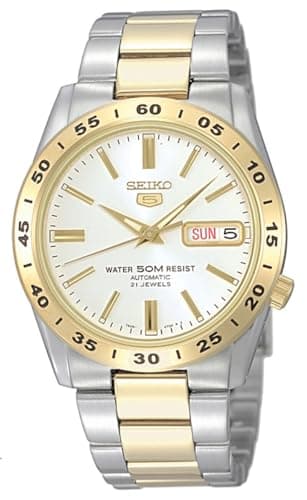
#ad · we may earn a commission from this link to Seiko 5 SNKE04
Seiko 5 SNKE04
SNKE04J1Best for: Buyers who care about J-suffix Japan assembly
A Japan-assembled Seiko 5 on a two-tone bracelet. The J suffix is the entire reason to pick this over its K-suffix twin.
- Spec completeness for the price
- 7.5
- Movement relative to bracket
- 7.4
- Case proportions
- 8.8
- Strap flexibility
- 7.6
- Availability
- 7.6
What it gets right
- J-suffix assembly
- Two-tone bracelet included
- 37 mm case
What it gets wrong
- 7S26 does not hack or hand-wind
- 50 m — swimming at a push, not diving
- Seiko does not publish full case dimensions for this reference
Skip this one if: the J suffix is not something you care about. The functional difference between J and K references is, by Seiko's own specification, nil — see our JDM guide.
| Case diameter | 37 mm |
|---|---|
| Lug-to-lug | Not published by Seiko for this reference |
| Thickness | Not published by Seiko for this reference |
| Lug width | Not published by Seiko for this reference |
| Crystal | Hardlex (hardened mineral) |
| Water resistance | 50 m (5 bar) |
| Dial | Champagne |
| Case and bracelet | Two-tone stainless steel |
| Market | J-suffix reference — Japan-assembled |
| Caliber | Seiko 7S26 |
| Type | Automatic. No hand-winding, no hacking |
| Beat rate | 21,600 vph (6 beats/sec) |
| Jewels | 21 |
| Power reserve | Approx. 41 hours |
| Stated accuracy | -20 to +40 sec/day |
| Complications | Day and date |
Price as of October 23, 2026. Prices move — Amazon's is the one that counts.
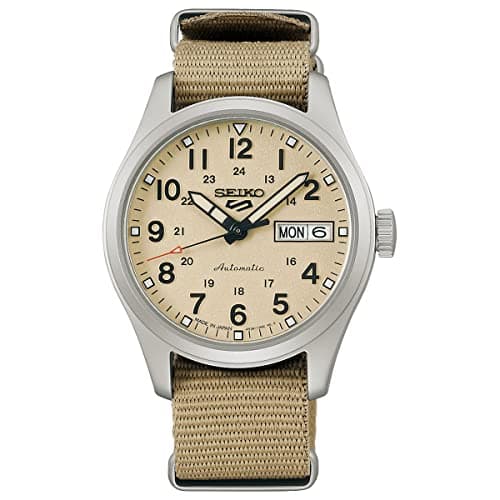
#ad · we may earn a commission from this link to Seiko 5 Sports Field SBSA199
Seiko 5 Sports Field SBSA199
SBSA199Best for: A Japan-market field automatic for a genuinely small wrist
A Japan-market 5 Sports field reference on nylon, and the smallest 4R36 field case Seiko lists anywhere: 36.4 mm across, 44.4 mm lug to lug.
- Spec completeness for the price
- 8.2
- Movement relative to bracket
- 8.5
- Case proportions
- 9.1
- Strap flexibility
- 8.2
- Availability
- 7.4
What it gets right
- 36.4 mm and 44.4 mm lug-to-lug — the smallest field case in the 4R36 range
- 12.5 mm thick, slimmer than the 41 mm HDB field references
- The 4R36 hacks and hand-winds
What it gets wrong
- A Japan-market reference, so it arrives as an import with a Japanese warranty
- Hardlex
- Seiko does not publish a lug width for it, so strap sizing needs measuring
Skip this one if: you want a US warranty and a domestic returns path. This is a JDM reference bought as an import — our JDM guide covers exactly what that changes.
| Market | Japanese domestic market (SBSA prefix) |
|---|---|
| Case diameter | 36.4 mm |
| Lug-to-lug | 44.4 mm |
| Thickness | 12.5 mm |
| Lug width | Not published by Seiko for this reference |
| Crystal | Curved Hardlex |
| Water resistance | 100 m (10 bar) |
| Strap | Nylon |
| Caliber | Seiko 4R36 |
| Type | Automatic, hand-winding and hacking |
| Beat rate | 21,600 vph (6 beats/sec) |
| Jewels | 24 |
| Power reserve | Approx. 41 hours |
| Stated accuracy | -35 to +45 sec/day |
| Complications | Day and date |
No buyable offer at the last check (October 23, 2026). We show nothing rather than a stale number.
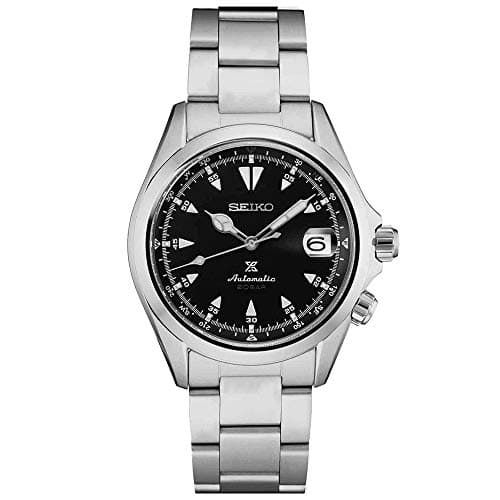
#ad · we may earn a commission from this link to Seiko Prospex SPB117
Seiko Prospex SPB117
SPB117J1Best for: The best-proportioned Seiko diver, if the budget stretches
The 62MAS-lineage diver: 39.5 mm, sapphire, and the 70-hour 6R35. This is where Seiko stops compromising, and the price step reflects it.
- Spec completeness for the price
- 9.3
- Movement relative to bracket
- 9.2
- Case proportions
- 9.6
- Strap flexibility
- 9.2
- Availability
- 7.9
What it gets right
- 70-hour power reserve — leave it off over a weekend and it is still running
- Sapphire, and a tighter stated accuracy spec than the 4R family
- 39.5 mm with a 46.4 mm lug-to-lug is the most universally wearable diver Seiko makes
What it gets wrong
- Roughly double the price of a Turtle
- 6R35 is still a 21,600 vph movement, so the seconds sweep is no smoother
- 20 mm lugs on a diver feel narrow to some
Skip this one if: your budget is doing other work. A Turtle is the same water rating and the same 6-beat sweep for half the money; what you buy here is sapphire, the power reserve and the proportions.
| Case diameter | 39.5 mm |
|---|---|
| Lug-to-lug | 46.4 mm |
| Thickness | 12.4 mm |
| Lug width | 20 mm |
| Crystal | Sapphire with anti-reflective coating |
| Water resistance | 200 m, ISO 6425 rated |
| Crown | Screw-down |
| Caliber | Seiko 6R35 |
| Type | Automatic, hand-winding and hacking |
| Beat rate | 21,600 vph (6 beats/sec) |
| Jewels | 24 |
| Power reserve | Approx. 70 hours |
| Stated accuracy | -15 to +25 sec/day |
| Complications | Date |
Questions
Is a J-suffix Seiko better than a K-suffix?
Not by any published specification. Seiko lists identical case dimensions, movements and water ratings for both. The differences are assembly location, packaging, documentation language and warranty market.
Are J-suffix Seikos more accurate?
This is widely claimed and we could not find it in any Seiko documentation or any measured comparison worth citing. We are not going to repeat an unsupported claim as fact.
Will Seiko honor a Japanese warranty in my country?
It varies by country and sometimes by individual service center. Many gray-market sellers provide their own warranty instead, which is often the more usable option. Check before you buy rather than after.
Does 'Made in Japan' on the dial mean anything?
It indicates assembly location. Seiko applies it inconsistently across the range, and it is not a statutory quality mark the way “Swiss Made” is — see our Japanese vs Swiss comparison.
Sources
- Seiko Watch Corporation — US catalog and specifications
- Seiko customer service — warranty and servicing
- Seiko instruction manuals and caliber documentation
Specifications are transcribed from manufacturer documentation and published standards. Where a manufacturer does not publish a figure, this page says so rather than estimating one.
Read next
- What does JDM mean for watches?Start here if the terminology is new.
- Best JDM Seiko watchesThe Japan-only references where the premium is actually justified.
- Buying a Seiko in JapanWhat changes when you buy in person rather than through a proxy.
- Japanese vs Swiss watchesWhy 'Swiss Made' is a legal mark and 'Made in Japan' is not.