Head-to-head
Japanese vs Swiss watches
Some of the differences are real and measurable. Most of what gets said about them is not.
By Stephen V. · Updated Jul 24, 2026
“Swiss made” is a legally defined mark: under Swiss law a watch may carry it when the technical development is done in Switzerland, at least 60% of manufacturing costs are incurred there, and the movement is cased up and inspected there. It is a country-of-origin rule, not a quality standard, and it says nothing about how well the watch is finished or how accurately it runs.
Japan has no equivalent statutory mark. “Made in Japan” on a Seiko dial indicates assembly location, and Seiko applies it inconsistently across its range — which is the source of most of the J-suffix versus K-suffix folklore.
What genuinely differs
Beat rate
Most Swiss movements at this price run at 28,800 vph — eight beats per second. Most Japanese movements at this price run at 21,600 vph — six. That is visible: the eight-beat seconds hand sweeps more smoothly. It is the most concrete difference between the two and it is one people notice in a shop without knowing why.
It is not a durability or accuracy claim. A slower beat rate means less wear and often a longer service interval; a faster one is less affected by shock in the short term. Both arguments are real and neither is decisive.
Vertical integration
Seiko manufactures its own movements, hairsprings, dials and cases. Very few Swiss brands at these prices do — most fit ETA or Sellita movements bought in. That is a genuine advantage for Seiko in the $200–$1,000 band, and it inverts at the very top where the Swiss manufactures do everything themselves.
Price positioning
Swiss brands price for the brand and the market position; Japanese brands price nearer to cost plus margin. The consequence at the entry level is stark: at $300 Seiko sells you an in-house automatic, and at $300 most Swiss brands sell you quartz. The Tissot PRX is exactly this — a superb object with a battery in it, at a price where Seiko gives you a rotor.
What does not differ
Reliability.Seiko’s 7S and 4R families have decades of field history and are as durable as anything Swiss at the price.
Accuracy, necessarily. A chronometer-certified Swiss movement is specified tighter than a 4R36. An uncertified ETA in a $600 watch frequently is not. The certification is the thing, not the country.
Finishing, at the top.Grand Seiko’s Zaratsu polishing and hand-set dial furniture compete directly with anything Switzerland produces, and that is not a controversial claim any more.
The watches on this page
Specifications are transcribed from Seiko’s published documentation. Prices come from Amazon and carry the date they were verified. We have not handled these watches — here is what we did instead.
No buyable offer at the last check (October 23, 2026). We show nothing rather than a stale number.
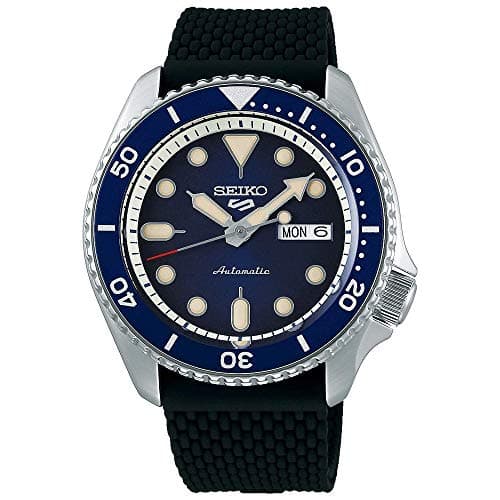
#ad · we may earn a commission from this link to Seiko 5 Sports SRPD93
Seiko 5 Sports SRPD93
SRPD93Best for: A first mechanical watch you will not outgrow
The 5KX case with a movement that hacks and hand-winds, in blue on a silicone strap. The default answer under $350, and the one most people should stop looking after.
- Spec completeness for the price
- 8.8
- Movement relative to bracket
- 8.5
- Case proportions
- 8.9
- Strap flexibility
- 9.5
- Availability
- 8.8
What it gets right
- Hacks and hand-winds — the SKX's biggest omission, fixed
- 22 mm lugs put the entire aftermarket strap catalog in play
- Day-date in a genuinely legible layout
- Case shape is the SKX profile people actually want
What it gets wrong
- Hardlex, not sapphire — it will scratch
- 100 m and no screw-down crown, so it is not an ISO 6425 diver despite the looks
- 13.4 mm thick under a shirt cuff
- Ships on a silicone strap rather than a bracelet
Skip this one if: you want an actual dive watch. The 100 m rating and the absence of a screw-down crown mean this is a dive-styled sports watch, not an ISO 6425 diver. The Turtle is the real one.
| Case diameter | 42.5 mm |
|---|---|
| Lug-to-lug | 46.0 mm |
| Thickness | 13.4 mm |
| Lug width | 22 mm |
| Crystal | Hardlex (hardened mineral) |
| Water resistance | 100 m — splash and swim, not scuba |
| Bezel | Blue unidirectional rotating |
| Dial | Blue sunray |
| Strap | Black silicone |
| Case back | See-through |
| Lume | LumiBrite |
| Caliber | Seiko 4R36 |
| Type | Automatic, hand-winding and hacking |
| Beat rate | 21,600 vph (6 beats/sec) |
| Jewels | 24 |
| Power reserve | Approx. 41 hours |
| Stated accuracy | -35 to +45 sec/day |
| Complications | Day and date |
Price as of October 23, 2026. Prices move — Amazon's is the one that counts.
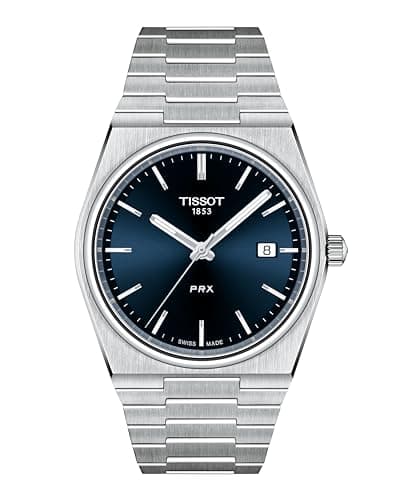
#ad · we may earn a commission from this link to Tissot PRX Quartz 40mm
Tissot PRX Quartz 40mm
Best for: An integrated-bracelet Swiss watch at Seiko prices
The Swiss integrated-bracelet watch Seiko has no direct answer to. Quartz here, which is what keeps it near Presage money.
- Spec completeness for the price
- 8.5
- Movement relative to bracket
- 7.6
- Case proportions
- 9.0
- Strap flexibility
- 5.5
- Availability
- 8.6
What it gets right
- Sapphire and 100 m
- Integrated bracelet finishing well above its price
- Swiss Made marking, which matters to some buyers
What it gets wrong
- Quartz at a price where Seiko sells mechanical
- Integrated bracelet cannot be swapped for a standard strap
- The automatic PRX costs substantially more
Skip this one if: you want a mechanical movement for the money. At this price Seiko sells you the 4R36 and the whole strap aftermarket; the PRX sells you finishing and a battery.
| Brand | Tissot (Swiss) |
|---|---|
| Case diameter | 40 mm |
| Crystal | Sapphire |
| Water resistance | 100 m |
| Movement | Swiss quartz |
| Bracelet | Integrated stainless steel |
No verified live price right now, so we are not showing one.
#ad · we may earn a commission from this link to Hamilton Khaki Field Mechanical 38mm
Hamilton Khaki Field Mechanical 38mm
Best for: A hand-wound Swiss field watch
A hand-wound Swiss field watch with an 80-hour reserve. The watch people mean when they say a Seiko field watch is not quite enough.
- Spec completeness for the price
- 8.4
- Movement relative to bracket
- 8.9
- Case proportions
- 9.3
- Strap flexibility
- 9.0
- Availability
- 8.4
What it gets right
- 80-hour power reserve on a hand-wound movement
- Sapphire crystal
- 38 mm with genuine field-watch proportions
What it gets wrong
- Hand-wound only — you wind it every day or it stops
- 50 m
- Roughly twice the price of the Seiko field references
Skip this one if: you will not wind a watch daily. That is not a criticism of you; a hand-wound watch is a small ritual and if you resent it, you will stop wearing the watch.
| Brand | Hamilton (Swiss, part of the Swatch Group) |
|---|---|
| Case diameter | 38 mm |
| Movement | Hand-wound mechanical, H-50 caliber |
| Power reserve | Approx. 80 hours |
| Water resistance | 50 m |
| Crystal | Sapphire |
No buyable offer at the last check (October 23, 2026). We show nothing rather than a stale number.
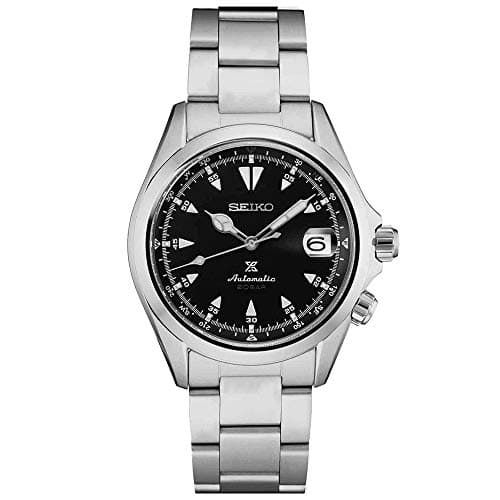
#ad · we may earn a commission from this link to Seiko Prospex SPB117
Seiko Prospex SPB117
SPB117J1Best for: The best-proportioned Seiko diver, if the budget stretches
The 62MAS-lineage diver: 39.5 mm, sapphire, and the 70-hour 6R35. This is where Seiko stops compromising, and the price step reflects it.
- Spec completeness for the price
- 9.3
- Movement relative to bracket
- 9.2
- Case proportions
- 9.6
- Strap flexibility
- 9.2
- Availability
- 7.9
What it gets right
- 70-hour power reserve — leave it off over a weekend and it is still running
- Sapphire, and a tighter stated accuracy spec than the 4R family
- 39.5 mm with a 46.4 mm lug-to-lug is the most universally wearable diver Seiko makes
What it gets wrong
- Roughly double the price of a Turtle
- 6R35 is still a 21,600 vph movement, so the seconds sweep is no smoother
- 20 mm lugs on a diver feel narrow to some
Skip this one if: your budget is doing other work. A Turtle is the same water rating and the same 6-beat sweep for half the money; what you buy here is sapphire, the power reserve and the proportions.
| Case diameter | 39.5 mm |
|---|---|
| Lug-to-lug | 46.4 mm |
| Thickness | 12.4 mm |
| Lug width | 20 mm |
| Crystal | Sapphire with anti-reflective coating |
| Water resistance | 200 m, ISO 6425 rated |
| Crown | Screw-down |
| Caliber | Seiko 6R35 |
| Type | Automatic, hand-winding and hacking |
| Beat rate | 21,600 vph (6 beats/sec) |
| Jewels | 24 |
| Power reserve | Approx. 70 hours |
| Stated accuracy | -15 to +25 sec/day |
| Complications | Date |
How to actually decide
Under $500
Japanese, if you want mechanical. The Swiss options at this price are largely quartz, and a quartz Swiss watch against a mechanical Japanese one is a straightforward decision in whichever direction you care about. Seiko, Citizen, Orient and Casio are ranked against each other on the best Japanese watches under $500.
$500–$1,500
Genuinely competitive. Hamilton, Tissot and Certina put real Swiss automatics here, and Seiko puts the 6R35 and the SPB line here. Do not assume the Swiss watch has the longer reserve or the faster beat: Hamilton’s H-10 and H-50 are rated for 80 hours against the 6R35’s 70, and the H-10 runs at the same 21,600 vph — Seiko vs Hamilton has the sources. Choose on the watch, not the flag.
The question to ask instead
Not “Japanese or Swiss” but “in-house or bought-in, and what beat rate, and what power reserve.” Those three questions have answers on a spec sheet and they predict how the watch behaves. Country of assembly does not.
Questions
Are Japanese watches as good as Swiss watches?
At the same price, generally yes, and below about $500 the Japanese options are usually better because they are mechanical where the Swiss ones are quartz. The differences that are real — beat rate, integration — cut in both directions rather than favoring one country.
What does 'Swiss Made' actually mean?
A legal country-of-origin mark: technical development in Switzerland, at least 60% of manufacturing costs incurred there, and final casing and inspection there. It is not a quality standard and says nothing about finishing or accuracy.
Why do Swiss watches have smoother seconds hands?
Beat rate. Most Swiss movements at these prices run at 28,800 vph — eight beats per second — against 21,600 vph, six beats, for most Japanese ones. That is the whole explanation, and Seiko largely does not build eight-beat movements in this range.
Does Seiko make its own movements?
Yes, including hairsprings, which is unusual. Most Swiss brands at comparable prices fit bought-in ETA or Sellita movements rather than manufacturing their own.
Sources
- Seiko Watch Corporation — US catalog and specifications
- Seiko Instruments — movement division (NH-series manufacturer)
- Seiko instruction manuals and caliber documentation
Specifications are transcribed from manufacturer documentation and published standards. Where a manufacturer does not publish a figure, this page says so rather than estimating one.
Read next
- Japanese vs Swiss movementsThe movement-level version of this comparison, with the beat-rate figures.
- Is Seiko a luxury brand?What in-house manufacturing does and does not buy.
- Seiko Alpinist vs Hamilton KhakiA concrete instance of this comparison at a real price.
- Seiko vs CitizenThe Japanese side of the field, compared internally.
- Seiko vs TissotThe Japan versus Switzerland argument at one specific price.
- Seiko vs CasioTwo Japanese brands aimed at completely different things.