Head-to-head
Seiko vs Hamilton
A Japanese maker that builds its own movements against an American-born Swiss brand with 80-hour reserves. Where they actually compete, the numbers are close and the trade-offs are specific.
By Stephen V. · Updated Sep 17, 2026
Quick picks
| # | Watch | Key spec | Score | Price |
|---|---|---|---|---|
| 1 | 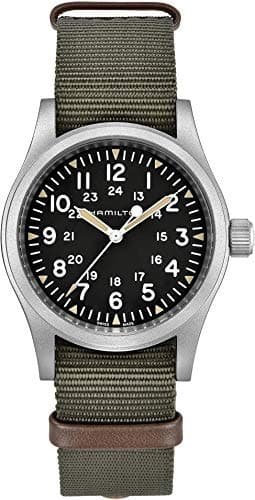 Hamilton Khaki Field Mechanical 38mm A hand-wound Swiss field watch with an 80-hour reserve. The watch people mean when they say a Seiko field watch is not quite enough. | 38mm · hand-wound | 8.8out of 10, compiled from published specifications | |
| 2 | 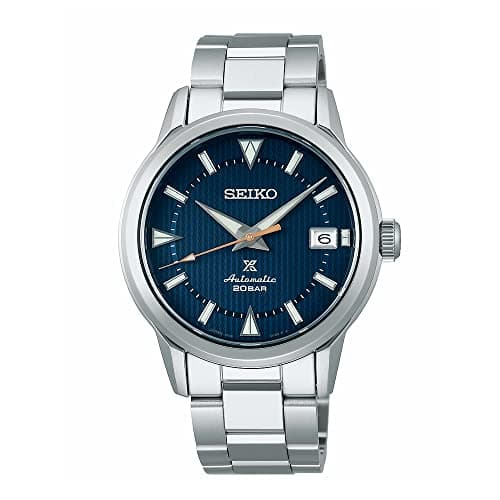 Seiko Prospex Alpinist SBDC159SBDC159 A Japan-market Alpinist built on the 1959 original rather than the compass-bezel one: 38 mm, curved sapphire, 200 m, and the 6R35's 70-hour reserve. | 38mm · 70h | 8.4out of 10, compiled from published specifications | |
| 3 | 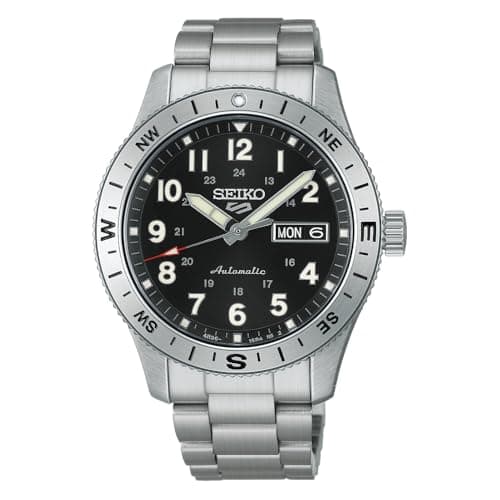 Seiko 5 Sports Field HDB006HDB006 Seiko's current 5 Sports Field: a 41 mm case with a lumed rotating bezel on the familiar 4R36. The field reference the line had been missing. | 41mm · 100m | 8.7out of 10, compiled from published specifications | |
| 4 | 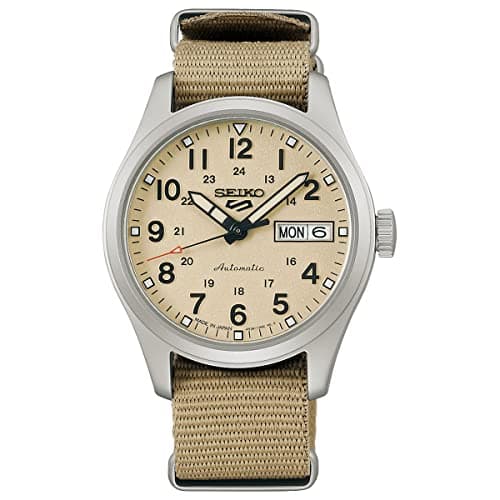 Seiko 5 Sports Field SBSA199SBSA199 A Japan-market 5 Sports field reference on nylon, and the smallest 4R36 field case Seiko lists anywhere: 36.4 mm across, 44.4 mm lug to lug. | 36.4mm · JDM | 8.3out of 10, compiled from published specifications |
4 watches on this page · Prices last verified Sep 18, 2026. Where no live price came back we show “Check price” rather than a number we cannot stand behind. How we pick.
Hamilton is an American-born, Swiss-made Swatch Group brand whose current movements are developed with ETA and carry 80-hour reserves. Seiko is a Japanese, vertically integrated maker that builds its own. Where the two actually compete — field watches — Hamilton gives you a thinner case and a longer reserve; Seiko gives you far more water resistance, and an automatic, at every size.
Two very different companies
Hamilton’s own summary of itself is exact: “Born in Lancaster, Pennsylvania in 1892 and crafted in Switzerland today.” It is one of the Swatch Group’s brands, alongside Omega, Longines and Tissot, and it is headquartered in Biel/Bienne. Swatch Group’s history says SSIH, the Omega and Tissot holding company that became part of today’s group, was “later joined by Hamilton”; the Swiss watch history site Timefiles dates that purchase to 1974. Hamilton’s FAQ is plain that every current watch is Swiss made, and its positioning is “Swiss precision and American spirit.”
Seiko began in 1881, when Kintaro Hattori opened a watch and clock shop in central Tokyo, and it is still a Japanese company. The Seiko group describes itself as “one of the few fully integrated watch manufacturers in the world” — it designs and builds its movements and springs itself, down to a proprietary mainspring and hairspring alloy. That difference in how the watches get made is the single biggest structural gap between the brands, and it shows up in the movements.
Both have real history, and it is different history
Neither brand is borrowing a heritage it did not earn. Hamilton’s includes the railroad watches that earned it the title “The Watch of Railroad Accuracy,” more than a million timepieces produced for the military between 1942 and 1945, the Ventura of 1957 — which Hamilton calls the world’s first electric watch — and a film career of more than 500 movies and television shows. Seiko’s includes Japan’s first wristwatch in 1913, the world’s first quartz wristwatch, the Astron, in 1969, and the 1959 Laurel Alpinist that today’s Alpinist is named for. If the story on the dial matters to you, pick the story; both are real.
Where they actually compete: the field watch
Hamilton’s current collections are Khaki Field, Khaki Aviation, Khaki Navy, Jazzmaster, Ventura and American Classic. The one that meets Seiko head-on, at a price people actually cross-shop, is the Khaki Field — and its counterparts are the Seiko Alpinist and the Seiko 5 Sports Field. This table puts the four watches on this page, plus Hamilton’s automatic Khaki Field for reference, into the same rows:
| Khaki Field Mech. 38 | Khaki Field Auto 38 | Alpinist SBDC159 | 5 Sports Field HDB006 | |
|---|---|---|---|---|
| Case diameter | 38 mm | 38 mm | 38.0 mm | 41.0 mm |
| Thickness | 9.5 mm | 11 mm | 12.9 mm | 13.2 mm |
| Lug-to-lug | 47 mm | 47 mm | 46.2 mm | 48.5 mm |
| Crystal | Sapphire | Sapphire | Sapphire | Hardlex |
| Water resistance | 50 m | 100 m | 200 m | 100 m |
| Movement | H-50, hand-wound | H-10, automatic | 6R35, automatic | 4R36, automatic |
| Power reserve | 80 h | 80 h | Approx. 70 h | Approx. 41 h |
The Hamilton figures are from Hamilton’s product pages for the Khaki Field Mechanical 38 mm and the Khaki Field Auto 38 mm; the Seiko figures are from Seiko’s published specifications for the SBDC159 and the 5 Sports Field. The Khaki Field Auto is shown for context; it is not one of the watches ranked here.
What the table says
Hamilton wins on thickness and reserve. The hand-wound Khaki Field Mechanical is 9.5 mm thick against the Alpinist’s 12.9 mm, and both Hamilton calibers are rated for 80 hours. Under a cuff, and on a Monday morning after a weekend off the wrist, those are differences you notice.
Seiko wins on water resistance, by a lot. The Alpinist is rated to 200 m (20 bar). The Khaki Field Mechanical is rated to 50 m, which is splash-and-rain territory rather than swimming. Even the Seiko 5 Sports Field matches the automatic Khaki Field at 100 m.
Fit is close to a tie. The Alpinist’s 46.2 mm lug-to-lug is a touch shorter than either 38 mm Hamilton’s 47 mm, and the 5 Sports Field is the longest of the four at 48.5 mm. If your wrist is small, the Japan-market SBSA199 is the outlier: 36.4 mm across and 44.4 mm lug to lug, the smallest 4R36 field case Seiko lists.
Crystal is a tie at the top and a Seiko loss at the bottom. Every Hamilton here and the Alpinist use sapphire; the 5 Sports Field uses curved Hardlex. Hardlex vs sapphire sets out what that trade costs you.
The movement question, properly
Hamilton says it develops its movements “together with ETA,” the Swatch Group’s movement maker, and describes the H-10 as an automatic with an 80-hour reserve and a Nivachron balance spring. Monochrome Watches describes the H-10 as Hamilton’s version of the ETA C07.611, running at 21,600 vph — the same beat rate as Seiko’s 6R35 and 4R36. So the smoothness of the seconds hand is not a difference between these watches; the reserve is.
Seiko’s advantage is that it publishes more about its movements. The 6R35 is rated +25 to −15 seconds a day on Seiko’s own specification for the SBDC159, and the 4R36 −35 to +45. We did not find a stated daily rate on the Hamilton product pages we used, so this page does not compare the two on accuracy. The broader argument — what a Japanese caliber and a Swiss one actually differ on — is on Japanese vs Swiss movements.
Hand-wound is a choice, not a spec
The Khaki Field Mechanical on this page is hand-wound. It has no rotor: you wind it by the crown, and an 80-hour reserve means a full wind lasts a little over three days. Some people love that ritual and some people come to resent it; if you have not owned a hand-wound watch, be honest about which you are. Every Seiko here is an automatic that winds itself as you wear it and can also be wound by hand. The model-level version of this decision — one Alpinist, one Khaki Field — is on Seiko Alpinist vs Hamilton Khaki.
Seiko vs Hamilton vs Tissot
Searches often add Tissot to this pair, and it belongs there: Tissot is another Swatch Group brand, so a Hamilton and a Tissot share a parent and a movement supplier, and differ mostly in design and in which categories each is strongest. The Tissot in our registry is the integrated-bracelet PRX, and Seiko vs Tissot covers it.
Buy the Seiko if
- The watch will swim: the Alpinist’s 200 m against the Khaki Field Mechanical’s 50 m settles it.
- You want an automatic that winds itself as you wear it.
- You want the smallest possible field case: the SBSA199 is 36.4 mm with a 44.4 mm lug-to-lug.
- You want a field watch at 5 Sports money, and Hardlex is an acceptable trade.
Buy the Hamilton if
- Thickness matters: 9.5 mm against 12.9 mm is the largest single difference on the page.
- You want the longer reserve: 80 hours against 70.
- You like winding a watch, or want the military-issue field-watch lineage Hamilton was part of.
- “Swiss made” on the dial genuinely matters to you. It is a legitimate reason; it is also not a specification.
What we are not claiming
We have not handled any of these watches. The case, crystal, water and reserve figures are transcribed from the two companies’ own product pages, linked above; the H-10’s ETA base is Monochrome Watches’ description, not Hamilton’s. We make no claim about finishing, which no specification captures and which is worth seeing in person before you choose.
The watches on this page
Specifications are transcribed from Seiko’s published documentation. Prices come from Amazon and carry the date they were verified. We have not handled these watches — here is what we did instead.
Price as of Sep 18, 2026. Prices move — Amazon's is the one that counts.
#ad · we may earn a commission from this link to Hamilton Khaki Field Mechanical 38mm
Hamilton Khaki Field Mechanical 38mm
Best for: A hand-wound Swiss field watch
A hand-wound Swiss field watch with an 80-hour reserve. The watch people mean when they say a Seiko field watch is not quite enough.
- Spec completeness for the price
- 8.4
- Movement relative to bracket
- 8.9
- Case proportions
- 9.3
- Strap flexibility
- 9.0
- Availability
- 8.4
What it gets right
- 80-hour power reserve on a hand-wound movement
- Sapphire crystal
- 38 mm with genuine field-watch proportions
What it gets wrong
- Hand-wound only — you wind it every day or it stops
- 50 m
- Roughly twice the price of the Seiko field references
Skip this one if: you will not wind a watch daily. That is not a criticism of you; a hand-wound watch is a small ritual and if you resent it, you will stop wearing the watch.
| Brand | Hamilton (Swiss, part of the Swatch Group) |
|---|---|
| Case diameter | 38 mm |
| Movement | Hand-wound mechanical, H-50 caliber |
| Power reserve | Approx. 80 hours |
| Water resistance | 50 m |
| Crystal | Sapphire |
Price as of Sep 18, 2026. Prices move — Amazon's is the one that counts.
#ad · we may earn a commission from this link to Seiko Prospex Alpinist SBDC159
Seiko Prospex Alpinist SBDC159
SBDC159Best for: A small, hard-wearing field watch with a 70-hour movement
A Japan-market Alpinist built on the 1959 original rather than the compass-bezel one: 38 mm, curved sapphire, 200 m, and the 6R35's 70-hour reserve.
- Spec completeness for the price
- 9.0
- Movement relative to bracket
- 9.2
- Case proportions
- 9.3
- Strap flexibility
- 7.6
- Availability
- 7.1
What it gets right
- 38 mm with a 46.2 mm lug-to-lug — genuinely small by current standards
- 70-hour power reserve and curved sapphire
- 200 m on a field watch, with a screw-down crown and a hard-coated case
What it gets wrong
- No internal compass bezel — that is the other Alpinist
- 19 mm lugs, an awkward width with a thin aftermarket
- Japan-market warranty
Skip this one if: the compass bezel was the thing pulling you to an Alpinist. This reference does not have one, and the references that do now sit several hundred dollars higher.
| Market | Japanese domestic market (SBDC prefix) |
|---|---|
| Case diameter | 38.0 mm |
| Lug-to-lug | 46.2 mm |
| Thickness | 12.9 mm |
| Lug width | 19 mm |
| Case material | Stainless steel with a super-hard coating |
| Crystal | Curved sapphire, anti-reflective inner coating |
| Water resistance | 200 m (20 bar) |
| Crown | Screw-down |
| Bezel | Fixed — no compass bezel on this reference |
| Display back | Yes — see-through screw caseback |
| Caliber | Seiko 6R35 |
| Type | Automatic, hand-winding and hacking |
| Beat rate | 21,600 vph (6 beats/sec) |
| Jewels | 24 |
| Power reserve | Approx. 70 hours |
| Stated accuracy | -15 to +25 sec/day |
| Complications | Date |
Price as of Sep 18, 2026. Prices move — Amazon's is the one that counts.
#ad · we may earn a commission from this link to Seiko 5 Sports Field HDB006
Seiko 5 Sports Field HDB006
HDB006Best for: A field watch with a rotating bezel and a mechanical movement
Seiko's current 5 Sports Field: a 41 mm case with a lumed rotating bezel on the familiar 4R36. The field reference the line had been missing.
- Spec completeness for the price
- 8.6
- Movement relative to bracket
- 8.5
- Case proportions
- 8.4
- Strap flexibility
- 9.3
- Availability
- 8.6
What it gets right
- Rotating bezel with its own LumiBrite, which the older field references did not have
- 20 mm lugs, the most common aftermarket size
- The 4R36 hacks and hand-winds
What it gets wrong
- 41 mm with a 48.5 mm lug-to-lug — bigger than the 39.4 mm field references it follows
- Hardlex, not sapphire
- 13.2 mm thick for a field watch
Skip this one if: you wanted the small field Seiko. This is the 41 mm replacement for that idea, and its 48.5 mm lug-to-lug is a different proposition from the 39.4 mm SRPG references, which Seiko has now sold out of.
| Case diameter | 41.0 mm |
|---|---|
| Lug-to-lug | 48.5 mm |
| Thickness | 13.2 mm |
| Lug width | 20 mm |
| Crystal | Curved Hardlex |
| Water resistance | 100 m (10 bar) |
| Bezel | Rotating, with LumiBrite on the bezel as well as the hands |
| Dial | Glossy black |
| Magnetic resistance | 4,800 A/m |
| Case back | See-through, screw case back |
| Clasp | Three-fold with push-button release |
| Caliber | Seiko 4R36 |
| Type | Automatic, hand-winding and hacking |
| Beat rate | 21,600 vph (6 beats/sec) |
| Jewels | 24 |
| Power reserve | Approx. 41 hours |
| Stated accuracy | -35 to +45 sec/day |
| Complications | Day and date |
Price as of Sep 18, 2026. Prices move — Amazon's is the one that counts.
#ad · we may earn a commission from this link to Seiko 5 Sports Field SBSA199
Seiko 5 Sports Field SBSA199
SBSA199Best for: A Japan-market field automatic for a genuinely small wrist
A Japan-market 5 Sports field reference on nylon, and the smallest 4R36 field case Seiko lists anywhere: 36.4 mm across, 44.4 mm lug to lug.
- Spec completeness for the price
- 8.2
- Movement relative to bracket
- 8.5
- Case proportions
- 9.1
- Strap flexibility
- 8.2
- Availability
- 7.4
What it gets right
- 36.4 mm and 44.4 mm lug-to-lug — the smallest field case in the 4R36 range
- 12.5 mm thick, slimmer than the 41 mm HDB field references
- The 4R36 hacks and hand-winds
What it gets wrong
- A Japan-market reference, so it arrives as an import with a Japanese warranty
- Hardlex
- Seiko does not publish a lug width for it, so strap sizing needs measuring
Skip this one if: you want a US warranty and a domestic returns path. This is a JDM reference bought as an import — our JDM guide covers exactly what that changes.
| Market | Japanese domestic market (SBSA prefix) |
|---|---|
| Case diameter | 36.4 mm |
| Lug-to-lug | 44.4 mm |
| Thickness | 12.5 mm |
| Lug width | Not published by Seiko for this reference |
| Crystal | Curved Hardlex |
| Water resistance | 100 m (10 bar) |
| Strap | Nylon |
| Caliber | Seiko 4R36 |
| Type | Automatic, hand-winding and hacking |
| Beat rate | 21,600 vph (6 beats/sec) |
| Jewels | 24 |
| Power reserve | Approx. 41 hours |
| Stated accuracy | -35 to +45 sec/day |
| Complications | Day and date |
Questions
Is Hamilton better than Seiko?
Not across the board. Hamilton’s field watches are thinner and carry an 80-hour reserve; Seiko’s are more water resistant and automatic at every size, and Seiko builds its own movements. For a field watch that will swim, the Seiko Alpinist is the better specification; for a thin watch with a long reserve, the Hamilton is.
Is Hamilton a Swiss or an American brand?
Both, historically. Hamilton was founded in Lancaster, Pennsylvania in 1892, and today it is a Swiss brand within the Swatch Group, headquartered in Biel/Bienne. Hamilton states that all its watches are Swiss made.
Who owns Hamilton watches?
The Swatch Group, which also owns Omega, Longines and Tissot among others. Swatch Group’s own history says Hamilton joined its predecessor holding company, SSIH.
Does Hamilton make its own movements?
Hamilton says it develops its movements together with ETA, the Swatch Group’s movement maker. Seiko, by contrast, designs and manufactures its own movements in-house.
Seiko Alpinist or Hamilton Khaki Field?
The Alpinist SBDC159 if you want 200 m of water resistance and an automatic; the Khaki Field Mechanical if you want a 9.5 mm-thin, hand-wound watch with an 80-hour reserve. Both are 38 mm with sapphire crystals.
Which is more water resistant, a Seiko or a Hamilton field watch?
The Seiko. The Alpinist SBDC159 is rated to 200 m and the 5 Sports Field to 100 m. The Hamilton Khaki Field Mechanical 38 mm is rated to 50 m, and the Khaki Field Auto 38 mm to 100 m.
Sources
- Swatch Group — Hamilton brand page
- Swatch Group — history
- Swatch Group — brands and companies
- Hamilton — company history
- Hamilton — FAQ (Swiss made; movements developed with ETA)
- Hamilton — Khaki Field Mechanical 38 mm H69439931 specifications
- Hamilton — Khaki Field Auto 38 mm H70455533 specifications
- Timefiles — From Lancaster to Bienne: Hamilton turns 130
- Monochrome Watches — Hamilton Khaki Field Murph 38 mm (H-10 base)
- Seiko Group — watch business
- Seiko — heritage
- Seiko Japan store — SBDC159 specifications
- Seiko USA — 5 Sports Field press release
Specifications are transcribed from manufacturer documentation and published standards. Where a manufacturer does not publish a figure, this page says so rather than estimating one.
Read next
- Seiko Alpinist vs Hamilton KhakiThe model-level version of this page.
- Best Seiko field watchesEvery Seiko field reference, ranked.
- Japanese vs Swiss movementsWhat actually differs inside the case.
- Seiko vs TissotThe other Swatch Group brand people cross-shop against Seiko.
- Japanese vs Swiss watchesThe country-level question, answered on specifications.
- Seiko Alpinist referenceThe SBDC159 in full.