Movements
Japanese vs Swiss movements
One number explains most of the visible difference, and it is not the one people argue about.
By Stephen V. · Updated Jul 24, 2026
The main measurable difference at these prices is beat rate: most Japanese movements run at 21,600 vph (six beats per second) and most Swiss ones at 28,800 vph (eight). That is why the Swiss seconds hand looks smoother. It is not an accuracy or durability claim, and the trade-offs run in both directions.
What beat rate actually is
The balance wheel of a mechanical watch oscillates back and forth, and each swing is a “vibration.” Beat rate is how many happen per hour. At 21,600 vph the seconds hand advances six times a second; at 28,800 vph, eight.
| Beat rate | Ticks per second | Typical of |
|---|---|---|
| 18,000 vph | 5 | Vintage movements |
| 21,600 vph | 6 | Seiko 4R, 6R, 7S; Miyota |
| 28,800 vph | 8 | ETA, Sellita, most modern Swiss |
| 36,000 vph | 10 | High-beat; Grand Seiko 9S85, Zenith El Primero |
The trade-offs, honestly
Higher beat rate
A faster balance is less disturbed by a given shock, because it spends less time in each swing — that is the theoretical accuracy argument. It also looks smoother, which is the real reason people care.
The cost is wear. More oscillations per hour means more cycles through every bearing, and higher-beat movements generally need lubrication attention sooner.
Lower beat rate
Less wear, longer practical service intervals, and — because the balance is doing less work — it is easier to achieve a long power reserve. Seiko’s 70-hour 6R35 at 21,600 vph is a good illustration; a 70-hour reserve at 28,800 vph requires a larger mainspring barrel and usually a thicker movement.
Where the Japanese side genuinely wins
Vertical integration. Seiko makes its own movements, hairsprings, dials and cases. Most Swiss brands under $1,500 fit ETA or Sellita movements bought in. If you value the manufacturer having designed the thing inside the watch, Japan wins that argument comfortably at this price.
Price for mechanical. At $300, Seiko sells you an in-house automatic. Most Swiss brands at $300 sell you quartz.
Where the Swiss side genuinely wins
The eight-beat sweep, if that matters to you. It is the single most visible difference and Seiko largely does not offer it below Grand Seiko.
Chronometer certification. COSC certification is far more common on Swiss movements at mid prices, and it is a measured, independently verified standard rather than a factory tolerance.
None of this is about the country. It is about which trade-offs each industry conventionally makes at a given price, and both sets are defensible. Conventions also have exceptions: Hamilton’s H-10, the automatic in its Khaki Field, runs at the same 21,600 vph as Seiko’s 4R and 6R calibers, and Seiko vs Hamilton compares the two brands on their published figures.
The watches on this page
Specifications are transcribed from Seiko’s published documentation. Prices come from Amazon and carry the date they were verified. We have not handled these watches — here is what we did instead.
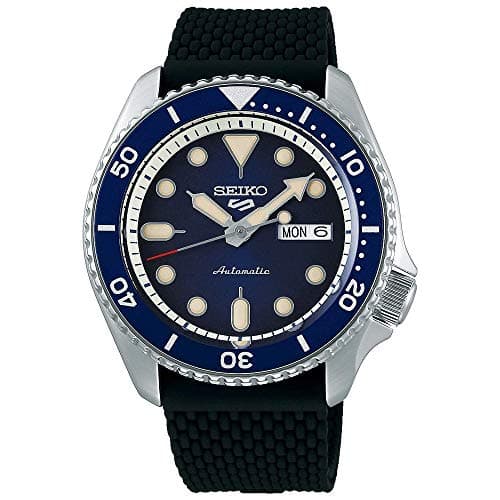
No buyable offer at the last check (October 23, 2026). We show nothing rather than a stale number.
#ad · we may earn a commission from this link to Seiko 5 Sports SRPD93
Seiko 5 Sports SRPD93
SRPD93Best for: A first mechanical watch you will not outgrow
The 5KX case with a movement that hacks and hand-winds, in blue on a silicone strap. The default answer under $350, and the one most people should stop looking after.
- Spec completeness for the price
- 8.8
- Movement relative to bracket
- 8.5
- Case proportions
- 8.9
- Strap flexibility
- 9.5
- Availability
- 8.8
What it gets right
- Hacks and hand-winds — the SKX's biggest omission, fixed
- 22 mm lugs put the entire aftermarket strap catalog in play
- Day-date in a genuinely legible layout
- Case shape is the SKX profile people actually want
What it gets wrong
- Hardlex, not sapphire — it will scratch
- 100 m and no screw-down crown, so it is not an ISO 6425 diver despite the looks
- 13.4 mm thick under a shirt cuff
- Ships on a silicone strap rather than a bracelet
Skip this one if: you want an actual dive watch. The 100 m rating and the absence of a screw-down crown mean this is a dive-styled sports watch, not an ISO 6425 diver. The Turtle is the real one.
| Case diameter | 42.5 mm |
|---|---|
| Lug-to-lug | 46.0 mm |
| Thickness | 13.4 mm |
| Lug width | 22 mm |
| Crystal | Hardlex (hardened mineral) |
| Water resistance | 100 m — splash and swim, not scuba |
| Bezel | Blue unidirectional rotating |
| Dial | Blue sunray |
| Strap | Black silicone |
| Case back | See-through |
| Lume | LumiBrite |
| Caliber | Seiko 4R36 |
| Type | Automatic, hand-winding and hacking |
| Beat rate | 21,600 vph (6 beats/sec) |
| Jewels | 24 |
| Power reserve | Approx. 41 hours |
| Stated accuracy | -35 to +45 sec/day |
| Complications | Day and date |
No verified live price right now, so we are not showing one.
#ad · we may earn a commission from this link to Hamilton Khaki Field Mechanical 38mm
Hamilton Khaki Field Mechanical 38mm
Best for: A hand-wound Swiss field watch
A hand-wound Swiss field watch with an 80-hour reserve. The watch people mean when they say a Seiko field watch is not quite enough.
- Spec completeness for the price
- 8.4
- Movement relative to bracket
- 8.9
- Case proportions
- 9.3
- Strap flexibility
- 9.0
- Availability
- 8.4
What it gets right
- 80-hour power reserve on a hand-wound movement
- Sapphire crystal
- 38 mm with genuine field-watch proportions
What it gets wrong
- Hand-wound only — you wind it every day or it stops
- 50 m
- Roughly twice the price of the Seiko field references
Skip this one if: you will not wind a watch daily. That is not a criticism of you; a hand-wound watch is a small ritual and if you resent it, you will stop wearing the watch.
| Brand | Hamilton (Swiss, part of the Swatch Group) |
|---|---|
| Case diameter | 38 mm |
| Movement | Hand-wound mechanical, H-50 caliber |
| Power reserve | Approx. 80 hours |
| Water resistance | 50 m |
| Crystal | Sapphire |
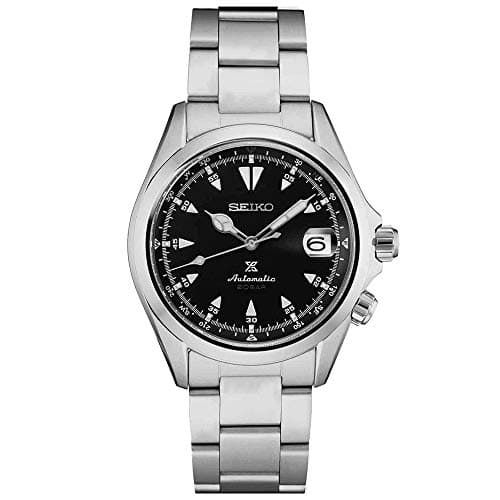
No buyable offer at the last check (October 23, 2026). We show nothing rather than a stale number.
#ad · we may earn a commission from this link to Seiko Prospex SPB117
Seiko Prospex SPB117
SPB117J1Best for: The best-proportioned Seiko diver, if the budget stretches
The 62MAS-lineage diver: 39.5 mm, sapphire, and the 70-hour 6R35. This is where Seiko stops compromising, and the price step reflects it.
- Spec completeness for the price
- 9.3
- Movement relative to bracket
- 9.2
- Case proportions
- 9.6
- Strap flexibility
- 9.2
- Availability
- 7.9
What it gets right
- 70-hour power reserve — leave it off over a weekend and it is still running
- Sapphire, and a tighter stated accuracy spec than the 4R family
- 39.5 mm with a 46.4 mm lug-to-lug is the most universally wearable diver Seiko makes
What it gets wrong
- Roughly double the price of a Turtle
- 6R35 is still a 21,600 vph movement, so the seconds sweep is no smoother
- 20 mm lugs on a diver feel narrow to some
Skip this one if: your budget is doing other work. A Turtle is the same water rating and the same 6-beat sweep for half the money; what you buy here is sapphire, the power reserve and the proportions.
| Case diameter | 39.5 mm |
|---|---|
| Lug-to-lug | 46.4 mm |
| Thickness | 12.4 mm |
| Lug width | 20 mm |
| Crystal | Sapphire with anti-reflective coating |
| Water resistance | 200 m, ISO 6425 rated |
| Crown | Screw-down |
| Caliber | Seiko 6R35 |
| Type | Automatic, hand-winding and hacking |
| Beat rate | 21,600 vph (6 beats/sec) |
| Jewels | 24 |
| Power reserve | Approx. 70 hours |
| Stated accuracy | -15 to +25 sec/day |
| Complications | Date |
Questions
Why do Japanese movements beat slower than Swiss ones?
It is a design convention rather than a limitation — a lower beat rate reduces wear and makes a long power reserve easier to achieve, which suits how Seiko positions its movements. Seiko does build high-beat movements at the Grand Seiko level.
Does a higher beat rate mean a more accurate watch?
Not on its own. A faster balance is less disturbed by shock in theory, but regulation, adjustment and certification matter far more. An uncertified 28,800 vph movement can easily run worse than a well-regulated 21,600 vph one.
What is a high-beat movement?
Generally 36,000 vph — ten ticks per second. Grand Seiko’s 9S85 and Zenith’s El Primero are the best-known examples, and both sit well above the price range this site covers.
Are Swiss movements more reliable than Japanese ones?
No. Seiko’s 7S and 4R families have decades of field history and are among the most produced mechanical movements ever made. Reliability is not one of the axes that separates the two.
Sources
- Seiko Instruments — movement division (NH-series manufacturer)
- Seiko Watch Corporation — US catalog and specifications
- Seiko instruction manuals and caliber documentation
Specifications are transcribed from manufacturer documentation and published standards. Where a manufacturer does not publish a figure, this page says so rather than estimating one.
Read next
- Japanese vs Swiss watchesThe whole-watch version of this comparison.
- Seiko 6R35 caliber referenceA 70-hour reserve at six beats, and why that combination exists.
- Seiko 4R36 caliber referenceSeiko's most common movement, at 21,600 vph.
- Seiko Alpinist vs Hamilton KhakiThe two conventions meeting at one price point.
- NH35 vs Miyota 8215Japan against Japan: the other 21,600 vph workhorse.
- NH35 vs ETA 2824The same argument at movement level, spec by spec.