Answers
Hardlex vs sapphire
Sapphire is harder. It is not straightforwardly better, and Seiko's reasoning is not just cost.
By Stephen V. · Updated Jul 24, 2026
Sapphire is roughly three times harder than Hardlex on the Vickers scale, so it resists scratching far better. Hardlex is Seiko’s hardened mineral glass and is more resistant to shattering under sharp impact for a given thickness. Sapphire is the better crystal for most people; the trade is real and it is not purely a cost decision.
The numbers
| Material | Approx. Vickers | Scratches | Shatters |
|---|---|---|---|
| Acrylic | ~50 | Very easily | Almost never |
| Mineral / Hardlex | ~700 | Readily | Chips before it cracks |
| Sapphire | ~2,000 | Rarely | Cracks under sharp impact |
For context, hardened steel is roughly 700–900 Vickers and sand — which is mostly quartz — is around 1,100. That last figure is the practical one: sand is harder than Hardlex and softer than sapphire, which is exactly why a beach holiday marks one and not the other.
What Hardlex actually is
Hardlex is Seiko’s proprietary hardened mineral glass — a soda-lime base that has been chemically or thermally treated to increase surface hardness. It is a real material with real engineering behind it, not a euphemism for cheap glass, and Seiko has used it across its range including on 200 m divers for decades.
Why Seiko keeps choosing it
Cost is part of it and it is not all of it. Two other arguments:
Shatter behavior. Under sharp point impact, mineral glass tends to chip locally while sapphire can propagate a crack across the crystal. On a watch whose water rating depends on the crystal staying sealed, a chip is a better failure than a crack.
Polishability. Hardlex scratches can often be polished out with a mild abrasive. Sapphire scratches essentially cannot — the material is harder than most polishing compounds, so a scratched sapphire crystal is replaced rather than repaired.
Neither argument is decisive. For most people, most of the time, sapphire is the better crystal and the scratch resistance is worth the money.
When to pay for it
Pay for sapphire if
- The watch will be near brick, concrete, granite, sand or a workshop
- You wear one watch daily rather than rotating several
- Scratches will genuinely bother you — this is a real and legitimate reason
Do not pay for sapphire if
- The watch lives on a desk and comes off in the evening
- The money would otherwise go on a bracelet, which changes the watch more
- You rotate several watches, so no single one accumulates much wear
Where to get sapphire on a Seiko budget
The King Turtle is a standard Turtle with sapphire and a ceramic bezel insert for roughly $100 more. The SPB Prospex line and the solar SNE divers ship sapphire as standard. And Orient’s Kamasu fits sapphire at a price where Seiko does not, which is the most uncomfortable fact in this whole comparison. Every Seiko that currently ships sapphire, from the quartz SUR311 upward, is ranked on the best Seiko watches with a sapphire crystal.
One pattern worth knowing before you use the crystal as a price proxy: it does not track case thickness at all. The thinnest full-size watch in this registry has sapphire while several thicker ones have Hardlex — the thickness ladder puts both columns side by side so you can see which trade you are actually making.
The watches on this page
Specifications are transcribed from Seiko’s published documentation. Prices come from Amazon and carry the date they were verified. We have not handled these watches — here is what we did instead.
Price as of October 23, 2026. Prices move — Amazon's is the one that counts.
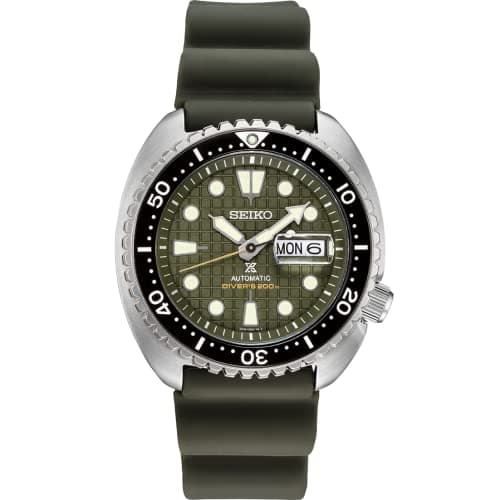
#ad · we may earn a commission from this link to Seiko Prospex King Turtle SRPE05
Seiko Prospex King Turtle SRPE05
SRPE05Best for: A Turtle with sapphire instead of Hardlex
The King Turtle: the Turtle case with sapphire and a ceramic bezel insert. The upgrade that answers the standard Turtle's one real complaint.
- Spec completeness for the price
- 8.9
- Movement relative to bracket
- 8.5
- Case proportions
- 8.8
- Strap flexibility
- 9.5
- Availability
- 8.1
What it gets right
- Sapphire crystal — the single biggest upgrade over a standard Turtle
- Ceramic bezel insert resists the scuffing an aluminum insert picks up
- Same forgiving 47.7 mm lug-to-lug
What it gets wrong
- The day/date magnifier is divisive and cannot be removed
- Costs meaningfully more than a standard Turtle for the same movement
- Still a 45 mm-wide case
Skip this one if: you do not care about crystal hardness. You are paying a real premium for sapphire and ceramic on an otherwise identical watch — if your Turtle lives on a desk, Hardlex will never bother you.
| Case diameter | 45.0 mm (cushion case) |
|---|---|
| Lug-to-lug | 47.7 mm |
| Thickness | 13.22 mm |
| Lug width | 22 mm |
| Crystal | Sapphire, anti-reflective inner coating, with a magnifier over the day/date |
| Bezel insert | Black ceramic |
| Water resistance | 200 m, ISO 6425 rated |
| Crown | Screw-down, at 4 o'clock |
| Dial | Khaki green with a 3-D pressed pattern |
| Strap | Khaki green silicone |
| Caliber | Seiko 4R36 |
| Type | Automatic, hand-winding and hacking |
| Beat rate | 21,600 vph (6 beats/sec) |
| Jewels | 24 |
| Power reserve | Approx. 41 hours |
| Stated accuracy | -35 to +45 sec/day |
| Complications | Day and date |
No buyable offer at the last check (October 23, 2026). We show nothing rather than a stale number.
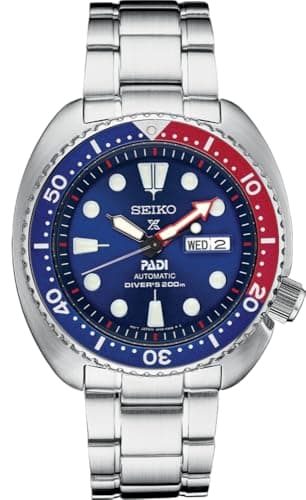
#ad · we may earn a commission from this link to Seiko Prospex Turtle SRPE99
Seiko Prospex Turtle SRPE99
SRPE99K1Best for: An actual dive watch you can also wear daily
A real 200 m ISO-rated diver with a screw-down crown, in the cushion case that wears far smaller than its 45 mm suggests.
- Spec completeness for the price
- 9.0
- Movement relative to bracket
- 8.5
- Case proportions
- 8.8
- Strap flexibility
- 9.5
- Availability
- 8.6
What it gets right
- Genuine ISO 6425 diver, not a diver-styled sports watch
- 47.7 mm lug-to-lug means it fits wrists that 45 mm suggests it should not
- Screw-down crown at 4 o'clock keeps it off the back of your hand
What it gets wrong
- Hardlex on a watch at this price is the recurring Seiko complaint
- The 45 mm figure scares people off before they try one
- PADI co-branding on the dial is not for everyone
Skip this one if: you have a wrist under about 6.5 inches. The lug-to-lug is forgiving but the case is still visually wide, and the smaller SRPG references exist for exactly this reason.
| Case diameter | 45.0 mm (cushion case) |
|---|---|
| Lug-to-lug | 47.7 mm |
| Thickness | 13.4 mm |
| Lug width | 22 mm |
| Crystal | Hardlex (hardened mineral) |
| Water resistance | 200 m, ISO 6425 rated for scuba diving |
| Crown | Screw-down, at 4 o'clock |
| Bezel | Unidirectional elapsed-timing bezel, PADI red and blue |
| Lume | LumiBrite on hands and markers |
| Bracelet | Steel, three-fold clasp with push-button release |
| Caliber | Seiko 4R36 |
| Type | Automatic, hand-winding and hacking |
| Beat rate | 21,600 vph (6 beats/sec) |
| Jewels | 24 |
| Power reserve | Approx. 41 hours |
| Stated accuracy | -35 to +45 sec/day |
| Complications | Day and date |
No verified live price right now, so we are not showing one.
#ad · we may earn a commission from this link to Orient Kamasu
Orient Kamasu
RA-AA0003R39BBest for: Sapphire on a 200 m diver at the lowest price
Sapphire and a 200 m rating at a price where Seiko still fits Hardlex. On paper, the single strongest argument against buying a Seiko diver.
- Spec completeness for the price
- 9.4
- Movement relative to bracket
- 8.8
- Case proportions
- 8.7
- Strap flexibility
- 9.0
- Availability
- 8.5
What it gets right
- Sapphire crystal, which the equivalently priced Seikos do not have
- Hacks and hand-winds
- 200 m with a screw-down crown
What it gets wrong
- Orient's resale and brand recognition are well below Seiko's
- Bracelet quality is the usual criticism
- Fewer aftermarket parts than the Seiko ecosystem
Skip this one if: you want the modding ecosystem. Almost every aftermarket dial, hand set and bezel insert is cut for Seiko cases and NH-series movements, not for Orient.
| Brand | Orient (owned by Seiko Epson) |
|---|---|
| Case diameter | 41.8 mm |
| Crystal | Sapphire |
| Water resistance | 200 m |
| Movement | Orient F6922 automatic, hacking and hand-winding |
| Complications | Day and date |
Questions
Is Hardlex the same as mineral glass?
Hardlex is Seiko’s proprietary hardened mineral glass — a soda-lime base treated to increase surface hardness. It is harder than untreated mineral crystal and far softer than sapphire.
Will Hardlex scratch easily?
More easily than sapphire, yes. At roughly 700 Vickers it is softer than sand (~1,100), which is why beach wear marks it. Desk wear will rarely trouble it.
Can Hardlex scratches be polished out?
Light ones, often yes, with a mild abrasive polish. Sapphire scratches generally cannot be — the material is harder than most polishing compounds, so a scratched sapphire crystal is replaced.
Why does Seiko use Hardlex on expensive dive watches?
Cost, plus a real argument that mineral glass chips locally under sharp impact where sapphire can crack across — and on a watch whose water rating depends on the crystal staying sealed, a chip is the better failure mode.
Is sapphire worth the upgrade?
For a watch worn daily in the world, usually yes. For one that lives on a desk, the money is better spent on a bracelet or strap.
Sources
- Seiko Watch Corporation — US catalog and specifications
- Seiko instruction manuals and caliber documentation
- Seiko Prospex collection — official specifications
Specifications are transcribed from manufacturer documentation and published standards. Where a manufacturer does not publish a figure, this page says so rather than estimating one.
Read next
- Best Seiko dive watchesWhich references ship sapphire and which do not.
- Seiko Prospex vs Orient KamasuWhere a rival ships sapphire at a Seiko Hardlex price.
- Seiko Turtle referenceIncluding the King Turtle sapphire upgrade.
- Seiko water resistance explainedWhy the crystal is part of the water rating.
- Seiko Turtle vs King TurtleThe same watch twice, with Hardlex on one and sapphire on the other.