Answers
Seiko water resistance explained
The number is a pressure test, not a depth. Getting that wrong is how watches die.
By Stephen V. · Updated Jul 24, 2026
A water-resistance rating is the result of a static pressure test, not a swimming depth. 30 m means hand-washing only. 100 m covers swimming. 200 m with an ISO 6425 DIVER’S marking is the only rating that certifies the watch for diving. Moving water generates far more pressure than still water at the same depth, which is why the numbers look so conservative.
Why the numbers are misleading
A 30 m rating does not mean you can take the watch 30 meters underwater. Under ISO 22810, the general water-resistance standard, the rating describes a static pressure test performed on a stationary watch in a laboratory.
Real water is not static. A hand entering water at speed briefly generates pressure far above the static equivalent — swimming strokes, a shower jet and a dropped arm in a pool all exceed what a 30 m rating was tested against. That gap between the number and reality is the reason the ratings look absurdly conservative and the reason they are not.
What each rating actually permits
| Rating | Safe for | Not safe for |
|---|---|---|
| 30 m | Rain, hand-washing | Showering, swimming, anything submerged |
| 50 m | Rain, hand-washing, brief splashing | Swimming, showering |
| 100 m | Swimming, snorkeling | Scuba diving, high-pressure jets |
| 200 m (ISO 6425) | Recreational scuba diving | Saturation diving |
Two references on this site sit either side of the most common mistake: the SNK809 at 30 m looks like a rugged field watch and is not one, and the SRPD93 at 100 m looks like a dive watch and is not one either.
What ISO 6425 actually tests
The divers’ watch standard is specific, which is why the DIVER’S marking means something the plain number does not. Among its requirements:
- Survival at 125% of the rated pressure
- No condensation after a thermal shock cycle between 40°C and 5°C
- A unidirectional bezel with a defined, legible minute scale
- Legibility of the time at 25 cm in total darkness
- Resistance to a magnetic field of 4,800 A/m
- A strap attachment surviving a defined tensile load
- Resistance to shock, salt water corrosion and external force on the crown
A 200 m watch withoutthe marking has not passed those tests. Seiko is careful about this: its Prospex divers carry DIVER’S on the dial and its 100 m sports watches do not.
The parts that age
Water resistance is a property of the case as a system — crystal, caseback, crown seals and gaskets — and gaskets are rubber. They compress, dry out and lose their seal over years, regardless of how the watch has been treated.
A ten-year-old 200 m diver that has never been serviced is not a 200 m diver any more, and nothing about it will tell you that until water gets in. If the watch actually goes in water, pressure-testing every few years is the step people skip.
Two other rules worth keeping: never operate the crown or pushers underwater, and on a screw-down crown, check it is screwed down before the watch gets wet. An unscrewed screw-down crown is just a push-pull crown with a longer thread.
The watches on this page
Specifications are transcribed from Seiko’s published documentation. Prices come from Amazon and carry the date they were verified. We have not handled these watches — here is what we did instead.
No buyable offer at the last check (October 23, 2026). We show nothing rather than a stale number.
#ad · we may earn a commission from this link to Seiko Prospex Turtle SRPE99
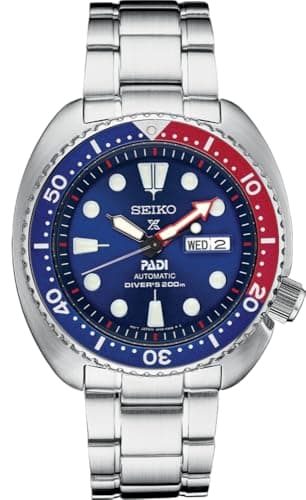
Seiko Prospex Turtle SRPE99
SRPE99K1Best for: An actual dive watch you can also wear daily
A real 200 m ISO-rated diver with a screw-down crown, in the cushion case that wears far smaller than its 45 mm suggests.
- Spec completeness for the price
- 9.0
- Movement relative to bracket
- 8.5
- Case proportions
- 8.8
- Strap flexibility
- 9.5
- Availability
- 8.6
What it gets right
- Genuine ISO 6425 diver, not a diver-styled sports watch
- 47.7 mm lug-to-lug means it fits wrists that 45 mm suggests it should not
- Screw-down crown at 4 o'clock keeps it off the back of your hand
What it gets wrong
- Hardlex on a watch at this price is the recurring Seiko complaint
- The 45 mm figure scares people off before they try one
- PADI co-branding on the dial is not for everyone
Skip this one if: you have a wrist under about 6.5 inches. The lug-to-lug is forgiving but the case is still visually wide, and the smaller SRPG references exist for exactly this reason.
| Case diameter | 45.0 mm (cushion case) |
|---|---|
| Lug-to-lug | 47.7 mm |
| Thickness | 13.4 mm |
| Lug width | 22 mm |
| Crystal | Hardlex (hardened mineral) |
| Water resistance | 200 m, ISO 6425 rated for scuba diving |
| Crown | Screw-down, at 4 o'clock |
| Bezel | Unidirectional elapsed-timing bezel, PADI red and blue |
| Lume | LumiBrite on hands and markers |
| Bracelet | Steel, three-fold clasp with push-button release |
| Caliber | Seiko 4R36 |
| Type | Automatic, hand-winding and hacking |
| Beat rate | 21,600 vph (6 beats/sec) |
| Jewels | 24 |
| Power reserve | Approx. 41 hours |
| Stated accuracy | -35 to +45 sec/day |
| Complications | Day and date |
No buyable offer at the last check (October 23, 2026). We show nothing rather than a stale number.
#ad · we may earn a commission from this link to Seiko 5 Sports SRPD93
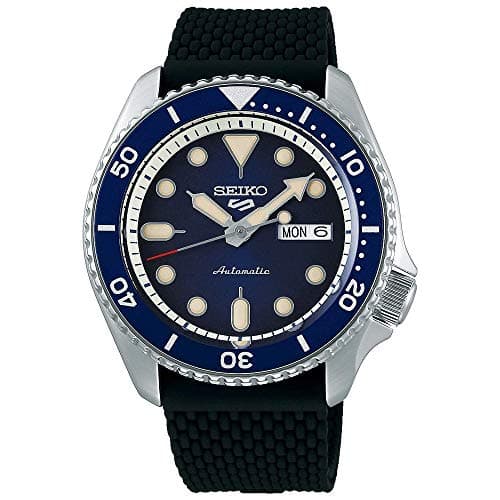
Seiko 5 Sports SRPD93
SRPD93Best for: A first mechanical watch you will not outgrow
The 5KX case with a movement that hacks and hand-winds, in blue on a silicone strap. The default answer under $350, and the one most people should stop looking after.
- Spec completeness for the price
- 8.8
- Movement relative to bracket
- 8.5
- Case proportions
- 8.9
- Strap flexibility
- 9.5
- Availability
- 8.8
What it gets right
- Hacks and hand-winds — the SKX's biggest omission, fixed
- 22 mm lugs put the entire aftermarket strap catalog in play
- Day-date in a genuinely legible layout
- Case shape is the SKX profile people actually want
What it gets wrong
- Hardlex, not sapphire — it will scratch
- 100 m and no screw-down crown, so it is not an ISO 6425 diver despite the looks
- 13.4 mm thick under a shirt cuff
- Ships on a silicone strap rather than a bracelet
Skip this one if: you want an actual dive watch. The 100 m rating and the absence of a screw-down crown mean this is a dive-styled sports watch, not an ISO 6425 diver. The Turtle is the real one.
| Case diameter | 42.5 mm |
|---|---|
| Lug-to-lug | 46.0 mm |
| Thickness | 13.4 mm |
| Lug width | 22 mm |
| Crystal | Hardlex (hardened mineral) |
| Water resistance | 100 m — splash and swim, not scuba |
| Bezel | Blue unidirectional rotating |
| Dial | Blue sunray |
| Strap | Black silicone |
| Case back | See-through |
| Lume | LumiBrite |
| Caliber | Seiko 4R36 |
| Type | Automatic, hand-winding and hacking |
| Beat rate | 21,600 vph (6 beats/sec) |
| Jewels | 24 |
| Power reserve | Approx. 41 hours |
| Stated accuracy | -35 to +45 sec/day |
| Complications | Day and date |
$359.009% off
Price as of October 23, 2026. Prices move — Amazon's is the one that counts.
#ad · we may earn a commission from this link to Seiko 5 SNK809
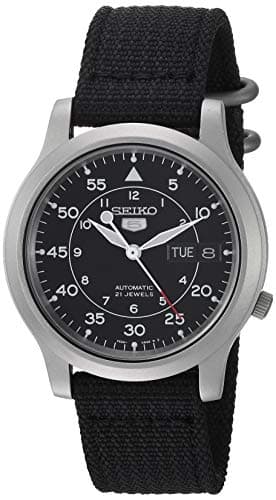
Seiko 5 SNK809
SNK809K2Best for: A genuinely small mechanical watch, if the remaining-stock price is still sensible
The classic small field Seiko: 37 mm, 7S26, canvas strap. It does not hack and it does not hand-wind. Now discontinued — the 7S26 went out of production in 2019 and Seiko's US catalog no longer lists it — so remaining stock is priced by scarcity, not by Seiko. Check the live price against a 4R36 reference before paying it.
- Spec completeness for the price
- 8.0
- Movement relative to bracket
- 7.4
- Case proportions
- 9.2
- Strap flexibility
- 7.8
- Availability
- 4.0
What it gets right
- 42 mm lug-to-lug fits genuinely small wrists
- Exhibition back on a watch at this price
- Legible 24-hour inner track
What it gets wrong
- 7S26 will not hand-wind and will not hack — you cannot set it to the second
- 30 m rating means keep it out of the shower
- 18 mm lugs are a narrower strap market than 20 or 22 mm
- Discontinued and sold from remaining stock — the price is whatever the seller asks, and it no longer tracks the bracket this watch defined
Skip this one if: the live price is at or above a 4R36 Seiko 5 Sports. This was the value pick of its bracket when Seiko still made it; sold from remaining stock it frequently is not, and the SRPD93 or the 36.4 mm SBSA199 give you hacking and hand-winding for the same money or less. Skip it too if setting the watch precisely matters to you — without hacking you cannot stop the seconds hand to sync it.
| Case diameter | 37.0 mm |
|---|---|
| Lug-to-lug | 42.0 mm |
| Thickness | 11.1 mm |
| Lug width | 18 mm |
| Crystal | Hardlex (hardened mineral) |
| Water resistance | 30 m — hand-washing only, not swimming |
| Display back | Yes — exhibition caseback |
| Caliber | Seiko 7S26 |
| Type | Automatic. No hand-winding, no hacking |
| Beat rate | 21,600 vph (6 beats/sec) |
| Jewels | 21 |
| Power reserve | Approx. 41 hours |
| Stated accuracy | -20 to +40 sec/day |
| Complications | Day and date |
Questions
Can I shower with a 100m Seiko?
Physically it will usually survive it, but hot water degrades gaskets faster than anything else a watch normally meets, and soap can work past a seal. Most watchmakers advise against it even at 100 m.
What does 30m water resistance actually mean?
That the watch passed a static pressure test equivalent to 30 meters. In practice it means rain and hand-washing only — not showering, not swimming, nothing submerged.
What is the difference between 200m and 200m DIVER'S?
The DIVER’S marking means the watch was tested to ISO 6425, which adds condensation, thermal shock, magnetic resistance, legibility and bezel requirements on top of the pressure test. A plain 200 m watch has passed only the pressure test.
Does water resistance wear off?
Yes. The rubber gaskets that seal the case compress and dry out over years. A watch that actually goes in water should be pressure-tested every few years, and after any service or battery change.
Can I swim with a Seiko 5?
The 100 m 5 Sports references, yes. The 30 m classic Seiko 5s such as the SNK809, no — that rating covers hand-washing only.
Sources
- ISO 6425 — Horology, divers' watches (standard listing)
- ISO 22810 — Horology, water-resistant watches (standard listing)
- Seiko Prospex collection — official specifications
- Seiko instruction manuals and caliber documentation
Specifications are transcribed from manufacturer documentation and published standards. Where a manufacturer does not publish a figure, this page says so rather than estimating one.
Read next
- Best Seiko dive watchesThe references that actually carry the ISO 6425 marking.
- Seiko 5 vs ProspexThe rating is most of what separates the two lines.
- Hardlex vs sapphireWhy the crystal is part of the water-resistance system.
- Seiko Turtle referenceA 200m ISO 6425 diver, spec by spec.
- Seiko LumiBrite explainedThe other dive-spec question: how the lume charges and fades.