Head-to-head
Seiko vs Casio
These two companies are not really competing. One sells you a movement, the other sells you a tool that will outlive it.
By Stephen V. · Updated Aug 19, 2026
Most brand-versus-brand comparisons are close. This one is not, and pretending otherwise would waste your time. Seiko and Casio are pointed at different things: Seiko builds mechanical watches around movements it manufactures itself, and Casio builds accurate, nearly indestructible electronic tools at prices that make a mechanical watch look like an indulgence. Both are right. They are answering different questions.
The one question that decides it
Do you want the watch to be mechanical?
If yes, buy Seiko, and it is not close. Casio’s volume range is quartz and digital; there is no Casio equivalent to the 4R36 sitting in a $250 watch. If a rotor, a mainspring and a sweeping seconds hand are the reason you are buying a watch at all, Casio does not sell one.
If you do not care — if what you want is a watch that is correct, cheap, and survives being ignored — Casio wins comprehensively, and it wins at a price Seiko cannot approach.
Where each one genuinely wins
| Axis | Winner | Why |
|---|---|---|
| Mechanical watches | Seiko | In-house automatics from about $150; Casio has no equivalent |
| Accuracy | Casio | Quartz is orders of magnitude tighter than any 4R caliber |
| Price floor | Casio | The cheapest watch on this site, and still a real 200 m diver |
| Toughness | Casio | G-Shock is engineered around shock resistance; Seiko's mainstream range is not |
| Maintenance | Casio | A battery, or nothing at all if it is solar |
| Aftermarket parts | Seiko | The entire modding supply chain is cut for Seiko cases |
| Resale | Seiko | Mechanical Seikos hold value; most Casios do not |
| Published dimensions | Seiko | More consistent lug-to-lug and thickness figures |
The pairing that is actually close
There is exactly one place these brands meet head-on, and it is the cheap steel diver. The Casio Duro MDV106 is a 200 m quartz diver with a unidirectional bezel that costs a fraction of anything mechanical. The Seiko 5 Sports SRPD93 is the default mechanical answer in the same shape.
| Seiko SRPD93 | Casio Duro MDV106 | |
|---|---|---|
| Movement | Seiko 4R36 automatic | Casio quartz, battery |
| Case diameter | 42.5 mm | 44 mm |
| Lug-to-lug | 46.0 mm | Not published in the retail listing |
| Thickness | 13.4 mm | Not published in the retail listing |
| Crystal | Hardlex | Mineral |
| Water resistance | 100 m | 200 m |
| Bezel | Unidirectional, 120-click | Unidirectional |
| Lug width | 22 mm | Not published in the retail listing |
The Duro out-rates the Seiko on water resistance and undercuts it enormously on price. What it does not have is a movement anyone will ever care about, a strap ecosystem, or published dimensions — three rows above read “not published” because Casio does not list them, and we are not going to fill them in from a tape measure we never held. The SRPD93’s 22 mm lugs, by contrast, put the entire aftermarket strap catalog in play.
Note also that neither of these is an ISO 6425 diver. The SRPD93 is 100 m without a screw-down crown — a dive-styled sports watch rather than a certified one — and Casio does not claim the standard either. If certification is the point, the Seiko divers that carry it are a separate shortlist.
The Casio nobody outside Japan has seen
If your mental model of Casio is resin and digital displays, the Oceanus line will not fit it. It is Casio’s Japan-market premium range: titanium cases, sapphire crystals, solar power and radio time synchronization, finished to a standard Casio does not apply to G-Shock or Edifice.
It is also the one place Casio competes with Seiko on finishing rather than on toughness or price. A titanium Oceanus is lighter than any steel Seiko, correct to the second without any input from you, and never needs a battery. What it does not have is a mechanical movement, a resale market outside Japan, or radio coverage in regions without a longwave transmitter to listen to. Our JDM Casio page covers the line properly.
Where each brand is actually made
“Are Casio watches made in Japan?” is one of the most-searched questions about the brand, and the honest answer is that it varies by reference, and the watch itself is the only reliable source. Country of origin is printed on the caseback or the dial, and that marking describes the watch in your hand rather than the company in general. We have not audited Casio’s manufacturing footprint and are not going to summarize it from memory. What we can say is narrower and more useful: the Oceanus line is sold primarily into the Japanese domestic market, which is why it sits in our JDM section rather than in a general Casio one.
Seiko is the same story with a different distribution. It manufactures in Japan and elsewhere, and its reference suffixes carry information about the market a watch was intended for — which is exactly what our JDM versus international pageexists to decode. Neither company is “a Japanese brand” in the simple sense the question assumes, and neither is pretending to be.
The honest recommendation
Buy Casio if the watch is a tool. If it needs to be right to the second, survive a building site, cost almost nothing and never ask anything of you, nothing Seiko sells competes and the Duro is the cheapest serious answer on this entire site.
Buy Seikoif the watch is an object. A mechanical movement you can watch through a caseback, a strap you can change, a reference number with a decade of documentation behind it and a secondary market that still wants it — those are the things you are paying the extra for, and they are real things, but they are not performance. Being clear about which of the two you want is the whole decision.
The place this comparison matters most is at the very bottom of the market, where Casio is the only one of the two with anything to sell: is there a good Seiko under $100works through what that budget actually buys, and why the Duro’s published 200 m rating is the reason it keeps winning the argument.
The watches on this page
Specifications are transcribed from Seiko’s published documentation. Prices come from Amazon and carry the date they were verified. We have not handled these watches — here is what we did instead.
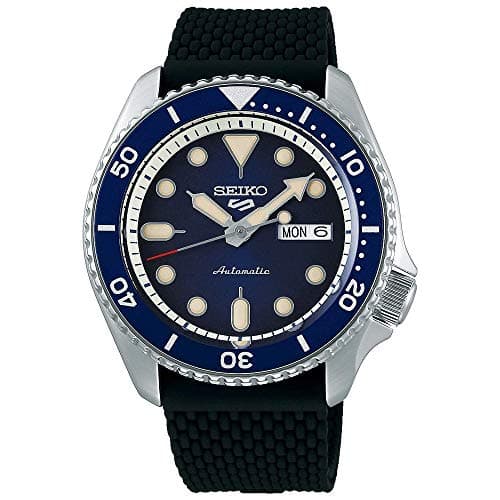
No buyable offer at the last check (October 23, 2026). We show nothing rather than a stale number.
#ad · we may earn a commission from this link to Seiko 5 Sports SRPD93
Seiko 5 Sports SRPD93
SRPD93Best for: A first mechanical watch you will not outgrow
The 5KX case with a movement that hacks and hand-winds, in blue on a silicone strap. The default answer under $350, and the one most people should stop looking after.
- Spec completeness for the price
- 8.8
- Movement relative to bracket
- 8.5
- Case proportions
- 8.9
- Strap flexibility
- 9.5
- Availability
- 8.8
What it gets right
- Hacks and hand-winds — the SKX's biggest omission, fixed
- 22 mm lugs put the entire aftermarket strap catalog in play
- Day-date in a genuinely legible layout
- Case shape is the SKX profile people actually want
What it gets wrong
- Hardlex, not sapphire — it will scratch
- 100 m and no screw-down crown, so it is not an ISO 6425 diver despite the looks
- 13.4 mm thick under a shirt cuff
- Ships on a silicone strap rather than a bracelet
Skip this one if: you want an actual dive watch. The 100 m rating and the absence of a screw-down crown mean this is a dive-styled sports watch, not an ISO 6425 diver. The Turtle is the real one.
| Case diameter | 42.5 mm |
|---|---|
| Lug-to-lug | 46.0 mm |
| Thickness | 13.4 mm |
| Lug width | 22 mm |
| Crystal | Hardlex (hardened mineral) |
| Water resistance | 100 m — splash and swim, not scuba |
| Bezel | Blue unidirectional rotating |
| Dial | Blue sunray |
| Strap | Black silicone |
| Case back | See-through |
| Lume | LumiBrite |
| Caliber | Seiko 4R36 |
| Type | Automatic, hand-winding and hacking |
| Beat rate | 21,600 vph (6 beats/sec) |
| Jewels | 24 |
| Power reserve | Approx. 41 hours |
| Stated accuracy | -35 to +45 sec/day |
| Complications | Day and date |
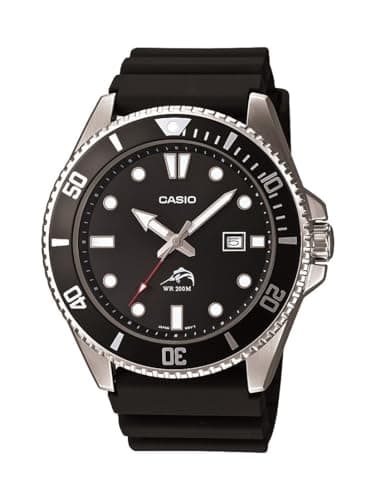
$84.9519% off
Price as of October 23, 2026. Prices move — Amazon's is the one that counts.
#ad · we may earn a commission from this link to Casio Duro MDV106
Casio Duro MDV106
Best for: The cheapest watch on this site that is still a real 200 m diver
A 200 m quartz diver for roughly the price of a strap. The honest floor of this entire category and the answer when the budget is genuinely tight.
- Spec completeness for the price
- 9.5
- Movement relative to bracket
- 8.0
- Case proportions
- 7.6
- Strap flexibility
- 8.4
- Availability
- 9.2
What it gets right
- 200 m for less than most people spend on a bracelet
- Quartz accuracy
- Genuinely hard to damage
What it gets wrong
- Resin strap and mineral crystal
- 44 mm and tall on a small wrist
- Nothing about it is special beyond the value
Skip this one if: you want something to keep. This is a tool that costs nothing and does its job; it is not an object you will still care about in ten years.
| Brand | Casio |
|---|---|
| Case diameter | 44 mm |
| Water resistance | 200 m |
| Movement | Casio quartz, battery-powered |
| Crystal | Mineral |
| Bezel | Unidirectional |
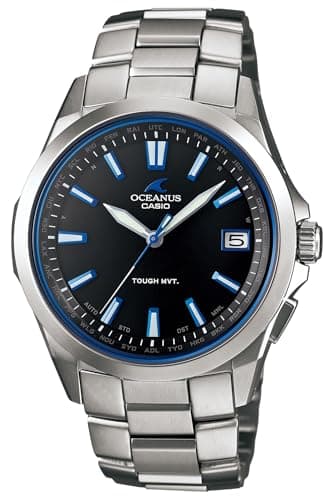
$614.458% off
Price as of October 23, 2026. Prices move — Amazon's is the one that counts.
#ad · we may earn a commission from this link to Casio Oceanus OCW-S100
Casio Oceanus OCW-S100
OCW-S100-1AJFBest for: The best-finished JDM watch that is not a Seiko
The JDM Casio nobody outside Japan knows about: a solar, radio-synced Oceanus, finished to a standard Casio never applies to G-Shock.
- Spec completeness for the price
- 7.0
- Movement relative to bracket
- 9.1
- Case proportions
- 8.0
- Strap flexibility
- 6.5
- Availability
- 7.2
What it gets right
- Solar and radio-synced, so it neither needs a battery nor setting
- Oceanus case finishing sits well above Casio's mainstream lines
- A genuinely Japan-market watch rather than an export model
What it gets wrong
- Costs several times a G-Shock
- Almost unknown outside Japan, so resale is thin
- We could not verify this reference's case material or dimensions against Casio's own published specification, so this page does not state them
Skip this one if: you need the published specification before buying. Casio's product pages refuse automated access, so we can confirm the line, the reference and the power source but not the case figures — and we will not copy them from a reseller.
| Brand | Casio (Oceanus line) |
|---|---|
| Market | Primarily Japanese domestic market |
| Reference | OCW-S100-1AJF |
| Movement | Solar, radio-controlled — per the retail listing |
| Case and dimensions | Not verifiable — Casio's specification pages block automated access |
Questions
Does Casio make mechanical watches?
Not in the range most people shop. Casio’s volume lines are quartz, digital and solar. If you want an automatic movement at this price, Seiko is the answer and Casio has no equivalent to the 4R calibers.
Are Casio watches made in Japan?
It varies by reference. Country of origin is printed on the caseback or the dial, and that marking is the only reliable source for the watch in your hand — we have not audited Casio’s manufacturing footprint and will not summarize it from memory. The Oceanus line is sold primarily into the Japanese domestic market, which is why we cover it in our JDM section.
Is a Casio more accurate than a Seiko?
Yes, by a wide margin. Casio’s quartz movements are orders of magnitude tighter than the -35 to +45 seconds per day Seiko specifies for its 4R automatics. Accuracy is simply not what a mechanical watch is bought for.
Is the Casio Duro MDV106 better than a Seiko 5?
As a tool, arguably — it is rated 200 m against the SRPD93’s 100 m and costs a fraction as much. As a watch to own, no: it has no mechanical movement, no strap ecosystem and no published dimensions. They are answers to different questions.
What is the Casio Oceanus?
Casio’s Japan-market premium line: titanium, sapphire, solar and radio-synced, finished well above G-Shock. It is the one Casio range that competes with Seiko on finishing rather than on price or toughness.
Which holds value better, Seiko or Casio?
Seiko, on mechanical references especially. Most Casios are inexpensive enough that resale is not really a consideration, and the JDM Oceanus line has a thin secondary market outside Japan.
Sources
- Seiko Watch Corporation — US catalog and specifications
- Seiko 5 Sports collection — official specifications
- ISO 6425 — Horology, divers' watches (standard listing)
- Seiko instruction manuals and caliber documentation
Specifications are transcribed from manufacturer documentation and published standards. Where a manufacturer does not publish a figure, this page says so rather than estimating one.
Read next
- JDM Casio: the Oceanus lineThe titanium, radio-synced Casio almost nobody outside Japan has seen.
- Seiko vs CitizenThe comparison where both sides make their own movements.
- Seiko SRPD93 referenceThe mechanical side of the cheap-steel-diver argument, in full.
- Best Seiko watches under $300Where Seiko's mechanical answer actually starts.
- JDM vs internationalWhat the reference suffixes say about where a watch was sold.