Roundups
Best Seiko Alpinist models
Seiko publishes three Alpinists today and one of them is reliably buyable in the US. Here is which, what the compass bezel is actually for, and what the discontinued generations are worth chasing.
By Stephen V. · Updated Oct 15, 2026
Quick picks
| # | Watch | Key spec | Score | Price |
|---|---|---|---|---|
| 1 | 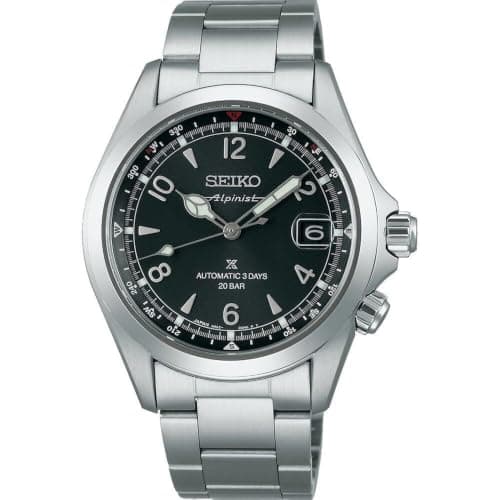 Seiko Prospex Alpinist SPB505SPB505J1 The current Alpinist, and the only one of the three Seiko publishes that has a live US listing: 39.5 mm, sapphire with a magnifier, a rotating compass bezel and the three-day 6R55. | 39.5mm · 72h | 8.9out of 10, compiled from published specifications | |
| 2 | 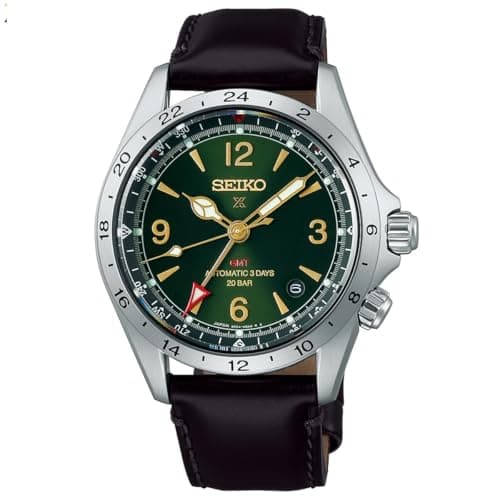 Seiko Prospex Alpinist GMT SBEJ005SBEJ005 The Alpinist with a second time zone: the same 39.5 mm case, the 6R54 GMT, a 24-hour inner ring and 72 hours of reserve. A Japan-market core-shop reference, sold here as an import. | 39.5mm · GMT | 8.5out of 10, compiled from published specifications | |
| 3 | 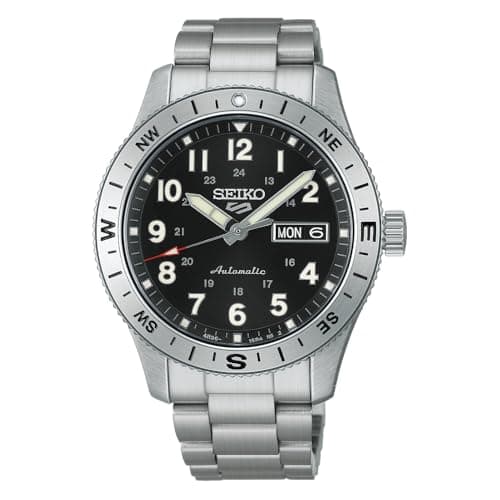 Seiko 5 Sports Field HDB006HDB006 Seiko's current 5 Sports Field: a 41 mm case with a lumed rotating bezel on the familiar 4R36. The field reference the line had been missing. | 41mm · 100m | 8.7out of 10, compiled from published specifications |
3 picks · Prices last verified October 16, 2026. Where no live price came back we show “Check price” rather than a number we cannot stand behind. How we pick.
The best Seiko Alpinist you can buy right now is the SPB505: 39.5 mm across a 46.4 mm lug-to-lug, 12.7 mm thick, sapphire with a magnifier, a rotating compass bezel, 200 m, and the 6R55 with three days of reserve. Take the SBEJ005 instead if you want a second time zone, or the Seiko 5 Sports Field HDB006 if the compass bezel is decoration to you rather than a tool.
The Alpinist is the oldest idea in Seiko’s sports catalog and the one most often bought for the wrong reason. Seiko describes the current watch as a re-imagining of the company’s first sport watch, introduced in 1959 — a mountaineering watch, not a diver — and the compass bezel that most people think of as the Alpinist signature arrived decades later. What has survived every generation is the specification brief: a case in the high 30s, a crystal you can live with, a water rating far beyond what a hiker needs, and a movement that will still be running after a weekend in a drawer.
The awkward part of answering “which Alpinist” in 2026 is that Seiko publishes three references — the SPB503, SPB505 and SPB507, all Caliber 6R55, all listed as available from November 2025 — and most of what is being sold as an Alpinist online is previous-generation stock whose specification pages Seiko has taken down. This page ranks what has a live listing and a published spec sheet, and it says plainly what the rest are.
The criteria, before the picks
Every figure below comes from Seiko’s own published documentation. We have not handled these watches, and the methodology page says exactly what that does and does not let us claim. Five things decide the ranking, in this order:
- Is the compass bezel real, and where does it sit? Seiko publishes a rotating compass bezel on the SPB505 and an inner rotating compass ring on the SBEJ005. An outer bezel is quicker to set; an inner ring under the crystal cannot be knocked out of alignment in a pack strap. Of everything this site tracks, exactly 1references publish a compass on the bezel — a count taken from our registry rather than typed.
- Lug-to-lug, not diameter. Both current Alpinists publish 39.5 mm across and 46.4 mm end to end. That second number is the one that decides whether the watch overhangs your wrist, and the fit guide explains the arithmetic.
- Crystal and coating. Sapphire with an anti-reflective inner coating on both current references, Hardlex on the budget alternative. On a watch you intend to own for a decade that gap matters more than a dial color; Hardlex versus sapphire has the hardness figures.
- Reserve and stated rate. The 6R55 and 6R54 are specified at approximately 72 hours and +25 to −15 seconds a day. The 4R36 in the budget pick is −35 to +45 seconds a day over about 41 hours. That is the single largest specification gap on this page.
- Can you actually buy it, and from whom? A J-suffix reference sold in the US and a Japan-market core-shop reference sold by an importer are different purchases with different warranty paths, and the ranking reflects that.
How the three compare
| Reference | Case | Lug-to-lug | Crystal | Water | Caliber | Reserve |
|---|---|---|---|---|---|---|
| SPB505J1 | 39.5 mm | 46.4 mm | Sapphire | 200 m | 6R55 | ~72 h |
| SBEJ005 | 39.5 mm | 46.4 mm | Sapphire | 200 m | 6R54 GMT | ~72 h |
| HDB006 | 41.0 mm | 48.5 mm | Hardlex | 100 m | 4R36 | ~41 h |
Read the first two rows as one watch with and without a GMT hand, and the third as a different proposition that happens to answer the same question for a lot of buyers. The SPB505 and SBEJ005 share a case; what separates them is the 24-hour hand, the strap, and whether you are buying from a US channel or an import one.
Why the SPB505 leads
It is the only Alpinist Seiko currently publishes that we can find with a live US listing, and the specification is the most complete the line has ever carried. Sapphire with a magnifier over the date, an anti-reflective coating on the inner surface, a screw-down crown, a 200 m rating, a super-hard coated case, LumiBrite on the hands and indexes, a see-through case back, and the 6R55 — 24 jewels, approximately 72 hours, +25 to −15 seconds a day. At 12.7 mm it is also the thinnest watch on this page despite having the deepest water rating.
Two honest marks against it. Seiko publishes a weight of 147.0 g, which is a lot for a 39.5 mm watch and tells you this is the bracelet version wearing a full steel head. And Seiko’s own specification page does not state the dial color or the band material for this reference, so neither appears in our spec table — we are not going to fill those rows from a retailer listing. The 0 references on this site that run a three-day 6R5x caliber are all at the top of the range, and this is one of them.
The GMT Alpinist, and what the import costs you
The SBEJ005 is the same 39.5 mm by 46.4 mm case with the 6R54 instead of the 6R55: a 24-hour dual-time hand read against an inner rotating ring that carries both 24-hour markings and a simple compass. Seiko publishes 13.6 mm of thickness, a Diashield-coated case, curved sapphire, a screw-lock crown, 20 bar, a cowhide strap with a one-push three-fold clasp, and 87.0 gon the scale — a lot less watch to carry than the bracelet SPB505.
The catch is in the first row of its spec table: this is a Japanese domestic market reference, a Seiko Global Brand Core Shop exclusive, sold in the US through an importer. That means import pricing that moves with the listing rather than with Seiko, and a warranty conversation that happens in Japan. What JDM actually changes covers that trade in detail, and buying a Seiko in Japan covers the version of it where you go and get the watch yourself. Seiko also does not publish a lug width for this reference, so a strap change starts with measuring it.
When a field watch is the better buy
A compass bezel only works if you can see the sun and your watch is set to local time. If you are honest that you will never do that, you are paying for the look, and the Seiko 5 Sports Field HDB006 gives you most of it for a fraction of the money: 41.0 mm, a rotating bezel with its own LumiBrite, 100 m, 20 mm lugs and the 4R36, which hacks and hand-winds. It is bigger — 48.5 mm lug to lug against 46.4 — it is Hardlex rather than sapphire, and its stated rate is four times looser. Those are the three things you are buying when you step up. The field watch roundup ranks that whole bracket.
The generations Seiko has stopped publishing
This is the part most Alpinist pages leave out. Several references that dominate the search results are discontinued remaining stock, and in some cases Seiko has withdrawn the specification page entirely:
- SPB121J1 — the green 2020 Alpinist that made the modern line famous. Third-party listings still appear, typically well above the current SPB505’s price, and Seiko’s catalog page for it now returns a 404. We will not transcribe its dimensions from a retailer, so it is not ranked here.
- SBDC159 — the Japan-market 1959-lineage Alpinist, 38.0 mm, 6R35, 200 m. It is still in our registry with its full published specification, and it has had no live Amazon offer at any price check since late September. Its specification lives on the Alpinist reference page.
- SPB117J1 — not an Alpinist at all, but the reference most often cross-shopped against one. It is a 62MAS-lineage diver, and it has been unbuyable just as long.
- SARB017 — the cult green Alpinist, discontinued in 2018 and now a second-hand purchase with everything that implies. Buying a used Seiko covers how to check one.
The practical consequence: if a listing shows you an Alpinist at a price that looks like a bargain, check the reference number before the photograph. The serial number guide explains what the case back will tell you.
Straps, bracelets and the 20 mm question
The SPB505 publishes 20 mm lugs, which is the most useful number on its spec sheet after the lug-to-lug. Twenty millimeters is the widest-stocked size in the aftermarket, so the watch is a strap platform as much as a watch — the bracelet replacement page covers the steel options and the strap roundup covers everything else. The SBEJ005 is the opposite case: Seiko does not publish its lug width at all, so measure before you order. Our lug width table lists every width Seiko publishes across the range.
The picks in full
Specifications are transcribed from Seiko’s published documentation. Prices come from Amazon and carry the date they were verified. We have not handled these watches — here is what we did instead.
Price as of October 16, 2026. Prices move — Amazon's is the one that counts.
#ad · we may earn a commission from this link to Seiko Prospex Alpinist SPB505
Seiko Prospex Alpinist SPB505
SPB505J1Best for: The Alpinist specification as Seiko currently builds it
The current Alpinist, and the only one of the three Seiko publishes that has a live US listing: 39.5 mm, sapphire with a magnifier, a rotating compass bezel and the three-day 6R55.
- Spec completeness for the price
- 8.7
- Movement relative to bracket
- 9.3
- Case proportions
- 9.4
- Strap flexibility
- 8.4
- Availability
- 8.6
What it gets right
- Three-day power reserve — put it down on Friday and it is still running Monday
- Sapphire with a magnifier, a screw-down crown and 200 m on a watch built for land
- 39.5 mm across a 46.4 mm lug-to-lug is the proportion the Alpinist has always traded on
- Seiko publishes a tighter rate for the 6R55 than for any 4R caliber
What it gets wrong
- The most expensive Seiko this site tracks, by some distance
- 147 g is heavy for a 39.5 mm watch
- Seiko does not publish the dial color or the band material on the specification page
- A compass bezel needs the sun, and a watch set to local time, to mean anything
Skip this one if: the compass bezel is decoration to you. It is most of what separates this from a field watch costing a quarter as much, and if you will never line it up on the sun, the Seiko 5 Sports field watch is the same idea without the fee.
| Case diameter | 39.5 mm |
|---|---|
| Lug-to-lug | 46.4 mm |
| Thickness | 12.7 mm |
| Lug width | 20 mm |
| Case material | Stainless steel with a super-hard coating |
| Crystal | Sapphire with a magnifier, anti-reflective coating on the inner surface |
| Water resistance | 200 m (20 bar) |
| Bezel | Rotating compass bezel |
| Crown | Screw-down |
| Case back | See-through screw case back |
| Lume | LumiBrite on hands and indexes |
| Magnetic resistance | 4,800 A/m |
| Weight | 147.0 g |
| Dial | Not published by Seiko for this reference |
| Caliber | Seiko 6R55 |
| Type | Automatic with manual winding and a stop-second function |
| Jewels | 24 |
| Power reserve | Approx. 72 hours (3 days) |
| Stated accuracy | +25 to -15 sec/day |
$1,368.4017% off
Price as of October 16, 2026. Prices move — Amazon's is the one that counts.
#ad · we may earn a commission from this link to Seiko Prospex Alpinist GMT SBEJ005
Seiko Prospex Alpinist GMT SBEJ005
SBEJ005Best for: An Alpinist that also tracks a second time zone
The Alpinist with a second time zone: the same 39.5 mm case, the 6R54 GMT, a 24-hour inner ring and 72 hours of reserve. A Japan-market core-shop reference, sold here as an import.
- Spec completeness for the price
- 8.4
- Movement relative to bracket
- 9.4
- Case proportions
- 9.2
- Strap flexibility
- 7.6
- Availability
- 7.8
What it gets right
- A real second time zone on a watch that is otherwise the current Alpinist
- 72-hour reserve, curved sapphire and a Diashield-coated case
- 87 g on leather — well under the weight of the bracelet SPB505
- The compass ring sits inside the crystal, so nothing rotates against your cuff
What it gets wrong
- A Japan-market reference bought as an import, with the warranty path that implies
- Seiko does not publish a lug width for it, so strap shopping starts with a caliper
- 13.6 mm thick — the GMT module costs you nearly a millimeter over the SPB505
- Import pricing moves with the listing rather than with Seiko
Skip this one if: you want a US warranty and a US service path. This is a Japanese core-shop reference sold through an importer, and that is the trade you are making for the GMT hand.
| Market | Japanese domestic market — Seiko Global Brand Core Shop exclusive |
|---|---|
| Case diameter | 39.5 mm |
| Lug-to-lug | 46.4 mm |
| Thickness | 13.6 mm |
| Lug width | Not published by Seiko for this reference |
| Case material | Stainless steel with a Diashield coating |
| Crystal | Curved sapphire, anti-reflective coating on the inner surface |
| Water resistance | 200 m (20 bar), daily-life reinforced |
| Bezel | Inner rotating ring with a simple compass; 24-hour markings |
| Crown | Screw-lock |
| Case back | See-through screw case back |
| Strap | Cowhide leather, one-push three-fold clasp |
| Lume | LumiBrite on hands and indexes |
| Weight | 87.0 g |
| Caliber | Seiko 6R54 |
| Type | Automatic with manual winding, stop-second, 24-hour dual-time hand |
| Jewels | 24 |
| Power reserve | Approx. 72 hours at full wind |
| Stated accuracy | +25 to -15 sec/day |
Price as of October 16, 2026. Prices move — Amazon's is the one that counts.
#ad · we may earn a commission from this link to Seiko 5 Sports Field HDB006
Seiko 5 Sports Field HDB006
HDB006Best for: A field watch with a rotating bezel and a mechanical movement
Seiko's current 5 Sports Field: a 41 mm case with a lumed rotating bezel on the familiar 4R36. The field reference the line had been missing.
- Spec completeness for the price
- 8.6
- Movement relative to bracket
- 8.5
- Case proportions
- 8.4
- Strap flexibility
- 9.3
- Availability
- 8.6
What it gets right
- Rotating bezel with its own LumiBrite, which the older field references did not have
- 20 mm lugs, the most common aftermarket size
- The 4R36 hacks and hand-winds
What it gets wrong
- 41 mm with a 48.5 mm lug-to-lug — bigger than the 39.4 mm field references it follows
- Hardlex, not sapphire
- 13.2 mm thick for a field watch
Skip this one if: you wanted the small field Seiko. This is the 41 mm replacement for that idea, and its 48.5 mm lug-to-lug is a different proposition from the 39.4 mm SRPG references, which Seiko has now sold out of.
| Case diameter | 41.0 mm |
|---|---|
| Lug-to-lug | 48.5 mm |
| Thickness | 13.2 mm |
| Lug width | 20 mm |
| Crystal | Curved Hardlex |
| Water resistance | 100 m (10 bar) |
| Bezel | Rotating, with LumiBrite on the bezel as well as the hands |
| Dial | Glossy black |
| Magnetic resistance | 4,800 A/m |
| Case back | See-through, screw case back |
| Clasp | Three-fold with push-button release |
| Caliber | Seiko 4R36 |
| Type | Automatic, hand-winding and hacking |
| Beat rate | 21,600 vph (6 beats/sec) |
| Jewels | 24 |
| Power reserve | Approx. 41 hours |
| Stated accuracy | -35 to +45 sec/day |
| Complications | Day and date |
How to choose between them
Will you actually use the compass?
A watch compass works by pointing the hour hand at the sun and bisecting the angle to 12; the bezel is there to hold the bearing once you have it. It needs sun, it needs the watch set to true local time rather than daylight saving, and it is accurate to roughly a quadrant. If that sounds useful, the bezel is worth the premium. If it sounds like a party trick, buy the field watch and spend the difference on a strap.
One time zone or two?
The 6R54 in the SBEJ005 adds an independently adjustable 24-hour hand, which is the mechanism that makes a GMT watch useful rather than decorative. The GMT roundupcovers Seiko’s cheaper 4R34 route to the same complication, and diver versus GMT is the page for deciding whether you want the complication at all.
US channel or Japanese import?
The SPB505 is a J-suffix reference with ordinary US retail distribution. The SBEJ005 is a core-shop exclusive bought from an importer. Both are genuine Seikos built in the same factories; what differs is the paperwork, the service path and how the price behaves.
Is 39.5 mm small?
Not by the standards of the line it belongs to, and not in the way the number suggests. The 46.4 mm lug-to-lug is close to the HDB006’s 48.5 mm and to several 42 mm divers this site tracks, because Alpinist lugs are long and straight. The small-wrist page ranks the whole range on that measurement rather than on diameter.
What about the SPB503 and SPB507?
They are the same watch as the SPB505 in different finishes — Seiko publishes 39.5 mm, 46.4 mm, 12.7 mm, 20 bar, sapphire with a magnifier and the 6R55 for all three, with the SPB507 on cow leather at 88.0 gagainst the SPB505’s 147.0 g. Neither had a live Amazon listing when this page was written, which is the only reason they are not ranked.
Questions
Which Seiko Alpinist is the current model?
Seiko currently publishes three: the SPB503, SPB505 and SPB507, all on Caliber 6R55 and all listed as available from November 2025. They share a 39.5 mm case, a 46.4 mm lug-to-lug, 12.7 mm of thickness, sapphire with a magnifier, a rotating compass bezel and a 20 bar rating. The SPB505 is the one with a live US listing as this page is written.
Is the Seiko Alpinist a dive watch?
No. Seiko rates the current Alpinist at 20 bar with a screw-down crown, which is a serious water rating, but Seiko does not present it as an ISO 6425 diver and it has no unidirectional timing bezel. What the water ratings actually certify explains the difference, and the dive roundup is the right page if that is what you need.
Why is the SPB121 more expensive than the current Alpinist?
Because it is discontinued and the listings are remaining stock rather than distribution. Seiko has withdrawn its specification page, and the asking prices we see are above the current SPB505’s. That is a seller’s decision about scarcity, not a statement about the watch, and it is the usual pattern for a Seiko reference that has gone out of production — the same thing happened to the SKX007.
What does the Alpinist compass bezel actually do?
It holds a bearing. You find north by pointing the hour hand at the sun and bisecting the angle between the hand and 12 o’clock, then rotate the bezel so its compass markings line up with what you found. The bezel does no measuring of its own, which is why it is a useful tool for someone who already navigates and an ornament for everyone else.
Is the Alpinist worth it over a Seiko 5?
It depends entirely on which specifications you will notice. The Alpinist buys you sapphire over Hardlex, 20 bar over 10, a three-day reserve over roughly 41 hours, a stated rate four times tighter, and a smaller lug-to-lug. If none of those change your week, a Seiko 5 does the same job for a quarter of the money, and we would rather say so.
Sources
- Seiko — Prospex Alpinist collection page (SPB503 / SPB505 / SPB507)
- Seiko — SPB505J1 published specifications
- Seiko — SPB507J1 published specifications
- Seiko Japan — Prospex Alpinist GMT SBEJ005 published specifications
- Seiko Prospex collection — official specifications
- Seiko instruction manuals and caliber documentation
- Seiko customer service — warranty and servicing
Specifications are transcribed from manufacturer documentation and published standards. Where a manufacturer does not publish a figure, this page says so rather than estimating one.
Read next
- Seiko Alpinist reference pageThe SBDC159's full published specification, and the line's history.
- Alpinist vs Hamilton KhakiThe other 38-40 mm field watch people cross-shop.
- Seiko Prospex explainedWhere the Alpinist sits inside Land, Sea and Sky.
- Best Seiko field watchesThe bracket below the Alpinist, where the HDB006 leads.
- Best Seiko GMT watchesThe cheaper 4R34 route to the SBEJ005's second time zone.
- Will a Seiko fit my wrist?Why 46.4 mm lug-to-lug matters more than 39.5 mm across.