Roundups
Best Seiko 5 models
The whole line explained through its best watches — what Seiko 5 means, the old-versus-new split, and where the range stops.
By Stephen V. · Updated Sep 29, 2026 · Published Aug 8, 2026
Quick picks
| # | Watch | Key spec | Score | Price |
|---|---|---|---|---|
| 1 | 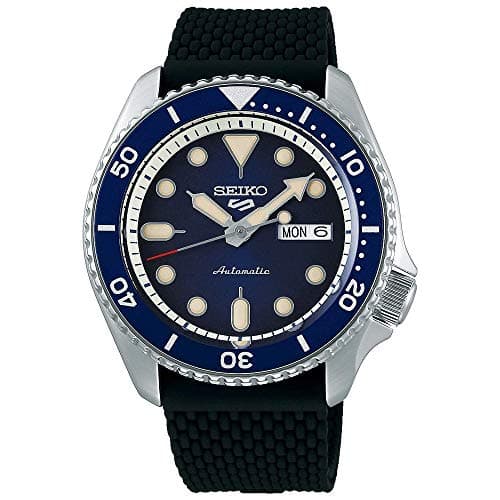 Seiko 5 Sports SRPD93SRPD93 The 5KX case with a movement that hacks and hand-winds, in blue on a silicone strap. The default answer under $350, and the one most people should stop looking after. | 42.5mm · 100m | 8.9out of 10, compiled from published specifications | |
| 2 | 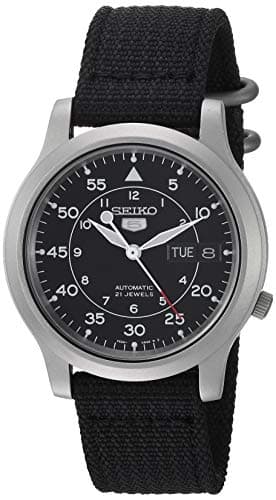 Seiko 5 SNK809SNK809K2 The classic small field Seiko: 37 mm, 7S26, canvas strap. It does not hack and it does not hand-wind. Now discontinued — the 7S26 went out of production in 2019 and Seiko's US catalog no longer lists it — so remaining stock is priced by scarcity, not by Seiko. Check the live price against a 4R36 reference before paying it. | 37mm · 30m | 7.3out of 10, compiled from published specifications | |
| 3 | 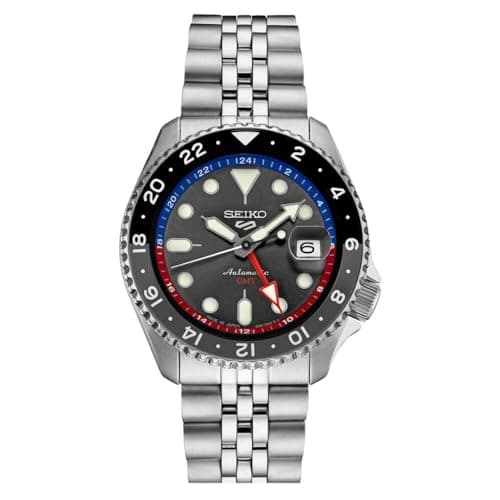 Seiko 5 Sports SKX GMT SSK019SSK019 The watch that made mechanical GMT affordable, in charcoal on a five-row bracelet. A caller GMT in the 5KX case for a fraction of what the complication used to cost. | 42.5mm · GMT | 9.1out of 10, compiled from published specifications | |
| 4 | 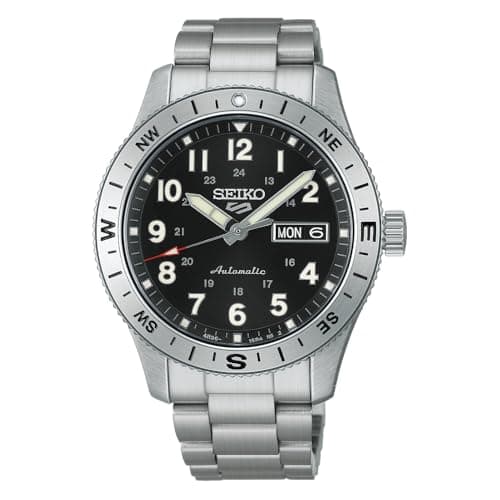 Seiko 5 Sports Field HDB006HDB006 Seiko's current 5 Sports Field: a 41 mm case with a lumed rotating bezel on the familiar 4R36. The field reference the line had been missing. | 41mm · 100m | 8.7out of 10, compiled from published specifications | |
| 5 | 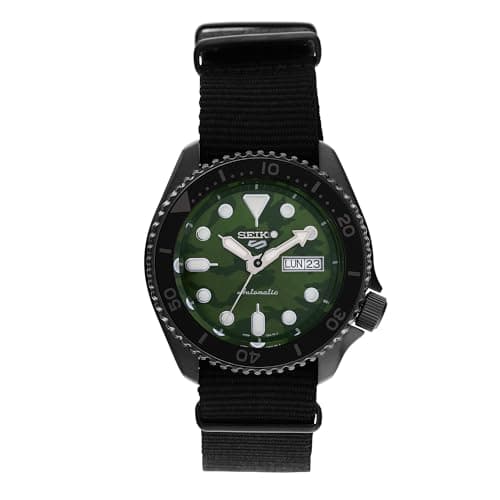 Seiko 5 Sports SRPJ37SRPJ37K1 Usually the cheapest way into the 5KX case and the 4R36. The same watch as the SRPD65 underneath, with a green camouflage dial and a nylon strap instead of a bracelet. | 42.5mm · 100m | 8.8out of 10, compiled from published specifications | |
| 6 | 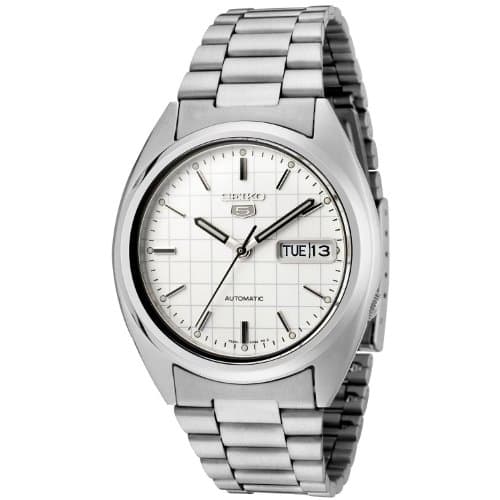 Seiko 5 SNXF05SNXF05K1 A white-dial Seiko 5 on a steel bracelet at 37 mm and 11 mm thick. The plainest mechanical watch Seiko ever sold in volume, and still findable under $200. | 37mm · 30m | 7.9out of 10, compiled from published specifications |
6 picks · Prices last verified October 23, 2026. Where no live price came back we show “Check price” rather than a number we cannot stand behind. How we pick.
Seiko 5 is the most important budget line in watchmaking and the most confusingly named. The “5” refers to five original attributes — an automatic movement, a day-date display, water resistance, a recessed crown at 4 o’clock, and a durable case and bracelet — though the modern range no longer holds all five on every reference. What has held constant since 1963 is the mission: a genuine in-house automatic at the lowest price a real mechanical watch can be built for. This page explains the line through its best current models, and the line hierarchy guide places it against Prospex and Presage.
The single most useful thing to understand about Seiko 5 today is that it is really two lines wearing one badge. There is the classic Seiko 5 — older references like the SNK809 and SNXF05 running the 7S26 — and there is 5 Sports, the modern relaunch running the 4R36 and its GMT sibling. They share a name and a philosophy and almost nothing else about their movements. Getting that split right is most of choosing well within the line.
Where the line came from
Seiko launched the 5 in 1963 as a deliberately democratic watch: an automatic with a day-date at a price ordinary buyers could reach, built to be worn hard and replaced cheaply rather than cherished. It became one of the best-selling mechanical watch families in history precisely because it never pretended to be more than it was, and that DNA is still visible in every reference on this page. Understanding the line as a value proposition first and a design second explains most of its choices, including the ones that frustrate enthusiasts.
The 2019 relaunch that folded the old SKX diver into the 5 line as 5 Sports was a genuine inflection point. It modernized the movement to the 4R36 and widened the range dramatically, but it also blurred what “Seiko 5” means, because the badge now covers everything from a 30 m classic to a GMT. That blur is exactly why a page like this, organized by movement and case family, is more useful than a flat list.
The old-versus-new movement split
The classic references run the 7S26, a genuine automatic that neither hacks nor hand-winds: you start a stopped one by shaking it or wearing it, and you cannot stop the seconds hand to set it to the second. The 5 Sports references run the 4R36, which hacks and hand-winds and adds a higher water rating in the bargain. The internet oversells the gap — both movements beat at the same 21,600 vibrations per hour, so neither sweeps more smoothly, and their day-to-day accuracy is broadly similar — but the convenience difference is real, and so is the price difference, with the classics sitting notably cheaper.
Which side to land on comes down to what you value. If you want the cheapest honest mechanical watch, or the smaller vintage cases, or simply a shape the modern range does not offer, the 7S26 classics are the answer and there is no shame in the older movement. If you want to set the watch precisely, hand-wind it in a rotation, or swim in it, the 4R36 5 Sports references are the pick, and the winner here leads for exactly that versatility.
The case families
The line organizes cleanly into three case families, and knowing them shortcuts the whole catalog. The 5KX is the modern flagship case — the SKX-inspired shape of the SRPD93 and the strap-mounted SRPJ37, and the same footprint the SSK019 GMT is built on — a substantial watch with the most common lug width and the deepest aftermarket support. The Field case, worn by the HDB006, puts the modern 4R36 behind a lumed rotating bezel in a 41 mm body built for legibility rather than for the water. And the classic case family — the SNK809 and the SNXF05 — carries the older 7S26 in genuinely vintage proportions, with narrower lugs and shorter lug-to-lug that fit small wrists the modern cases cannot.
A useful shortcut: the lug width tracks the case family, and the width decides how easily you can change straps. The 5KX and GMT cases use the widest, most common size with the deepest aftermarket support, the small 5 Sports case sits a step narrower, and the classic cases are narrower still, which limits the off-the-shelf strap selection even as it helps the watch wear small. If swapping straps often is part of the appeal, that points you toward the modern cases.
There is a fourth case none of the picks above uses, and it is worth knowing about: the mid-size SKX, which Seiko publishes at 38.0 mm across, 44.2 mm lug-to-lug and 12.1 mm thick — the 5KX silhouette shrunk back to the proportions of the 1980s originals. The green SRPK33 is the reference to know it by, and it is ranked on the green-dial roundup.
| Model | Case family | Movement | Water rating |
|---|---|---|---|
| SRPD93 | 5KX | 4R36 | 100 m |
| SRPJ37 | 5KX | 4R36 | 100 m |
| SSK019 | 5KX (GMT) | 4R34 | 100 m |
| HDB006 | Field | 4R36 | 100 m |
| SNK809 | Classic | 7S26 | 30 m |
| SNXF05 | Classic | 7S26 | 30 m |
What the line deliberately leaves out
Part of understanding the Seiko 5 is understanding its boundaries, because they are chosen rather than accidental. There is no sapphire anywhere in the line and no ISO 6425 diver, and both omissions exist to protect the price and to leave room above for Prospex and Presage. A 5 Sports reference will happily look like a tool diver and cost a fraction of one, and the honest reason it can is that it is not certified to the same standard. Buying into the line means accepting those boundaries as the cost of the value, and the comparison with Prospex is where you decide whether you have outgrown them.
The upside of those boundaries is a range that is unusually easy to recommend without caveats you cannot honor. Within its lane, a Seiko 5 does exactly what it says, at a price that makes a mistake cheap, which is why it remains the default first mechanical watch a generation of buyers is pointed toward.
The honest limits of the line
Two run through the whole range and are worth stating plainly. First, every Seiko 5 uses Hardlex, not sapphire — there is no sapphire option anywhere in the line, so if a scratch-proof crystal is a requirement, you are shopping Prospex or Presage, not this line. Second, no Seiko 5 is an ISO 6425 diver: the 5 Sports references reach 100 m and look the part, but they lack the screw-down crown and the certification that make a real diver, and the classics are only 30 m, which is hand-washing rather than swimming. Neither limit is a flaw — they are the cost of the line’s price — but a buyer who needs sapphire or a true diver should know the line does not contain one, and the Seiko 5 versus Prospex comparison is where that decision belongs.
Two cross-cuts through this range are worth following if a specific feature is what brought you here. Almost every 5 and 5 Sports reference shows a day as well as a date, and the day-date ranking explains which calibers keep that window and which quietly drop it. For the two-tone and gold-bezel references in the line, best gold and two-tone Seikos sets out where the finish sits and what Seiko does and does not publish about it.
The badge covers two separate collections, and that is the single most expensive confusion in the Seiko range: Seiko 5 against Seiko 5 Sports sets out the 7S26 against the 4R36, 30 m against 100 m, and 37 mm against 42.5 mm, with the published figures for each.
The picks in full
Specifications are transcribed from Seiko’s published documentation. Prices come from Amazon and carry the date they were verified. We have not handled these watches — here is what we did instead.
No buyable offer at the last check (October 23, 2026). We show nothing rather than a stale number.
#ad · we may earn a commission from this link to Seiko 5 Sports SRPD93
Seiko 5 Sports SRPD93
SRPD93Best for: A first mechanical watch you will not outgrow
The 5KX case with a movement that hacks and hand-winds, in blue on a silicone strap. The default answer under $350, and the one most people should stop looking after.
- Spec completeness for the price
- 8.8
- Movement relative to bracket
- 8.5
- Case proportions
- 8.9
- Strap flexibility
- 9.5
- Availability
- 8.8
What it gets right
- Hacks and hand-winds — the SKX's biggest omission, fixed
- 22 mm lugs put the entire aftermarket strap catalog in play
- Day-date in a genuinely legible layout
- Case shape is the SKX profile people actually want
What it gets wrong
- Hardlex, not sapphire — it will scratch
- 100 m and no screw-down crown, so it is not an ISO 6425 diver despite the looks
- 13.4 mm thick under a shirt cuff
- Ships on a silicone strap rather than a bracelet
Skip this one if: you want an actual dive watch. The 100 m rating and the absence of a screw-down crown mean this is a dive-styled sports watch, not an ISO 6425 diver. The Turtle is the real one.
| Case diameter | 42.5 mm |
|---|---|
| Lug-to-lug | 46.0 mm |
| Thickness | 13.4 mm |
| Lug width | 22 mm |
| Crystal | Hardlex (hardened mineral) |
| Water resistance | 100 m — splash and swim, not scuba |
| Bezel | Blue unidirectional rotating |
| Dial | Blue sunray |
| Strap | Black silicone |
| Case back | See-through |
| Lume | LumiBrite |
| Caliber | Seiko 4R36 |
| Type | Automatic, hand-winding and hacking |
| Beat rate | 21,600 vph (6 beats/sec) |
| Jewels | 24 |
| Power reserve | Approx. 41 hours |
| Stated accuracy | -35 to +45 sec/day |
| Complications | Day and date |
$359.009% off
Price as of October 23, 2026. Prices move — Amazon's is the one that counts.
#ad · we may earn a commission from this link to Seiko 5 SNK809
Seiko 5 SNK809
SNK809K2Best for: A genuinely small mechanical watch, if the remaining-stock price is still sensible
The classic small field Seiko: 37 mm, 7S26, canvas strap. It does not hack and it does not hand-wind. Now discontinued — the 7S26 went out of production in 2019 and Seiko's US catalog no longer lists it — so remaining stock is priced by scarcity, not by Seiko. Check the live price against a 4R36 reference before paying it.
- Spec completeness for the price
- 8.0
- Movement relative to bracket
- 7.4
- Case proportions
- 9.2
- Strap flexibility
- 7.8
- Availability
- 4.0
What it gets right
- 42 mm lug-to-lug fits genuinely small wrists
- Exhibition back on a watch at this price
- Legible 24-hour inner track
What it gets wrong
- 7S26 will not hand-wind and will not hack — you cannot set it to the second
- 30 m rating means keep it out of the shower
- 18 mm lugs are a narrower strap market than 20 or 22 mm
- Discontinued and sold from remaining stock — the price is whatever the seller asks, and it no longer tracks the bracket this watch defined
Skip this one if: the live price is at or above a 4R36 Seiko 5 Sports. This was the value pick of its bracket when Seiko still made it; sold from remaining stock it frequently is not, and the SRPD93 or the 36.4 mm SBSA199 give you hacking and hand-winding for the same money or less. Skip it too if setting the watch precisely matters to you — without hacking you cannot stop the seconds hand to sync it.
| Case diameter | 37.0 mm |
|---|---|
| Lug-to-lug | 42.0 mm |
| Thickness | 11.1 mm |
| Lug width | 18 mm |
| Crystal | Hardlex (hardened mineral) |
| Water resistance | 30 m — hand-washing only, not swimming |
| Display back | Yes — exhibition caseback |
| Caliber | Seiko 7S26 |
| Type | Automatic. No hand-winding, no hacking |
| Beat rate | 21,600 vph (6 beats/sec) |
| Jewels | 21 |
| Power reserve | Approx. 41 hours |
| Stated accuracy | -20 to +40 sec/day |
| Complications | Day and date |
No buyable offer at the last check (October 23, 2026). We show nothing rather than a stale number.
#ad · we may earn a commission from this link to Seiko 5 Sports SKX GMT SSK019
Seiko 5 Sports SKX GMT SSK019
SSK019Best for: A second time zone on a mechanical movement, cheaply
The watch that made mechanical GMT affordable, in charcoal on a five-row bracelet. A caller GMT in the 5KX case for a fraction of what the complication used to cost.
- Spec completeness for the price
- 9.2
- Movement relative to bracket
- 9.4
- Case proportions
- 8.5
- Strap flexibility
- 9.5
- Availability
- 8.7
What it gets right
- Genuine mechanical GMT at a price nothing else matches
- Same 22 mm lugs and case footprint as the rest of the 5KX family
- Rotating 24-hour bezel adds a third zone
What it gets wrong
- Caller GMT, not a traveler GMT — the local hour hand does not jump
- Hardlex
- 13.6 mm thick
Skip this one if: you actually fly. A caller GMT is designed for tracking home from your desk; changing your local time zone on it means resetting the whole watch. Frequent travelers want a traveler (flyer) GMT, which Seiko sells only much higher up.
| Case diameter | 42.5 mm |
|---|---|
| Lug-to-lug | 46.0 mm |
| Thickness | 13.6 mm |
| Lug width | 22 mm |
| Crystal | Hardlex (hardened mineral) |
| Water resistance | 100 m (10 bar) |
| Bezel | Bi-color 24-hour GMT bezel |
| Dial | Charcoal |
| Bracelet | Stainless steel five-row, tri-fold push-button clasp |
| Case back | Screw-down, see-through |
| Caliber | Seiko 4R34 |
| Type | Automatic GMT, hand-winding and hacking |
| Beat rate | 21,600 vph (6 beats/sec) |
| Jewels | 24 |
| Power reserve | Approx. 41 hours |
| Stated accuracy | -35 to +45 sec/day |
| GMT type | Caller (office) GMT — the 24-hour hand is independent |
Price as of October 23, 2026. Prices move — Amazon's is the one that counts.
#ad · we may earn a commission from this link to Seiko 5 Sports Field HDB006
Seiko 5 Sports Field HDB006
HDB006Best for: A field watch with a rotating bezel and a mechanical movement
Seiko's current 5 Sports Field: a 41 mm case with a lumed rotating bezel on the familiar 4R36. The field reference the line had been missing.
- Spec completeness for the price
- 8.6
- Movement relative to bracket
- 8.5
- Case proportions
- 8.4
- Strap flexibility
- 9.3
- Availability
- 8.6
What it gets right
- Rotating bezel with its own LumiBrite, which the older field references did not have
- 20 mm lugs, the most common aftermarket size
- The 4R36 hacks and hand-winds
What it gets wrong
- 41 mm with a 48.5 mm lug-to-lug — bigger than the 39.4 mm field references it follows
- Hardlex, not sapphire
- 13.2 mm thick for a field watch
Skip this one if: you wanted the small field Seiko. This is the 41 mm replacement for that idea, and its 48.5 mm lug-to-lug is a different proposition from the 39.4 mm SRPG references, which Seiko has now sold out of.
| Case diameter | 41.0 mm |
|---|---|
| Lug-to-lug | 48.5 mm |
| Thickness | 13.2 mm |
| Lug width | 20 mm |
| Crystal | Curved Hardlex |
| Water resistance | 100 m (10 bar) |
| Bezel | Rotating, with LumiBrite on the bezel as well as the hands |
| Dial | Glossy black |
| Magnetic resistance | 4,800 A/m |
| Case back | See-through, screw case back |
| Clasp | Three-fold with push-button release |
| Caliber | Seiko 4R36 |
| Type | Automatic, hand-winding and hacking |
| Beat rate | 21,600 vph (6 beats/sec) |
| Jewels | 24 |
| Power reserve | Approx. 41 hours |
| Stated accuracy | -35 to +45 sec/day |
| Complications | Day and date |
Price as of October 23, 2026. Prices move — Amazon's is the one that counts.
#ad · we may earn a commission from this link to Seiko 5 Sports SRPJ37
Seiko 5 Sports SRPJ37
SRPJ37K1Best for: The lowest price of entry to a hacking Seiko automatic
Usually the cheapest way into the 5KX case and the 4R36. The same watch as the SRPD65 underneath, with a green camouflage dial and a nylon strap instead of a bracelet.
- Spec completeness for the price
- 9.0
- Movement relative to bracket
- 8.5
- Case proportions
- 8.7
- Strap flexibility
- 9.5
- Availability
- 8.4
What it gets right
- Same case and caliber as references costing meaningfully more
- Usually the lowest price anywhere on a hacking, hand-winding 4R36
- 22 mm lugs, and it ships on nylon so a strap swap costs nothing to try
What it gets wrong
- The camouflage dial is a style commitment the plain references do not ask for
- Nylon strap rather than a bracelet, so a bracelet is an extra purchase
- Hardlex, and 13.4 mm thick
Skip this one if: you want a dial you can wear to anything. The camouflage print is the whole character of this reference — if that is not what you want, the plain-dial SRPD65 is the same watch underneath.
| Case diameter | 42.5 mm |
|---|---|
| Lug-to-lug | 46.0 mm |
| Thickness | 13.4 mm |
| Lug width | 22 mm |
| Crystal | Hardlex (hardened mineral) |
| Water resistance | 100 m |
| Caliber | Seiko 4R36 |
| Type | Automatic, hand-winding and hacking |
| Beat rate | 21,600 vph (6 beats/sec) |
| Jewels | 24 |
| Power reserve | Approx. 41 hours |
| Stated accuracy | -35 to +45 sec/day |
| Complications | Day and date |
No buyable offer at the last check (October 23, 2026). We show nothing rather than a stale number.
#ad · we may earn a commission from this link to Seiko 5 SNXF05
Seiko 5 SNXF05
SNXF05K1Best for: A first mechanical watch on a bracelet, under $200
A white-dial Seiko 5 on a steel bracelet at 37 mm and 11 mm thick. The plainest mechanical watch Seiko ever sold in volume, and still findable under $200.
- Spec completeness for the price
- 7.8
- Movement relative to bracket
- 7.4
- Case proportions
- 9.0
- Strap flexibility
- 7.6
- Availability
- 7.9
What it gets right
- 37 mm and 11 mm thick — normally proportioned rather than a modern slab
- Steel bracelet included
- Plain white dial with applied markers, which suits a strap change
What it gets wrong
- 7S26 does not hack or hand-wind
- 30 m
- 19 mm lug width — an awkward size in the aftermarket, where 18, 20 and 22 mm dominate
Skip this one if: you intend to change straps often. At 19 mm the aftermarket is noticeably thinner than at 18 or 20 mm, so in practice you keep the bracelet it arrives on.
| Case diameter | 37 mm (excluding crown) |
|---|---|
| Lug-to-lug | Not published by Seiko for this reference |
| Thickness | 11 mm |
| Lug width | 19 mm |
| Crystal | Hardlex (hardened mineral) |
| Water resistance | 30 m |
| Dial | White |
| Case and bracelet | Stainless steel |
| Caliber | Seiko 7S26 |
| Type | Automatic. No hand-winding, no hacking |
| Beat rate | 21,600 vph (6 beats/sec) |
| Jewels | 21 |
| Power reserve | Approx. 41 hours |
| Stated accuracy | -20 to +40 sec/day |
| Complications | Day and date |
How to choose a Seiko 5
Decide between classic and 5 Sports first
This is the fork that organizes the entire line. Classic Seiko 5 means the 7S26, smaller vintage cases, lower prices and a 30 m rating; 5 Sports means the 4R36, larger modern cases, hacking and hand-winding, and 100 m. Almost every other decision follows from this one, so settle it before you start comparing dials — a buyer who wants a small, cheap, characterful watch and a buyer who wants a versatile daily automatic are shopping two different lines that happen to share a badge.
Match the case family to your wrist
The 5KX is a substantial case that sits tall; the small 5 Sports case keeps the modern movement in a slimmer, more modest body; and the classic cases are genuinely small with shorter lug-to-lug that fits wrists the 5KX overhangs. Measure across the top of your wrist and compare that to the lug-to-lug figure rather than the diameter — the 5KX’s numbers look manageable until the lug-to-lug puts it over the edge of a smaller wrist. Fit is what decides whether the watch gets worn.
Be honest about hacking and hand-winding
The 4R36’s ability to hack and hand-wind is the headline reason to choose 5 Sports over a classic, and plenty of people pay for it and never use it. If you wear one watch daily and never set it to a time signal, the 7S26 classics do the same core job for less, in cases the modern line does not offer. If you rotate watches or care about a precise setting, the convenience is genuine and worth the step.
Do not expect a diver or sapphire
The 5 Sports references look like divers and are not — 100 m and no screw-down crown, so no ISO 6425 certification — and nothing in the entire line uses sapphire. If your requirement is a real diver or a scratch-proof crystal, the honest answer is that you are shopping the wrong line, and Prospex is where those live. Buying a 5 Sports expecting dive capability is the most common disappointment in the range, and it is entirely avoidable.
Consider the GMT if a second zone matters
The SSK019 brought a genuine mechanical GMT into the Seiko 5 line, on the 5KX case, for a fraction of what the complication used to cost. It is a caller GMT, which suits tracking a distant time zone from home rather than resetting local time on a plane, so it is superb for someone with family or colleagues abroad and the wrong tool for a frequent flier. If a second zone is on your list at all, it is the standout in the line.
Let the badge tell you what to check, not what to trust
Because “Seiko 5” now spans such a wide range, the name alone tells you almost nothing about the watch in front of you — you have to check the movement and the water rating on each reference rather than assume they follow from the badge. A 5 can be a 30 m non-hacking classic or a 100 m hacking GMT, and the difference between them is larger than the shared name suggests. Read the card, not the label.
Buy on the dial only after the movement and size fit
Dial color is the most fun part of choosing a Seiko 5 and the last decision you should make. Settle the classic-versus-5 Sports fork and the case family against your wrist first, and let the shortlist that survives compete on looks. Doing it the other way round — falling for a dial and then discovering the case or movement is wrong for you — is the most common way a Seiko 5 ends up unworn.
Weigh the classic’s charm against its limits
The 7S26 classics are the more characterful watches and the more compromised ones, and it is worth holding both facts at once. They give you smaller vintage cases and a lower price and a shape the modern line does not offer; they also give up hacking, hand-winding and any water rating beyond hand-washing. If you love the look and will keep the watch dry and set it casually, none of that matters. If it will get wet or you want to set it to the second, the charm is not worth the trade and a 5 Sports reference is the honest pick.
Budget for a strap and a resize
The 5KX and GMT cases use the most common lug width and the deepest aftermarket support, so a strap swap is the cheapest way to transform them; the classics use a narrower width with a thinner selection. Whichever you choose, the factory bracelets in this line are the weakest component on the watch, and a better strap or a proper resize changes how it feels more than any dial variant does.
Questions
What does Seiko 5 actually mean?
It originally referred to five attributes — an automatic movement, a day-date display, water resistance, a recessed crown at 4 o’clock, and a durable case and bracelet — though the modern range no longer holds all five on every reference. The constant since 1963 is the mission: a genuine in-house automatic at the lowest price a real mechanical watch can be built for.
What is the difference between classic Seiko 5 and Seiko 5 Sports?
The movement, chiefly. Classic Seiko 5 like the SNK809 runs the 7S26, which does not hack or hand-wind and is rated 30 m; 5 Sports like the SRPD93 runs the 4R36, which does both and is rated 100 m. They share a badge and a philosophy but differ in movement, case size and price — the classics are smaller and cheaper.
Which is the best Seiko 5 to buy?
The SRPD93 for most people — the 5KX case, the hacking 4R36, 100 m, and the deepest strap support in the line. If you want a smaller, more classic watch and can still find one at budget money — it is discontinued and sold from remaining stock — the SNK809; if you want a second time zone, the SSK019 GMT; and if you want a field watch with a lumed rotating bezel, the HDB006. The best one depends on which of those you need.
Is a Seiko 5 a real dive watch?
No. The 5 Sports references reach 100 m and look like divers, but they lack the screw-down crown and the ISO 6425 certification that define a real diver, and the classics are only 30 m. There is no ISO diver anywhere in the Seiko 5 line — for that you move up to Prospex.
Do any Seiko 5 models have sapphire crystals?
No — the entire Seiko 5 line uses Hardlex, Seiko’s hardened mineral crystal. If a sapphire crystal is a requirement, you are shopping Prospex or Presage rather than Seiko 5. Hardlex resists shattering better than sapphire but scratches more easily, which is the trade the whole line accepts to hit its price.
Sources
- Seiko 5 Sports collection — official specifications
- Seiko Watch Corporation — US catalog and specifications
- Seiko instruction manuals and caliber documentation
- ISO 22810 — Horology, water-resistant watches (standard listing)
Specifications are transcribed from manufacturer documentation and published standards. Where a manufacturer does not publish a figure, this page says so rather than estimating one.
Read next
- Seiko line hierarchyWhere Seiko 5 sits against Prospex, Presage and the rest of the range.
- Seiko 5 vs ProspexThe line to step up to when you need sapphire or a real ISO diver.
- Seiko 7S26 caliber referenceThe movement in the classic Seiko 5 references, and exactly what it does not do.
- Seiko 4R36 caliber referenceThe hacking, hand-winding movement in the 5 Sports references.
- Best Seiko automatic watchesPast the Seiko 5: the automatics by use case, and the 4R versus 6R split.
- Seiko 5 vs SKXWhy the SKX name now lives on the 100m 5 Sports line.
- Why is the Seiko 5 called 5?The five attributes, and how many the modern line still keeps.
- Best Seiko green dial watchesThe green 5 Sports references, including the 38 mm mid-size SKX, ranked on dial color.
- Best Seiko watches for lumeWhich 5 Sports references Seiko publishes a LumiBrite row for, and which it does not.