Answers
Why is the Seiko 5 called 5?
It was a list of five promises. Most current Seiko 5s no longer keep all of them, and Seiko has quietly stopped claiming they do.
By Stephen V. · Updated Aug 19, 2026
The 5 refers to five attributes the line guaranteed when Seiko launched it in 1963: automatic winding, a day-date display, water resistance, a recessed crown at 4 o’clock, and a durable case and bracelet. Today the “5” functions as a line name rather than a specification promise — current Seiko 5s do not all carry all five, and the ones that do are the exception.
The five, one at a time
The list is worth taking seriously rather than reciting, because each item was a real commitment at the time and each one tells you something about what the line was for. Seiko launched the 5 as a deliberately democratic watch: a genuine automatic at a price ordinary buyers could reach, built to be worn hard rather than cherished. The five attributes were the specification floor that promise rested on.
1. An automatic movement
Self-winding, no battery, no daily winding required. This is the one attribute that has never lapsed — every Seiko 5 has an automatic movement, and it remains the reason to buy one. In 1963 an affordable automatic was a genuine achievement; today it is the last part of the original promise Seiko still keeps without exception.
2. A day-date display
Both, in a single window arrangement. This one has definitively lapsed. Seiko’s own 5 Sports GMT references — the SSK family, running the 4R34— show a date and no day at all, because the 24-hour wheel occupies the space the day wheel used to. They are Seiko 5s and they are missing one of the five.
3. Water resistance
The vaguest of the five, and the one that has drifted furthest. “Water resistant” was a meaningful claim in 1963 and is nearly meaningless as a category today, because the range now spans figures that mean completely different things. Compare two current Seiko 5s:
| Reference | Water resistance | What that actually allows |
|---|---|---|
| SNK809 | 30 m | Hand-washing. Not swimming, not the shower |
| SRPD93 | 100 m | Swimming and snorkeling; not scuba |
Both are Seiko 5s. One of them should not go in a swimming pool. If “water resistant” were still a guarantee the line enforced, that gap could not exist — and it is the clearest single piece of evidence that the 5 is now a badge rather than a specification. Our water-resistance guide explains what each figure actually certifies.
4. A recessed crown at 4 o’clock
A crown at 4 rather than 3 keeps it off the back of your hand, which matters on a watch designed to be worn while working. Recessing it into the case protects it from knocks. It is a genuinely thoughtful detail and it survives on a great many references — but not on all of them. Plenty of current Seiko 5s put the crown at 3, and that is now a design choice per reference rather than a rule the line enforces.
5. A durable case and bracelet
The softest of the five, and the hardest to test. It meant the watch should survive being treated as a tool, and in practice the line has kept faith with it: Seiko 5s are famously hard to kill. What it never meant was a goodbracelet, and the folded-link bracelets on the cheaper references are the recurring complaint about them — which is part of why replacing the bracelet is one of the most common things owners do.
So how many does a current Seiko 5 have?
It depends entirely on the reference, which is the point. A classic SNK-series 5 has the automatic movement, the day-date and the crown position, but its 30 m rating stretches “water resistance” past breaking point. A 5 Sports GMT has the movement, the rating and the durability, but no day. There is no current reference you can point at and say it holds all five without argument.
Seiko has not restated the five as a guarantee, and the 2019 relaunch that folded the discontinued SKX diver into the 5 line as 5 Sportsmade the shift obvious: the 5 became a tier in the range — the entry tier, below Prospex and Presage— rather than a list of features. The badge now tells you roughly what a watch costs and roughly what it is for, which is a more useful thing for it to tell you than what its crown position is.
Why the question keeps getting asked
Because the name looks like it means something specific, and it did. Nobody asks what the “Prospex” in Prospex stands for, because it obviously does not resolve to a list. A numeral invites you to look for five of something, and the internet supplies five different lists depending on where you land, which is why it is worth naming the source of the one above.
The version above is the one Seiko’s own line history supports. If you see a list that includes a feature no Seiko 5 has ever guaranteed, it has been reconstructed from memory by someone who was also guessing.
Does it matter when you are buying one?
Only as a warning against a specific mistake: do not treat the 5 badge as a specification. It does not tell you the water rating, it does not tell you whether there is a day wheel, and it does not tell you where the crown is. Read the reference, not the line name. Every one of those figures is published per reference, and every page on this site lists them for exactly that reason.
What the badge does reliably tell you is the tier: an in-house automatic movement at the lowest price Seiko builds one for. That has been true since 1963 and it is still the whole argument for the line. Two references make the range legible — the classic small 5 and the modern 5 Sports — and the difference between them is a better illustration of what happened to the five attributes than any list.
The watches on this page
Specifications are transcribed from Seiko’s published documentation. Prices come from Amazon and carry the date they were verified. We have not handled these watches — here is what we did instead.
$359.009% off
Price as of October 23, 2026. Prices move — Amazon's is the one that counts.
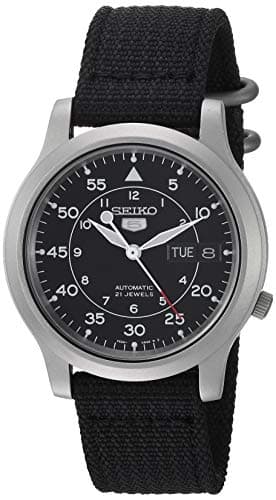
#ad · we may earn a commission from this link to Seiko 5 SNK809
Seiko 5 SNK809
SNK809K2Best for: A genuinely small mechanical watch, if the remaining-stock price is still sensible
The classic small field Seiko: 37 mm, 7S26, canvas strap. It does not hack and it does not hand-wind. Now discontinued — the 7S26 went out of production in 2019 and Seiko's US catalog no longer lists it — so remaining stock is priced by scarcity, not by Seiko. Check the live price against a 4R36 reference before paying it.
- Spec completeness for the price
- 8.0
- Movement relative to bracket
- 7.4
- Case proportions
- 9.2
- Strap flexibility
- 7.8
- Availability
- 4.0
What it gets right
- 42 mm lug-to-lug fits genuinely small wrists
- Exhibition back on a watch at this price
- Legible 24-hour inner track
What it gets wrong
- 7S26 will not hand-wind and will not hack — you cannot set it to the second
- 30 m rating means keep it out of the shower
- 18 mm lugs are a narrower strap market than 20 or 22 mm
- Discontinued and sold from remaining stock — the price is whatever the seller asks, and it no longer tracks the bracket this watch defined
Skip this one if: the live price is at or above a 4R36 Seiko 5 Sports. This was the value pick of its bracket when Seiko still made it; sold from remaining stock it frequently is not, and the SRPD93 or the 36.4 mm SBSA199 give you hacking and hand-winding for the same money or less. Skip it too if setting the watch precisely matters to you — without hacking you cannot stop the seconds hand to sync it.
| Case diameter | 37.0 mm |
|---|---|
| Lug-to-lug | 42.0 mm |
| Thickness | 11.1 mm |
| Lug width | 18 mm |
| Crystal | Hardlex (hardened mineral) |
| Water resistance | 30 m — hand-washing only, not swimming |
| Display back | Yes — exhibition caseback |
| Caliber | Seiko 7S26 |
| Type | Automatic. No hand-winding, no hacking |
| Beat rate | 21,600 vph (6 beats/sec) |
| Jewels | 21 |
| Power reserve | Approx. 41 hours |
| Stated accuracy | -20 to +40 sec/day |
| Complications | Day and date |
No buyable offer at the last check (October 23, 2026). We show nothing rather than a stale number.
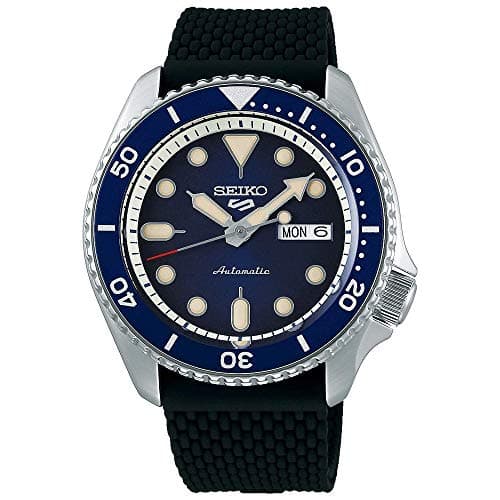
#ad · we may earn a commission from this link to Seiko 5 Sports SRPD93
Seiko 5 Sports SRPD93
SRPD93Best for: A first mechanical watch you will not outgrow
The 5KX case with a movement that hacks and hand-winds, in blue on a silicone strap. The default answer under $350, and the one most people should stop looking after.
- Spec completeness for the price
- 8.8
- Movement relative to bracket
- 8.5
- Case proportions
- 8.9
- Strap flexibility
- 9.5
- Availability
- 8.8
What it gets right
- Hacks and hand-winds — the SKX's biggest omission, fixed
- 22 mm lugs put the entire aftermarket strap catalog in play
- Day-date in a genuinely legible layout
- Case shape is the SKX profile people actually want
What it gets wrong
- Hardlex, not sapphire — it will scratch
- 100 m and no screw-down crown, so it is not an ISO 6425 diver despite the looks
- 13.4 mm thick under a shirt cuff
- Ships on a silicone strap rather than a bracelet
Skip this one if: you want an actual dive watch. The 100 m rating and the absence of a screw-down crown mean this is a dive-styled sports watch, not an ISO 6425 diver. The Turtle is the real one.
| Case diameter | 42.5 mm |
|---|---|
| Lug-to-lug | 46.0 mm |
| Thickness | 13.4 mm |
| Lug width | 22 mm |
| Crystal | Hardlex (hardened mineral) |
| Water resistance | 100 m — splash and swim, not scuba |
| Bezel | Blue unidirectional rotating |
| Dial | Blue sunray |
| Strap | Black silicone |
| Case back | See-through |
| Lume | LumiBrite |
| Caliber | Seiko 4R36 |
| Type | Automatic, hand-winding and hacking |
| Beat rate | 21,600 vph (6 beats/sec) |
| Jewels | 24 |
| Power reserve | Approx. 41 hours |
| Stated accuracy | -35 to +45 sec/day |
| Complications | Day and date |
Questions
What does the 5 in Seiko 5 stand for?
Five attributes the line guaranteed at its 1963 launch: automatic winding, a day-date display, water resistance, a recessed crown at 4 o’clock, and a durable case and bracelet.
Do current Seiko 5 watches still have all five attributes?
No, and most do not. The 5 Sports GMT references show a date with no day; the SNK-series 5s are rated 30 m, which stretches “water resistance” past its useful meaning; and plenty of current 5s place the crown at 3 rather than 4. The name now functions as a line label.
When did Seiko launch the 5?
1963. It was built as a deliberately democratic watch — a genuine automatic with a day-date at a price ordinary buyers could reach — and became one of the best-selling mechanical watch families ever made.
Is a Seiko 5 Sports the same thing as a Seiko 5?
5 Sports is a sub-line within the 5, created in 2019 when Seiko folded the discontinued SKX diver into the range. It generally means a larger case and a higher water rating than a classic 5, but it is the same tier of the catalog.
Does the Seiko 5 badge tell you the water resistance?
No, and this is the practical reason the question matters. Current Seiko 5s run from 30 m to 100 m. Read the rating for the specific reference rather than assuming the line name covers it.
Sources
- Seiko 5 Sports collection — official specifications
- Seiko Watch Corporation — US catalog and specifications
- Seiko instruction manuals and caliber documentation
Specifications are transcribed from manufacturer documentation and published standards. Where a manufacturer does not publish a figure, this page says so rather than estimating one.
Read next
- Seiko's lines explainedWhere the 5 sits against Prospex, Presage, King Seiko and Grand Seiko.
- Best Seiko 5 modelsThe references worth buying inside the line, with published specs.
- Seiko 5 vs ProspexThe same movement in two cases, and what the extra money buys.
- Seiko water resistance explainedWhy 30 m and 100 m mean genuinely different things.
- Seiko SNK809 referenceThe classic small 5, in full published detail.