Roundups
Best Seiko watches under $200
The genuine-budget tier. A real in-house mechanical watch this cheap is remarkable — as long as you know what it withholds.
By Stephen V. · Updated Sep 29, 2026 · Published Aug 8, 2026
Quick picks
| # | Watch | Key spec | Score | Price |
|---|---|---|---|---|
| 1 | 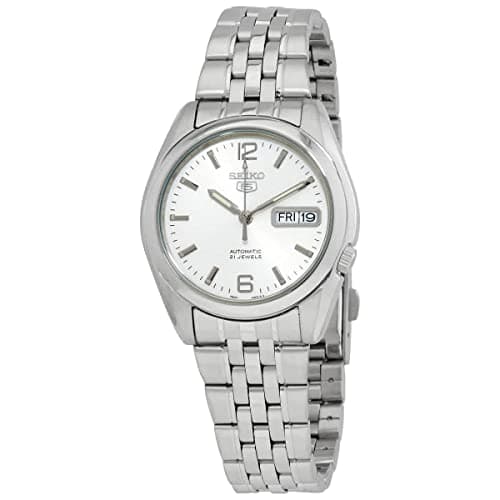 Seiko 5 SNK385SNK385K1 The white-dial Seiko 5 that keeps getting recommended as a cheap dress watch. It earns it — 37 mm, luminous applied markers, and an automatic underneath. | 37mm · 30m | 8.0out of 10, compiled from published specifications | |
| 2 | 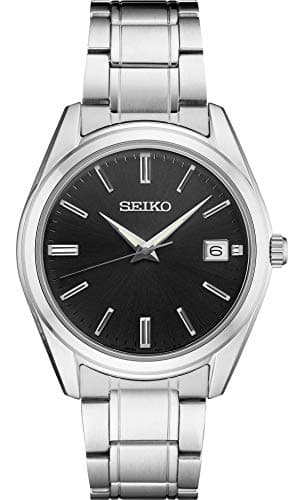 Seiko Essentials SUR311SUR311 A plain steel quartz watch that does exactly what it says. The cheapest sensible Seiko on this list and the right answer more often than people admit. | 40.2mm · quartz | 8.8out of 10, compiled from published specifications | |
| 3 | 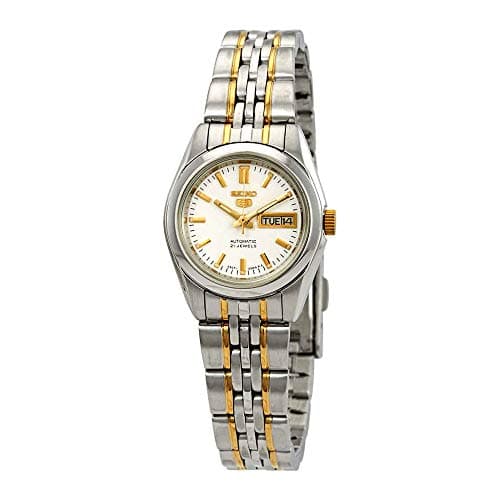 Seiko 5 SYMA35SYMA35K A 29 mm Seiko 5 automatic. Genuinely small, genuinely mechanical, and one of very few watches that is both. | 29mm · 30m | 7.9out of 10, compiled from published specifications | |
| 4 | 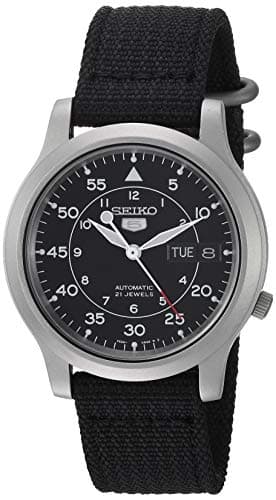 Seiko 5 SNK809SNK809K2 The classic small field Seiko: 37 mm, 7S26, canvas strap. It does not hack and it does not hand-wind. Now discontinued — the 7S26 went out of production in 2019 and Seiko's US catalog no longer lists it — so remaining stock is priced by scarcity, not by Seiko. Check the live price against a 4R36 reference before paying it. | 37mm · 30m | 7.3out of 10, compiled from published specifications | |
| 5 | 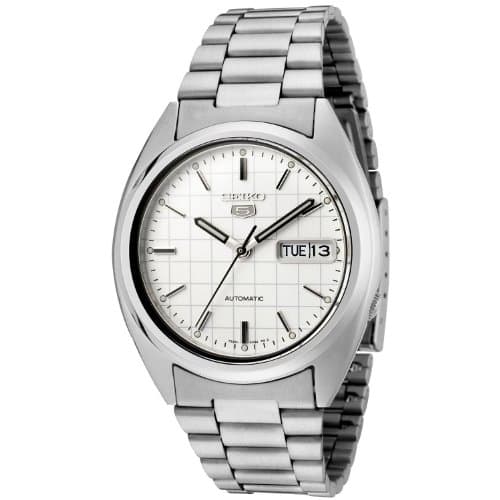 Seiko 5 SNXF05SNXF05K1 A white-dial Seiko 5 on a steel bracelet at 37 mm and 11 mm thick. The plainest mechanical watch Seiko ever sold in volume, and still findable under $200. | 37mm · 30m | 7.9out of 10, compiled from published specifications |
5 picks · Prices last verified October 23, 2026. Where no live price came back we show “Check price” rather than a number we cannot stand behind. How we pick.
Under $200 is the price at which most of the watch industry stops selling anything mechanical. Seiko does not. Four of the five picks on this page are automatics running the 7S26 — a movement Seiko designs, builds and regulates itself, and has been iterating on since the 1990s. A company putting its own mechanical caliber into a watch this cheap is genuinely unusual, and it is the entire reason this bracket is worth writing about rather than a fashion-watch aisle with second hands.
The catch is that the price is honest about what it is. Under $200 buys the movement and very little around it. Every mechanical pick here is rated 30 m, wears a Hardlex crystal, and mostly ships on a folded-link bracelet that is the first thing anyone replaces. None of those is a defect — they are the cost of the movement being real — and knowing which of them you can live with is the whole decision.
Availability, honestly
Two of the five references here are no longer made. Seiko stopped producing the 7S26 in 2019, and the SNK809 and SNXF05 have gone from its US catalog; what is still sold is remaining stock, priced by whoever holds it rather than by Seiko. The SNK809’s live price has drifted well past this bracket as a result; the SNXF05’s has not, and it is still listed under $200. Both stay on the page because they are the references this bracket was built around — but the SNK809 is the one to check before you trust its reputation. Check the live price on each card; the number, not the reputation, decides which of these is still a budget watch.
What the 7S26 is, and what it withholds
The 7S26 is a genuine automatic: a rotor winds a mainspring as your wrist moves, and the watch runs from that stored energy for roughly 41 hours off the wrist. It beats at 21,600 vibrations per hour, carries a day-date on most references, and is about as durable as an entry-level movement gets — the reason these watches turn up running decades later.
What it withholds is two conveniences. It does not hand-wind: there is no way to wind it from the crown, so a stopped watch is restarted by shaking it or putting it on and moving for a while. And it does not hack: the seconds hand keeps sweeping while you set the time, so you can get within ten or fifteen seconds of a reference and no closer. Neither matters if you wear one watch daily; both begin to matter if you rotate several or set your watches to the second. The full caliber page covers the behavior in detail.
The three limits you are accepting
A 30 m water rating. Four of these are rated 30 m, and under ISO 22810 that is a static pressure test, not a swimming certification. Treat it as hand-washing and rain. It is emphatically not a shower or a pool, and the gaskets that hold even that rating are old on some references. If the watch needs to get wet, only the quartz SUR311 on this page qualifies.
Hardlex, not sapphire — on every mechanical pick here.Only the quartz SUR311 ships sapphire; the four automatics all use Seiko’s hardened mineral crystal. Hardlex sits far below sapphire on the hardness scale and picks up scratches from ordinary contact — a desk edge, a doorframe — over months. It also chips less readily than sapphire under a sharp knock, which is the trade nobody mentions, but on the mechanical picks at this price the plain fact is that the crystal will mark.
Folded-link bracelets. Where these ship on a bracelet, it is folded steel rather than solid links, and it rattles and pinches in a way solid bracelets do not. This is the single easiest thing to fix and the cheapest upgrade with the largest effect on how the watch feels.
The quartz exception
The SUR311 is the one pick here that is not mechanical, and it quietly outperforms everything else on the page at the things a watch is for. It is rated 100 m, so it swims. It is 8.36 mm thick, where the automatics run 10.5 to 11 mm and wear taller. And a quartz movement keeps time to a standard the 7S26 cannot approach — the mechanical picks can drift most of a minute a day and remain in specification.
It is on this list because leaving it off would be dishonest. If you cannot articulate why you want a mechanical watch, the SUR311 is the better buy, and the only thing it lacks is the movement you could not explain wanting. If you can articulate it, buy one of the automatics without guilt — but make that an actual choice rather than a default.
The size no one expects
These are small watches, and that has quietly become an advantage. The picks run from 29 mm (SYMA35) through 37 mm (SNK809, SNK385, SNXF05) to 40.2 mm (SUR311). For most of the last two decades almost nothing was built under 40 mm, and a 37 mm case now reads as correct rather than small — it was the standard men’s size for most of the twentieth century. If a 42 mm watch has always felt faintly wrong on you, the cases here are part of why these references keep getting recommended. The small-wrist page sorts the whole catalog on this.
Why a budget Seiko outlasts watches that cost more
The 7S26 is built to a tolerance that assumes it will be neither serviced often nor treated gently, and it is famously forgiving of both. There is no delicate finishing to spoil and no exotic parts to source, which is why a fifteen-year-old SNK809 pulled from a drawer usually starts on the first shake. Three of these — the SNK809, the SNK385 and the SYMA35 — even carry an exhibition caseback, so the movement doing that work is visible, which is a strange luxury to find under $200.
None of that makes them precise or waterproof or scratch-resistant, and it is worth resisting the forums that talk about these watches as though they punch above every weight. They punch above one specific weight — mechanical movement per dollar — and they are ordinary or worse on crystal, water resistance and bracelet. Bought for the thing they are good at, they are close to unbeatable. Bought expecting an all-rounder, they disappoint in exactly predictable ways.
Where each pick makes sense
The SNK385 is the SNK809’s dress-leaning sibling: a white dial that rewards a leather strap and a jacket. The SNK809 itself is the default budget field watch — the one to buy if you want the archetype and a canvas strap — if you can still find it at budget money, which its remaining-stock pricing no longer guarantees. The SNXF05 trades the field look for a steel bracelet and a plain white dial in the same 37 mm case. Those two carry the bracket’s real catch, and it is worth planning around rather than discovering at checkout: both are remaining stock, and their availability rotates— across our last twelve price checks the SNK385 carried a live offer in two and the SNXF05 in four. The live table at the top of this page is the only honest arbiter of which is orderable today. The SYMA35 is the outlier for genuinely small wrists at 29 mm, mechanical where almost nothing that size is, and it has been the most consistently orderable mechanical watch here. And the SUR311 is the one to buy when you have read all of the above and quietly concluded you would rather the watch just kept time — which is a more common conclusion than the hobby admits. None of these is the wrong answer; they are five different right answers to five slightly different questions about size, dial and movement.
| Reference | Movement | Water rating | The catch |
|---|---|---|---|
| SNK385 | 7S26 auto | 30 m | Dress-leaning, 30 m rules out swimming |
| SUR311 | Quartz | 100 m | Not mechanical — the trade for everything else |
| SYMA35 | 7S26 auto | 30 m | 29 mm reads small on a larger wrist |
| SNK809 | 7S26 auto | 30 m | Discontinued; remaining-stock price often above the bracket |
| SNXF05 | 7S26 auto | 30 m | Discontinued; remaining stock, still listed under $200 |
Two ways to widen this bracket. Dropping the Seiko-only rule brings in the Casio Duro and the rest of the Japanese field — best Japanese watches under $200 ranks them together. Buying pre-owned brings the bigger Seikos into range, with the caveats worked through in buying a used Seiko.
The bracket below this one is worth a paragraph of its own, because the honest answer is structural rather than a shorter list: is there a good Seiko under $100explains why running an in-house movement factory sets a floor above that number, and where Seiko’s real mechanical and quartz floors actually sit.
The picks in full
Specifications are transcribed from Seiko’s published documentation. Prices come from Amazon and carry the date they were verified. We have not handled these watches — here is what we did instead.
No buyable offer at the last check (October 23, 2026). We show nothing rather than a stale number.
#ad · we may earn a commission from this link to Seiko 5 SNK385
Seiko 5 SNK385
SNK385K1Best for: A first dress-leaning mechanical watch
The white-dial Seiko 5 that keeps getting recommended as a cheap dress watch. It earns it — 37 mm, luminous applied markers, and an automatic underneath.
- Spec completeness for the price
- 8.1
- Movement relative to bracket
- 7.4
- Case proportions
- 9.0
- Strap flexibility
- 7.6
- Availability
- 8.0
What it gets right
- Clean white dial that suits a strap change
- 37 mm
- Exhibition back
What it gets wrong
- 7S26 — no hacking, no hand-winding
- 30 m
- Seiko no longer publishes a full spec sheet for the SNK series
Skip this one if: you need one watch for everything. At 30 m this cannot be a swim watch, so it works as a second watch rather than an only watch.
| Case diameter | 37 mm |
|---|---|
| Lug-to-lug | Not published by Seiko for this reference |
| Thickness | 11 mm |
| Lug width | Not published by Seiko for this reference |
| Crystal | Hardlex (hardened mineral) |
| Water resistance | 30 m |
| Display back | Yes — exhibition caseback |
| Caliber | Seiko 7S26 |
| Type | Automatic. No hand-winding, no hacking |
| Beat rate | 21,600 vph (6 beats/sec) |
| Jewels | 21 |
| Power reserve | Approx. 41 hours |
| Stated accuracy | -20 to +40 sec/day |
| Complications | Day and date |
$265.0019% off
Price as of October 23, 2026. Prices move — Amazon's is the one that counts.
#ad · we may earn a commission from this link to Seiko Essentials SUR311
Seiko Essentials SUR311
SUR311Best for: A no-fuss everyday watch under $200
A plain steel quartz watch that does exactly what it says. The cheapest sensible Seiko on this list and the right answer more often than people admit.
- Spec completeness for the price
- 8.7
- Movement relative to bracket
- 8.0
- Case proportions
- 9.2
- Strap flexibility
- 9.2
- Availability
- 8.9
What it gets right
- 8.36 mm thick — it disappears under a cuff
- 100 m on a dress-adjacent watch is unusually generous
- Sapphire at a price where Seiko normally fits Hardlex
What it gets wrong
- Battery replacement every few years
- No exhibition back and nothing mechanical to look at
Skip this one if: you want a mechanical watch. That is a legitimate reason to spend more, but be honest that it is the reason — this keeps better time than anything else on this list.
| Case diameter | 40.2 mm |
|---|---|
| Lug-to-lug | Not published by Seiko for this reference |
| Thickness | 8.36 mm |
| Lug width | 20 mm |
| Crystal | Sapphire |
| Water resistance | 100 m (10 bar) |
| Caliber | Seiko 6N52 quartz, battery-powered |
| Stated accuracy | ±15 sec/month |
| Battery life | Approx. 3 years |
| Dial | Black |
| Complications | Date |
Price as of October 23, 2026. Prices move — Amazon's is the one that counts.
#ad · we may earn a commission from this link to Seiko 5 SYMA35
Seiko 5 SYMA35
SYMA35KBest for: A small mechanical watch for a small wrist
A 29 mm Seiko 5 automatic. Genuinely small, genuinely mechanical, and one of very few watches that is both.
- Spec completeness for the price
- 7.7
- Movement relative to bracket
- 7.4
- Case proportions
- 9.0
- Strap flexibility
- 7.4
- Availability
- 8.0
What it gets right
- 29 mm and mechanical — a combination almost nobody else offers new
- Exhibition caseback
- Automatic at a quartz price
What it gets wrong
- 7S26 does not hack or hand-wind
- 30 m
- Small dial is harder to read
Skip this one if: you want to set the time precisely. The 7S26 has no hacking, so syncing it to the second is not possible.
| Case diameter | 29 mm |
|---|---|
| Lug-to-lug | Not published by Seiko for this reference |
| Thickness | Not published by Seiko for this reference |
| Crystal | Hardlex |
| Water resistance | 30 m |
| Display back | Yes — exhibition caseback |
| Caliber | Seiko 7S26 |
| Type | Automatic. No hand-winding, no hacking |
| Beat rate | 21,600 vph (6 beats/sec) |
| Jewels | 21 |
| Power reserve | Approx. 41 hours |
| Stated accuracy | -20 to +40 sec/day |
| Complications | Day and date |
$359.009% off
Price as of October 23, 2026. Prices move — Amazon's is the one that counts.
#ad · we may earn a commission from this link to Seiko 5 SNK809
Seiko 5 SNK809
SNK809K2Best for: A genuinely small mechanical watch, if the remaining-stock price is still sensible
The classic small field Seiko: 37 mm, 7S26, canvas strap. It does not hack and it does not hand-wind. Now discontinued — the 7S26 went out of production in 2019 and Seiko's US catalog no longer lists it — so remaining stock is priced by scarcity, not by Seiko. Check the live price against a 4R36 reference before paying it.
- Spec completeness for the price
- 8.0
- Movement relative to bracket
- 7.4
- Case proportions
- 9.2
- Strap flexibility
- 7.8
- Availability
- 4.0
What it gets right
- 42 mm lug-to-lug fits genuinely small wrists
- Exhibition back on a watch at this price
- Legible 24-hour inner track
What it gets wrong
- 7S26 will not hand-wind and will not hack — you cannot set it to the second
- 30 m rating means keep it out of the shower
- 18 mm lugs are a narrower strap market than 20 or 22 mm
- Discontinued and sold from remaining stock — the price is whatever the seller asks, and it no longer tracks the bracket this watch defined
Skip this one if: the live price is at or above a 4R36 Seiko 5 Sports. This was the value pick of its bracket when Seiko still made it; sold from remaining stock it frequently is not, and the SRPD93 or the 36.4 mm SBSA199 give you hacking and hand-winding for the same money or less. Skip it too if setting the watch precisely matters to you — without hacking you cannot stop the seconds hand to sync it.
| Case diameter | 37.0 mm |
|---|---|
| Lug-to-lug | 42.0 mm |
| Thickness | 11.1 mm |
| Lug width | 18 mm |
| Crystal | Hardlex (hardened mineral) |
| Water resistance | 30 m — hand-washing only, not swimming |
| Display back | Yes — exhibition caseback |
| Caliber | Seiko 7S26 |
| Type | Automatic. No hand-winding, no hacking |
| Beat rate | 21,600 vph (6 beats/sec) |
| Jewels | 21 |
| Power reserve | Approx. 41 hours |
| Stated accuracy | -20 to +40 sec/day |
| Complications | Day and date |
No buyable offer at the last check (October 23, 2026). We show nothing rather than a stale number.
#ad · we may earn a commission from this link to Seiko 5 SNXF05
Seiko 5 SNXF05
SNXF05K1Best for: A first mechanical watch on a bracelet, under $200
A white-dial Seiko 5 on a steel bracelet at 37 mm and 11 mm thick. The plainest mechanical watch Seiko ever sold in volume, and still findable under $200.
- Spec completeness for the price
- 7.8
- Movement relative to bracket
- 7.4
- Case proportions
- 9.0
- Strap flexibility
- 7.6
- Availability
- 7.9
What it gets right
- 37 mm and 11 mm thick — normally proportioned rather than a modern slab
- Steel bracelet included
- Plain white dial with applied markers, which suits a strap change
What it gets wrong
- 7S26 does not hack or hand-wind
- 30 m
- 19 mm lug width — an awkward size in the aftermarket, where 18, 20 and 22 mm dominate
Skip this one if: you intend to change straps often. At 19 mm the aftermarket is noticeably thinner than at 18 or 20 mm, so in practice you keep the bracelet it arrives on.
| Case diameter | 37 mm (excluding crown) |
|---|---|
| Lug-to-lug | Not published by Seiko for this reference |
| Thickness | 11 mm |
| Lug width | 19 mm |
| Crystal | Hardlex (hardened mineral) |
| Water resistance | 30 m |
| Dial | White |
| Case and bracelet | Stainless steel |
| Caliber | Seiko 7S26 |
| Type | Automatic. No hand-winding, no hacking |
| Beat rate | 21,600 vph (6 beats/sec) |
| Jewels | 21 |
| Power reserve | Approx. 41 hours |
| Stated accuracy | -20 to +40 sec/day |
| Complications | Day and date |
How to choose under $200
Start with whether it ever gets wet
This one question removes four of the five picks. If the watch will be on your wrist in a shower, a pool or the sea, the 30 m automatics are out no matter how much you like them, and the only pick left is the 100 m quartz SUR311. There is no way around this at the price — a swim-safe mechanical Seiko starts a bracket up, in the under-$300 range, where the 100 m 5 Sports references live.
Then measure your wrist across the top
Put a ruler across the top of your wrist, edge to edge, where the watch sits. That figure in millimeters is roughly the longest lug-to-lug you can wear without the lugs overhanging. The picks here are small — a 29 mm SYMA35 will look like a vintage dress watch on a 7.5-inch wrist, and a 37 mm SNK809 is about as large as this page goes. If you want more presence than that, the budget tier is the wrong page and a larger 5 Sports reference is the answer.
Decide about the bracelet before you fall for a dial
The folded bracelets here are the weakest component on every watch that has one. The good news is that this is the cheapest problem in watches to solve: a nylon strap costs a rounding error against the watch and changes how it wears more than any dial variant does. Budget for one from the start and buy whichever reference has the dial you actually want — see the strap roundup for what fits.
Be honest about hacking
You do not get it here, on any of the automatics. Most people who say they need it never once set a watch against a time signal, and if that is you, the absence costs you nothing. If you genuinely set your watches to the second, or you will rotate several and dislike shaking a stopped one awake, accept now that this bracket cannot give you that and step up to a movement that can — the 4R36 in the next bracket up hacks and hand-winds.
Take the quartz option seriously
The SUR311 keeps far better time than any mechanical pick here, is the thinnest watch on the page, and is the only one you can swim in. The instinct to dismiss quartz as the lesser choice is worth examining rather than obeying. If the reason you want mechanical is that mechanical watches are interesting to you, that is a real and sufficient reason, and you should buy the automatic. If you cannot find that reason when you look for it, the quartz is quietly the smarter buy and there is no shame in it.
Do not over-research a cheap watch
The budget tier attracts a disproportionate amount of forum analysis relative to what is at stake, and it is easy to spend more hours choosing than the price difference between any two picks could ever justify. The honest shortcut: pick the size that fits and the dial you like, accept the strap upgrade, and buy. Every reference here is a competent watch bought for the right reason, and the differences between them are smaller than the agonizing implies.
Buy from a seller who honors the warranty
At this price the watch itself is a small outlay, but a gray-market example with no warranty and an unknown history is a false economy when a sealed, warrantied one costs little more. Buy from a seller who honors Seiko’s warranty, keep the papers, and you have a watch that can be serviced and authenticated later. The budget tier is exactly where people cut this corner and exactly where a dead movement is most annoying to chase, because the repair can approach the price of the watch.
Do not expect finishing to match the movement
The one place these watches feel their price is the details around the movement — printed rather than applied markers on some references, a hollow end-link, a clasp that stamps shut rather than clicking. None of it affects how the watch runs, and all of it is normal at the price. Noticing it is fine; letting it talk you into spending three times as much for a slightly crisper bezel edge is how a budget purchase quietly stops being one.
What these numbers cannot tell you
How the dial catches light, whether the folded bracelet pinches your particular wrist, how the canvas strap softens. We have not handled these watches and will not pretend the specification captures everything — it gets you to a shortlist of two, and the last step, if you can manage it, is seeing one in person. At this price, though, the downside of a wrong guess is small, which is part of what makes the budget tier a good place to make a first mistake.
Questions
Is a real automatic watch under $200 too good to be true?
No — it is real, and it is possible because Seiko manufactures its own movements at scale. The 7S26 has no delicate finishing and no exotic parts, so Seiko can build, regulate and warranty it at a price almost nobody else matches on a mechanical caliber. The compromises are elsewhere: the crystal, the 30 m rating and the bracelet, not the movement.
Can I swim with a Seiko rated 30 m?
No. A 30 m rating under ISO 22810 is a static pressure test, not a swimming certification, and on an older reference the gaskets may be well past their best. Hand-washing and rain are fine; a pool or a shower is not. The only swim-safe pick on this page is the 100 m quartz SUR311.
Why won't the SNK809 hand-wind?
Because the 7S26 has no hand-winding mechanism — it was engineered down to a price, and that feature was one of the things left out. You restart a stopped one by shaking it for half a minute or wearing it and moving. If hand-winding matters to you, the 4R36 in the next bracket up adds it.
Is the quartz SUR311 a downgrade from the automatics?
Only if the mechanical movement is the point for you. On every objective measure — accuracy, water resistance, thickness — the SUR311 beats the automatics here. What it lacks is the automatic movement itself, which is a legitimate thing to want, but worth wanting on purpose rather than by default.
Are these watches too small for a man?
They are small by recent habit, not by history — 37 mm was a standard men’s size for most of the twentieth century, and the 42 mm norm is a fairly recent swing. On wrists under about 7 inches the SNK809 and SNK385 sit beautifully; the 29 mm SYMA35 is genuinely small and better suited to the smallest wrists.
Sources
- Seiko 5 Sports collection — official specifications
- Seiko Watch Corporation — US catalog and specifications
- ISO 22810 — Horology, water-resistant watches (standard listing)
- Seiko instruction manuals and caliber documentation
Specifications are transcribed from manufacturer documentation and published standards. Where a manufacturer does not publish a figure, this page says so rather than estimating one.
Read next
- Best Seiko watches under $300The next rung up, where the movement gains hacking and hand-winding.
- Seiko 7S26 caliber referenceThe movement in four of the five picks, and exactly what it does not do.
- Best Seiko for small wristsThese are small cases; this page ranks the whole catalog on fit.
- Best Seiko field watchesWhere the SNK809's field styling fits into the wider category.