Head-to-head
Seiko Diver vs Citizen Promaster
The biggest cross-brand diver decision under $500: a Seiko mechanical against Citizen's automatic and its very mature Eco-Drive. It turns on one question.
By Stephen V. · Updated Aug 8, 2026
This is the diver decision most people actually face: a Seiko on one side, a Citizen Promaster on the other, both rated 200 m, both under the same ceiling. Citizen makes the choice harder by offering it two ways — a mechanical automatic and an Eco-Drive solar quartz — so the real comparison is three watches, not two. The Seiko is the Turtle SRPE99. Citizen fields the Promaster Dive Automatic NY0129 and the Promaster Dive Eco-Drive.
| Seiko Turtle SRPE99 | Promaster Dive Automatic NY0129 | Promaster Dive Eco-Drive | |
|---|---|---|---|
| Movement | Seiko 4R36 automatic | Citizen 8204 automatic | Eco-Drive solar quartz |
| Beat rate | 21,600 vph | 21,600 vph | — (quartz) |
| Complications | Day-date | Day-date | Not published |
| Case diameter | 45.0 mm | 41.0 mm | 44 mm |
| Lug-to-lug | 47.7 mm | Not published | Not published |
| Thickness | 13.4 mm | 13.0 mm | Not published |
| Crystal | Hardlex | Not published | Mineral |
| Water resistance | 200 m, ISO 6425 | 200 m, ISO-certified | 200 m, ISO-compliant |
| Crown | Screw-down | Screw-down | Screw-down |
| Strap | Not published | Urethane (rubber) | Polyurethane |
| Battery | None (mechanical) | None (mechanical) | None (solar) |
The one question that decides it
Do you want the watch to be mechanical?That is the whole decision, and it splits three ways. If yes, the answer narrows to the Seiko Turtle or the Citizen Promaster Dive Automatic, and Seiko’s deeper mechanical range, aftermarket and resale tilt it toward the Turtle. If you do not care whether it is mechanical, the Eco-Drive is the better instrument — a light-powered movement that never needs a battery and keeps far tighter time than any automatic here.
Everything else is a refinement of that answer. Get the mechanical-or-not question right and the rest is detail.
Where Citizen genuinely wins
Eco-Drive is the most mature light-powered platform anyone sells — decades of iteration, no battery replacement ever, and quartz accuracy that leaves a mechanical movement far behind. As a pure timekeeping tool the Promaster Dive Eco-Drive is simply the better watch, and Citizen usually prices it below the equivalent Seiko. The NY0129, for its part, is a competent mechanical diver that typically undercuts the Turtle on price for a similar 200 m specification. If cost per unit of capability is how you score, Citizen tends to win the line.
Where Seiko genuinely wins
Seiko wins on everything around the watch. The aftermarket for dials, hands, bezel inserts and cases is built around Seiko cases and its movements, and has been for two decades; Citizen has almost none of that. Resale is stronger on named Seiko references than on most Citizen ones. And Seiko publishes more: the Turtle has a case diameter, a lug-to-lug and a thickness on this site, where the Citizen entries read “not published in the retail listing.” If lug-to-lug is how you decide whether a watch fits, that asymmetry is a real cost of buying Citizen — see the fuller Seiko vs Citizen comparison for how that plays out across the range.
The solar-versus-mechanical trade, plainly
An Eco-Drive keeps quartz time and never asks anything of you; you will not wind it, set it often, or replace a battery. A 4R36 in the Turtle is a mechanical object that runs fast or slow by a matter of seconds a day, needs winding or wearing to stay alive, and is the entire reason some people buy a watch at all. Neither is a mistake. The Eco-Drive is the better tool; the automatic is the better toy, in the most respectful sense of the word. Deciding which sentence you agree with is the comparison.
The certification detail
The Turtle carries an ISO 6425 dive marking; the NY0129 is listed as ISO certified; the Promaster Dive Eco-Drive is described as ISO-compliant. For recreational use all three are genuine dive-capable watches, and the wording differs more than the capability does. If a formal ISO 6425 certification specifically matters to you, the Turtle states it outright — the water-resistance guide explains what that marking tests and what “compliant” does and does not promise.
The cons on each side
None of the three is beyond criticism. The Turtle scratches, thanks to Hardlex, runs a 41-hour reserve that punishes being set down, and is a large 45 mm watch. The NY0129’s drawback is geometry: at 50 mm lug-to-lug it spans more wrist than the 45 mm Turtle does despite being 4 mm narrower, and it is the thicker of the two at 13.7 mm. The Eco-Drive’s catch is philosophical for some and practical for others — it is quartz, so there is no rotor to enjoy and no mechanical soul to it, and its polyurethane strap has a plain-tool feel. Each of these is a fair price for what the watch does well; none of them is hidden.
Worth flagging too: this comparison is asymmetric on data, not just on movement. Seiko and Citizen both publish the two automatics’ dimensions in full, but the Eco-Drive is listed with far less detail, so part of choosing it is accepting that you will confirm fewer numbers before the watch arrives. That is not a flaw in the watch; it is a flaw in the paperwork, and for a mail-order purchase, where you cannot try the watch on first, it is a real one that the specification sheet alone will not warn you about.
Buy the Seiko Turtle if
You want a mechanical watch, you might change straps or eventually mod it, and you want the shorter lug-to-lug of the two automatics. You value the ISO 6425 marking and the stronger resale. It is the enthusiast’s pick of the three — see the Turtle reference and the wider Seiko dive field.
Buy the Citizen Promaster if
Buy the Eco-Drive if you want a diver that keeps accurate time and never needs winding or a battery, and you are not attached to the movement being mechanical — it is the better daily instrument and usually the cheaper one. Buy the Promaster Dive Automatic NY0129 if you want mechanical but prefer Citizen’s case and price, and you are comfortable buying a 41 mm case whose lug-to-lug Citizen does not publish.
The watches on this page
Specifications are transcribed from Seiko’s published documentation. Prices come from Amazon and carry the date they were verified. We have not handled these watches — here is what we did instead.
No buyable offer at the last check (October 23, 2026). We show nothing rather than a stale number.
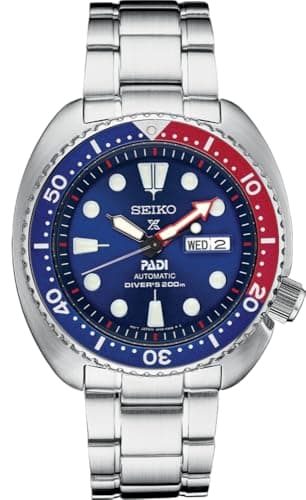
#ad · we may earn a commission from this link to Seiko Prospex Turtle SRPE99
Seiko Prospex Turtle SRPE99
SRPE99K1Best for: An actual dive watch you can also wear daily
A real 200 m ISO-rated diver with a screw-down crown, in the cushion case that wears far smaller than its 45 mm suggests.
- Spec completeness for the price
- 9.0
- Movement relative to bracket
- 8.5
- Case proportions
- 8.8
- Strap flexibility
- 9.5
- Availability
- 8.6
What it gets right
- Genuine ISO 6425 diver, not a diver-styled sports watch
- 47.7 mm lug-to-lug means it fits wrists that 45 mm suggests it should not
- Screw-down crown at 4 o'clock keeps it off the back of your hand
What it gets wrong
- Hardlex on a watch at this price is the recurring Seiko complaint
- The 45 mm figure scares people off before they try one
- PADI co-branding on the dial is not for everyone
Skip this one if: you have a wrist under about 6.5 inches. The lug-to-lug is forgiving but the case is still visually wide, and the smaller SRPG references exist for exactly this reason.
| Case diameter | 45.0 mm (cushion case) |
|---|---|
| Lug-to-lug | 47.7 mm |
| Thickness | 13.4 mm |
| Lug width | 22 mm |
| Crystal | Hardlex (hardened mineral) |
| Water resistance | 200 m, ISO 6425 rated for scuba diving |
| Crown | Screw-down, at 4 o'clock |
| Bezel | Unidirectional elapsed-timing bezel, PADI red and blue |
| Lume | LumiBrite on hands and markers |
| Bracelet | Steel, three-fold clasp with push-button release |
| Caliber | Seiko 4R36 |
| Type | Automatic, hand-winding and hacking |
| Beat rate | 21,600 vph (6 beats/sec) |
| Jewels | 24 |
| Power reserve | Approx. 41 hours |
| Stated accuracy | -35 to +45 sec/day |
| Complications | Day and date |
Price as of October 23, 2026. Prices move — Amazon's is the one that counts.
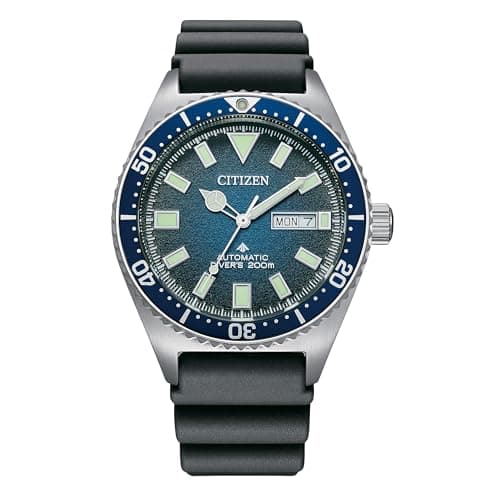
#ad · we may earn a commission from this link to Citizen Promaster Dive Automatic NY0129
Citizen Promaster Dive Automatic NY0129
NY0129-07LBest for: A 200 m Japanese automatic diver at the lowest price
Citizen's automatic answer to the Turtle: an ISO 6425 200 m diver on Citizen's own 8204, on rubber, usually undercutting Seiko on price.
- Spec completeness for the price
- 8.6
- Movement relative to bracket
- 8.8
- Case proportions
- 8.4
- Strap flexibility
- 8.0
- Availability
- 8.6
What it gets right
- ISO 6425 certified 200 m diver at a price below most Seiko divers
- Day-date, a screw-down crown and a lumed unidirectional bezel
- Citizen publishes a stated daily rate, which Seiko does not for the 4R at this price
What it gets wrong
- Ships on urethane rather than a bracelet
- Citizen does not publish the crystal material or a lug-to-lug figure
- 13 mm thick
Skip this one if: you want a steel bracelet in the box. This reference ships on a black urethane strap, and Citizen does not publish a lug-to-lug figure to size an aftermarket one from.
| Brand | Citizen |
|---|---|
| Case diameter | 41 mm |
| Lug-to-lug | Not published by Seiko for this reference |
| Thickness | 13 mm |
| Case material | Stainless steel |
| Crystal | Crystal glass — Citizen does not publish the material |
| Water resistance | 200 m (20 bar), ISO 6425 certified |
| Movement | Citizen 8204 automatic |
| Power reserve | Approx. 42 hours |
| Stated accuracy | -20 to +40 sec/day |
| Crown | Screw-down |
| Bezel | Unidirectional rotating diver's bezel |
| Strap | Black urethane (rubber) |
| Dial | Blue |
| Complications | Day and date |
$450.0034% off
Price as of October 23, 2026. Prices move — Amazon's is the one that counts.
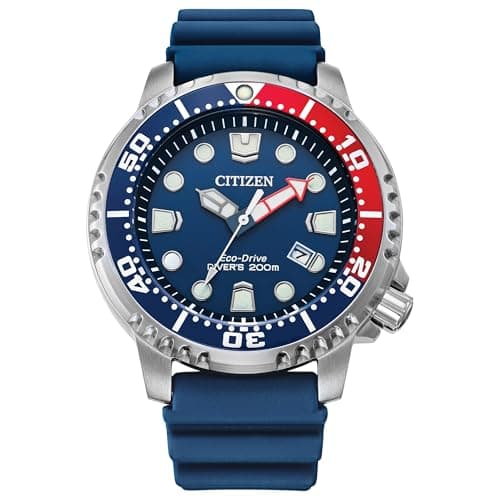
#ad · we may earn a commission from this link to Citizen Promaster Dive Eco-Drive
Citizen Promaster Dive Eco-Drive
BN0168-06LBest for: A light-powered ISO diver you never service on a schedule
The solar diver that most directly rivals Seiko's SNE line. Eco-Drive is the most mature light-powered platform anyone sells.
- Spec completeness for the price
- 8.5
- Movement relative to bracket
- 8.6
- Case proportions
- 8.1
- Strap flexibility
- 8.4
- Availability
- 8.7
What it gets right
- Eco-Drive has a longer track record than any competing solar platform
- 200 m ISO-compliant rating
- No winding and no battery
What it gets wrong
- Quartz tick
- Polyurethane strap
- No exhibition back
Skip this one if: the movement being mechanical is the point of the purchase. This is the better watch on every measurable axis and the wrong watch if that is what you want.
| Brand | Citizen |
|---|---|
| Case diameter | 44 mm |
| Lug width | 20 mm |
| Crystal | Mineral |
| Water resistance | 200 m, ISO compliant, screw-down crown |
| Movement | Citizen Eco-Drive E168, light-powered quartz |
| Stated accuracy | ±15 sec/month |
| Power reserve | Approx. 6 months from full charge |
| Strap | Polyurethane |
| Charge | Runs on any light source; no battery replacement |
Where it is genuinely a coin flip
The two automatics — the Turtle and the NY0129 — are close enough on paper that case shape and dial preference can reasonably decide it, provided the 50 mm lug-to-lug fits you. If you will never mod or resell, the Citizen’s lower price is a real argument. If you might do either, the Seiko’s ecosystem is worth the difference. There is no wrong answer between two 200 m automatics this similar.
The Eco-Drive sits outside that flip. It is not competing with the automatics on the same axis at all — it is a different kind of watch that happens to share a water rating, and it wins or loses entirely on whether you want mechanical. Do not let its accuracy talk you out of an automatic if an automatic is what you actually wanted.
If you are still torn, let the strap and your servicing habits break the tie. All three run without a battery — two mechanical, one solar — so none saddles you with cell changes, but only the Eco-Drive frees you from winding and setting as well. Against that, the two automatics reward attention in a way the Eco-Drive never will, and reward the aftermarket and resale that only the Seiko fully enjoys. The Turtle is the enthusiast’s answer, the Eco-Drive the pragmatist’s, and the Sea Automatic the value-minded middle — and there is no wrong seat at that table, only the one that matches how you actually want to live with a watch day to day.
Questions
Is the Seiko Turtle better than a Citizen Promaster?
Not in general. The Turtle wins on aftermarket support, resale and published dimensions; Citizen wins on price and, with Eco-Drive, on timekeeping and never needing a battery. The decision turns on whether you want a mechanical watch, not on which brand is better.
Is Eco-Drive better than a Seiko automatic for a diver?
As a timekeeping tool, clearly — it is quartz-accurate and never needs winding or a battery. As a mechanical object it is not competing at all, which is the whole point for buyers who specifically want an automatic like the Turtle’s 4R36.
Why does Citizen not publish case dimensions?
Citizen tends to disclose less dimensional detail than Seiko in its retail listings, which is why the Promaster entries here read “not published” where the Turtle has figures. If lug-to-lug is how you judge fit, that missing data is a genuine drawback of buying Citizen sight-unseen.
Are all three watches really 200 m?
Yes. The Turtle is 200 m and ISO 6425 marked, the Promaster Dive Eco-Drive is 200 m and described as ISO-compliant, and the NY0129 is listed as ISO certified. All three are genuine recreational dive watches; the difference is in certification wording, not depth rating.
Which holds its value best?
The Seiko, generally. Named Seiko references have an active secondary market that most Citizen references do not, so you tend to recover more of a Turtle if you sell it than either Promaster.
Sources
- Seiko Prospex collection — official specifications
- ISO 6425 — Horology, divers' watches (standard listing)
- Citizen Watch Company — official specifications
Specifications are transcribed from manufacturer documentation and published standards. Where a manufacturer does not publish a figure, this page says so rather than estimating one.