Answers
Seiko model numbers explained
Three different numbers, one of them printed on the watch and the other two not. Here is which is which, and the decoding myth to drop.
By Stephen V. · Updated Oct 17, 2026
A Seiko carries three numbers that get called the “model number”. The reference— SRPD65K1, SPB103J1 — is how the watch is sold, and it is usually not printed on the watch at all. The caliber-case codeon the case back — 4R36-07G0 — is the authoritative identifier: the first part is the movement, the second is the case. The serial number, also on the back, encodes when it was made. If you are trying to identify a watch in your hand, use the case back.
Almost every frustrating Seiko search comes from these three being used interchangeably. Someone reads about an “SRPD65”, turns their own watch over, finds “4R36-07G0” and concludes they have a different watch. They may well have the same one. These are two naming systems describing the same object from different ends — one for selling it, one for servicing it.
The three numbers, and where each lives
| Number | Example | Where it is | What it tells you |
|---|---|---|---|
| Reference | SPB103J1 | Box, papers, listings — rarely the watch | Which product this is, as Seiko sells it |
| Caliber-case code | 4R36-07G0 | Engraved on the case back | The movement, then the case. The identifier a watchmaker uses. |
| Serial number | Six characters | Engraved on the case back | Roughly when it was made |
| Caliber alone | 4R36, 6R35, V198 | Case back, sometimes the dial | The movement family and its published specification |
For the serial number specifically, the decoding is its own small discipline and we have a page for it: the serial number lookup explains how the first two characters give you a year and a month, and the limits of that method.
Reading the caliber-case code, which is the useful one
Take 4R36-07G0. Everything before the hyphen is the caliber: 4R36, one of Seiko’s automatic movement families, with a published specification you can look up — 41 hours of reserve, −35 to +45 seconds a day, day and date, hacking and hand-winding. Everything after the hyphen is Seiko’s code for the case this movement was fitted into. Together they identify the watch for service purposes better than the reference does, because they describe the two things a watchmaker needs to order parts for.
This is also the quickest way to learn something real about a watch you are considering secondhand. A case-back caliber of 7S26 tells you immediately that the movement does not hack or hand-wind and that it is remaining stock rather than current production; a 6R35 tells you to expect a 70-hour reserve and a tighter stated rate. The reference number tells you none of that until you look it up. 4R36 versus 6R35 has both datasheets.
The decoding myth: the prefix does not tell you the line
There are a great many “Seiko prefix decoder” tables online claiming that the first letters identify the collection. They do not, and this site’s own registry disproves it in one line. All three of these share the SRP prefix and belong to three different Seiko lines:
- SRPB43 — a Presage Cocktail Time dress watch.
- SRPD93 — a Seiko 5 Sports diver-styled automatic.
- SRPE99 — a Prospex 200 m ISO 6425 diver.
Seiko has never published a public key to its reference prefixes, and the patterns that do exist are conventions rather than rules — they shift between generations and regions. What follows is therefore described honestly as patterns observed across the references this site tracks, not as a decoder:
| Prefix pattern | Observed in this registry as | Example |
|---|---|---|
| SRP + letter | Any of Seiko 5 Sports, Presage or Prospex — the prefix alone is not decisive | SRPD93 / SRPB43 / SRPE99 |
| SPB, SBDC | Prospex, upper tier — 6R calibers, sapphire | SPB103J1, SBDC159 |
| SUR, SUP | Quartz and solar Essentials and dress references | SUR311, SUP467 |
| SSC, SSB, SSG | Quartz and solar chronographs and radio-sync references | SSC815, SSB429, SSG021 |
| SARY, SBSA, SBEJ, SZSB | Japanese domestic market references | SARY093, SBSA199 |
| SNK, SYM | Older Seiko 5 references on the 7S26 | SNK809K2, SYMA35K |
| HDB | The current Seiko 5 Sports Field series | HDB006 |
Of the references this site tracks, 5publish a Japanese-domestic-market row in their own specification — a count read from the registry rather than typed — and the four-character S-prefix pattern in that table is the reliable tell. Japan-only models covers what that means to buy.
The suffix: J, K, and the digit after it
A trailing letter on a reference — the J in SPB103J1, the K in SNK809K2— is a market and assembly marker. Broadly, J-suffix references are associated with Japanese assembly and K-suffix with Seiko’s other plants, and the same watch is often sold in both forms, in different regions, at different prices, with different dial text. The trailing digit distinguishes variants within that — a strap-versus-bracelet execution, for instance.
What matters practically: the two are not always interchangeable in price or warranty, so a listing that gives you “SPB103” without the suffix has withheld something. JDM versus international covers the consequences, and buying a Seiko on Amazon covers reading a listing that is vague about it.
How to identify a watch you already own, in order
- Turn it over and read the case back. Note the caliber-case code and the serial. On a see-through back the engraving runs around the outer ring.
- Look up the caliber first. That gives you the movement specification immediately — reserve, rate, whether it hacks — without knowing the reference at all.
- Then search the full case-back string. The caliber and case code together will usually surface the marketing reference.
- Use the serial for the date. The serial lookuphas the method and its ambiguities — the year digit repeats every ten years, so it narrows rather than pinpoints.
- Treat a nickname as a hint, never an identifier. Turtle, Samurai and Sumo are collector words for case shapes that span multiple references and calibers.
The four references below are the ones in this registry that show the patterns most clearly: a J-suffix Prospex, a K-suffix Prospex, a K-suffix Seiko 5 on the older caliber, and a four-character Japanese-domestic prefix.
The watches on this page
Specifications are transcribed from Seiko’s published documentation. Prices come from Amazon and carry the date they were verified. We have not handled these watches — here is what we did instead.

Price as of October 23, 2026. Prices move — Amazon's is the one that counts.
#ad · we may earn a commission from this link to Seiko Prospex Sumo SPB103J1
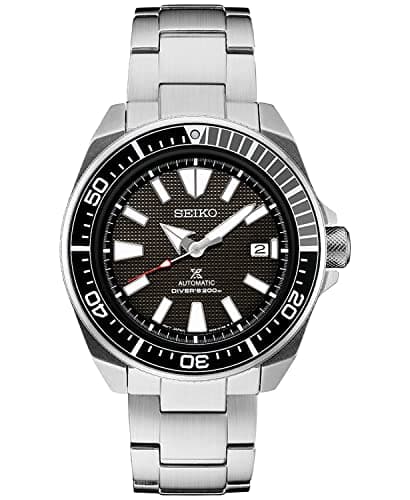
Seiko Prospex Sumo SPB103J1
SPB103J1Best for: Sapphire and a 70-hour reserve in a big 200 m ISO diver
The Sumo you can actually order: 45 mm, sapphire and the 70-hour 6R35 on 20 mm lugs. The upgrades are real, and so is the 52.6 mm lug-to-lug that pays for them.
- Spec completeness for the price
- 8.4
- Movement relative to bracket
- 8.6
- Case proportions
- 7.2
- Strap flexibility
- 8.8
- Availability
- 7.2
What it gets right
- Sapphire crystal where the Samurai and Turtle use Hardlex
- 70-hour 6R35 — off on Friday evening, still running on Monday morning
- 12.9 mm thick, only 0.6 mm taller than the far smaller 2024 Samurai
What it gets wrong
- 52.6 mm lug-to-lug — 4.9 mm longer than a Turtle, and the number that decides fit
- The 2019 reference: the 2022 SPB321/SPB323 add a ceramic insert and hard coating this one lacks
- 20 mm lugs read narrow against a 45 mm case
- Priced near the $1,000 line, a full bracket above the Samurai
Skip this one if: the flat top of your wrist measures less than 52.6 mm across. Lugs that overhang the wrist are the one thing no strap change fixes, and on this case the length, not the 12.9 mm height, is the constraint.
| Case diameter | 45.0 mm |
|---|---|
| Lug-to-lug | 52.6 mm |
| Thickness | 12.9 mm |
| Lug width | 20 mm |
| Crystal | Sapphire |
| Water resistance | 200 m, ISO 6425 rated |
| Crown | Screw-down |
| Case back | Screw-down |
| Bezel | Unidirectional rotating |
| Lume | LumiBrite on hands, indexes and bezel |
| Clasp | Three-fold, secure lock, push-button release, extender |
| Weight | 188.0 g |
| Caliber | Seiko 6R35 |
| Type | Automatic, hand-winding and hacking |
| Beat rate | 21,600 vph (6 beats/sec) |
| Jewels | 24 |
| Power reserve | Approx. 70 hours |
| Stated accuracy | -15 to +25 sec/day |
| Complications | Date |
No buyable offer at the last check (October 23, 2026). We show nothing rather than a stale number.
#ad · we may earn a commission from this link to Seiko Prospex Samurai SRPF03
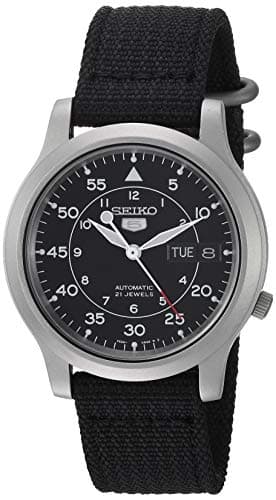
Seiko Prospex Samurai SRPF03
SRPF03K1Best for: A 200 m diver with sharp, faceted case geometry
The angular one. A 200 m ISO diver with hard-cut case facets — the Seiko diver you buy when the Turtle is too round.
- Spec completeness for the price
- 8.8
- Movement relative to bracket
- 8.4
- Case proportions
- 8.6
- Strap flexibility
- 9.5
- Availability
- 8.3
What it gets right
- Slimmer than the Turtle at 12.8 mm
- Faceted case catches light in a way the rounder Seikos do not
- Full ISO 6425 diver rating
What it gets wrong
- Date only — no day, unlike the 4R36 references
- Hardlex
- Sharp lug edges are less forgiving on a small wrist
Skip this one if: you want the day complication. The Samurai runs the 4R35, which is the same movement as the 4R36 minus the day wheel.
| Case diameter | 43.8 mm |
|---|---|
| Lug-to-lug | 47.0 mm |
| Thickness | 12.8 mm |
| Lug width | 22 mm |
| Crystal | Hardlex (hardened mineral) |
| Water resistance | 200 m, ISO 6425 rated |
| Crown | Screw-down |
| Caliber | Seiko 4R35 |
| Type | Automatic, hand-winding and hacking |
| Beat rate | 21,600 vph (6 beats/sec) |
| Jewels | 23 |
| Power reserve | Approx. 41 hours |
| Stated accuracy | -35 to +45 sec/day |
| Complications | Date |
$359.009% off
Price as of October 23, 2026. Prices move — Amazon's is the one that counts.
#ad · we may earn a commission from this link to Seiko 5 SNK809
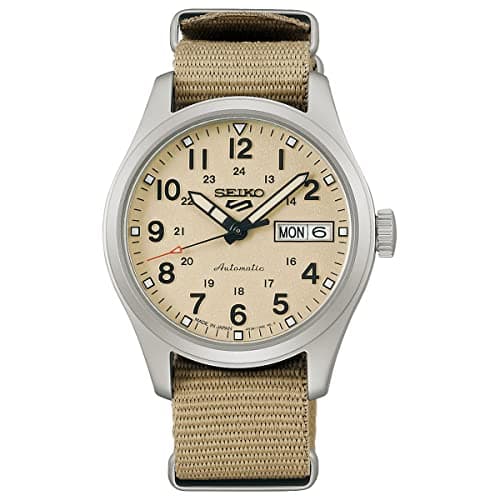
Seiko 5 SNK809
SNK809K2Best for: A genuinely small mechanical watch, if the remaining-stock price is still sensible
The classic small field Seiko: 37 mm, 7S26, canvas strap. It does not hack and it does not hand-wind. Now discontinued — the 7S26 went out of production in 2019 and Seiko's US catalog no longer lists it — so remaining stock is priced by scarcity, not by Seiko. Check the live price against a 4R36 reference before paying it.
- Spec completeness for the price
- 8.0
- Movement relative to bracket
- 7.4
- Case proportions
- 9.2
- Strap flexibility
- 7.8
- Availability
- 4.0
What it gets right
- 42 mm lug-to-lug fits genuinely small wrists
- Exhibition back on a watch at this price
- Legible 24-hour inner track
What it gets wrong
- 7S26 will not hand-wind and will not hack — you cannot set it to the second
- 30 m rating means keep it out of the shower
- 18 mm lugs are a narrower strap market than 20 or 22 mm
- Discontinued and sold from remaining stock — the price is whatever the seller asks, and it no longer tracks the bracket this watch defined
Skip this one if: the live price is at or above a 4R36 Seiko 5 Sports. This was the value pick of its bracket when Seiko still made it; sold from remaining stock it frequently is not, and the SRPD93 or the 36.4 mm SBSA199 give you hacking and hand-winding for the same money or less. Skip it too if setting the watch precisely matters to you — without hacking you cannot stop the seconds hand to sync it.
| Case diameter | 37.0 mm |
|---|---|
| Lug-to-lug | 42.0 mm |
| Thickness | 11.1 mm |
| Lug width | 18 mm |
| Crystal | Hardlex (hardened mineral) |
| Water resistance | 30 m — hand-washing only, not swimming |
| Display back | Yes — exhibition caseback |
| Caliber | Seiko 7S26 |
| Type | Automatic. No hand-winding, no hacking |
| Beat rate | 21,600 vph (6 beats/sec) |
| Jewels | 21 |
| Power reserve | Approx. 41 hours |
| Stated accuracy | -20 to +40 sec/day |
| Complications | Day and date |
Price as of October 23, 2026. Prices move — Amazon's is the one that counts.
#ad · we may earn a commission from this link to Seiko 5 Sports Field SBSA199
Seiko 5 Sports Field SBSA199
SBSA199Best for: A Japan-market field automatic for a genuinely small wrist
A Japan-market 5 Sports field reference on nylon, and the smallest 4R36 field case Seiko lists anywhere: 36.4 mm across, 44.4 mm lug to lug.
- Spec completeness for the price
- 8.2
- Movement relative to bracket
- 8.5
- Case proportions
- 9.1
- Strap flexibility
- 8.2
- Availability
- 7.4
What it gets right
- 36.4 mm and 44.4 mm lug-to-lug — the smallest field case in the 4R36 range
- 12.5 mm thick, slimmer than the 41 mm HDB field references
- The 4R36 hacks and hand-winds
What it gets wrong
- A Japan-market reference, so it arrives as an import with a Japanese warranty
- Hardlex
- Seiko does not publish a lug width for it, so strap sizing needs measuring
Skip this one if: you want a US warranty and a domestic returns path. This is a JDM reference bought as an import — our JDM guide covers exactly what that changes.
| Market | Japanese domestic market (SBSA prefix) |
|---|---|
| Case diameter | 36.4 mm |
| Lug-to-lug | 44.4 mm |
| Thickness | 12.5 mm |
| Lug width | Not published by Seiko for this reference |
| Crystal | Curved Hardlex |
| Water resistance | 100 m (10 bar) |
| Strap | Nylon |
| Caliber | Seiko 4R36 |
| Type | Automatic, hand-winding and hacking |
| Beat rate | 21,600 vph (6 beats/sec) |
| Jewels | 24 |
| Power reserve | Approx. 41 hours |
| Stated accuracy | -35 to +45 sec/day |
| Complications | Day and date |
Questions
Where is the model number on a Seiko watch?
On the case back, as a caliber-case code like 4R36-07G0, together with the serial number. The marketing reference — SRPD65, SPB103J1 — is usually on the box and the papers rather than on the watch itself.
What does 4R36-07G0 mean?
The part before the hyphen is the movement: caliber 4R36, a Seiko automatic with a published 41-hour reserve and a stated −35 to +45 seconds a day. The part after it is Seiko’s code for the case the movement was fitted into. Together they identify the watch for service.
What does the K or J mean at the end of a Seiko model number?
It is a market and assembly marker — broadly, J for Japanese assembly and K for Seiko’s other plants, with the same watch often sold in both forms in different regions and at different prices. The trailing digit separates variants such as bracelet versus strap.
Can I tell which Seiko line a reference belongs to from the prefix?
Not reliably, and this is the most common mistake in online decoder tables. SRPB43 is a Presage, SRPD93 is a Seiko 5 Sports and SRPE99 is a Prospex — all three share the SRP prefix. Seiko publishes no public key, so check the caliber and the collection name instead.
How do I find out how old my Seiko is?
From the serial number on the case back: the first character gives the last digit of the year and the second gives the month. It narrows the date to one year in every ten rather than pinpointing it. The serial lookup page has the full method.
Is the caliber the same as the model number?
No. The caliber is the movement — 4R36, 6R35, V198 — and many different watches share one. The model number identifies the whole product. The case back carries both, joined by a hyphen, which is why it is the most useful thing on the watch.
Sources
- Seiko Watch Corporation — US catalog and specifications
- Seiko instruction manuals and caliber documentation
- Seiko customer service — warranty and servicing
- Seiko Instruments — movement division (NH-series manufacturer)
Specifications are transcribed from manufacturer documentation and published standards. Where a manufacturer does not publish a figure, this page says so rather than estimating one.
Read next
- Seiko serial number lookupThe third number on the case back: how to get a date out of it.
- Every Seiko nickname, decodedThe parallel naming system collectors use, and the references behind each name.
- The Seiko line hierarchyWhat the prefix will not tell you: which collection a watch belongs to.
- Spotting a fake SeikoWhere the reference, caliber and case back are the evidence.