Head-to-head
Seiko Presage vs Tissot PRX
A Japanese mechanical dress watch against a Swiss quartz on an integrated bracelet. The price is close; the two things you are buying do not overlap at all.
By Stephen V. · Updated Aug 8, 2026
Put a Presage Cocktail Time next to a Tissot PRX at the same money and the headline writes itself: one is a Japanese mechanical dress watch, the other a Swiss quartz on an integrated bracelet. The Cocktail Time SRPB43 is a 40.5 mm automatic on the 4R35, with a box-shaped crystal and an exhibition caseback that shows the movement off. The PRX Quartz 40mm is a 40 mm Swiss watch with a sapphire crystal, 100 m of water resistance and a bracelet built into the case. They land in the same bracket and they are not the same kind of object at all. The choice is between a real mechanical movement and Swiss finishing on an integrated bracelet, and it pays to be precise about which you are buying.
| Presage Cocktail Time SRPB43 | Tissot PRX Quartz 40mm | |
|---|---|---|
| Movement | Seiko 4R35 automatic | Swiss quartz |
| Winding | Automatic | Quartz (battery) |
| Case diameter | 40.5 mm | 40 mm |
| Lug-to-lug | 47.6 mm | Not published |
| Thickness | 11.8 mm | Not published |
| Crystal | Box-shaped Hardlex | Sapphire |
| Water resistance | 50 m | 100 m |
| Exhibition caseback | Yes | Not published |
| Strap fitment | 20 mm, standard lugs | Integrated bracelet |
The verdict
If you want a mechanical watch, buy the Presage.At this price Seiko gives you a genuine automatic, a box crystal that is more expensive to shape than the PRX’s flat sapphire, and the freedom to change straps — and it shows you the rotor through the back. If you want sapphire, 100 m, Swiss finishing and one perfect bracelet you never think about, buy the PRX. It is a superbly made object with a battery where the Seiko has a rotor. The price is close enough that this is a values question, not a budget one: a movement to care about, or a finish and a bracelet to admire. The two do not overlap, so decide which sentence is yours.
The movement is the whole argument
The Cocktail Time runs the 4R35, a mechanical automatic: it winds from the motion of your wrist, it has a rotor you can watch spin through the exhibition back, and it keeps time to a mechanical tolerance of seconds a day. The PRX Quartz runs a Swiss quartz movement: a battery, a stepping seconds hand, and accuracy an automatic cannot approach. If a mechanical movement is the reason you are buying a watch at all, the PRX is out of the conversation no matter how good it looks — and if you do not care whether there is a rotor inside, the Presage is spending your money on something you did not ask for. This is the axis. Everything else on the page is a tie-breaker once you have answered it.
What “Swiss” does and does not buy here
It is worth deflating the flag before it decides a purchase it does not actually speak to. “Swiss Made” is a legal country-of-origin mark — it certifies where development, a defined share of manufacturing cost, and final casing and inspection happen. It is not a quality grade, and it says nothing about whether a watch is mechanical or quartz. A Swiss quartz PRX and a Japanese automatic Presage are different machines, not two rungs on one ladder, and the label ranks neither above the other. Seiko, for its part, manufactures its own movements in-house, which most Swiss brands at this price do not. The fuller Japanese versus Swiss comparison lays out exactly what the mark covers; the short version is that it should not settle this decision for you.
The integrated bracelet, and its catch
The PRX’s integrated steel bracelet is a large part of why people want it — it is well finished, it flows out of the case, and it delivers a cohesive, expensive-looking result straight out of the box. It is also a wall. Because the bracelet is integrated, the case will not take a standard strap, so you are committed to the bracelet Tissot gives you. The Cocktail Time goes the other way: 20 mm standard lugs that accept almost any strap you can name, and a dress case that is open to a leather change or a bracelet you add later. If you enjoy swapping straps, the integrated bracelet is a constraint; if you want one bracelet, done right, and never want to think about it again, it is a feature. Which sentence describes you is a real part of the decision — see the dress-watch field for how flexible the Seiko side is.
The crystal gap
Here the PRX has the plain advantage. The Cocktail Time’s crystal is box-shaped Hardlex — visually distinctive, flat on top with near-vertical sides that throw a sharp refractive edge, and more expensive to shape than a flat disc. But Hardlex is mineral, not sapphire, so it marks more readily. The PRX uses sapphire, which is far more scratch-resistant. So the Seiko wins on the shape and the drama of its crystal and the Tissot wins on its durability, and both of those are true at once. If a crystal that stays unmarked for years matters more to you than one that refracts beautifully, that is a point for the PRX — the Hardlex versus sapphire guide has the hardness figures behind the trade.
Water resistance and thickness
Two more lines from the table. On water, the PRX leads: 100 m against the Cocktail Time’s 50 m. Neither is a dive watch, but 100 m swims without a second thought where 50 m is a rain-and-handwash rating that dislikes the pool — and the Presage’s leather strap dislikes water regardless of what the case is rated for. On thickness, the Seiko has a published figure to stand on: 11.8 mm, genuinely slim, the kind of case that slips under a shirt cuff. Tissot does not publish a thickness for the PRX in the same listing, so that is a comparison you will have to make in person rather than on paper — which is itself worth knowing before you buy either one unseen.
On the wrist, and what each is for
The two are close in diameter — 40.5 mm for the Cocktail Time, 40 mm for the PRX — but they are built for different rooms. The Presage is a dress watch: 11.8 mm thin, on a leather strap or a bracelet you add later, with a dial that exists to catch light across a dinner table. It dresses up cleanly and dresses down only so far; a formal case on a casual day can read as trying slightly too hard. The PRX is a sports-casual, integrated-bracelet watch, descended from a 1970s design language of angular steel cases on woven bracelets. It leans casual-to-smart rather than formal, and its steel bracelet and 100 m rating make it the more natural everyday companion of the two. So even setting the movement question aside, they are not really interchangeable on the wrist. If your gap is a watch for a jacket and an occasion, the Cocktail Time fills it and the PRX does not quite. If your gap is one steel watch to wear with almost anything, five days a week, the PRX is closer to that brief and the leather-strapped Presage is not. Deciding which hole in the collection you are filling often settles the choice before the mechanical-versus-quartz debate even starts — and it is the question people skip because the spec sheet does not ask it.
The cons, one watch at a time
Neither watch is above criticism. The Presage’s limitations are its 50 m rating, which rules out swimming; its box crystal being mineral Hardlex, so the very feature that sells the watch is also the surface most likely to scuff; and a leather strap that wants keeping dry and will age. The PRX’s drawbacks are the flip side of its strengths: the integrated bracelet locks you out of straps entirely, the movement is quartz, so there is no rotor to enjoy and nothing to wind, and the Swiss premium pays for origin and finishing rather than for a mechanical movement. Each watch pays for its best trait somewhere else on the sheet. Going in with both lists in hand is the point — both are strong at their price, and neither is flawless.
Buy the Presage Cocktail Time if
You want a mechanical movement you can watch through the back, the box crystal and the sunburst dial are what draw you, and you value being able to change straps on 20 mm lugs. You are comfortable with 50 m as a splash rating and you would rather have a rotor than a battery. See the Cocktail Time reference for the full published specification.
Buy the Tissot PRX if
You want sapphire, 100 m and Swiss finishing on an integrated bracelet, and low maintenance matters more to you than owning a mechanical movement. You do not plan to change straps, and one cohesive bracelet you never fuss over is exactly the appeal. It answers a different question than the Seiko does, and it answers it well — the wider Seiko versus Tissot comparison covers the rest of the range.
The watches on this page
Specifications are transcribed from Seiko’s published documentation. Prices come from Amazon and carry the date they were verified. We have not handled these watches — here is what we did instead.
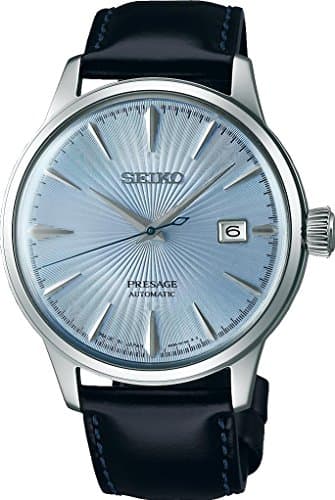
No buyable offer at the last check (October 23, 2026). We show nothing rather than a stale number.
#ad · we may earn a commission from this link to Seiko Presage Cocktail Time SRPB43
Seiko Presage Cocktail Time SRPB43
SRPB43J1Best for: A dress watch that looks like it cost three times the money
The blue Cocktail Time. A box-shaped crystal over a deeply textured dial — the most expensive-looking watch Seiko sells at this price by a wide margin.
- Spec completeness for the price
- 8.6
- Movement relative to bracket
- 8.4
- Case proportions
- 8.5
- Strap flexibility
- 9.2
- Availability
- 8.4
What it gets right
- The box crystal distorts light at the edges the way vintage acrylic did
- Sunburst dial texture that photographs badly and looks superb in person
- Exhibition back
What it gets wrong
- 50 m, so it is not a swim watch
- 47.6 mm lug-to-lug is long for a 40.5 mm dress case
- Hardlex on a curved crystal is harder to polish than a flat one
Skip this one if: you need one watch for everything. At 50 m and on a leather strap this is a shirt-cuff watch — pair it with a diver rather than asking it to be one.
| Case diameter | 40.5 mm |
|---|---|
| Lug-to-lug | 47.6 mm |
| Thickness | 11.8 mm |
| Lug width | 20 mm |
| Crystal | Box-shaped Hardlex |
| Water resistance | 50 m — splash resistant, not for swimming |
| Display back | Yes — exhibition caseback |
| Caliber | Seiko 4R35 |
| Type | Automatic, hand-winding and hacking |
| Beat rate | 21,600 vph (6 beats/sec) |
| Jewels | 23 |
| Power reserve | Approx. 41 hours |
| Stated accuracy | -35 to +45 sec/day |
| Complications | Date |
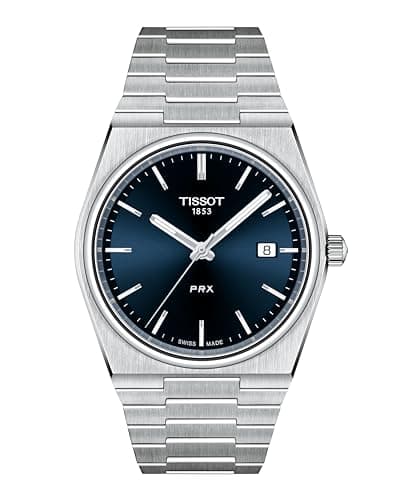
Price as of October 23, 2026. Prices move — Amazon's is the one that counts.
#ad · we may earn a commission from this link to Tissot PRX Quartz 40mm
Tissot PRX Quartz 40mm
Best for: An integrated-bracelet Swiss watch at Seiko prices
The Swiss integrated-bracelet watch Seiko has no direct answer to. Quartz here, which is what keeps it near Presage money.
- Spec completeness for the price
- 8.5
- Movement relative to bracket
- 7.6
- Case proportions
- 9.0
- Strap flexibility
- 5.5
- Availability
- 8.6
What it gets right
- Sapphire and 100 m
- Integrated bracelet finishing well above its price
- Swiss Made marking, which matters to some buyers
What it gets wrong
- Quartz at a price where Seiko sells mechanical
- Integrated bracelet cannot be swapped for a standard strap
- The automatic PRX costs substantially more
Skip this one if: you want a mechanical movement for the money. At this price Seiko sells you the 4R36 and the whole strap aftermarket; the PRX sells you finishing and a battery.
| Brand | Tissot (Swiss) |
|---|---|
| Case diameter | 40 mm |
| Crystal | Sapphire |
| Water resistance | 100 m |
| Movement | Swiss quartz |
| Bracelet | Integrated stainless steel |
How to actually choose
Lead with the movement question, because it eliminates fastest. If you would be unhappy without a mechanical watch, the PRX is out regardless of how good it looks, and the Cocktail Time is your watch. If you genuinely do not mind quartz and the integrated-bracelet look is what you love, the PRX is a coherent package the Presage does not try to match. Only after that should crystal, water rating and strap flexibility break the tie — and by then you will usually find the movement question has already decided it. Read the 4R35 caliber reference if the automatic is what tips you toward the Seiko.
Questions
Is the Tissot PRX automatic or quartz?
The PRX Quartz 40mm is quartz — battery-powered and Swiss. Tissot also makes an automatic PRX, a different and more expensive watch; the quartz is the one that lands at the Cocktail Time’s price, which is the point of the comparison.
Is a Swiss quartz watch better than a Japanese automatic?
Neither is better in the abstract. The quartz PRX keeps more accurate time and never needs winding; the Presage is a mechanical movement, which is the whole reason many people buy a watch. “Swiss Made” is an origin mark, not a quality grade, so it does not settle it.
Can I put a different strap on the Tissot PRX?
Not a standard one. The PRX uses an integrated bracelet, so the case will not accept a normal strap without aftermarket adapters. The Cocktail Time’s 20 mm standard lugs take any strap, which is one of the real differences between them.
Which has the better crystal?
On scratch resistance, the PRX, which uses sapphire against the Cocktail Time’s mineral Hardlex. On shape and character, the Seiko, whose box crystal is more distinctive and more expensive to make. Both statements are true at once.
Can I swim with the Presage Cocktail Time?
Its 50 m rating covers rain, hand-washing and a splash, but not swimming or diving, and the leather strap dislikes water regardless. The 100 m PRX is the one of the two you can swim in.
Sources
- Seiko Presage collection — official specifications
- Seiko Watch Corporation — US catalog and specifications
- Tissot — official specifications
Specifications are transcribed from manufacturer documentation and published standards. Where a manufacturer does not publish a figure, this page says so rather than estimating one.