Head-to-head
Seiko Prospex Turtle vs Alpinist
Both wear the Prospex name; one is a certified diver on Hardlex, the other a sapphire field watch with a longer-running movement. The gap is wider than it looks.
By Stephen V. · Updated Aug 8, 2026
Both of these are Prospex, which is the first thing to clear up: the Turtle SRPE99 is the dive side of the line and the Alpinist SBDC159 is the field-and-adventure side. They are not the same class of watch. The Turtle is a certified 200 m diver on Hardlex running the 4R36; the Alpinist is a Japan-market field watch with a curved sapphire crystal and the longer-running 6R35, in a much smaller case. The Alpinist costs more, and the table shows where the money goes. Seiko Prospex explained covers why both wear the same badge, and the Alpinist roundup covers which Alpinist to buy once you have decided that is the side you want.
| Prospex Turtle SRPE99 | Prospex Alpinist SBDC159 | |
|---|---|---|
| Caliber | 4R36 | 6R35 |
| Complications | Day-date | Date |
| Beat rate | 21,600 vph | 21,600 vph |
| Power reserve | 41 h | 70 h |
| Hacks / hand-winds | Yes / yes | Yes / yes |
| Case diameter | 45.0 mm | 38.0 mm |
| Lug-to-lug | 47.7 mm | 46.2 mm |
| Thickness | 13.4 mm | 12.9 mm |
| Lug width | 22 mm | 19 mm |
| Crystal | Hardlex | Curved sapphire |
| Water resistance | 200 m, ISO 6425 | 200 m |
| Extra | ISO 6425 DIVER’S marking | Hard-coated case |
| Market | Not published | Japan-market |
The verdict
For one watch that goes in water and needs to be shrugged off, the Turtle. It is certified to ISO 6425, has a screw-down crown, and costs less. For one watch that is mostly on land, wants a scratch-resistant crystal, and will be worn for days between windings, the Alpinist.Sapphire, a 70-hour reserve and a 39.5 mm case make it the more refined everyday piece — you pay more, and it is a Japan-market reference, which changes how you buy it.
Neither is strictly better. They are tuned for different lives. The Turtle is a tool that also tells time; the Alpinist is a watch that also has a tool on it.
Two movements, and the reserve gap
The Turtle’s 4R36 and the Alpinist’s 6R35 are both 21,600 vph and both hack and hand-wind, but the reserve is not close: 41 hours against 70. In practice that is the difference between a watch you must wear most days to keep running and one you can leave off over a weekend and still find alive on Monday. For a watch that rotates in and out of a collection, 70 hours is the more forgiving number, and it is the clearest mechanical reason the Alpinist costs more.
The crystal, and what it is worth
The Turtle uses Hardlex; the Alpinist uses sapphire, which is roughly three times as hard on the Vickers scale and the more scratch-resistant by a wide margin — see Hardlex vs sapphire for the figures. On a field watch that lives against desks, doorframes and rock, that is a genuine advantage. On a dive watch there is an old engineering argument that mineral resists shattering better than sapphire for a given thickness, which is part of why Seiko keeps Hardlex on the Turtle. Both arguments are real; which applies depends on how the watch is used.
What about the compass bezel?
The Alpinist most people picture has an internal rotating bezel marked as a compass, turned by a second crown at 4 o’clock. The SBDC159 is not that watch. It is the 1959 re-interpretation, which goes back past the compass to the original Laurel Alpinist: one screw-down crown, a fixed bezel, nothing to rotate. If the compass mechanism is the thing pulling you, the references that still carry it sit several hundred dollars above this one. The Turtle, meanwhile, has the flourish people actually use — a timing bezel for elapsed minutes.
Size, and how they wear
The Turtle is 45.0 mm across, 47.7 mm lug-to-lug and 13.4 mm thick; the Alpinist is 38.0 mm across, 46.2 mm lug-to-lug and 12.9 mm thick. The Alpinist is much the smaller watch in width, and only a shade shorter across the wrist, which is worth knowing: at 12.9 mm on a 38 mm case it is a chunky field watch, not a slim one. The Turtle carries its extra half millimetre better because the diameter absorbs it. Neither is thin.
The JDM question
The Alpinist SBDC159 is a Japan-market reference, which means the warranty is written for Japan and international coverage is not guaranteed the way it is on a global-market watch. It is still bought and worn worldwide, but you should buy it knowing what a Japan-market warranty is and is not — the JDM guide covers the practical side. The Turtle, as a globally distributed reference, sidesteps that entirely, which is a small but real point in its favor for a first Seiko.
Where each falls short
The Turtle’s weak points are the ones any 4R diver has: Hardlex that scratches, a 45 mm case that overwhelms a small wrist, and a 41-hour reserve that needs the watch worn regularly. The Alpinist trades some of those away and adds its own. It is 12.9 mm thick on a much smaller 38 mm case, so it wears tall for its diameter; the 19 mm lug width has a much thinner strap aftermarket than 20 or 22 mm; and the Japan-market warranty is a genuine caveat if you buy from outside a supporting region. Sapphire and 70 hours are real upgrades, but they do not make the Alpinist a strictly better object — they make it a different, pricier one.
One more practical note the spec sheet hides: the Alpinist’s 19 mm lugs and the Turtle’s 22 mm mean they do not share straps, so if you own one and buy the other you are not carrying a strap over. Both widths are well supported, but it is worth knowing before you plan a shared rotation around them. It is a small thing next to movement and crystal, yet strap compatibility is exactly the kind of detail that only surfaces after the second purchase, by which point it is too late to plan around.
Buy the Turtle if
Water is in the picture, you want the ISO certification and screw-down crown, and you would rather spend less. You are comfortable with 45 mm and Hardlex, and you value a globally supported warranty. See the full Turtle reference for where it sits in the dive line.
Buy the Alpinist if
The watch lives mostly on land, you want sapphire and the 70-hour reserve, and 38 mm suits you better than 45 mm. You are willing to pay more, to live with 19 mm lugs, and to accept a Japan-market warranty. It is the more refined everyday watch of the two.
The watches on this page
Specifications are transcribed from Seiko’s published documentation. Prices come from Amazon and carry the date they were verified. We have not handled these watches — here is what we did instead.
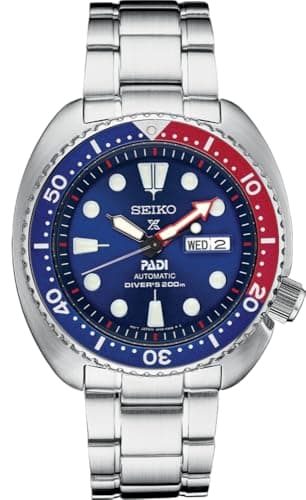
No buyable offer at the last check (October 23, 2026). We show nothing rather than a stale number.
#ad · we may earn a commission from this link to Seiko Prospex Turtle SRPE99
Seiko Prospex Turtle SRPE99
SRPE99K1Best for: An actual dive watch you can also wear daily
A real 200 m ISO-rated diver with a screw-down crown, in the cushion case that wears far smaller than its 45 mm suggests.
- Spec completeness for the price
- 9.0
- Movement relative to bracket
- 8.5
- Case proportions
- 8.8
- Strap flexibility
- 9.5
- Availability
- 8.6
What it gets right
- Genuine ISO 6425 diver, not a diver-styled sports watch
- 47.7 mm lug-to-lug means it fits wrists that 45 mm suggests it should not
- Screw-down crown at 4 o'clock keeps it off the back of your hand
What it gets wrong
- Hardlex on a watch at this price is the recurring Seiko complaint
- The 45 mm figure scares people off before they try one
- PADI co-branding on the dial is not for everyone
Skip this one if: you have a wrist under about 6.5 inches. The lug-to-lug is forgiving but the case is still visually wide, and the smaller SRPG references exist for exactly this reason.
| Case diameter | 45.0 mm (cushion case) |
|---|---|
| Lug-to-lug | 47.7 mm |
| Thickness | 13.4 mm |
| Lug width | 22 mm |
| Crystal | Hardlex (hardened mineral) |
| Water resistance | 200 m, ISO 6425 rated for scuba diving |
| Crown | Screw-down, at 4 o'clock |
| Bezel | Unidirectional elapsed-timing bezel, PADI red and blue |
| Lume | LumiBrite on hands and markers |
| Bracelet | Steel, three-fold clasp with push-button release |
| Caliber | Seiko 4R36 |
| Type | Automatic, hand-winding and hacking |
| Beat rate | 21,600 vph (6 beats/sec) |
| Jewels | 24 |
| Power reserve | Approx. 41 hours |
| Stated accuracy | -35 to +45 sec/day |
| Complications | Day and date |
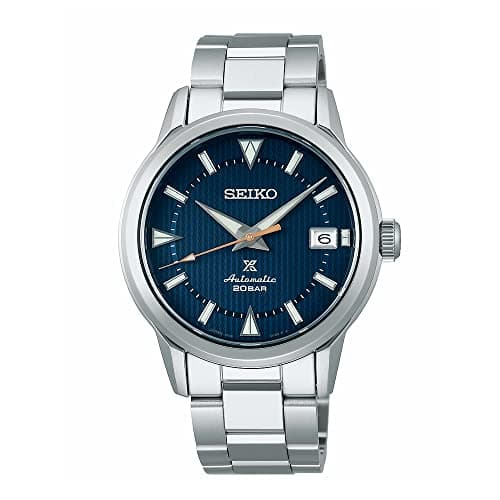
No buyable offer at the last check (October 23, 2026). We show nothing rather than a stale number.
#ad · we may earn a commission from this link to Seiko Prospex Alpinist SBDC159
Seiko Prospex Alpinist SBDC159
SBDC159Best for: A small, hard-wearing field watch with a 70-hour movement
A Japan-market Alpinist built on the 1959 original rather than the compass-bezel one: 38 mm, curved sapphire, 200 m, and the 6R35's 70-hour reserve.
- Spec completeness for the price
- 9.0
- Movement relative to bracket
- 9.2
- Case proportions
- 9.3
- Strap flexibility
- 7.6
- Availability
- 7.1
What it gets right
- 38 mm with a 46.2 mm lug-to-lug — genuinely small by current standards
- 70-hour power reserve and curved sapphire
- 200 m on a field watch, with a screw-down crown and a hard-coated case
What it gets wrong
- No internal compass bezel — that is the other Alpinist
- 19 mm lugs, an awkward width with a thin aftermarket
- Japan-market warranty
Skip this one if: the compass bezel was the thing pulling you to an Alpinist. This reference does not have one, and the references that do now sit several hundred dollars higher.
| Market | Japanese domestic market (SBDC prefix) |
|---|---|
| Case diameter | 38.0 mm |
| Lug-to-lug | 46.2 mm |
| Thickness | 12.9 mm |
| Lug width | 19 mm |
| Case material | Stainless steel with a super-hard coating |
| Crystal | Curved sapphire, anti-reflective inner coating |
| Water resistance | 200 m (20 bar) |
| Crown | Screw-down |
| Bezel | Fixed — no compass bezel on this reference |
| Display back | Yes — see-through screw caseback |
| Caliber | Seiko 6R35 |
| Type | Automatic, hand-winding and hacking |
| Beat rate | 21,600 vph (6 beats/sec) |
| Jewels | 24 |
| Power reserve | Approx. 70 hours |
| Stated accuracy | -15 to +25 sec/day |
| Complications | Date |
If you can own only one
For a single do-everything watch, weigh how the watch will actually live. If it will see water, sweat and knocks and you want to stop thinking about it, the Turtle’s certification, screw-down crown and lower price make it the safer default, and Hardlex’s shatter resistance is a point in its favor for hard wear. If it will mostly ride a desk, a trail and a jacket sleeve, the Alpinist’s sapphire, 70-hour reserve and much smaller footprint make it the nicer daily companion.
The deciding question is not diver versus field in the abstract; it is whether your week has more water in it or more desks. Answer that honestly and the watch chooses itself. If the answer is genuinely both, the Turtle survives the field better than the Alpinist survives the deep, so the tool is the more forgiving one-watch pick — see the dive-watch field for the alternatives around it.
Questions
Is the Alpinist a diver like the Turtle?
No. Both are rated 200 m, but the Turtle carries an ISO 6425 dive certification and a screw-down crown, while the Alpinist is a field-and-adventure watch. The 200 m rating means the Alpinist survives water; it is not sold as a professional dive tool the way the Turtle is.
Why does the Alpinist cost more?
Three things: a sapphire crystal instead of Hardlex, the 6R35 movement with a 70-hour reserve instead of the 4R36’s 41 hours, and a hard-coated case. It is also a Japan-market reference, which tends to carry a higher price outside Japan.
Is the 6R35 better than the 4R36?
Mostly in reserve. Both run at 21,600 vph and hack and hand-wind, but the 6R35 holds 70 hours to the 4R36’s 41, so it tolerates being set down for days. In accuracy and daily use they are close; the reserve is the headline difference.
Does the Alpinist SBDC159 have a compass bezel?
No. This reference is the 1959 re-interpretation, with one screw-down crown and a fixed bezel. The compass mechanism belongs to the other Alpinist family, and the references that still carry it are several hundred dollars dearer.
Does the Japan-market Alpinist come with an international warranty?
Not reliably. The SBDC159 is a Japan-market reference and its warranty is written for Japan, so international coverage is not guaranteed. It is widely sold worldwide anyway; just buy it knowing the warranty situation.
Sources
- Seiko Prospex collection — official specifications
- Seiko instruction manuals and caliber documentation
- ISO 6425 — Horology, divers' watches (standard listing)
Specifications are transcribed from manufacturer documentation and published standards. Where a manufacturer does not publish a figure, this page says so rather than estimating one.