Head-to-head
Seiko Prospex vs Presage
A certified dive tool against a dress watch, sharing a movement family and almost nothing else. The choice is entirely about where the watch goes.
By Stephen V. · Updated Aug 8, 2026
The Prospex Turtle SRPE99 and the Presage Cocktail Time SRPB43 share the 4R movement family and sit near each other on price, and there the resemblance ends. The Turtle is a professional-specification dive watch — 200 m, ISO 6425, screw-down crown. The Cocktail Time is a dress watch — 50 m, a box crystal, an exhibition caseback. You are not choosing between two versions of one idea; you are choosing which idea you need.
| Prospex Turtle SRPE99 | Presage Cocktail Time SRPB43 | |
|---|---|---|
| Caliber | 4R36 | 4R35 |
| Complications | Day-date | Date |
| Beat rate | 21,600 vph | 21,600 vph |
| Power reserve | 41 h | 41 h |
| Hacks / hand-winds | Yes / yes | Yes / yes |
| Case diameter | 45.0 mm | 40.5 mm |
| Lug-to-lug | 47.7 mm | 47.6 mm |
| Thickness | 13.4 mm | 11.8 mm |
| Lug width | 22 mm | 20 mm |
| Crystal | Hardlex | Box-shaped Hardlex |
| Water resistance | 200 m, ISO 6425 | 50 m |
| Crown | Screw-down | Not published |
| Exhibition caseback | Not published | Yes |
The verdict
If the watch will ever be in water, buy the Turtle.It is rated 200 m, carries an ISO 6425 marking, and has a screw-down crown — three things the Cocktail Time has none of. If the watch is for a jacket and a dinner, buy the Cocktail Time. The Turtle is a 45 mm cushion-cased dive watch and will look exactly like one under a cuff, which is the wrong look for the job the Presage is built for.
This is decided by use, not by taste, which is unusual. The movement is common to both. Everything that separates them is in the case, and the case is built around two incompatible purposes.
The same movement, again
The Turtle runs the 4R36, the Cocktail Time the 4R35— one family, one difference, the day wheel. Both are 21,600 vph and 41-hour movements that hack and hand-wind. Whatever you pay extra for on either watch, it is not the movement, and it is worth being clear about that before the price gap talks you into a story about mechanical superiority that does not exist here.
What the Turtle’s case buys
The Turtle is 45.0 mm across, 47.7 mm lug-to-lug and 13.4 mm thick, on 22 mm lugs, behind Hardlex, rated 200 m to ISO 6425. The ISO marking is the part that matters: it is a tested standard, not a label. It covers condensation resistance after thermal shock, survival at 125% of rated pressure, a unidirectional timing bezel, legibility in darkness, magnetic resistance and a strap rated to a defined load. The screw-down crown is what holds the rating. A Cocktail Time meets none of this and is not sold as if it did. See the water-resistance guide for what each part certifies.
What the Cocktail Time’s case buys
The Cocktail Time is 40.5 mm across, 47.6 mm lug-to-lug and 11.8 mm thick, on 20 mm lugs, rated 50 m. The money goes to appearance: a box-shaped crystal that stands proud and refracts at its edge, a deep sunburst dial that shifts as the light moves, and an exhibition caseback. It is 1.4 mm thinner than the Turtle and slips under a cuff the Turtle would tent. None of that helps it survive a pool, and none of the Turtle’s toughness helps it look right with a suit.
The lug-to-lug surprise
The two watches are almost the same length end to end — 47.7 mm and 47.6 mm — despite a 4.5 mm gap in diameter. The Turtle’s cushion case packs a large dial into short lugs; the Presage stretches a small dial onto long ones. If you were expecting the 45 mm Turtle to dwarf the 40.5 mm Presage lengthwise, the numbers say otherwise. It is width and thickness, not span, that separate how they wear.
Where each falls short
The Turtle’s honest weaknesses are size and crystal: 45 mm is a lot of watch for a smaller wrist, 13.4 mm is not slim, and Hardlex marks more easily than sapphire. Some buyers also find the day-date busier than they want on a tool watch. The Cocktail Time’s weaknesses are the mirror image. 50 m rules out swimming, the leather strap needs care and will age, and its crystal is Hardlex as well, so the box shape that sells the watch is also the first thing to scuff. Both are honest values at their price; neither is beyond criticism, and pretending otherwise would not help you choose.
The exhibition caseback, briefly
One small asymmetry the table records: the Cocktail Time has an exhibition caseback and the Turtle does not. A dive watch wants a solid, gasketed back to hold pressure, so the Turtle hides its 4R36 behind steel; the dress watch has no such constraint and shows its 4R35 off through the back. If watching the rotor spin is part of the appeal for you, only one of these two offers it, and it is the dressier one — which is the general pattern here, since almost everything that makes the Cocktail Time nicer to look at is the same thing that makes it the weaker tool. It is a neat illustration of the whole comparison in one component: the window exists on the dress watch precisely because the dress watch is never asked to hold back a column of water, and it is absent on the Turtle for exactly the same reason.
Buy the Turtle if
The watch goes near water, or you simply want a real dive watch with the certification behind it. You are fine with 45 mm and a tool look. You want the day-date and the screw-down crown. The Turtle is one of the most established dive references Seiko makes — see the Turtle reference and the wider dive-watch field for where it stands.
Buy the Cocktail Time if
The watch is for occasions the Turtle would ruin. You want the box crystal, the dial and the thinner case, and you accept 50 m as a rain-and-handwash rating rather than a swimming one. It is the wrong watch for a pool and the right one for a jacket, and it knows exactly which it is.
The watches on this page
Specifications are transcribed from Seiko’s published documentation. Prices come from Amazon and carry the date they were verified. We have not handled these watches — here is what we did instead.
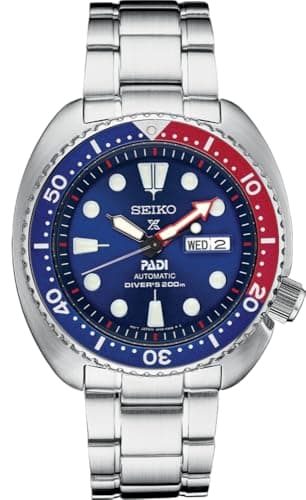
No buyable offer at the last check (October 23, 2026). We show nothing rather than a stale number.
#ad · we may earn a commission from this link to Seiko Prospex Turtle SRPE99
Seiko Prospex Turtle SRPE99
SRPE99K1Best for: An actual dive watch you can also wear daily
A real 200 m ISO-rated diver with a screw-down crown, in the cushion case that wears far smaller than its 45 mm suggests.
- Spec completeness for the price
- 9.0
- Movement relative to bracket
- 8.5
- Case proportions
- 8.8
- Strap flexibility
- 9.5
- Availability
- 8.6
What it gets right
- Genuine ISO 6425 diver, not a diver-styled sports watch
- 47.7 mm lug-to-lug means it fits wrists that 45 mm suggests it should not
- Screw-down crown at 4 o'clock keeps it off the back of your hand
What it gets wrong
- Hardlex on a watch at this price is the recurring Seiko complaint
- The 45 mm figure scares people off before they try one
- PADI co-branding on the dial is not for everyone
Skip this one if: you have a wrist under about 6.5 inches. The lug-to-lug is forgiving but the case is still visually wide, and the smaller SRPG references exist for exactly this reason.
| Case diameter | 45.0 mm (cushion case) |
|---|---|
| Lug-to-lug | 47.7 mm |
| Thickness | 13.4 mm |
| Lug width | 22 mm |
| Crystal | Hardlex (hardened mineral) |
| Water resistance | 200 m, ISO 6425 rated for scuba diving |
| Crown | Screw-down, at 4 o'clock |
| Bezel | Unidirectional elapsed-timing bezel, PADI red and blue |
| Lume | LumiBrite on hands and markers |
| Bracelet | Steel, three-fold clasp with push-button release |
| Caliber | Seiko 4R36 |
| Type | Automatic, hand-winding and hacking |
| Beat rate | 21,600 vph (6 beats/sec) |
| Jewels | 24 |
| Power reserve | Approx. 41 hours |
| Stated accuracy | -35 to +45 sec/day |
| Complications | Day and date |
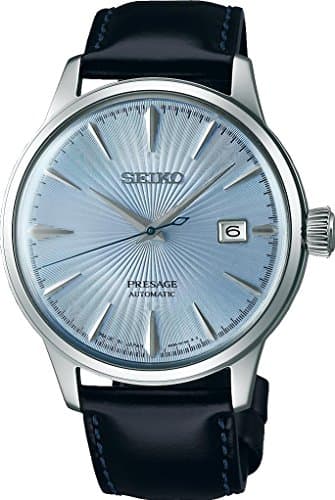
No buyable offer at the last check (October 23, 2026). We show nothing rather than a stale number.
#ad · we may earn a commission from this link to Seiko Presage Cocktail Time SRPB43
Seiko Presage Cocktail Time SRPB43
SRPB43J1Best for: A dress watch that looks like it cost three times the money
The blue Cocktail Time. A box-shaped crystal over a deeply textured dial — the most expensive-looking watch Seiko sells at this price by a wide margin.
- Spec completeness for the price
- 8.6
- Movement relative to bracket
- 8.4
- Case proportions
- 8.5
- Strap flexibility
- 9.2
- Availability
- 8.4
What it gets right
- The box crystal distorts light at the edges the way vintage acrylic did
- Sunburst dial texture that photographs badly and looks superb in person
- Exhibition back
What it gets wrong
- 50 m, so it is not a swim watch
- 47.6 mm lug-to-lug is long for a 40.5 mm dress case
- Hardlex on a curved crystal is harder to polish than a flat one
Skip this one if: you need one watch for everything. At 50 m and on a leather strap this is a shirt-cuff watch — pair it with a diver rather than asking it to be one.
| Case diameter | 40.5 mm |
|---|---|
| Lug-to-lug | 47.6 mm |
| Thickness | 11.8 mm |
| Lug width | 20 mm |
| Crystal | Box-shaped Hardlex |
| Water resistance | 50 m — splash resistant, not for swimming |
| Display back | Yes — exhibition caseback |
| Caliber | Seiko 4R35 |
| Type | Automatic, hand-winding and hacking |
| Beat rate | 21,600 vph (6 beats/sec) |
| Jewels | 23 |
| Power reserve | Approx. 41 hours |
| Stated accuracy | -35 to +45 sec/day |
| Complications | Date |
If you need one watch for both
You cannot have one watch that is both a certified diver and a formal dress piece — those cases are built to opposite briefs. If forced to pick one that leans both ways, the Turtle is the more versatile survivor: a dive watch dresses down to everything short of black tie, while a 50 m dress watch simply cannot follow you into the situations the Turtle is rated for. The honest recommendation for a true one-watch collection is the tool, then a strap change for the rare formal night.
If the collection already has a rugged watch, that logic flips, and the Cocktail Time is the more useful addition — it fills a gap the Turtle cannot. Buy against what you already own, not against the spec sheet in isolation. The related Seiko 5 vs Prospex comparison covers the tool side of this decision in more depth.
And if neither quite fits — too much diver, too little dress — the honest move is to look one step sideways rather than split the difference. The Seiko 5 sits below the Turtle as a lighter everyday sports watch, and the bracelet Presage references answer the dress brief without the leather strap. The point of this page is not that you must own one of these two, but that the tool-versus-formal split is the axis to decide on first, whichever exact reference you land on.
Questions
Do the Prospex Turtle and Presage use the same movement?
The same family. The Turtle runs the 4R36 and the Cocktail Time the 4R35 — identical but for the 4R36’s added day wheel. Both are 21,600 vph, 41-hour movements that hack and hand-wind, so the price difference is entirely the case.
Is the Turtle dressy enough for a suit?
Not really. It is a 45 mm cushion-cased dive watch, and on a strap it can be smartened but never made formal. For a jacket-and-dinner watch the Cocktail Time is built for the job and the Turtle is not.
Can the Cocktail Time handle any water?
Rain, hand-washing and a splash, yes — 50 m covers those. Swimming and diving, no, and the leather strap dislikes water regardless. If water is in the picture at all, the Turtle’s 200 m ISO 6425 case is the correct choice.
Why is the Turtle bigger but the same length as the Presage?
The Turtle’s cushion case is wide but short between the lugs, at 47.7 mm; the Presage is narrow but long, at 47.6 mm. Diameter differs by 4.5 mm while lug-to-lug is almost identical, so the watches wear more alike in length than the case sizes suggest.
Which should a first-time buyer get?
If you own no watch at all, the Turtle is the safer single purchase because it survives more situations. If you already have something you can knock around and want to dress up, the Cocktail Time fills the gap the Turtle cannot.
Sources
- Seiko Prospex collection — official specifications
- Seiko Presage collection — official specifications
- ISO 6425 — Horology, divers' watches (standard listing)
Specifications are transcribed from manufacturer documentation and published standards. Where a manufacturer does not publish a figure, this page says so rather than estimating one.