Head-to-head
Seiko Sumo vs Samurai
Two 200 m Prospex divers on the same 20 mm lugs. One buys sapphire and a 70-hour reserve; the other buys a case more wrists can wear.
By Stephen V. · Updated Sep 10, 2026
The Sumo SPB103J1 is the better-specified watch: sapphire instead of Hardlex, the 70-hour 6R35 instead of the 41-hour 4R35, and a tighter stated accuracy. The Samurai SRPL11 is the one more wrists can wear: 41.7 mm across and 49.5 mm lug-to-lug, against the Sumo’s 45 mm and 52.6 mm. Both are 200 m ISO 6425 divers, date only, on 20 mm lugs.
Sumo and Samurai are collector nicknames rather than model names. Seiko lists both watches by reference number inside Prospex — its own page for the SPB103J1 files it under Prospex Sea, and Seiko USA sells the SRPL11 as a Prospex Automatic Diver — and the names stuck because each one describes a case. Both are genuine 200 m ISO 6425 divers. Both are date-only. Both, less obviously, run on 20 mm lugs. What separates them is a crystal, a movement family and 3.1 mm of lug-to-lug, and the question this page answers is whether the first two are worth the third, and the price step that comes with them.
Published specifications, side by side
| Sumo SPB103J1 | Samurai SRPL11 | |
|---|---|---|
| Case diameter | 45.0 mm | 41.7 mm |
| Lug-to-lug | 52.6 mm | 49.5 mm |
| Thickness | 12.9 mm | 12.3 mm |
| Lug width | 20 mm | 20 mm |
| Crystal | Sapphire | Hardlex |
| Water resistance | 200 m, ISO 6425 | 200 m, ISO 6425 |
| Crown | Screw-down | Screw-down |
| Bezel | Unidirectional | Unidirectional |
| Caliber | 6R35 automatic | 4R35 automatic |
| Beat rate | 21,600 vph | 21,600 vph |
| Power reserve | Approx. 70 hours | Approx. 41 hours |
| Stated accuracy | -15 to +25 sec/day | -35 to +45 sec/day |
| Jewels | 24 | 23 |
| Hacking / hand-winding | Both | Both |
| Complications | Date | Date |
| Weight | 188.0 g | Not published by Seiko |
Read down the table and the two watches agree on more rows than they differ on: the same rating, the same crown and bezel arrangement, the same date-only complication, the same 21,600 vph beat rate and — the one people do not expect — the same 20 mm lug width. The differences come down to four things: the crystal, the movement family behind the reserve and accuracy figures, the size of the case, and the price. Everything below is about which of those four matters to you.
The number that decides it: 52.6 mm
Start with fit, because it is the one difference you cannot buy your way around. The Sumo’s 52.6 mm lug-to-lug is 3.1 mm longer than the Samurai’s 49.5 mm and 4.9 mm longer than a Turtle’s 47.7 mm. Lug-to-lug is the figure that decides whether the ends of a watch sit on your wrist or hang past its edges, and it is the figure our small-wrist page ranks on for exactly that reason.
The practical test takes a minute. Lay a ruler across the flat top of your wrist, where the watch head sits, and read off the width. If it is comfortably more than 52.6 mm, the Sumo will sit inside it. If it lands between 49.5 mm and 52.6 mm, only the Samurai will. If it is under 49.5 mm, neither of these will sit flat, and the small-wrist page is the better place to start.
Height is not the problem people assume it is. At 12.9 mm the Sumo is only 0.6 mm taller than the 2024 Samurai and slimmer than the 13.4 mm Turtle, so both watches here will slide under most cuffs. The Sumo reads as a big watch because of its length and its 45 mm width, not because of its profile.
What the Sumo’s money buys
A sapphire crystal
The Samurai uses Hardlex, Seiko’s hardened mineral glass; the Sumo uses sapphire. The trade between them is covered in full in Hardlex vs sapphire, and the short version is that sapphire is far harder, so it resists the fine scratches a daily diver collects from desks, doorframes and car doors, while Hardlex is the tougher of the two against a single sharp knock. On a watch worn every day, sapphire is the upgrade you notice in year three rather than on day one.
The 6R35, and the 70 hours
The 6R35 stores roughly 70 hours of running time, against the 4R35’s 41. In ownership terms that is the difference between a watch that is still running on Monday after coming off on Friday evening and one that has stopped by Sunday morning and needs the time and date set again. For anyone who rotates between watches, it is the most useful single figure on the Sumo’s sheet.
Seiko also specifies the 6R35 more tightly: -15 to +25 seconds a day, against -35 to +45 for the 4R35. That is a factory tolerance across every example rather than a prediction for yours, and we have not timed either watch, but a narrower guaranteed window is a real difference in specification. What the 6R35 does not buy is a smoother seconds hand. Both movements beat at 21,600 vph, six steps a second, so the sweep looks the same — the point the 4R36 vs 6R35 comparison makes at greater length for the day-date member of the 4R family.
What the Samurai does better
The Samurai’s case is the reason to buy it. Seiko describes the 2024 redesign as keeping “the straight contour of the original design” with a “sleeker more compact profile,” and the figures bear that out: 41.7 mm across, 12.3 mm thick, and the shorter lug-to-lug of the two by 3.1 mm. It is a full ISO 6425 diver in a case that fits a wider range of wrists than the Sumo does, and it keeps its hard-edged character while doing it.
It is also the cheaper way into a 200 m ISO diver by a wide margin. The Sumo on this page sits near the $1,000 line; the Samurai sits in the $500 bracket, which is where Seiko’s 4R divers live. If the watch is going in the water, getting knocked around and not being thought about, the Samurai’s certification is identical to the Sumo’s, and the certification — not the crystal — is what decides whether a watch can be dived.
One caveat belongs next to the case. The Samurai’s 49.5 mm lug-to-lug is long for a 41.7 mm watch — longer than the 45 mm Turtle’s — because its straight lugs run outward rather than turning down. It is the smaller of the two watches here, but it is not a small watch by lug-to-lug, and the ruler test above applies to it as well.
Which Sumo, and which Samurai
Both nicknames cover more than one reference, and the two on this page were chosen partly on availability, so it is worth being precise about what each one is.
The Sumo on this page is the SPB103J1, the 2019 reference. In 2022 Seiko updated the Sumo as the SPB321 and SPB323, which, according to Monochrome’s review of the 2022 models, keep the same 45 mm, 12.9 mm and 52.6 mm case and the same 6R35, and add a ceramic bezel insert and a hard coating on the case and bracelet. None of the 2022 references came back from Amazon’s catalog when we checked in September 2026; the SPB103J1 did, in stock. What you give up by buying it is the ceramic insert and the coating. The case dimensions and the movement are the same.
The Samurai on this page is the SRPL11, from Seiko’s 2024 redesign, which also includes the black-dial SRPL13 and the black-coated SRPL15 on a silicone strap. Seiko USA publishes the same 41.7 mm case on 20 mm lugs for all three. The older Samurai case — the SRPF03 our Samurai reference page is built around — is a larger watch on 22 mm lugs and is still listed, so if you find one, do not assume the figures above apply to it. The SRPL11 is the 2024 reference that came back “In Stock” when we checked, which is why it is the one compared here.
The 20 mm lugs, and what they mean for straps
Both watches take 20 mm straps, which surprises people who assume a 45 mm diver runs 22 mm. On the Samurai, 20 mm is in proportion with a 41.7 mm case. On the Sumo it is narrow against the case, and that contrast is part of the look rather than an oversight — one of the explanations Monochrome gives for the nickname is exactly that pairing of a broad, muscular case with a slim 20 mm bracelet.
The practical upshot is good news for both. 20 mm is nearly as well served by the aftermarket as 22 mm, and the strap roundup sorts its picks by lug width. What does not carry over is anything cut for the older 22 mm Samurai: a curved-end strap or bracelet made for the SRPF03 will not fit the 2024 case.
Price, and the cheaper routes to each upgrade
The Sumo costs a full price bracket more than the Samurai, so it is fair to ask whether you can have its upgrades without its size. You can have one of them. The King Turtle puts sapphire on a 4R36 diver at a price between the two, in a 45 mm cushion case whose 47.7 mm lug-to-lug is shorter than either watch here — and it adds the day display both of these lack.
The 70-hour reserve is the harder one. Every 4R diver on this site — Turtle, King Turtle, Samurai — stops at about 41 hours; the 70 hours arrive with the 6R family, and that is where the Sumo’s price comes from. So the decision reduces to a simple test. If sapphire is the upgrade you want, there is a cheaper and shorter way to it. If the reserve and the tighter accuracy tolerance are what you want, the Sumo is the diver on this page that has them, and its size is part of what they cost.
Buy the Sumo if
- the flat top of your wrist is comfortably wider than 52.6 mm
- you rotate watches and want one that is still running after a weekend off the wrist
- you want sapphire and will keep the watch long enough for it to matter
- you like a big diver, and the broad-case, narrow-strap look is part of the appeal
Buy the Samurai if
- your wrist measures less than 52.6 mm across the top — the Sumo will overhang it
- you want a real ISO 6425 diver in the lower bracket and can live with Hardlex
- you wear one watch every day, so a 41-hour reserve never runs down
- you prefer the Samurai’s hard-edged case to the Sumo’s broad one
The honest recommendation
For most buyers the Samurai is the better purchase and the Sumo is the better watch, and those are different statements. The Samurai gives you the identical dive certification in a case that fits more people, a full price bracket lower. The Sumo adds two upgrades that are genuinely worth having — sapphire and 70 hours — and asks you to wear 52.6 mm of watch to get them. Measure first. If the Sumo fits and the budget stretches, it is the one you will not outgrow. If it does not fit, nothing else on its specification sheet makes up for that.
What this page does not claim
We have not handled, worn, dived or timed either watch. Every figure above is transcribed from Seiko’s published specifications, and the details of the 2022 Sumo are attributed to the review they come from. Lume brightness, bezel action, bracelet feel and dial finishing are real differences that no published figure captures, and we have not guessed at them. Prices move: the ones in the cards below are Amazon’s at the stamped date, which is why the prose above uses brackets rather than numbers.
Worth saying plainly, since this whole comparison is conducted in collector vocabulary: neither “Sumo” nor “Samurai” is a Seiko word. Both are community names for case shapes that have spanned several generations and two calibers. The nickname guide lists which names Seiko actually prints and which it does not.
The watches on this page
Specifications are transcribed from Seiko’s published documentation. Prices come from Amazon and carry the date they were verified. We have not handled these watches — here is what we did instead.

Price as of October 25, 2026. Prices move — Amazon's is the one that counts.
#ad · we may earn a commission from this link to Seiko Prospex Sumo SPB103J1
Seiko Prospex Sumo SPB103J1
SPB103J1Best for: Sapphire and a 70-hour reserve in a big 200 m ISO diver
The Sumo you can actually order: 45 mm, sapphire and the 70-hour 6R35 on 20 mm lugs. The upgrades are real, and so is the 52.6 mm lug-to-lug that pays for them.
- Spec completeness for the price
- 8.4
- Movement relative to bracket
- 8.6
- Case proportions
- 7.2
- Strap flexibility
- 8.8
- Availability
- 7.2
What it gets right
- Sapphire crystal where the Samurai and Turtle use Hardlex
- 70-hour 6R35 — off on Friday evening, still running on Monday morning
- 12.9 mm thick, only 0.6 mm taller than the far smaller 2024 Samurai
What it gets wrong
- 52.6 mm lug-to-lug — 4.9 mm longer than a Turtle, and the number that decides fit
- The 2019 reference: the 2022 SPB321/SPB323 add a ceramic insert and hard coating this one lacks
- 20 mm lugs read narrow against a 45 mm case
- Priced near the $1,000 line, a full bracket above the Samurai
Skip this one if: the flat top of your wrist measures less than 52.6 mm across. Lugs that overhang the wrist are the one thing no strap change fixes, and on this case the length, not the 12.9 mm height, is the constraint.
| Case diameter | 45.0 mm |
|---|---|
| Lug-to-lug | 52.6 mm |
| Thickness | 12.9 mm |
| Lug width | 20 mm |
| Crystal | Sapphire |
| Water resistance | 200 m, ISO 6425 rated |
| Crown | Screw-down |
| Case back | Screw-down |
| Bezel | Unidirectional rotating |
| Lume | LumiBrite on hands, indexes and bezel |
| Clasp | Three-fold, secure lock, push-button release, extender |
| Weight | 188.0 g |
| Caliber | Seiko 6R35 |
| Type | Automatic, hand-winding and hacking |
| Beat rate | 21,600 vph (6 beats/sec) |
| Jewels | 24 |
| Power reserve | Approx. 70 hours |
| Stated accuracy | -15 to +25 sec/day |
| Complications | Date |
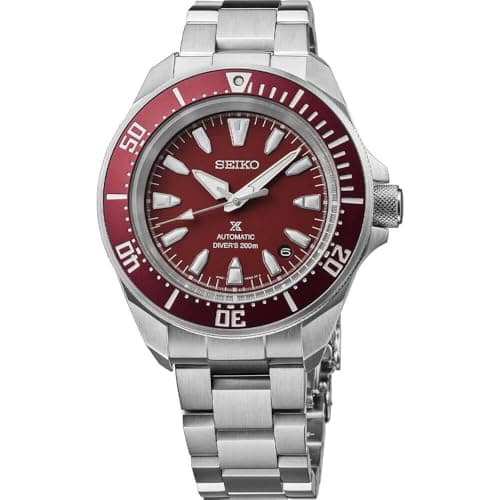
No buyable offer at the last check (October 25, 2026). We show nothing rather than a stale number.
#ad · we may earn a commission from this link to Seiko Prospex Samurai SRPL11
Seiko Prospex Samurai SRPL11
SRPL11K1Best for: A real ISO diver for a wrist that the Turtle overwhelms
The 2024 Samurai, redesigned smaller. A 200 m ISO diver at 41.7 mm with a screw-down crown and a red dial — the compact end of Seiko's mechanical diver range.
- Spec completeness for the price
- 8.5
- Movement relative to bracket
- 8.4
- Case proportions
- 8.2
- Strap flexibility
- 9.0
- Availability
- 8.6
What it gets right
- 41.7 mm and 12.3 mm — the slimmest, smallest case in Seiko's ISO diver range
- Genuine ISO 6425 diver with a screw-down crown, not a diver-styled sports watch
- Bracelet ships with a diving extension
What it gets wrong
- Hardlex, on a diver at this price
- 49.5 mm lug-to-lug is long relative to the 41.7 mm case — it wears larger than the diameter suggests
- 4R35 drops the day, so it is date-only
Skip this one if: your wrist is under about 6.5 inches. The diameter looks modest but the 49.5 mm lug-to-lug is longer than the 45 mm Turtle's, and that is the number that decides fit.
| Case diameter | 41.7 mm |
|---|---|
| Lug-to-lug | 49.5 mm |
| Thickness | 12.3 mm |
| Lug width | 20 mm |
| Crystal | Hardlex (hardened mineral) |
| Water resistance | 200 m, ISO 6425 rated for scuba diving |
| Crown | Screw-down |
| Bezel | Unidirectional rotating |
| Caliber | Seiko 4R35 |
| Type | Automatic, hand-winding and hacking |
| Beat rate | 21,600 vph (6 beats/sec) |
| Jewels | 23 |
| Power reserve | Approx. 41 hours |
| Stated accuracy | -35 to +45 sec/day |
| Complications | Date |
Questions
Is the Seiko Sumo bigger than the Samurai?
Yes, in every dimension. The Sumo SPB103J1 is 45.0 mm across, 52.6 mm lug-to-lug and 12.9 mm thick; the 2024 Samurai SRPL11 is 41.7 mm, 49.5 mm and 12.3 mm. The 3.1 mm difference in lug-to-lug is the one that decides fit.
Does the Seiko Samurai have a sapphire crystal?
Not the 2024 references. Seiko publishes Hardlex for the SRPL11, SRPL13 and SRPL15. The Sumo SPB103J1 has sapphire, which is one of the two upgrades it carries over the Samurai.
What is the power reserve of the Sumo and the Samurai?
About 70 hours for the Sumo’s 6R35 and about 41 hours for the Samurai’s 4R35. Both beat at 21,600 vph, so the longer reserve does not come with a smoother seconds hand.
Do the Sumo and the Samurai use the same lug width?
Yes: 20 mm on both the Sumo and the 2024 Samurai. The older Samurai case used by the SRPF03 takes 22 mm, so straps cut for that watch will not fit the new one.
Is the SPB103 the current Sumo?
It is the 2019 reference. Seiko updated the Sumo in 2022 as the SPB321 and SPB323, which Monochrome reports keep the same case and 6R35 and add a ceramic bezel insert and a hard coating. The SPB103J1 is the Sumo that came back orderable on Amazon when we checked in September 2026.
Are the Sumo and the Samurai both real dive watches?
Yes. Both are rated 200 m to ISO 6425, with screw-down crowns and unidirectional bezels. The certification is identical; the differences are the crystal, the movement and the case.
Does either watch show the day?
No. The 6R35 and the 4R35 are both date-only calibers. If you want the day as well, the 4R36 in the Turtle and the King Turtle carries it.
Sources
- Seiko — Prospex SPB103J1 published specifications
- Seiko USA — Prospex SRPL11 published specifications
- Seiko USA — Prospex SRPL13 published specifications
- Seiko USA — Prospex SRPL15 published specifications
- Monochrome Watches — review of the 2022 Seiko Sumo SPB321J1 and SPB323J1
- Seiko Prospex collection — official specifications
- ISO 6425 — Horology, divers' watches (standard listing)
- Seiko instruction manuals and caliber documentation
Specifications are transcribed from manufacturer documentation and published standards. Where a manufacturer does not publish a figure, this page says so rather than estimating one.
Read next
- Seiko SumoWhat the Sumo is, and the other Prospex divers to weigh against it.
- Seiko Samurai referenceThe older SRPF03 Samurai case, spec by spec, against the Turtle.
- Best Seiko dive watchesBoth case families in context with the rest of the ISO range.
- 4R36 vs 6R35The movement step behind the price step.
- Hardlex vs sapphireThe crystal difference, and where it does not matter.