Head-to-head
Grand Seiko vs Seiko
Grand Seiko has been a separate brand since 2017, competing with Swiss high-end. Mainstream Seiko is the value line. Same corporate group, very different watches.
By Stephen V. · Updated Aug 8, 2026
“Grand Seiko versus Seiko” sounds like a comparison within one brand, and it stopped being that in 2017. Grand Seiko became a separate brand that year, spun out to stand on its own against the Swiss high end, and it now competes with manufacturers many multiples of mainstream Seiko’s price. The two share a corporate parent and a great deal of engineering heritage, but they are aimed at completely different buyers. Mainstream Seiko — the value line, represented here by the Prospex SPB117 and the Presage Cocktail Time SRPB43 — is where most people start. Grand Seiko starts in the low four figures and climbs well past that, into genuine luxury. This page is about how far apart they really are, and why they still feel related.
| Axis | Seiko | Grand Seiko |
|---|---|---|
| Position | Value / mainstream | Independent luxury brand since 2017 |
| Price | Value, up to the low four figures | Starts in the low four figures and climbs well past |
| Case finishing | Machine-finished, competent | Zaratsu hand-polishing |
| Dials | Well-made for the price | Hand-finished, often textured |
| Movements | 4R and 6R automatics (4R35, 6R35) | High-beat, Spring Drive, hand-assembled |
| Corporate group | Seiko Group | Seiko Group, operated independently |
| Competes with | Value Swiss and Japanese | Swiss high-end |
They are two brands now
The most important fact first: since 2017, Grand Seiko has been an independent brand, not a range within Seiko. Before that it was a top-tier Seiko line; now it has its own name, its own boutiques and its own market position, deliberately separated so it would not be read as “the expensive Seiko” but as a luxury manufacturer in its own right. The two still sit under the same corporate group, and Grand Seiko still draws on Seiko’s manufacturing depth, but the branding split was the point. It let Grand Seiko be judged against Swiss high-end names rather than against a supermarket Seiko 5, which is exactly the company it wants to keep. Treating them as one brand with a cheap end and an expensive end misreads what happened.
What Grand Seiko is competing with
Swiss high-end, openly and on its own terms. Its case work is defined by Zaratsu polishing — a hand-held, distortion-free mirror polishing done against a spinning plate, which produces the flat, blade-sharp reflective surfaces the brand is known for. Its dials are hand-finished and frequently textured, modeled on natural scenes, and assembled to a standard that stands next to anything from Switzerland. And its signature movement technology, Spring Drive, is genuinely its own: a mechanical mainspring regulated electronically, giving a seconds hand that glides rather than ticks or beats and accuracy a normal automatic cannot reach. High-beat mechanical calibers sit alongside it. This is not value engineering — it is a manufacturer trying to out-finish the Swiss, and by most accounts succeeding.
What mainstream Seiko is
The value line, and proudly so. It is where you find in-house mechanical watchmaking at prices that undercut almost everything comparable, built around workhorse automatic calibers — the 4R and 6R families — rather than hand-finished movements. The SPB117 is a good example of its ceiling: a 39.5 mm sapphire diver, 200 m and ISO 6425, on the 70-hour 6R35, a genuinely refined watch that still costs a fraction of any Grand Seiko. The Cocktail Time SRPB43 sits lower still, a dress automatic on the 4R35 with a box crystal. These are excellent watches for the money, and “for the money” is the whole identity of the line. See the sub-four-figure field for where the top of mainstream Seiko lands, and the Cocktail Time reference for the dress end.
The three things that separate them
Finishing, dials and movements, in roughly that order of visibility. The finishing gap is the one you see first: Zaratsu-polished Grand Seiko cases throw sharp, undistorted reflections that machine-finished mainstream Seiko cases, competent as they are, simply do not attempt. The dials are next: Grand Seiko hand-finishes and textures its dials to a level a 4R-powered Seiko does not, and the difference is obvious in the metal even if photographs flatten it. And the movements are the deepest gap — Spring Drive and high-beat mechanical calibers, hand-assembled and regulated to tight tolerances, against the perfectly good but industrially produced 4R and 6R automatics in mainstream Seiko. Each of these costs real money to do, which is much of why the prices sit where they do — see why Seiko watches cost what they do.
Same group, different watches
It is fair to ask how two brands under one corporate roof end up so far apart, and the answer is that they are built to different briefs with different budgets. Grand Seiko is engineered and finished without the cost ceiling that defines mainstream Seiko, because its buyers are paying for exactly that finishing. Mainstream Seiko is engineered to a price, because its buyers are paying to get into a real mechanical watch cheaply. The shared parent means Grand Seiko can draw on decades of Seiko manufacturing know-how, which is part of why it can challenge the Swiss at all — but the watches that reach your wrist are not two versions of one thing. They are two different products for two different customers who happen to share a corporate ancestor.
Where the shared heritage still shows
For all the distance between them, the family resemblance is real, and it explains why the comparison gets made at all. Grand Seiko can challenge the Swiss partly because it inherits decades of Seiko manufacturing depth — the same corporate group that makes millions of value watches also gives Grand Seiko a base of movement engineering, case-making and dial work to build its luxury pieces on. You can occasionally see the lineage in a shared design language or a case profile that echoes a mainstream reference. But inheritance is not equivalence: a Grand Seiko takes that shared foundation and adds hand-finishing, better materials and a movement built to a standard mainstream Seiko never attempts. The heritage is why they feel related; the finishing is why they are not the same watch.
The honest read for a buyer
You are not really cross-shopping these, and that is the useful conclusion. If your budget is mainstream-Seiko money, a Grand Seiko is not an option and comparing them only tells you what the ceiling looks like. If your budget is Grand Seiko money and you want that finishing, a mainstream Seiko will feel like a different class of object — because it is. The interesting question is not “which is better” — the Grand Seiko is more watch, at many times the price, and that is not in dispute — but “which league are you shopping in.” The is Seiko a luxury brand guide and the line hierarchy map the whole ladder from a Seiko 5 to Grand Seiko so you can place yourself on it honestly.
Is the finishing gap visible to a normal buyer?
A fair question, since “Zaratsu polishing” and “hand-finished dials” can sound like enthusiast shorthand for something you would need a loupe to see. The honest answer is that yes, the gap is visible, though it is easier to feel in person than to capture in a photograph. Grand Seiko’s mirror-polished case flanks throw a clean, undistorted reflection that reads almost like liquid metal, where a machine-finished Seiko case, good as it is, shows the faint softness of an industrial process. The dials are the clearer tell: Grand Seiko’s textures and applied markers catch light with a sharpness and depth that a 4R-powered Seiko dial, competent and clean, does not chase. Under a jeweler’s light, side by side, most people see it immediately even if they cannot name what they are seeing. In a photograph, or across a room, much of it disappears — which is part of why the value line is such good value. You are paying mainstream Seiko money for most of the function and a photograph’s worth of the look. Grand Seiko money buys the part of the finishing that only reveals itself up close, in the metal, over time. Whether that part is worth many multiples of the price is entirely a question of how much you care about the object as opposed to the reading on its dial — and that is a question only you can answer honestly.
Buy mainstream Seiko if
You want a genuine in-house mechanical watch and value is the point — the most watch for the money, not the finest finishing at any price. The SPB117 is close to the ceiling of what the line does, and the Cocktail Time shows its dress end. Both are excellent for what they cost, and neither is pretending to be a Grand Seiko. Start with the sub-four-figure field to see where the top of mainstream Seiko sits.
Step up to Grand Seiko if
Zaratsu finishing, hand-finished dials and Spring Drive are what you actually want, and your budget is luxury money rather than value money. That is a different purchase in a different league, starting in the low four figures and climbing well past — and if it is the finishing and the movement technology drawing you, nothing in mainstream Seiko will substitute for it. Read up on Spring Drive first, since it is the technology that most defines what you would be paying for.
The watches on this page
Specifications are transcribed from Seiko’s published documentation. Prices come from Amazon and carry the date they were verified. We have not handled these watches — here is what we did instead.
No buyable offer at the last check (October 23, 2026). We show nothing rather than a stale number.
#ad · we may earn a commission from this link to Seiko Prospex SPB117
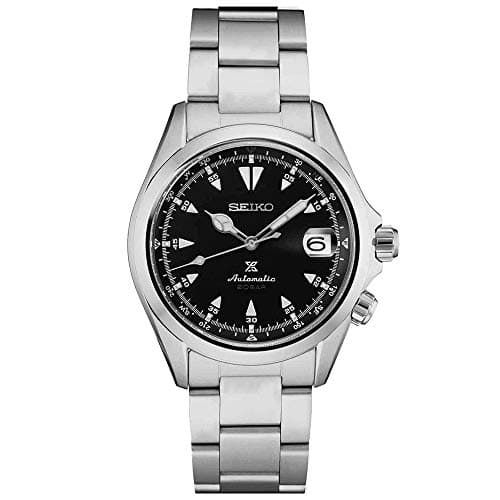
Seiko Prospex SPB117
SPB117J1Best for: The best-proportioned Seiko diver, if the budget stretches
The 62MAS-lineage diver: 39.5 mm, sapphire, and the 70-hour 6R35. This is where Seiko stops compromising, and the price step reflects it.
- Spec completeness for the price
- 9.3
- Movement relative to bracket
- 9.2
- Case proportions
- 9.6
- Strap flexibility
- 9.2
- Availability
- 7.9
What it gets right
- 70-hour power reserve — leave it off over a weekend and it is still running
- Sapphire, and a tighter stated accuracy spec than the 4R family
- 39.5 mm with a 46.4 mm lug-to-lug is the most universally wearable diver Seiko makes
What it gets wrong
- Roughly double the price of a Turtle
- 6R35 is still a 21,600 vph movement, so the seconds sweep is no smoother
- 20 mm lugs on a diver feel narrow to some
Skip this one if: your budget is doing other work. A Turtle is the same water rating and the same 6-beat sweep for half the money; what you buy here is sapphire, the power reserve and the proportions.
| Case diameter | 39.5 mm |
|---|---|
| Lug-to-lug | 46.4 mm |
| Thickness | 12.4 mm |
| Lug width | 20 mm |
| Crystal | Sapphire with anti-reflective coating |
| Water resistance | 200 m, ISO 6425 rated |
| Crown | Screw-down |
| Caliber | Seiko 6R35 |
| Type | Automatic, hand-winding and hacking |
| Beat rate | 21,600 vph (6 beats/sec) |
| Jewels | 24 |
| Power reserve | Approx. 70 hours |
| Stated accuracy | -15 to +25 sec/day |
| Complications | Date |
No buyable offer at the last check (October 23, 2026). We show nothing rather than a stale number.
#ad · we may earn a commission from this link to Seiko Presage Cocktail Time SRPB43
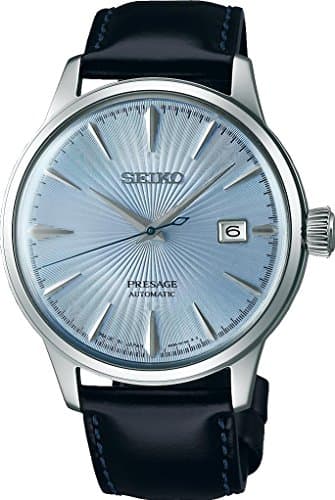
Seiko Presage Cocktail Time SRPB43
SRPB43J1Best for: A dress watch that looks like it cost three times the money
The blue Cocktail Time. A box-shaped crystal over a deeply textured dial — the most expensive-looking watch Seiko sells at this price by a wide margin.
- Spec completeness for the price
- 8.6
- Movement relative to bracket
- 8.4
- Case proportions
- 8.5
- Strap flexibility
- 9.2
- Availability
- 8.4
What it gets right
- The box crystal distorts light at the edges the way vintage acrylic did
- Sunburst dial texture that photographs badly and looks superb in person
- Exhibition back
What it gets wrong
- 50 m, so it is not a swim watch
- 47.6 mm lug-to-lug is long for a 40.5 mm dress case
- Hardlex on a curved crystal is harder to polish than a flat one
Skip this one if: you need one watch for everything. At 50 m and on a leather strap this is a shirt-cuff watch — pair it with a diver rather than asking it to be one.
| Case diameter | 40.5 mm |
|---|---|
| Lug-to-lug | 47.6 mm |
| Thickness | 11.8 mm |
| Lug width | 20 mm |
| Crystal | Box-shaped Hardlex |
| Water resistance | 50 m — splash resistant, not for swimming |
| Display back | Yes — exhibition caseback |
| Caliber | Seiko 4R35 |
| Type | Automatic, hand-winding and hacking |
| Beat rate | 21,600 vph (6 beats/sec) |
| Jewels | 23 |
| Power reserve | Approx. 41 hours |
| Stated accuracy | -35 to +45 sec/day |
| Complications | Date |
If you are choosing where to start
Most people meet Seiko through the value line and only later wonder about Grand Seiko, and that is a sensible order. A mainstream Seiko teaches you what you actually value in a watch — whether it is the mechanical movement, the finishing, the size, the dial — for a fraction of the cost of finding out at the luxury end. If, after living with one, what you keep wanting is sharper finishing and a movement like Spring Drive, that is the signal to save for a Grand Seiko rather than to buy another mainstream piece. If what you have is already enough, the value line has done its job. The ladder runs one way, and there is no need to climb it faster than your own taste asks you to.
Questions
Is Grand Seiko the same as Seiko?
Not since 2017, when Grand Seiko became a separate brand. They share a corporate group and engineering heritage, but Grand Seiko competes with Swiss high-end and starts in the low four figures, while mainstream Seiko is the value line built to a price.
Why is Grand Seiko so much more expensive?
Zaratsu hand-polishing, hand-finished dials, and movements like Spring Drive and high-beat calibers, all assembled to a luxury standard. Those cost far more to produce than the industrial 4R and 6R automatics in mainstream Seiko.
What is Spring Drive?
Grand Seiko’s signature movement: a mechanical mainspring regulated electronically, giving a gliding seconds hand and accuracy a normal automatic cannot reach. It is one of the main things separating Grand Seiko from mainstream Seiko, covered in the Spring Drive guide.
Is a mainstream Seiko a good watch if I cannot afford Grand Seiko?
Yes. Mainstream Seiko is in-house mechanical watchmaking at a fraction of Grand Seiko money, and watches like the SPB117 are genuinely refined. It is a different league, not a lesser version of the same watch.
Are Grand Seiko and Seiko owned by the same company?
They sit under the same corporate group, but Grand Seiko operates as an independent brand with its own name, boutiques and market position, deliberately separated in 2017 so it would be judged against Swiss luxury rather than against mainstream Seiko.
Sources
Specifications are transcribed from manufacturer documentation and published standards. Where a manufacturer does not publish a figure, this page says so rather than estimating one.
Read next
- Is Seiko a luxury brand?Where mainstream Seiko and Grand Seiko sit on the luxury ladder.
- Spring Drive vs quartzThe movement technology that defines Grand Seiko.
- Seiko's lines explainedThe full ladder from Seiko 5 up to Grand Seiko.
- Why Seiko watches cost what they doWhat the price gap between the lines is made of.
- Seiko vs RolexWhat ten to twenty times the price buys, and where it does not.