Head-to-head
Seiko 5 vs Citizen Eco-Drive
The classic mechanical-versus-solar decision. As an instrument the Eco-Drive wins; as a mechanical object the Seiko does. Which sentence is yours settles it.
By Stephen V. · Updated Aug 8, 2026
This is the oldest decision in affordable watches wearing modern clothes: mechanical or solar. On one side, the Seiko 5 Sports SRPD93 — a 42.5 mm automatic on the 4R36, rated 100 m, the kind of watch you wind by wearing. On the other, the Citizen Promaster Dive Eco-Drive — a 200 m, ISO-compliant diver powered by light, on a polyurethane strap, that never takes a battery and never needs winding. They occupy the same shelf and answer opposite instincts. One is a mechanical object you tend; the other is an instrument you forget about. Being honest about which you actually want is most of the work here.
| Seiko 5 Sports SRPD93 | Citizen Promaster Dive Eco-Drive | |
|---|---|---|
| Movement | Seiko 4R36 mechanical | Eco-Drive solar quartz |
| Powered by | Automatic winding | Light (no battery ever) |
| Case diameter | 42.5 mm | 44 mm |
| Lug-to-lug | 46.0 mm | Not published |
| Thickness | 13.4 mm | Not published |
| Lug width | 22 mm | 20 mm |
| Crystal | Hardlex | Mineral |
| Water resistance | 100 m | 200 m, ISO-compliant |
| Strap | Not published | Polyurethane |
| Battery | None (mechanical) | None (solar) |
The one question that decides it
Do you want the watch to be mechanical? That is the whole decision. If yes, buy the Seiko 5: it is an automatic with a rotor, character and a movement that is the entire reason some people own a watch, and the diver-level version of this matchup only reinforces it. If you do not care whether there is a rotor inside, buy the Eco-Drive: it keeps far tighter time, never needs winding or a battery, and out-rates the Seiko on water. As a pure timekeeping tool the Citizen is the better watch; as a mechanical thing to own, it is not competing at all. Answer that one question honestly and the rest is detail.
As an instrument, the Eco-Drive wins
There is no polite way around it, and no reason to look for one. Eco-Drive is the most mature light-powered platform anyone sells — decades of refinement, a cell that charges from any light and never gets replaced, and quartz accuracy that a mechanical movement cannot approach. A 4R36 in the Seiko is a mechanical movement that runs fast or slow by seconds a day and stops if you set it down for a couple of days; the Eco-Drive holds quartz time and asks nothing of you at all. Add a 200 m rating and ISO-compliant construction and, measured as a tool — accuracy, water capability, maintenance — the Citizen is simply the better watch, and it usually costs less. If that is how you score a watch, stop here and buy it. And if you have already decided on light power and are choosing between brands, Seiko Solar vs Citizen Eco-Drive lines up both brands’ manuals: rate, reserve and charging time.
As a mechanical object, the Seiko wins
And measured the other way, the result flips just as cleanly. The Seiko 5 has a rotor you can feel wind as you move, a mechanism that is the point of the purchase rather than a means to a reading on a dial. It is the reason mechanical watches still exist in a world that solved accuracy with quartz fifty years ago: people want the object, not just the time. The 4R36 hacks and hand-winds, it sits in a 42.5 mm case with a day-date, and it plugs into a strap ecosystem and a modding community the Eco-Drive has no equivalent to. None of that makes it keep better time — it plainly does not — but keeping time is not why anyone buys a mechanical watch. See whether Seiko is a good brand for the wider case, and the 4R36 reference for the movement itself.
The water and certification gap
The table’s clearest lead for Citizen is water: 200 m and ISO-compliant against the Seiko 5’s 100 m. Both will swim without concern, but the Eco-Drive is built and described as a dive watch in a way the Seiko 5 is not — the SRPD93 wears dive styling without a dive certification, where the Promaster carries the depth rating and the ISO-compliant construction to back the look. If the watch will genuinely see the water rather than just reference it, that is a real point for Citizen. If the diving is aesthetic — a bezel you like the look of and never time anything with — then 100 m is already more than the wear demands, and the gap is one you will never actually reach.
The strap ecosystem
One advantage the spec sheet undersells: the Seiko 5’s 22 mm lugs are the single most-supported width in the aftermarket, so the watch takes almost any strap made and is a natural base for a rotation of them. The Eco-Drive arrives on a polyurethane strap that is functional rather than lovely, and the Promaster case is less open to casual swapping. If changing the look of a watch by changing its strap is part of the fun for you, the Seiko is by some distance the more flexible platform. If you would put a watch on and wear it as bought for years, that flexibility is worth nothing to you, and the Citizen’s tool strap is simply part of a tool watch. It is the same feature read two different ways.
Two different ways to live with a watch
Beyond the spec sheet, these two ask completely different things of you day to day, and that is worth picturing before you buy. The Seiko 5 is a watch you participate in. Worn daily, its automatic winding keeps it running off your own motion; left off for a couple of days, it stops, and you wind the crown and reset it to start again. Some people find that a small pleasure — a ritual that makes the watch feel alive — and some find it a recurring chore that slowly stops them reaching for it. The Eco-Drive asks for none of that. It charges from light through the dial, holds accurate time on its own, and if you set it down for a month it is still running and still right when you pick it up. There is no winding, rarely any resetting, and never a battery to change. Neither model of ownership is better in the abstract; they suit different temperaments. If the involvement is part of why you want a watch, the Seiko rewards it. If a watch is a tool you would rather not think about, the Citizen removes every point of friction the Seiko keeps. The honest test is to imagine the watch after the novelty has worn off: which relationship still sounds appealing on a busy Monday, the one you tend or the one you forget, is the one to buy.
The published-data asymmetry
Notice that the Citizen’s lug-to-lug and thickness rows read “not published.” That is not an oversight on this page; Citizen simply discloses less dimensional detail in its retail listings than Seiko does. The Seiko 5 has a case diameter, a lug-to-lug and a thickness you can check before you commit; the Eco-Drive’s equivalent figures are not stated in the same way, so part of buying the Citizen is accepting you will confirm fewer numbers before it arrives. For a mail-order purchase, where you cannot try it on first, that is a genuine cost that has nothing to do with how good the watch is — the broader Seiko versus Citizen comparison runs into the same asymmetry across the range.
The cons on each side
Neither is beyond criticism. The Seiko 5’s weak points are the ones any 4R watch has: it loses seconds a day where the Citizen loses none, it stops if you leave it off for a couple of days, its Hardlex crystal scratches more readily than a sapphire, and at 13.4 mm it is a touch thick for its diameter. The Eco-Drive’s catch is philosophical for some and practical for others — it is quartz, so there is no rotor to enjoy and no mechanical soul to it, its polyurethane strap is plain, and its case dimensions are not published for you to check. Each of these is a fair price for what the watch does well, and none of them is hidden. Choosing well means picking the set of compromises you can live with, not pretending one watch has none.
Buy the Seiko 5 if
You want a mechanical watch — a rotor, character, a movement that is the reason you are buying at all — and you like the idea of building a strap rotation on 22 mm lugs. You want a published case size before you commit, and 100 m is plenty for how you will actually wear it. See the full SRPD93 reference, or the wider Seiko 5 lineup, for where it sits.
Buy the Citizen Eco-Drive if
You want a watch that keeps accurate time and never needs winding or a battery, you want 200 m and ISO-compliant construction, and you are not attached to the movement being mechanical. It is the better instrument and usually the cheaper one, and if you would rather forget a watch than tend it, it is the right choice without apology. The Seiko diver versus Promaster comparison covers the mechanical Citizen alternative if that tempts you too.
The watches on this page
Specifications are transcribed from Seiko’s published documentation. Prices come from Amazon and carry the date they were verified. We have not handled these watches — here is what we did instead.
No buyable offer at the last check (October 23, 2026). We show nothing rather than a stale number.
#ad · we may earn a commission from this link to Seiko 5 Sports SRPD93
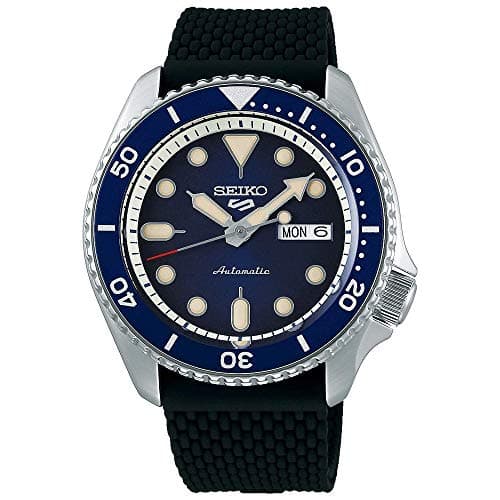
Seiko 5 Sports SRPD93
SRPD93Best for: A first mechanical watch you will not outgrow
The 5KX case with a movement that hacks and hand-winds, in blue on a silicone strap. The default answer under $350, and the one most people should stop looking after.
- Spec completeness for the price
- 8.8
- Movement relative to bracket
- 8.5
- Case proportions
- 8.9
- Strap flexibility
- 9.5
- Availability
- 8.8
What it gets right
- Hacks and hand-winds — the SKX's biggest omission, fixed
- 22 mm lugs put the entire aftermarket strap catalog in play
- Day-date in a genuinely legible layout
- Case shape is the SKX profile people actually want
What it gets wrong
- Hardlex, not sapphire — it will scratch
- 100 m and no screw-down crown, so it is not an ISO 6425 diver despite the looks
- 13.4 mm thick under a shirt cuff
- Ships on a silicone strap rather than a bracelet
Skip this one if: you want an actual dive watch. The 100 m rating and the absence of a screw-down crown mean this is a dive-styled sports watch, not an ISO 6425 diver. The Turtle is the real one.
| Case diameter | 42.5 mm |
|---|---|
| Lug-to-lug | 46.0 mm |
| Thickness | 13.4 mm |
| Lug width | 22 mm |
| Crystal | Hardlex (hardened mineral) |
| Water resistance | 100 m — splash and swim, not scuba |
| Bezel | Blue unidirectional rotating |
| Dial | Blue sunray |
| Strap | Black silicone |
| Case back | See-through |
| Lume | LumiBrite |
| Caliber | Seiko 4R36 |
| Type | Automatic, hand-winding and hacking |
| Beat rate | 21,600 vph (6 beats/sec) |
| Jewels | 24 |
| Power reserve | Approx. 41 hours |
| Stated accuracy | -35 to +45 sec/day |
| Complications | Day and date |
$450.0034% off
Price as of October 23, 2026. Prices move — Amazon's is the one that counts.
#ad · we may earn a commission from this link to Citizen Promaster Dive Eco-Drive
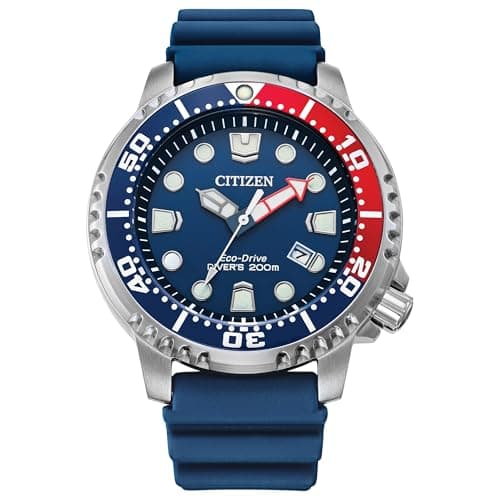
Citizen Promaster Dive Eco-Drive
BN0168-06LBest for: A light-powered ISO diver you never service on a schedule
The solar diver that most directly rivals Seiko's SNE line. Eco-Drive is the most mature light-powered platform anyone sells.
- Spec completeness for the price
- 8.5
- Movement relative to bracket
- 8.6
- Case proportions
- 8.1
- Strap flexibility
- 8.4
- Availability
- 8.7
What it gets right
- Eco-Drive has a longer track record than any competing solar platform
- 200 m ISO-compliant rating
- No winding and no battery
What it gets wrong
- Quartz tick
- Polyurethane strap
- No exhibition back
Skip this one if: the movement being mechanical is the point of the purchase. This is the better watch on every measurable axis and the wrong watch if that is what you want.
| Brand | Citizen |
|---|---|
| Case diameter | 44 mm |
| Lug width | 20 mm |
| Crystal | Mineral |
| Water resistance | 200 m, ISO compliant, screw-down crown |
| Movement | Citizen Eco-Drive E168, light-powered quartz |
| Stated accuracy | ±15 sec/month |
| Power reserve | Approx. 6 months from full charge |
| Strap | Polyurethane |
| Charge | Runs on any light source; no battery replacement |
If you are genuinely torn
Let your servicing habits break the tie. A mechanical Seiko will eventually want a service, and in the meantime it wants wearing or winding to stay alive; an Eco-Drive wants a windowsill and nothing else. If the idea of maintaining a watch appeals to you as part of owning one, that instinct points at the Seiko. If it reads as a chore, the Citizen removes it entirely — no winding, no setting most of the time, no battery, ever. Neither answer is wrong, and neither watch is trying to be the other. The mistake is buying the mechanical watch and resenting the upkeep, or buying the solar watch and missing the rotor.
Questions
Is a Seiko 5 or a Citizen Eco-Drive more accurate?
The Eco-Drive, by a wide margin. It is quartz, so it keeps far tighter time than the mechanical 4R36 in the Seiko 5, which runs fast or slow by seconds a day. Accuracy is the Citizen’s clearest win.
Does the Eco-Drive ever need a battery?
No. Eco-Drive charges from light and never takes a replaceable battery, which is the platform’s headline feature. The Seiko 5 has no battery either, but it is mechanical: it needs winding or wearing to keep running.
Which is more water-resistant?
The Citizen. The Promaster Dive Eco-Drive is 200 m and ISO-compliant; the Seiko 5 SRPD93 is 100 m and carries dive styling without a dive certification. Both swim, but only the Citizen is built as a dive watch.
Is a mechanical watch worth it over solar?
Only if you want the mechanism. As an instrument the Eco-Drive wins on accuracy, water and maintenance. People buy the Seiko for the rotor and the character, which is a real reason, just not a technical one.
Why are so many of the Citizen's specs 'not published'?
Citizen discloses less dimensional detail than Seiko in its retail listings, so figures like case diameter and lug-to-lug are not stated the way the Seiko’s are. If fit is how you decide, that missing data is a real drawback of buying sight-unseen.
Sources
- Seiko Watch Corporation — US catalog and specifications
- Seiko 5 Sports collection — official specifications
- Citizen Watch Company — official specifications
Specifications are transcribed from manufacturer documentation and published standards. Where a manufacturer does not publish a figure, this page says so rather than estimating one.
Read next
- Seiko vs CitizenThe full brand comparison behind this matchup.
- Seiko diver vs Citizen PromasterThe 200 m dive-level version, including Citizen's automatic.
- Seiko 4R36 caliber referenceThe mechanical movement inside the Seiko 5.
- Is Seiko a good brand?The wider case for buying mechanical Seiko.
- Seiko 5 vs Citizen TsuyosaThe same brands, with an integrated bracelet in the way.