Answers
Buying a vintage Seiko
The dial sells the watch and the caliber decides whether you get to keep it. Seiko publishes the list of calibers it will no longer touch, so check that first.
By Stephen V. · Updated Sep 24, 2026
Before condition, price or dial, check the caliber. Seiko’s US service center publishes a list of calibers it will no longer repair because the parts are gone — fifteen mechanical and thirty quartz, including the 6139 chronograph Seiko celebrates on its own heritage page. A watch on that list is a watch that cannot be put right when it stops. Everything else about a vintage Seiko is negotiable; that is not.
Where we stand on this
This site earns a commission when you buy a watch through its links, and every one of those links goes to a watch that is currently in production. We sell nothing vintage, we cannot inspect a used watch, and we will not quote a used price — the used market has no published price and no published condition, and a number we made up would be worth less than no number at all. So read this page as what it is: the documentation we can actually verify about servicing and ownership, followed by the new references that give you the same look with a service path behind them. If the documentation talks you out of a vintage purchase, good. If it does not, you will at least have budgeted for it.
What people mean by “vintage Seiko”
There is no official cutoff. Seiko publishes no definition of vintage and does not use the word as a category. What people are usually pointing at is the run of watches from the early 1960s to some time in the 1990s, and Seiko’s own heritage timeline is the cleanest map of it. The dates that matter to a buyer:
- 1960 — Grand Seiko. Seiko describes it as a timepiece embodying its original technologies and its highest levels of design and manufacturing expertise. The top of the house, then and now.
- 1961 — King Seiko.Seiko’s own framing is accuracy and quality “with a more accessible price point.” This is the line the “vintage King Seiko” searches are aimed at.
- 1965 — the first Japanese diver’s watch. Automatic, water resistant to 150 m, and, per Seiko, worn by Antarctic explorers and mountaineers. Every Prospex diver descends from this.
- 1967 — the first Japanese 300 m diver.One-piece case construction and a Hardlex crystal, which is where Seiko’s long attachment to Hardlex starts.
- 1968 — Seiko 5 Sports. Seiko describes it as an enhanced 5 with 70 m water resistance, Hardlex and a range of colors aimed at younger buyers. The ancestor of the SRPD-series 5 Sports on the shelf today.
- 1969 — two of them.The Quartz Astron on December 25, which Seiko calls the world’s first quartz wristwatch, and the world’s first automatic chronograph with a vertical clutch, caliber 6139 Speedtimer. Remember that caliber number; it comes back later on this page.
Notice what that timeline does not give you: reference numbers. Seiko’s heritage pages talk in eras and calibers, not in the four-digit-dash-four-digit codes collectors trade in. If you want to know what the watch in front of you actually is, the caseback tells you, and reading a Seiko casebackcovers both numbers stamped there — the caliber-and-case reference and the production serial. Start there, because the next section needs the caliber.
The caliber decides whether the watch has a future
A vintage watch is a mechanism that will eventually need parts. Seiko is unusually direct about what happens then. Its customer-service FAQ on old watches says that “for repair of old watches, there may be a depletion of the parts in stock, and sometimes a watch cannot be repaired due to the discontinuation of necessary parts”, and that where that happens Seiko will “have to return your watch unrepaired.”
That is the general warning. The specific version is better, and almost nobody shopping for a vintage Seiko seems to know it exists: Seiko Service USA publishes the actual list. Under the heading “the following calibers are no longer available for service as parts have been discontinued for many years and there is no longer any stock”, it names forty-five calibers and adds: “You are kindly requested not to send watches with these calibers as they will be returned unrepaired.” Here is the list as published, so you can check a caseback against it before you bid on anything.
| Type | Calibers |
|---|---|
| Mechanical | 1104, 1520, 2409, 2517, 2706, 2906, 4006, 5126, 5606, 6138, 6139, 6206, 6619, 7025, 7625 |
| Quartz | 0903, 1400, 1600, 2620, 3421, 5T50, 5T52, 6730, 7122, 7123, 7548, 7549, 7751, 7752, 7759, 7800, 7810, 7812, 7813, 7820, 7K52, 7N49, 8122, 8123, 8620, 8621, H357, H556, H557, H558 |
Read the mechanical row again. 6139is on it — the caliber Seiko names on its own heritage page as the world’s first automatic chronograph with a vertical clutch, the movement inside the watches that get called the most collectible vintage Seikos of all. Seiko is proud of it in its museum and will send it back to you unrepaired in its service department. Both things are true at once, and a buyer who only reads the heritage page learns the first one.
What the list does not say
It is worth being precise, because a list like this gets over-read in both directions.
- It is a US list. It is what Seiko Service USA will and will not take in. The same page separately flags a set of calibers that must go to Japan for service, with a five-to-eight-week lead time plus shipping and customs on top. An independent watchmaker is a different route again, with different parts sources.
- Absence is not a promise. The famous vintage diver calibers are not on it, and neither is the 7S26. That does not mean every part for them is sitting in a drawer — the general FAQ warning about stock depletion still applies. It means Seiko’s US service center has not declared them dead.
- It can change. Parts stock only goes one way. The list we transcribed is the list on the page on the date in the table caption, and a caliber that is fine this year is not guaranteed to be fine in five.
- Parts are not the only failure. A cracked Hardlex crystal, a corroded case or a worn-out bezel insert are not movement parts, and for a discontinued reference they can be just as hard to source.
What a service costs, from Seiko’s own price list
If the caliber is serviceable, the next question is what that costs, and this is the other thing Seiko publishes that almost nobody quotes. Seiko Service USA lists retail movement service prices by caliber family. The figures relevant to anything a vintage or modern-vintage-style shopper is looking at:
| Caliber family | Price |
|---|---|
| 7S / 2R mechanical | $137.00 |
| 4R mechanical | $176.00 |
| 6R mechanical | $296.00 |
| 8R mechanical | $373.00 |
| 8L / 6L mechanical | $398.00 |
| Other mechanical | $359.00 |
| 5R6 Spring Drive | $630.00 |
| Discontinued quartz calibers | $204.00 |
| Analog battery or rechargeable quartz | $100.00 to $135.00 |
Seiko states what the money buys: complete service of the movement, fixing or replacing necessary movement parts, ultrasonic cleaning, lubrication, timing adjustment and accuracy testing to the caliber specification, and — the line that matters most on an old watch — replacement of gaskets and water resistance testing. The work carries a twelve-month guarantee on Seiko watches. Prices, the page says, are subject to change without notice.
Now do the arithmetic that actually decides a purchase. Suppose you find a tidy vintage Seiko 5 for a couple of hundred dollars. It is forty years old, so assume it needs an overhaul; that is a further $137 if the movement is a 7S, or $359if it falls into “other mechanical.” You are now past the price of a brand-new Seiko 5 with a three-year warranty, and you still have a forty-year-old case, crystal and bracelet. That is not an argument against buying vintage. It is an argument against buying vintage as the cheap option, which is how it is usually sold. Our page on what servicing a Seiko involves works through the same replace-versus-service decision on a modern reference.
Three years, and why a watch in a drawer still ages
Seiko’s own service interval is shorter than most owners assume. Its care FAQ is titled “why does Seiko recommend servicing your watch about every three years” and answers it in terms of physical change rather than usage: “worn out movement parts and aged oil inside the movement may cause a watch to lose time or stop.”
Aged oil is the key phrase for a vintage buyer. Lubricant degrades on a calendar, not on a counter of wrist hours, which means “barely worn, kept in a box since 1985” is not the reassurance a listing intends it to be. A watch that has sat still for decades has oil that has dried or migrated and, often, a mainspring that has been left wound. Running it dry is how a cheap service becomes an expensive one. If a seller cannot tell you when the watch was last serviced, assume the answer is never and price it accordingly.
The water-resistance number on a vintage dial is decoration
A vintage diver will say 150 m or 200 m on the dial, and that number described the watch when it left the factory. Seiko is explicit that it does not describe it now. The same care FAQ states that “a watch’s water resistance is not permanently guaranteed,” that it is affected by “the ageing of gaskets or deformation of watch parts due to an accidental shock,” and that deteriorated gaskets can let rust or moisture into the movement.
So treat a vintage rating as zero until a watchmaker has replaced the seals and pressure-tested the case — which, usefully, is included in the service price above. Until then the watch is a dry-land watch, whatever the dial claims, and a 1970s diver is the single worst candidate for “I’ll just wear it in the pool and see.” If you want to understand what the printed figure meant in the first place, Seiko water resistance explained covers the ratings and the ISO standards behind them.
Parts you cannot buy, and what that does to the used market
One more Seiko policy shapes the entire vintage market and is worth quoting exactly. Asked where an owner can obtain watch parts, Seiko answers: “We do not supply spare parts directly to individuals anywhere in the world”, and directs you to an authorized service center or appointed dealer instead.
Follow that through. Every replacement dial, hand set, bezel insert and crown offered for a vintage Seiko outside the service network came from somewhere other than Seiko: a scavenged donor watch, old dealer stock, or an aftermarket workshop. Which is precisely why the vintage Seiko market is full of watches assembled from several watches, and why a redialed watch — a genuine case and movement carrying a reprinted or replacement dial — is so common at the affordable end. A redial is not necessarily a fraud; a redial sold as original is. The same logic sits behind Seiko’s October 2025 notice about counterfeits sold through online marketplaces. Our page on spotting a fake Seiko covers the checks that do not require opening the watch.
What a listing has to show you before you commit
None of this requires expertise. It requires that the seller answer questions, and the refusal to answer is itself the answer.
- The caseback, photographed and legible. You need the caliber to check the list above. A listing that shows six angles of the dial and none of the caseback has made a choice.
- A service date, with an invoice.“Recently serviced” with no invoice and no watchmaker named is a sentence, not a fact.
- Whether the dial is original.Ask directly. A seller who says “I believe so” is telling you it has not been established.
- Whether it runs, and for how long off the wrist. A watch that runs on a shake and stops in four hours is a watch with a service in its near future.
- The crystal, lume and bezel honestly described. These are the parts that are hard to source for a discontinued reference, and they are the parts photographs flatter most.
- A return window. On a forty-year-old mechanism bought sight-unseen, the return policy is most of the protection you have.
The warranty question, answered plainly
A vintage Seiko has no manufacturer warranty and cannot have one. Seiko USA’s limited warrantyruns three years from the date of original purchase from Seiko or an authorized Seiko dealer, and is valid only with a warranty card that dealer filled in and dated. Both halves of that rule out a 1978 watch bought from a stranger. What you can get instead is the twelve-month guarantee Seiko Service USA puts on its own service work — which is a real thing worth having, and another reason to treat the overhaul as part of the purchase price rather than a problem for later. For the equivalent question on a new watch, see buying a Seiko on Amazon, where the seller decides whether a warranty card comes in the box at all.
If you want the look and a service path, buy new
This is the part where a vintage guide usually gets coy. We will not: for most people asking for a vintage Seiko, the thing they actually want is a watch that looks like the 1960s or 1970s, and Seiko still sells several. The advantage is not nostalgia, it is the service list. A watch built on a current caliber is a watch Seiko has a published price to overhaul, which is the one guarantee a vintage purchase cannot give you.
The references below are mapped to the vintage archetypes people search for, and every one is in production with a live price:
- A vintage Seiko 5, the shape and the movement. The SNK385 and SNKE04 are 37 mm 7S26automatics with a day-date window — the same formula as the 1970s 5s, on the cheapest family on Seiko’s service price list at $137. The SNKE04 carries a J-suffix reference for buyers who care where it was assembled, which JDM versus international explains. The better-known SNK809 is the same caliber and case size; check its price against these two before choosing, because the remaining-stock price on that reference has drifted a long way from what it used to be — the SNK809 reference page has the detail.
- A cushion-case diver.The King Turtle SRPE05 is the modern version of the wide, crown-at-four cushion case the vintage divers made famous, and it answers the old watches’ weak point with a sapphire crystal and a ceramic bezel insert instead of Hardlex and aluminum. The King Turtle page has the full spec table, and best Seiko divers ranks it against the rest.
- A vintage dress watch. The Presage Cocktail Time SRPB46 is the mid-century cocktail-lounge dial done as a current watch, and the JDM-only Seiko Mechanical SZSB011 is the quieter, more austere version of the same idea. Best Seiko dress watches compares them properly.
What none of these gives you is the thing a vintage watch gives you, and it would be dishonest to pretend otherwise: a new watch has no history, no patina, and no story about where it has been. If that is what you are buying, no current reference substitutes.
When a vintage Seiko is still the right buy
Plenty of the time. The documentation above is not an argument against vintage; it is an argument against buying vintage carelessly. A vintage Seiko is a good buy when several of these are true at once:
- You want a watch Seiko does not make any more— a specific dial, a case shape, a complication that left the catalog. That is unanswerable by anything current, and it is the only reason that really needs no defense.
- The caliber is not on the no-service list and you have checked, from a photograph of the caseback, rather than assumed.
- You have budgeted the overhaul into the purchase price at the published figure for its caliber family, and the total still looks like a good deal to you.
- You are buying it to wear on dry land, or you are having the seals replaced and the case pressure-tested before it goes near water.
- You have a watchmaker— Seiko’s network or an independent who works on vintage Seiko and will look at it before you are committed.
If you can tick those, buy the old watch with a clear head. If you cannot tick the second one, you are not buying a watch; you are buying an object that currently tells the time.
The watches on this page
Specifications are transcribed from Seiko’s published documentation. Prices come from Amazon and carry the date they were verified. We have not handled these watches — here is what we did instead.
Price as of Sep 25, 2026. Prices move — Amazon's is the one that counts.
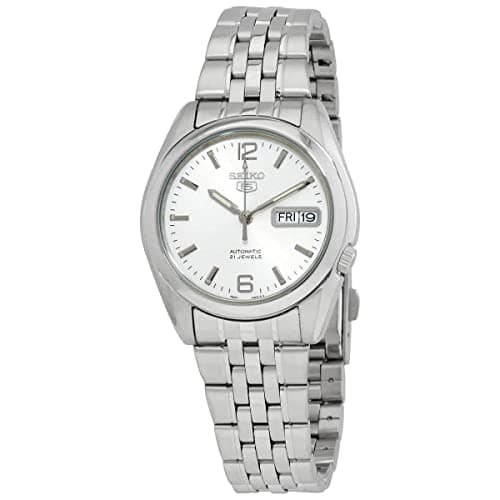
#ad · we may earn a commission from this link to Seiko 5 SNK385
Seiko 5 SNK385
SNK385K1Best for: A first dress-leaning mechanical watch
The white-dial Seiko 5 that keeps getting recommended as a cheap dress watch. It earns it — 37 mm, luminous applied markers, and an automatic underneath.
- Spec completeness for the price
- 8.1
- Movement relative to bracket
- 7.4
- Case proportions
- 9.0
- Strap flexibility
- 7.6
- Availability
- 8.0
What it gets right
- Clean white dial that suits a strap change
- 37 mm
- Exhibition back
What it gets wrong
- 7S26 — no hacking, no hand-winding
- 30 m
- Seiko no longer publishes a full spec sheet for the SNK series
Skip this one if: you need one watch for everything. At 30 m this cannot be a swim watch, so it works as a second watch rather than an only watch.
| Case diameter | 37 mm |
|---|---|
| Lug-to-lug | Not published by Seiko for this reference |
| Thickness | 11 mm |
| Lug width | Not published by Seiko for this reference |
| Crystal | Hardlex (hardened mineral) |
| Water resistance | 30 m |
| Display back | Yes — exhibition caseback |
| Caliber | Seiko 7S26 |
| Type | Automatic. No hand-winding, no hacking |
| Beat rate | 21,600 vph (6 beats/sec) |
| Jewels | 21 |
| Power reserve | Approx. 41 hours |
| Stated accuracy | -20 to +40 sec/day |
| Complications | Day and date |
No buyable offer at the last check (Sep 25, 2026). We show nothing rather than a stale number.
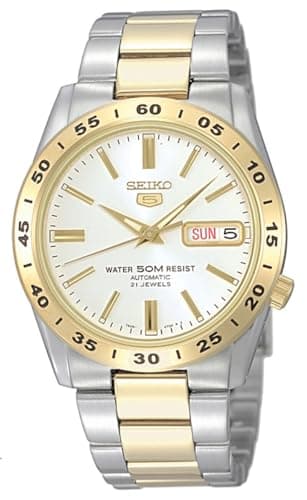
#ad · we may earn a commission from this link to Seiko 5 SNKE04
Seiko 5 SNKE04
SNKE04J1Best for: Buyers who care about J-suffix Japan assembly
A Japan-assembled Seiko 5 on a two-tone bracelet. The J suffix is the entire reason to pick this over its K-suffix twin.
- Spec completeness for the price
- 7.5
- Movement relative to bracket
- 7.4
- Case proportions
- 8.8
- Strap flexibility
- 7.6
- Availability
- 7.6
What it gets right
- J-suffix assembly
- Two-tone bracelet included
- 37 mm case
What it gets wrong
- 7S26 does not hack or hand-wind
- 50 m — swimming at a push, not diving
- Seiko does not publish full case dimensions for this reference
Skip this one if: the J suffix is not something you care about. The functional difference between J and K references is, by Seiko's own specification, nil — see our JDM guide.
| Case diameter | 37 mm |
|---|---|
| Lug-to-lug | Not published by Seiko for this reference |
| Thickness | Not published by Seiko for this reference |
| Lug width | Not published by Seiko for this reference |
| Crystal | Hardlex (hardened mineral) |
| Water resistance | 50 m (5 bar) |
| Dial | Champagne |
| Case and bracelet | Two-tone stainless steel |
| Market | J-suffix reference — Japan-assembled |
| Caliber | Seiko 7S26 |
| Type | Automatic. No hand-winding, no hacking |
| Beat rate | 21,600 vph (6 beats/sec) |
| Jewels | 21 |
| Power reserve | Approx. 41 hours |
| Stated accuracy | -20 to +40 sec/day |
| Complications | Day and date |
Price as of Sep 25, 2026. Prices move — Amazon's is the one that counts.
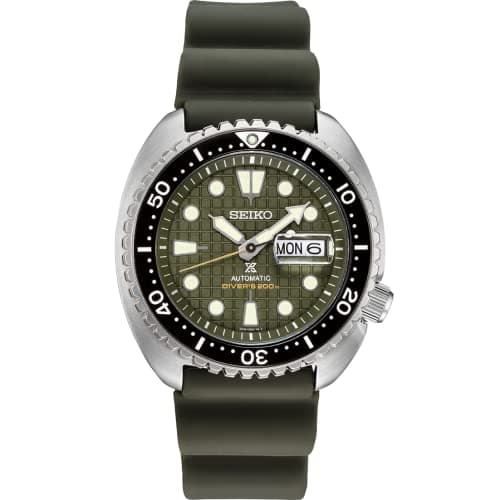
#ad · we may earn a commission from this link to Seiko Prospex King Turtle SRPE05
Seiko Prospex King Turtle SRPE05
SRPE05Best for: A Turtle with sapphire instead of Hardlex
The King Turtle: the Turtle case with sapphire and a ceramic bezel insert. The upgrade that answers the standard Turtle's one real complaint.
- Spec completeness for the price
- 8.9
- Movement relative to bracket
- 8.5
- Case proportions
- 8.8
- Strap flexibility
- 9.5
- Availability
- 8.1
What it gets right
- Sapphire crystal — the single biggest upgrade over a standard Turtle
- Ceramic bezel insert resists the scuffing an aluminum insert picks up
- Same forgiving 47.7 mm lug-to-lug
What it gets wrong
- The day/date magnifier is divisive and cannot be removed
- Costs meaningfully more than a standard Turtle for the same movement
- Still a 45 mm-wide case
Skip this one if: you do not care about crystal hardness. You are paying a real premium for sapphire and ceramic on an otherwise identical watch — if your Turtle lives on a desk, Hardlex will never bother you.
| Case diameter | 45.0 mm (cushion case) |
|---|---|
| Lug-to-lug | 47.7 mm |
| Thickness | 13.22 mm |
| Lug width | 22 mm |
| Crystal | Sapphire, anti-reflective inner coating, with a magnifier over the day/date |
| Bezel insert | Black ceramic |
| Water resistance | 200 m, ISO 6425 rated |
| Crown | Screw-down, at 4 o'clock |
| Strap | Khaki green silicone |
| Caliber | Seiko 4R36 |
| Type | Automatic, hand-winding and hacking |
| Beat rate | 21,600 vph (6 beats/sec) |
| Jewels | 24 |
| Power reserve | Approx. 41 hours |
| Stated accuracy | -35 to +45 sec/day |
| Complications | Day and date |
No buyable offer at the last check (Sep 25, 2026). We show nothing rather than a stale number.
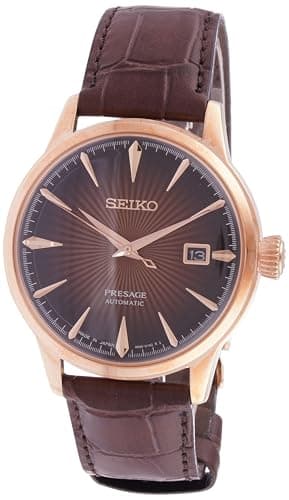
#ad · we may earn a commission from this link to Seiko Presage Cocktail Time SRPB46
Seiko Presage Cocktail Time SRPB46
SRPB46J1Best for: A dress watch with a dial that changes in the light
The brown-gradient Cocktail Time, on leather. The same box crystal and pressed dial as the blue one, in a warmer color that is easier to wear with everything.
- Spec completeness for the price
- 8.4
- Movement relative to bracket
- 8.4
- Case proportions
- 8.5
- Strap flexibility
- 9.2
- Availability
- 8.0
What it gets right
- Gradient dial that reads near-black in shade and warm brown in direct light
- Box crystal, and the same pressed dial treatment as the rest of the line
- Exhibition back
What it gets wrong
- 50 m, so it is not a swim watch
- Leather strap will need replacing
- Brown is harder to pair with a black belt than the blue or white dials
Skip this one if: your shoes and belt are black. A brown-strapped, brown-dialed watch is the one dress combination that visibly fights a black outfit — the blue Cocktail Time is the safer single pick.
| Case diameter | 40.5 mm |
|---|---|
| Lug-to-lug | Not published by Seiko for this reference |
| Thickness | 11.8 mm |
| Lug width | 20 mm |
| Crystal | Box-shaped Hardlex |
| Water resistance | 50 m |
| Display back | Yes — see-through screw caseback |
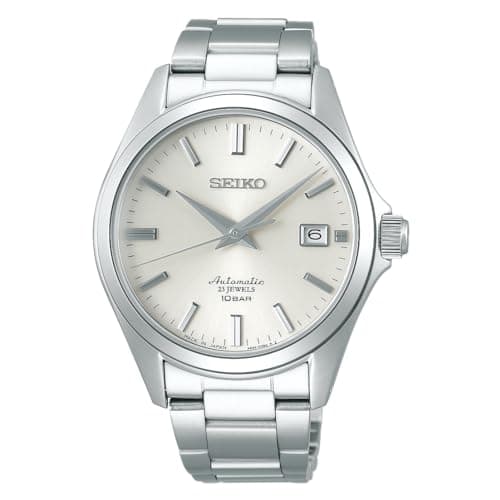
| Caliber | Seiko 4R35 |
| Type | Automatic, hand-winding and hacking |
| Beat rate | 21,600 vph (6 beats/sec) |
| Jewels | 23 |
| Power reserve | Approx. 41 hours |
| Stated accuracy | -35 to +45 sec/day |
| Complications | Date |
Price as of Sep 25, 2026. Prices move — Amazon's is the one that counts.
#ad · we may earn a commission from this link to Seiko Mechanical SZSB011
Seiko Mechanical SZSB011
SZSB011Best for: A JDM-only dress automatic
A Japan-market Mechanical Dress Line reference — the SARB-successor territory that never gets an international catalog number.
- Spec completeness for the price
- 8.4
- Movement relative to bracket
- 8.9
- Case proportions
- 8.8
- Strap flexibility
- 8.6
- Availability
- 7.2
What it gets right
- Sapphire crystal at a price where Seiko usually fits Hardlex
- 6R-series movement rather than the 4R family
- Genuinely not sold outside Japan
What it gets wrong
- Japan-market warranty — check what the seller actually honors in your country
- Documentation and instructions may be Japanese-only
- Seiko does not publish an English spec page for this reference
Skip this one if: warranty service matters to you. A JDM reference bought through a third-party seller is not covered the way a domestic-market Seiko is — read our JDM guide before you buy one.
| Market | Japanese domestic market — no international reference exists |
|---|---|
| Case diameter | 38.5 mm |
| Lug-to-lug | Not published by Seiko for this reference |
| Crystal | Sapphire |
| Water resistance | 50 m |
| Caliber | Seiko 6R15 automatic |
| Warranty | Japan-market warranty; international coverage varies by seller |
Questions
Are vintage Seiko watches worth buying?
They can be, but not as the cheap option. The deciding factor is the caliber: Seiko Service USA publishes a list of calibers it will no longer repair because parts are gone, and a watch on that list cannot be put right when it stops. If the caliber is serviceable and you budget the overhaul at Seiko’s published price for that caliber family, a vintage Seiko is a reasonable buy. If you are buying it because it is cheaper than a new one, add the service cost and check that the arithmetic still works.
Can Seiko still service a vintage Seiko?
Sometimes. Seiko’s customer-service FAQ says that for old watches “there may be a depletion of the parts in stock, and sometimes a watch cannot be repaired due to the discontinuation of necessary parts,” in which case it returns the watch unrepaired. Seiko Service USA goes further and names the calibers it will not accept at all, asking owners not to send them. Check the caliber on the caseback against that list before you buy, not after.
Which Seiko calibers can Seiko no longer service?
As published by Seiko Service USA and checked on September 24, 2026, the mechanical calibers are 1104, 1520, 2409, 2517, 2706, 2906, 4006, 5126, 5606, 6138, 6139, 6206, 6619, 7025 and 7625; the quartz calibers are 0903, 1400, 1600, 2620, 3421, 5T50, 5T52, 6730, 7122, 7123, 7548, 7549, 7751, 7752, 7759, 7800, 7810, 7812, 7813, 7820, 7K52, 7N49, 8122, 8123, 8620, 8621, H357, H556, H557 and H558. Seiko’s wording is that parts “have been discontinued for many years and there is no longer any stock.” Parts stock only moves one way, so re-check the page rather than trusting a transcription.
How much does it cost to service a vintage Seiko?
Seiko Service USA publishes retail movement-service prices by caliber family: $137 for 7S and 2R mechanical calibers, $176 for 4R, $296 for 6R, $359 for “other mechanical,” and $204 for discontinued quartz calibers, with prices subject to change without notice. The service covers complete movement work, cleaning, lubrication, timing to specification, gasket replacement and water-resistance testing, and carries a twelve-month guarantee. An independent watchmaker will quote differently.
Is a vintage Seiko diver still water resistant?
Assume not. Seiko states that water resistance “is not permanently guaranteed” and is affected by gasket aging and by deformation from shocks, and that deteriorated gaskets can let rust or moisture into the movement. The 200 m printed on a 1970s dial described the watch when it was new. Treat it as zero until a watchmaker has replaced the seals and pressure-tested the case.
How do I find out which caliber my vintage Seiko has?
It is stamped on the caseback. A Seiko caseback carries two numbers that do different jobs: a caliber-and-case reference, and a production serial. The caliber is the first part of the reference, which is the number you check against the no-service list. Reading a Seiko serial number works through both numbers and what each one can and cannot tell you.
What is the best vintage Seiko 5?
We will not rank used watches, because we cannot verify the condition or the price of any individual example and those two things decide the answer. What we can say is that the 7S-family movement in the current Seiko 5s is the cheapest caliber family on Seiko’s service price list at $137, and that the SNK385 and SNKE04 are 37 mm 7S26 automatics you can buy new, with a warranty, for around what a tidy vintage example plus an overhaul costs.
Does a vintage Seiko come with a warranty?
No. Seiko USA’s limited warranty runs three years from the date of original purchase from Seiko or an authorized dealer and requires a warranty card that dealer filled in and dated, so it cannot apply to a decades-old watch bought secondhand. The nearest equivalent is the twelve-month guarantee Seiko Service USA gives on its own service work.
Sources
- Seiko — FAQ: where can I have my old watch repaired?
- Seiko — FAQ: where can I obtain watch parts?
- Seiko — FAQ: why does Seiko recommend servicing your watch about every three years?
- Seiko Service USA — estimated movement service prices and non-serviceable calibers
- Seiko — heritage: history and milestones
- Seiko USA — limited warranty
- Seiko — important notice on counterfeit watches (October 6, 2025)
- Seiko customer service — warranty and servicing
- Seiko Watch Corporation — US catalog and specifications
Specifications are transcribed from manufacturer documentation and published standards. Where a manufacturer does not publish a figure, this page says so rather than estimating one.
Read next
- Servicing a Seiko: when and what it costsThe same replace-versus-service decision on a watch that is still in production.
- How to read a Seiko serial numberGetting the caliber off the caseback, which is step one here.
- How to spot a fake SeikoRedials, franken-watches and the checks that do not need the case opened.
- Seiko water resistance explainedWhat the number on the dial meant before the gaskets aged.
- Best Seiko 5 modelsThe current line, including the 7S26 references closest to the old ones.
- Seiko King Turtle referenceThe cushion-case diver, in full published detail.