Answers
How long does a Seiko last?
Longer than the movement. A Seiko's life ends when the parts run out, and Seiko publishes the list.
By Stephen V. · Updated Oct 29, 2026
Quick picks
| # | Watch | Key spec | Score | Price |
|---|---|---|---|---|
| 1 |  Seiko Prospex Sumo SPB103J1SPB103J1 The Sumo you can actually order: 45 mm, sapphire and the 70-hour 6R35 on 20 mm lugs. The upgrades are real, and so is the 52.6 mm lug-to-lug that pays for them. | 45mm · 70h | 8.0out of 10, compiled from published specifications | |
| 2 | 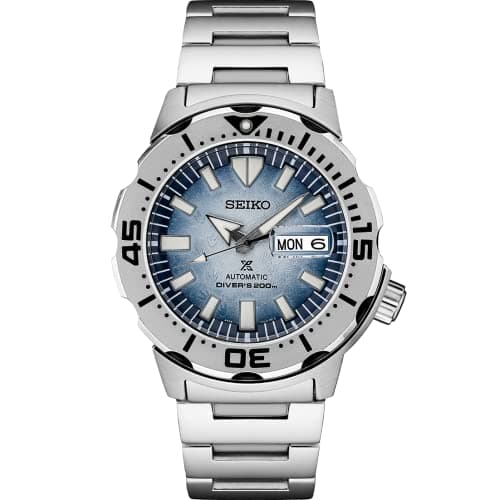 Seiko Prospex Diver SRPG57SRPG57K1 A 200 m Prospex automatic in the modern compact diver case. The one to look at if the Turtle and Samurai both feel too wide. | 42.4mm · 200m ISO | 8.6out of 10, compiled from published specifications | |
| 3 | 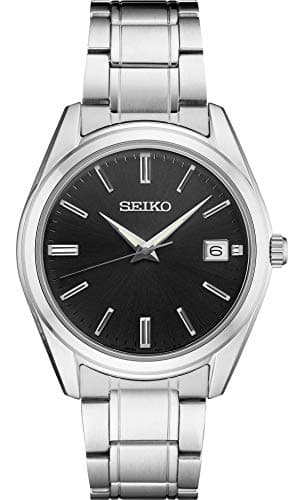 Seiko Essentials SUR311SUR311 A plain steel quartz watch that does exactly what it says. The cheapest sensible Seiko on this list and the right answer more often than people admit. | 40.2mm · quartz | 8.8out of 10, compiled from published specifications | |
| 4 | 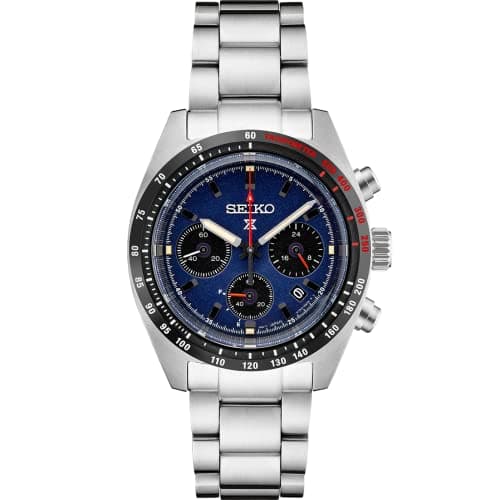 Seiko Prospex Speedtimer Solar Chronograph SSC815SSC815 The Speedtimer specification at its smallest and cheapest: a 39 mm case, curved sapphire, and a chronograph that runs on light rather than on a battery. | 39.0mm · solar chrono | 8.6out of 10, compiled from published specifications | |
| 5 | 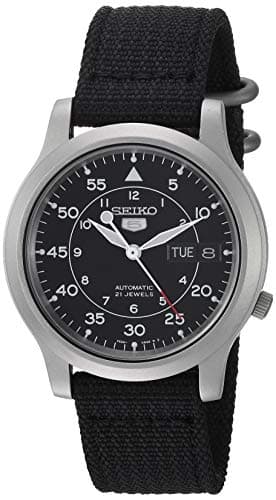 Seiko 5 SNK809SNK809K2 The classic small field Seiko: 37 mm, 7S26, canvas strap. It does not hack and it does not hand-wind. Now discontinued — the 7S26 went out of production in 2019 and Seiko's US catalog no longer lists it — so remaining stock is priced by scarcity, not by Seiko. Check the live price against a 4R36 reference before paying it. | 37mm · 30m | 7.3out of 10, compiled from published specifications |
5 watches on this page · Prices last verified October 30, 2026. Where no live price came back we show “Check price” rather than a number we cannot stand behind. How we pick.
Indefinitely, as long as parts exist — which is the real limit, not wear. Seiko recommends a service “about every three years,” publishes what each caliber family costs to service, and publishes a list of 45 calibers it will no longer service because the parts are gone. Nothing in current production is on that list. A serviced mechanical Seiko outlives its owner; an unserviced one dies of dried oil, usually long before anything breaks.
“How long do Seiko watches last” usually gets answered with an anecdote about a grandfather’s watch, and the anecdote is both true and useless. The question has four different real answers, because Seiko sells four different machines under one name and each one wears out somewhere else. This page is built on what Seiko publishes about its own watches, with the figures quoted and the sources linked.
Four machines, four different answers
The single most useful thing to know before reading further: the thing that consumes itself is different in each of the four systems Seiko sells. Of the 62 references in our registry, 38 publish a reserve measured in hours (mechanical), 4 publish one measured in months (light-powered) and 1publish a battery life instead — counts computed from the registry rather than typed.
| System | The consumable | What it asks of you | Seiko's published service price |
|---|---|---|---|
| Mechanical (7S, 4R, 6R) | Lubricant, then parts | An overhaul on a calendar, not on usage | $137 (7S/2R) to $296 (6R) |
| Battery quartz | A disposable cell | A cell change every few years | $100 to $135 |
| Solar | A rechargeable capacitor | Light, and nothing else for many years | $100 to $135 |
| Kinetic | A rechargeable cell | Wear, plus an eventual cell | $100 to $135 |
Read the right-hand column as the floor of what keeping a watch running costs, and the left-hand one as what decides when you pay it. A mechanical Seiko is the only system here whose consumable degrades whether or not you wear the watch. Which Seikos need batteries sorts the whole range into these four systems if you are not sure which one you own.
What Seiko actually says about three years
Seiko’s care FAQ is titled “Why does Seiko recommend servicing your watch about every three years?” and it answers the question in terms of physical change rather than usage. Internal components wear, the lubricants degrade, and either can make a watch lose time or stop. A service inspects the parts, repairs or replaces the worn ones, then cleans and re-lubricates them.
The phrase that matters most for anyone planning to keep a watch for decades is the one about lubricant. Oil degrades on a calendar, not on a counter of wrist hours. “Barely worn, kept in a box since 2010” is therefore not the reassurance it sounds like, and running a watch with dried oil is how a routine overhaul becomes a parts job. The same FAQ adds the second half, which almost nobody plans for: a watch’s water resistance is not permanent, because gaskets age and impacts deform parts, and failing seals let moisture into the movement.
Three years is a recommendation rather than a deadline, and Seiko says the right interval depends on climate and care. Plenty of 4R and 7S movements run for a decade untouched. What the recommendation buys is the difference between a cleaning and a repair.
The published service prices
Seiko Service USA publishes retail movement-service prices by caliber family, which is the other thing almost nobody quotes. These are the figures as published on its service price page, checked on 2026-10-29; the page states that prices are subject to change without notice.
| Caliber family | Price |
|---|---|
| 7S / 2R mechanical | $137.00 |
| 4R mechanical | $176.00 |
| 6R mechanical | $296.00 |
| 8R mechanical | $373.00 |
| 8L / 6L mechanical | $398.00 |
| Other mechanical | $359.00 |
| Discontinued quartz calibers | $204.00 |
| Analog battery or rechargeable quartz | $100.00 to $135.00 |
Seiko states what the money buys: complete service of the movement, repair or replacement of necessary parts, ultrasonic cleaning of the case and band, lubrication, timing adjustment, and replacement of gaskets with a water-resistance test. The work carries a twelve-month service guarantee on Seiko watches. What servicing a Seiko involves works through the same decision on a watch that is still in production.
The real end of a Seiko’s life is a parts list
Here is the part that actually answers the question. Under the heading “the following calibers are no longer available for service as parts have been discontinued for many years”, Seiko Service USA names forty-five calibers and adds that watches sent in with them will be returned unrepaired. That list, not metal fatigue, is where a Seiko’s life ends.
Two things follow, and they point in opposite directions. The reassuring one: no caliber in current production is on it. A 4R35, a 4R36, a 6R35, a 7S26 or any of the current quartz and solar calibers can be serviced today, and the mechanical calibers on the list are 1960s and 1970s movements. The sobering one: parts stock only moves one way, and the list grows. Buying a vintage Seiko reproduces the list in full so you can check a caseback against it before bidding, and it includes the 6139— the caliber Seiko celebrates on its own heritage pages as the first automatic chronograph with a vertical clutch, and will send back to you unrepaired.
Absence from the list is not a promise either. Seiko’s general warning about parts depletion still applies to everything, and a cracked crystal, a corroded case or a discontinued bezel insert are not movement parts at all — on an out-of-production reference those can be harder to find than a mainspring.
The arithmetic that decides replace versus service
Longevity is a money question, not a metallurgy question, and the sum is short. A 7S26 overhaul is published at $137. A new SNK809 runs the same 7S26 and costs a little over twice that at the live price in the table above. So the second overhaul on a 7S26 Seiko 5, some six years in, approaches the price of a new watch with a fresh case, crystal, bracelet and warranty.
Move up one tier and the sum inverts. A 4R overhaul is $176 against a 4R watch that costs several hundred; a 6R overhaul is $296 against a 6R35 Prospex that costs four figures. The more the watch cost, the more obviously worth servicing it is — which is the opposite of how people usually feel about it, because the cheap watch is the one whose service quote produces sticker shock.
For a battery quartz the arithmetic barely exists: a cell is a few dollars fitted, and the $100 to $135 figure above is a full movement service rather than a battery change. On an Essentials quartz a full movement service is not a sensible purchase and was never meant to be one; quartz versus automatic sets out the whole trade.
The lifetime question, answered honestly
“Seiko lifetime warranty” is one of the most-searched variants of this question, so it deserves a straight answer rather than a confident one. We do not print warranty terms from memory, and warranty length varies by market, by collection and by where the watch was bought — it is exactly the kind of money fact this site refuses to guess at. What Seiko does publish, and what this page is built on, is a recommended service interval, a service price list, a twelve-month guarantee on service work, and a list of calibers it will no longer repair. Read those four together and the picture is clear: Seiko plans for its watches to be maintained indefinitely, and tells you where that stops.
For the pre-owned market the practical version of the same point is that a seller who cannot tell you when a watch was last serviced is telling you that it never was. Buying a used Seiko handles the still-in-production end of that market, where the live new price decides everything.
Does leaving it in a drawer make it last longer?
No, and for a mechanical watch it is actively worse. The lubricant ages regardless, and a movement that has not turned for years often has oil that has dried or migrated off the bearing surfaces; the first time it runs after that, it runs dry. A watch worn in rotation and serviced on a calendar lasts longer than one stored and forgotten.
There is one real exception, and it is the solar case. A solar Seiko left in a dark drawer for a long period will discharge, and how Seiko’s solar calibers work explains the recovery: light brings it back, and the capacitor is a slow wear item rather than a component that fails on a schedule. It is the lowest-maintenance system Seiko sells, and it is the honest answer to anyone whose actual question is “which one will I have to think about least.”
Five things that actually extend the life of a Seiko
- Treat the service interval as a calendar item. Seiko’s own figure is about three years, and the cheap version of that job is the one you book before anything is wrong.
- Have the gaskets and water resistance checked when you service it. Seiko includes both in the service price, and water in a movement is the one failure that turns a service into a replacement.
- Do not set the date inside the change window. On a mechanical Seiko that is a real way to damage the calendar wheels; the setting guide gives the safe procedure.
- Check the caliber before you buy anything old. Against Seiko’s published no-service list, not against a forum’s opinion of it.
- Prefer a reference with a serviceable, current caliber if the plan is to keep it for decades. That is a boring criterion, and it is the one that decides the outcome.
The watches on this page
Specifications are transcribed from Seiko’s published documentation. Prices come from Amazon and carry the date they were verified. We have not handled these watches — here is what we did instead.
Price as of October 30, 2026. Prices move — Amazon's is the one that counts.
#ad · we may earn a commission from this link to Seiko Prospex Sumo SPB103J1
Seiko Prospex Sumo SPB103J1
SPB103J1Best for: Sapphire and a 70-hour reserve in a big 200 m ISO diver
The Sumo you can actually order: 45 mm, sapphire and the 70-hour 6R35 on 20 mm lugs. The upgrades are real, and so is the 52.6 mm lug-to-lug that pays for them.
- Spec completeness for the price
- 8.4
- Movement relative to bracket
- 8.6
- Case proportions
- 7.2
- Strap flexibility
- 8.8
- Availability
- 7.2
What it gets right
- Sapphire crystal where the Samurai and Turtle use Hardlex
- 70-hour 6R35 — off on Friday evening, still running on Monday morning
- 12.9 mm thick, only 0.6 mm taller than the far smaller 2024 Samurai
What it gets wrong
- 52.6 mm lug-to-lug — 4.9 mm longer than a Turtle, and the number that decides fit
- The 2019 reference: the 2022 SPB321/SPB323 add a ceramic insert and hard coating this one lacks
- 20 mm lugs read narrow against a 45 mm case
- Priced near the $1,000 line, a full bracket above the Samurai
Skip this one if: the flat top of your wrist measures less than 52.6 mm across. Lugs that overhang the wrist are the one thing no strap change fixes, and on this case the length, not the 12.9 mm height, is the constraint.
| Case diameter | 45.0 mm |
|---|---|
| Lug-to-lug | 52.6 mm |
| Thickness | 12.9 mm |
| Lug width | 20 mm |
| Crystal | Sapphire |
| Water resistance | 200 m, ISO 6425 rated |
| Crown | Screw-down |
| Case back | Screw-down |
| Bezel | Unidirectional rotating |
| Lume | LumiBrite on hands, indexes and bezel |
| Clasp | Three-fold, secure lock, push-button release, extender |
| Weight | 188.0 g |
| Caliber | Seiko 6R35 |
| Type | Automatic, hand-winding and hacking |
| Beat rate | 21,600 vph (6 beats/sec) |
| Jewels | 24 |
| Power reserve | Approx. 70 hours |
| Stated accuracy | -15 to +25 sec/day |
| Complications | Date |
Price as of October 30, 2026. Prices move — Amazon's is the one that counts.
#ad · we may earn a commission from this link to Seiko Prospex Diver SRPG57
Seiko Prospex Diver SRPG57
SRPG57K1Best for: A 200 m Seiko diver in a smaller case
A 200 m Prospex automatic in the modern compact diver case. The one to look at if the Turtle and Samurai both feel too wide.
- Spec completeness for the price
- 8.4
- Movement relative to bracket
- 8.4
- Case proportions
- 8.8
- Strap flexibility
- 9.2
- Availability
- 8.2
What it gets right
- 12.3 mm is slim for a 200 m Seiko diver
- 20 mm lugs open up a wider strap market than 22 mm
- Full ISO 6425 rating
What it gets wrong
- Hardlex
- Date only
- Seiko does not publish a lug-to-lug figure for this reference
Skip this one if: lug-to-lug is your buying constraint. Seiko does not publish it here, and we are not going to invent a number for you — measure one in person or start with a reference where the figure is documented.
| Case diameter | 42.4 mm |
|---|---|
| Lug-to-lug | Not published by Seiko for this reference |
| Thickness | 12.3 mm |
| Lug width | 20 mm |
| Crystal | Hardlex (hardened mineral) |
| Water resistance | 200 m, ISO 6425 rated |
| Crown | Screw-down |
| Caliber | Seiko 4R35 |
| Type | Automatic, hand-winding and hacking |
| Beat rate | 21,600 vph (6 beats/sec) |
| Jewels | 23 |
| Power reserve | Approx. 41 hours |
| Stated accuracy | -35 to +45 sec/day |
| Complications | Date |
$265.0020% off
Price as of October 30, 2026. Prices move — Amazon's is the one that counts.
#ad · we may earn a commission from this link to Seiko Essentials SUR311
Seiko Essentials SUR311
SUR311Best for: A no-fuss everyday watch under $200
A plain steel quartz watch that does exactly what it says. The cheapest sensible Seiko on this list and the right answer more often than people admit.
- Spec completeness for the price
- 8.7
- Movement relative to bracket
- 8.0
- Case proportions
- 9.2
- Strap flexibility
- 9.2
- Availability
- 8.9
What it gets right
- 8.36 mm thick — it disappears under a cuff
- 100 m on a dress-adjacent watch is unusually generous
- Sapphire at a price where Seiko normally fits Hardlex
What it gets wrong
- Battery replacement every few years
- No exhibition back and nothing mechanical to look at
Skip this one if: you want a mechanical watch. That is a legitimate reason to spend more, but be honest that it is the reason — this keeps better time than anything else on this list.
| Case diameter | 40.2 mm |
|---|---|
| Lug-to-lug | 47.0 mm |
| Thickness | 8.36 mm |
| Lug width | 20 mm |
| Case material | Stainless steel |
| Crystal | Sapphire |
| Water resistance | 100 m (10 bar) |
| Weight | 113.0 g |
| LumiBrite | On the hands and indexes |
| Band | Stainless steel bracelet, three-fold clasp with push-button release |
| Case back | Screw case back |
| Caliber | Seiko 6N52 quartz, battery-powered |
| Stated accuracy | ±15 sec/month |
| Battery life | Approx. 3 years |
| Dial | Black |
| Complications | Date |
Price as of October 30, 2026. Prices move — Amazon's is the one that counts.
#ad · we may earn a commission from this link to Seiko Prospex Speedtimer Solar Chronograph SSC815
Seiko Prospex Speedtimer Solar Chronograph SSC815
SSC815Best for: A Seiko chronograph you charge with daylight
The Speedtimer specification at its smallest and cheapest: a 39 mm case, curved sapphire, and a chronograph that runs on light rather than on a battery.
- Spec completeness for the price
- 9.0
- Movement relative to bracket
- 8.8
- Case proportions
- 8.9
- Strap flexibility
- 7.8
- Availability
- 8.7
What it gets right
- Solar, so the chronograph never costs you a battery appointment
- Curved sapphire at a price where Seiko usually fits Hardlex
- 39.0 mm — the smallest case Seiko puts the V192 chronograph in
- A power reserve indicator, which most solar watches hide behind a button press
What it gets wrong
- 13.3 mm thick on a 39 mm case, so it wears taller than the diameter suggests
- Seiko does not publish a lug-to-lug or a lug width for this reference
- 10 bar, not a diver — the Speedtimer is a timing watch, not a Sea reference
- Seiko has withdrawn the individual catalog page, so the launch release is the only first-party spec sheet left
Skip this one if: you want a mechanical chronograph. Seiko builds one in this same line, the 8R-powered Speedtimer, and it costs several times this watch — a solar module and a column wheel are different purchases.
| Case diameter | 39.0 mm |
|---|---|
| Thickness | 13.3 mm |
| Lug-to-lug | Not published by Seiko for this reference |
| Lug width | Not published by Seiko for this reference |
| Case material | Stainless steel |
| Crystal | Curved sapphire with an anti-reflective coating on the inner surface |
| Water resistance | 100 m (10 bar) |
| Magnetic resistance | 4,800 A/m |
| Dial | Sandblast finish — Seiko published the launch set in white, navy, gold and black |
| Bracelet | Stainless steel, three-fold clasp with push-button release |
| Caliber | Seiko V192 solar chronograph |
| Functions | 60-minute chronograph, adjustable 24-hour hand, power reserve indicator |
| Power reserve | Approx. 6 months from a full charge (Seiko's published V192 figure) |
| Stated accuracy | Monthly rate not published by Seiko for this caliber |
$359.009% off
Price as of October 30, 2026. Prices move — Amazon's is the one that counts.
#ad · we may earn a commission from this link to Seiko 5 SNK809
Seiko 5 SNK809
SNK809K2Best for: A genuinely small mechanical watch, if the remaining-stock price is still sensible
The classic small field Seiko: 37 mm, 7S26, canvas strap. It does not hack and it does not hand-wind. Now discontinued — the 7S26 went out of production in 2019 and Seiko's US catalog no longer lists it — so remaining stock is priced by scarcity, not by Seiko. Check the live price against a 4R36 reference before paying it.
- Spec completeness for the price
- 8.0
- Movement relative to bracket
- 7.4
- Case proportions
- 9.2
- Strap flexibility
- 7.8
- Availability
- 4.0
What it gets right
- 42 mm lug-to-lug fits genuinely small wrists
- Exhibition back on a watch at this price
- Legible 24-hour inner track
What it gets wrong
- 7S26 will not hand-wind and will not hack — you cannot set it to the second
- 30 m rating means keep it out of the shower
- 18 mm lugs are a narrower strap market than 20 or 22 mm
- Discontinued and sold from remaining stock — the price is whatever the seller asks, and it no longer tracks the bracket this watch defined
Skip this one if: the live price is at or above a 4R36 Seiko 5 Sports. This was the value pick of its bracket when Seiko still made it; sold from remaining stock it frequently is not, and the SRPD93 or the 36.4 mm SBSA199 give you hacking and hand-winding for the same money or less. Skip it too if setting the watch precisely matters to you — without hacking you cannot stop the seconds hand to sync it.
| Case diameter | 37.0 mm |
|---|---|
| Lug-to-lug | 42.0 mm |
| Thickness | 11.1 mm |
| Lug width | 18 mm |
| Crystal | Hardlex (hardened mineral) |
| Water resistance | 30 m — hand-washing only, not swimming |
| Display back | Yes — exhibition caseback |
| Caliber | Seiko 7S26 |
| Type | Automatic. No hand-winding, no hacking |
| Beat rate | 21,600 vph (6 beats/sec) |
| Jewels | 21 |
| Power reserve | Approx. 41 hours |
| Stated accuracy | -20 to +40 sec/day |
| Complications | Day and date |
If longevity is the whole brief, buy in this order
1. Solar, if you want to think about it least
No disposable cell, no winding, no routine service trigger. The capacitor is a slow wear item measured in many years, and a solar Speedtimer — or anything in the solar range — asks for light and nothing else. The trade is a ticking seconds hand and nothing mechanical to look at.
2. A current 6R or 4R automatic, if you want it repairable in 2060
Both caliber families are in production, both are on Seiko’s service price list, and neither is anywhere near its no-service list. A 6R35 costs more to service and sits in a more expensive watch, which makes the service obviously worth paying for; the 4R35 is the volume answer at $176 an overhaul.
3. Battery quartz, if the honest plan is to wear it and replace it
A three-year cell, fifteen seconds a month, and a full movement service that costs a meaningful fraction of the watch. That is not a criticism — it is the correct way to own an inexpensive watch, and a sapphire-crystal one at that.
4. Kinetic, only if you already own one
Rotor-charged quartz was Seiko’s answer before solar, and the current catalog has moved on. The Kinetic page covers the published figures and the capacitor question. As a new purchase, solar does the same job with fewer moving parts.
What not to buy for longevity
A vintage reference on a caliber you have not checked against Seiko’s list. The dial sells the watch and the caliber decides whether you get to keep it, which is the entire argument of the vintage guide.
Questions
How long do Seiko 5 watches last?
As long as they are serviced. The 7S26 in the older Seiko 5s is not on Seiko’s no-service caliber list, and Seiko publishes a $137 movement-service price for the 7S family. The practical limit is economic rather than mechanical: by the second overhaul the total approaches the price of a new one.
Do Seiko watches last a lifetime?
A serviced mechanical Seiko can, and many do. The limit is parts availability rather than wear: Seiko publishes a list of forty-five calibers it will no longer service because the parts are gone, and nothing in current production is on it.
How often should a Seiko be serviced?
Seiko recommends a service about every three years, and says the right interval depends on climate and on how the watch is cared for. The reasoning is lubricant degradation and gasket aging rather than usage, which is why a watch kept in a box still needs it.
How long does a Seiko quartz watch last?
The watch outlasts many cells. Seiko publishes an approximately three-year battery life for the 6N52 in the Essentials SUR311, for example, and a cell change is routine. The case, crystal and bracelet decide the watch’s real lifespan, not the movement.
How long does a Seiko solar watch last?
There is no routine battery change at all — light charges an internal capacitor that runs the movement. How Seiko’s solar calibers work is honest about the one caveat: the capacitor is a rechargeable cell, and like any rechargeable it can lose some capacity after many years, at which point it can be replaced.
Is it worth servicing a cheap Seiko?
Often not, and that is a published-price question rather than an opinion. Compare Seiko’s service price for the caliber family against the live price of a new example of the same watch. The more expensive the watch, the more clearly the service is worth paying for.
Does Seiko offer a lifetime warranty?
We do not publish warranty terms from memory, and they vary by market and seller. What Seiko publishes is a recommended three-year service interval, a service price list by caliber family, a twelve-month guarantee on service work, and the list of calibers it will no longer repair. Check Seiko’s own warranty page for the terms that apply where the watch was bought.
Sources
- Seiko — why Seiko recommends servicing your watch about every three years
- Seiko Service USA — published service prices and no-service caliber list
- Seiko customer service — warranty and servicing
- Seiko instruction manuals and caliber documentation
Specifications are transcribed from manufacturer documentation and published standards. Where a manufacturer does not publish a figure, this page says so rather than estimating one.
Read next
- What servicing a Seiko costsThe same decision on a watch that is still in production.
- Buying a vintage SeikoThe full no-service caliber list, transcribed.
- Do Seiko watches need batteries?The four power systems, and which one you actually own.
- Seiko SUR311 referenceThe three-year cell, with the published accuracy figure beside it.