Answers
Do Seiko watches need batteries?
Some do, some never will, and two of them have a cell you are not supposed to replace yourself. Here is how to tell which Seiko you are holding.
By Stephen V. · Updated Oct 17, 2026
It depends which kind you have, and Seiko sells four. An automaticSeiko has no battery at all — it runs on a wound mainspring. A battery quartz Seiko does, and it lasts about three years. A solar Seiko has a rechargeable cell that daylight keeps topped up and that you never routinely replace. A Kinetic Seiko has a capacitor charged by your wrist motion, which is also not a battery you swap. Only one of the four sends you to a jeweler every few years.
This question gets asked because the answer is genuinely not obvious from the outside. Two Seikos sitting in the same display case at the same price can be a wound mechanical watch and a light-powered quartz, and nothing on the dial necessarily tells you which. Worse, the two that do not take a battery are often described as “battery free” in a way that implies they never need anything, which is not quite true either.
The four systems, and what each one needs from you
| System | Battery? | What powers it | What you have to do |
|---|---|---|---|
| Automatic (4R, 6R, 7S, NH) | No | A mainspring wound by wrist motion | Wear it, or wind it. It stops in about 41–72 hours of stillness. |
| Battery quartz (6N, 7T, 8T …) | Yes | A silver-oxide cell | Replace the cell roughly every 3 years |
| Solar (V-series) | No swap | A rechargeable cell charged by light | Give it daylight. Nothing else, for years. |
| Kinetic (5M, 5J, 7D …) | No swap | A capacitor charged by wrist motion | Wear it. The capacitor is a service item, not a shop-counter swap. |
Of the 62 products this site tracks, 3publish a solar caliber in their specification — a count read from our own registry rather than typed. The rest split between mechanical references and battery quartz.
How to tell which one you have, without opening anything
- Watch the seconds hand for five seconds. A mechanical Seiko sweeps in small steps that look continuous — six or eight per second. A quartz Seiko, solar or battery, ticks once per second. This is the fastest test and it is almost never wrong.
- Read the dial. Seiko prints “Automatic”, “Kinetic”, “Solar” or “Quartz” on most dials, usually under the logo or above the six.
- Check the case back for the caliber. The first four characters are the movement: a 4R or 6R or 7S is mechanical, a V-prefix is solar, a 5M or 7D is Kinetic, and most other letter-number quartz codes take a cell. Model numbers explained decodes the whole string.
- Look for an exhibition window. If you can see a rotor spinning through the back, it is an automatic and there is no battery in there at all.
If it is a battery quartz: what the three years actually means
Seiko states approximately three years of battery life for the current Essentials quartz references, and the figure is realistic rather than optimistic — it assumes no alarm, no chronograph running, and a dial without a heavy lume load. Two practical points. First, many Seiko quartz movements warn you: when the cell is nearly flat the seconds hand starts jumping in two-second steps instead of one. That is not a fault; it is the end-of-life indicator doing its job, and you have days rather than hours. Second, change it promptly. A flat cell left in a watch for a year can leak, and a leak is a far more expensive problem than a replacement.
Who should buy one anyway: someone who wants a watch that is right when they pick it up after three weeks in a drawer. That is a real advantage and the main reason the Essentials line exists.
If it is solar: what “never needs a battery” leaves out
A solar Seiko converts light through the dial into charge held in a rechargeable cell. There is no routine battery change, and that is the whole proposition. What the marketing skips is that the cell is a component with a finite life, and Seiko treats it as a service item rather than a counter swap — when it eventually stops holding charge it is replaced during a service, by a watchmaker, not by a jeweler with a case knife. Seiko does not publish a fixed lifespan for it, and we are not going to invent one.
The reserve figures are published, though, and they are the number that matters day to day: Seiko states approximately 6 months from a full charge for the V198 in the Coutura chronograph and approximately 12 monthsfor the V115 in the women’s solar reference. Both are specified at ±15 seconds a month. A solar watch that has stopped is not broken — it is flat, and a few hours of daylight on a windowsill will start it again. The solar caliber page has the charging detail, and the solar roundup ranks the range.
If it is Kinetic: the one people get wrong
Kinetic is Seiko’s hybrid — a rotor, like an automatic, but it generates electricity into a capacitor instead of winding a spring. So there is no battery to replace and no winding to do, but there isa capacitor that ages, and a Kinetic that will not hold charge is a service job. It is also worth knowing that no Kinetic Seiko is purchasable new through this site’s registry, which is why the Kinetic page is written as a reference rather than a roundup.
Which should you buy?
- You wear one watch every day: automatic. It never needs a cell, and daily wear keeps it wound.
- You rotate several, or wear one occasionally: solar. It stays charged in a lit room and it is right when you pick it up.
- You want the cheapest thing that is always correct: battery quartz, and accept a jeweler visit every three years.
- You want the most accurate: either quartz type — ±15 seconds a month against ±15 to 45 seconds a day for the mechanicals. Why a Seiko runs fast or slow has the per-caliber windows.
The four references below are one of each: a battery quartz, a solar chronograph, a solar dress watch and an automatic, so you can price the difference rather than argue about it.
The watches on this page
Specifications are transcribed from Seiko’s published documentation. Prices come from Amazon and carry the date they were verified. We have not handled these watches — here is what we did instead.
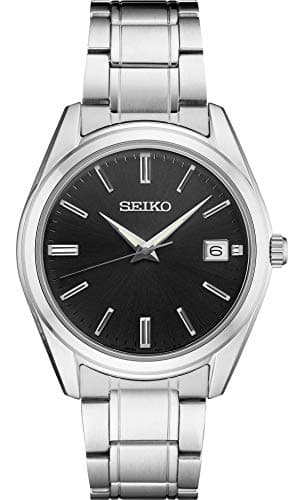
$265.0019% off
Price as of October 23, 2026. Prices move — Amazon's is the one that counts.
#ad · we may earn a commission from this link to Seiko Essentials SUR311
Seiko Essentials SUR311
SUR311Best for: A no-fuss everyday watch under $200
A plain steel quartz watch that does exactly what it says. The cheapest sensible Seiko on this list and the right answer more often than people admit.
- Spec completeness for the price
- 8.7
- Movement relative to bracket
- 8.0
- Case proportions
- 9.2
- Strap flexibility
- 9.2
- Availability
- 8.9
What it gets right
- 8.36 mm thick — it disappears under a cuff
- 100 m on a dress-adjacent watch is unusually generous
- Sapphire at a price where Seiko normally fits Hardlex
What it gets wrong
- Battery replacement every few years
- No exhibition back and nothing mechanical to look at
Skip this one if: you want a mechanical watch. That is a legitimate reason to spend more, but be honest that it is the reason — this keeps better time than anything else on this list.
| Case diameter | 40.2 mm |
|---|---|
| Lug-to-lug | Not published by Seiko for this reference |
| Thickness | 8.36 mm |
| Lug width | 20 mm |
| Crystal | Sapphire |
| Water resistance | 100 m (10 bar) |
| Caliber | Seiko 6N52 quartz, battery-powered |
| Stated accuracy | ±15 sec/month |
| Battery life | Approx. 3 years |
| Dial | Black |
| Complications | Date |
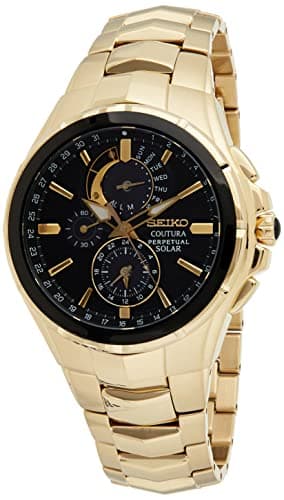
No buyable offer at the last check (October 23, 2026). We show nothing rather than a stale number.
#ad · we may earn a commission from this link to Seiko Coutura Solar Chronograph SSC700
Seiko Coutura Solar Chronograph SSC700
SSC700Best for: A quartz watch you charge with daylight and otherwise ignore
Sapphire, 100 m, a perpetual calendar and no battery to replace, in one watch. The most complete spec sheet in Seiko's quartz range at anything like this money.
- Spec completeness for the price
- 8.9
- Movement relative to bracket
- 8.6
- Case proportions
- 7.8
- Strap flexibility
- 8.0
- Availability
- 8.5
What it gets right
- Sapphire crystal at a price where Seiko normally fits Hardlex
- Solar — no battery change for the life of the capacitor
- Perpetual calendar means the date is right through February without you touching it
- Chronograph, alarm and a power-reserve indicator in one watch
What it gets wrong
- 44 mm is a large watch, and Seiko does not publish a lug-to-lug for it
- The gold-finish case is a styling commitment
Skip this one if: you want something mechanical or something small. This is a big light-powered quartz with a lot of functions, and that is the whole point of it.
| Case diameter | 44 mm |
|---|---|
| Thickness | 11.77 mm |
| Lug-to-lug | Not published by Seiko for this reference |
| Case material | Stainless steel with a gold finish |
| Crystal | Sapphire |
| Water resistance | 100 m (10 bar) |
| Caliber | Seiko V198 solar chronograph |
| Stated accuracy | ±15 sec/month |
| Power reserve | Approx. 6 months from full charge |
| Chronograph | 60 minutes, in 1/5-second increments, with split-time measurement |
| Calendar | Perpetual — leap year, month, day and date, to 2100 |
| Complications | Alarm, power reserve indicator, small seconds |
| Dial | Black |
| Bracelet | Stainless steel |
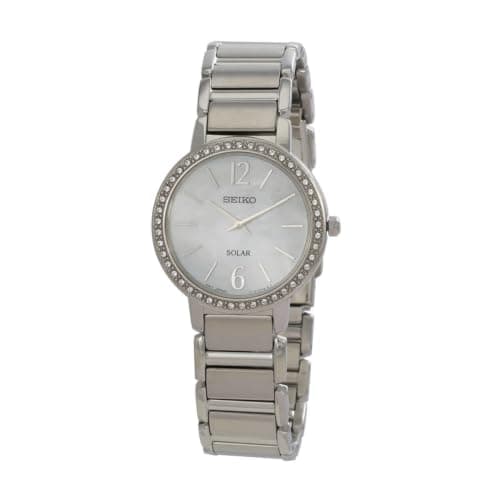
Price as of October 23, 2026. Prices move — Amazon's is the one that counts.
#ad · we may earn a commission from this link to Seiko Women's Solar SUP467
Seiko Women's Solar SUP467
SUP467Best for: A dress watch that never needs winding or a battery
A 30.5 mm solar dress watch that runs about a year on a full charge. No battery changes, no winding, quartz accuracy — the lowest-maintenance watch on this list.
- Spec completeness for the price
- 8.0
- Movement relative to bracket
- 8.2
- Case proportions
- 8.4
- Strap flexibility
- 7.5
- Availability
- 8.4
What it gets right
- Solar — no battery replacement for the life of the capacitor
- About 12 months of running from one full charge
- 6.8 mm thick and 30.5 mm across, so it sits flat under a cuff
What it gets wrong
- Seiko rates it splash resistant only, not 30 m or 50 m
- Quartz, so nothing mechanical to look at
- The capacitor is a wear item eventually, even though the watch never needs a battery
Skip this one if: the watch needs to go anywhere near water. Seiko rates this one splash resistant rather than to a depth, so it is a dress watch in the strict sense.
| Case diameter | 30.5 mm |
|---|---|
| Lug-to-lug | 37.7 mm |
| Thickness | 6.8 mm |
| Lug width | 12 mm |
| Case material | Stainless steel |
| Crystal | Curved Hardlex |
| Water resistance | Splash resistant, per Seiko — not rated for swimming |
| Caliber | Seiko V115 solar quartz |
| Stated accuracy | ±15 sec/month |
| Power reserve | Approx. 12 months from full charge |
| Magnetic resistance | 4,800 A/m |
| Weight | 75.0 g |
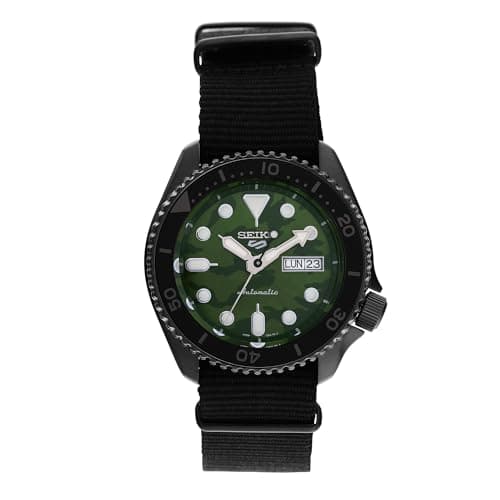
Price as of October 23, 2026. Prices move — Amazon's is the one that counts.
#ad · we may earn a commission from this link to Seiko 5 Sports SRPJ37
Seiko 5 Sports SRPJ37
SRPJ37K1Best for: The lowest price of entry to a hacking Seiko automatic
Usually the cheapest way into the 5KX case and the 4R36. The same watch as the SRPD65 underneath, with a green camouflage dial and a nylon strap instead of a bracelet.
- Spec completeness for the price
- 9.0
- Movement relative to bracket
- 8.5
- Case proportions
- 8.7
- Strap flexibility
- 9.5
- Availability
- 8.4
What it gets right
- Same case and caliber as references costing meaningfully more
- Usually the lowest price anywhere on a hacking, hand-winding 4R36
- 22 mm lugs, and it ships on nylon so a strap swap costs nothing to try
What it gets wrong
- The camouflage dial is a style commitment the plain references do not ask for
- Nylon strap rather than a bracelet, so a bracelet is an extra purchase
- Hardlex, and 13.4 mm thick
Skip this one if: you want a dial you can wear to anything. The camouflage print is the whole character of this reference — if that is not what you want, the plain-dial SRPD65 is the same watch underneath.
| Case diameter | 42.5 mm |
|---|---|
| Lug-to-lug | 46.0 mm |
| Thickness | 13.4 mm |
| Lug width | 22 mm |
| Crystal | Hardlex (hardened mineral) |
| Water resistance | 100 m |
| Caliber | Seiko 4R36 |
| Type | Automatic, hand-winding and hacking |
| Beat rate | 21,600 vph (6 beats/sec) |
| Jewels | 24 |
| Power reserve | Approx. 41 hours |
| Stated accuracy | -35 to +45 sec/day |
| Complications | Day and date |
Questions
Do automatic Seiko watches need batteries?
No. An automatic runs entirely on a mainspring wound by the motion of your wrist. There is no cell in the watch. The trade is that it stops when you stop wearing it — after about 41 hours on the 4R calibers and 70 to 72 hours on the 6R family.
How long does a Seiko battery last?
Seiko states approximately three years for the current Essentials quartz references. A chronograph or an alarm model used heavily will be shorter. Many Seiko quartz movements signal a nearly flat cell by moving the seconds hand in two-second steps.
Do solar Seiko watches ever need a new battery?
Not routinely. The rechargeable cell is charged by light and is designed to last for years of normal use, but it is a component with a finite life and Seiko treats its replacement as a service job rather than a counter swap. Seiko does not publish a fixed lifespan, so neither do we.
My solar Seiko has stopped. Is it broken?
Most likely it is simply flat, which happens if it has been in a drawer or under a long sleeve for months. Put it somewhere bright — a windowsill, not direct summer sun on a hot sill — for a few hours and see whether it restarts. The solar caliber page has the charge times Seiko publishes.
What size battery does my Seiko take?
It depends entirely on the movement, and the reference is printed inside the watch rather than on it. We deliberately do not publish a per-caliber battery table, because getting it wrong would send someone to a shop with the wrong cell — read the caliber from your case back and let the jeweler match it, or check that caliber’s own Seiko instruction manual.
Is solar or automatic better?
Solar if you want accuracy and zero maintenance; automatic if you want a mechanical object. Solar is roughly thirty times more accurate on stated figures and needs nothing but light. An automatic has no electronics to age and can be serviced indefinitely. Quartz versus automatic covers the rest of the trade.
Sources
- Seiko instruction manuals and caliber documentation
- Seiko Watch Corporation — US catalog and specifications
- Seiko customer service — warranty and servicing
- Seiko Instruments — movement division (NH-series manufacturer)
Specifications are transcribed from manufacturer documentation and published standards. Where a manufacturer does not publish a figure, this page says so rather than estimating one.
Read next
- Seiko solar calibersCharge times, reserves and what the V-series actually does.
- Seiko Kinetic explainedThe hybrid with a capacitor instead of a battery, and why none is sold new here.
- Best Seiko solar watchesThe range that never needs a battery change, ranked.
- Why is my Seiko running fast or slow?The per-caliber accuracy windows, including the quartz-versus-mechanical gap.