Movements
Seiko Kinetic explained
A rotor that charges a quartz watch. What Kinetic is, what Seiko published for it, why it is gone from the catalog, and the solar and automatic watches that now do its jobs.
By Stephen V. · Updated Sep 17, 2026
Seiko Kinetic is a quartz movement charged by an oscillating weight rather than a disposable battery: the rotor spins a tiny generator, the generator charges a rechargeable cell, and the cell runs an ordinary quartz circuit. Seiko’s manuals give roughly six months from a full charge and better than 15 seconds a month. Seiko no longer lists Kinetic as a movement type, so a new one is not on the menu; solar and automatic are.
What Kinetic is
Kinetic is Seiko’s name for a hybrid that sits between an automatic and a quartz watch. From the outside it looks like an automatic: turn it over and there is an oscillating weight that swings when your wrist moves. Inside, that weight does not wind a mainspring. It drives a small generator, and the generator charges a rechargeable cell that powers a conventional quartz movement with a stepper motor. The timekeeping is quartz; only the power source is mechanical.
Seiko’s own heritage timeline puts the technology in a longer sequence of “no battery change” work: a solar watch in 1977, a quartz watch with a hand-winding generating system in 1986, and then, in 1988, the world’s first A.G.S. watch, caliber 7M22, which Seiko notes was “later renamed as Kinetic.” A.G.S. stood for Automatic Generating System, and that is still the plainest description of it. Time and Tide’s history of the range dates the rename to 1993. The same Seiko timeline lists the Ultimate Kinetic Chronograph, caliber 9T82, in 1999, and the Kinetic Perpetual in 2005, which Seiko describes as the first watch to generate and save its own electricity.
The idea was to remove the one recurring chore of quartz, the battery, without giving up quartz accuracy. Solar does the same thing with light. Kinetic did it with motion, which is why the two technologies ended up competing for the same buyer, and why one of them is still in the catalog and the other is not.
How it works, in Seiko’s own figures
The clearest description of a Kinetic movement is its instruction manual, and Seiko still publishes them. The manual for the 5M62 and 5M63, the calibers in the best-known Kinetic divers, describes “an analogue quartz watch equipped with the Kinetic technology developed by SEIKO” that “generates the electric energy to power the watch, utilizing the movement of your arm, and stores it in the rechargeable battery, which requires no periodical replacement unlike conventional button-type batteries.” Older manuals, such as the Auto Relay’s, call the same component the Kinetic Electricity Storage Unit, or E.S.U.
| Specification | Published value |
|---|---|
| Crystal oscillator | 32,768 Hz |
| Monthly rate | Less than 15 seconds at 5 to 35 °C |
| Duration of charge, full | Approx. 6 months |
| Swings to 1 day of reserve | About 250, at two swings a second |
| Swings to 2 days of reserve | About 450 to 500 in total |
| Low-charge warning | Seconds hand steps every 2 seconds; about 24 hours left |
| Driving system | Step motor |
| Power source | Button-type rechargeable battery, 1 piece |
Two details in that table explain most of what owners notice. The first is the charging rate: about 250 side-to-side swings buys a single day of running, and Seiko’s guidance is to wear the watch for at least ten hours a day. A Kinetic worn daily stays charged; a Kinetic worn on weekends does not build a reserve quickly. The second is the low-charge warning. When the seconds hand starts jumping in two-second steps, the watch is still keeping time but has roughly a day left, and it needs to be swung or worn.
The power reserve indicator is the feature people remember. Press the button at two o’clock and the seconds hand jumps ahead by 5, 10, 20 or 30 seconds before resuming. The manual reads those as between 1 and 7 days, between 7 days and a month, about a month, and about 4 to 6 months of reserve, respectively. It is a guideline rather than a gauge, and Seiko says so, but it is more information than most quartz watches give you.
The Kinetic family
Kinetic was a family of calibers rather than a single movement, and the variants are the ones that turn up in searches: Auto Relay, Perpetual, Direct Drive, GMT and Chronograph. The figures below are transcribed from the corresponding Seiko manuals, all of which are still available from Seiko’s instruction manual archive.
| Caliber | What it is | Full charge | Distinguishing function |
|---|---|---|---|
| 5M62 / 5M63 | Three-hand date / day-date | Approx. 6 months | Power reserve indicator; the diver's caliber |
| 5M82 | Three-hand date | Approx. 6 months | Diver's caliber; same reserve and swing figures as the 5M62 |
| 5M85 | GMT diver | Approx. 6 months | Independent 24-hour hand for a second zone |
| 5J22 Auto Relay | Three-hand with power save | Up to 4 years | Hands stop after 72 h; IC keeps time; hands catch up when swung |
| 7D48 Perpetual | Perpetual calendar with power save | Up to 4 years | Calendar correct to February 2100 without adjustment |
| 5D44 Direct Drive | Three-hand, crown-charged | Approx. 1 month | Turning the crown generates power; live generation indicator |
| 7L22 Chronograph | 45-minute chronograph | Approx. 5 months | 1/5-second stopwatch on a Kinetic power source |
The Auto Relay is the cleverest of these and the one most worth understanding. Its manual describes a power save function: if the watch senses no movement for about 72 hours, the hands stop to conserve energy while the internal circuit keeps counting time. Pick it up, swing it a few times, and the hands run forward to the correct time. That is how a six-month reserve becomes a four-year one. The Kinetic Perpetual’s 7D48 does the same trick and keeps a perpetual calendar running through the sleep, which is what Seiko means by a watch that saves its own electricity.
Direct Drive went the other way. Its 5D44 manual describes a crown that generates electricity when turned, with an indicator hand that shows the power being generated in real time and then the reserve. Its full-charge figure is only about a month, the shortest in the family, because the design spent its energy on the display rather than on sleep. It is a fascinating object and the hardest Kinetic to recommend used, for the reason the next section covers.
Kinetic vs automatic
This is the comparison most people are actually asking about, usually because they own one of each or are choosing a used watch. The two look alike from the back and behave differently in every way that matters.
| Kinetic (5M62) | Automatic (4R36) | |
|---|---|---|
| Timekeeping | Quartz crystal, step motor | Balance wheel, 21,600 vph |
| Stated accuracy | Less than 15 sec/month | -35 to +45 sec/day |
| Reserve from full | Approx. 6 months | Approx. 41 hours |
| Seconds hand | Ticks once a second | Steps six times a second |
| Charging | Rotor into a rechargeable cell | Rotor winds a mainspring; also hand-winds |
| Long-term wear item | The rechargeable cell | Lubricants; a service every several years |
| Still made by Seiko | No longer listed | Yes, across the range |
Accuracy is the decisive line. Fifteen seconds a month is a quartz number; the 4R36’s -35 to +45 seconds a day is a mechanical one, and a good example of either lands well inside its window. If you want the watch to be right without thinking about it, Kinetic wins by a wide margin. If you want a sweeping seconds hand and a movement that is an object in its own right, the automatic wins, and nothing about Kinetic’s quartz tick will change your mind.
Reserve is the line that surprises people in the other direction. An automatic worn daily never stops, but a 41-hour reserve means a watch taken off on Friday evening is stopped by Sunday. A charged Kinetic runs for months. The catch is the word charged: an automatic that has stopped is fully wound again in a minute with the crown, while a flat Kinetic needs hundreds of swings just to reach a day of reserve. Which of those failure modes annoys you more is a fair way to decide between the two on a used-watch table. If the Kinetic is out of the running and the real choice is between a current quartz Seiko and an automatic, Seiko quartz vs automatic compares them on today’s references. Our guide to winding a Seiko automatic covers the mechanical side of that routine.
Kinetic vs solar
Kinetic and solar are the same idea with different inputs. Both are quartz. Both charge a rechargeable cell instead of consuming a disposable battery. Both tick once a second and keep quartz time. The difference is where the energy comes from, and that difference decided the contest.
| Kinetic | Solar (V-series) | |
|---|---|---|
| Energy in | Wrist motion turning a rotor | Light through the dial onto a cell |
| Charges when | Worn and moving | Anywhere there is light, worn or not |
| Reserve from full | Approx. 6 months (5M62) | Months; some dive calibers around 10 |
| Recover from flat | Hundreds of swings for a day of reserve | Leave it in daylight |
| Sits in a drawer | Discharges, and old cells suffer for it | Stays charged near a window |
| Current Seiko catalog | Not listed | Listed as a movement type |
A solar watch charges on a desk, on a shelf, on a wrist under a sleeve that catches daylight at lunch. A Kinetic charges only when it is being moved, which means the buyer who rotates through several watches, the exact buyer who reads a site like this one, is the buyer Kinetic served worst. Seiko’s solar calibers also state their reserves in months, and a watch that keeps itself charged unworn is simply the easier product to own. Add that solar has no rotor, no generator and no bearing to wear, and the outcome is not mysterious.
The rechargeable cell, honestly
Every serious complaint about Kinetic comes back to one component. Seiko’s own manual is careful about it: the rechargeable battery “requires no periodical replacement,” but the same document adds that “the duration of charge decreases gradually over time,” and that the extent of the decrease depends on how the watch is used. That is a fair description of any rechargeable cell, and over the lifetime of a watch bought in the 1990s or 2000s it has had time to play out.
The Escapement Room’s May 2025 explainer fills in the part Seiko’s manuals do not: early Kinetic movements used a true capacitor with a reserve measured in days, later replaced at service by a lithium-ion cell, and modern replacement cells are reported to fail early when they have sat at a very low state of charge, with the article citing reports of 18 to 24 months from new cells that had been stored. That matches the pattern owners describe. A Kinetic worn every day tends to be fine. A Kinetic left flat in a drawer for a year is the one that comes back with a one-day reserve and a bill.
The practical rules follow from that. Keep it charged, which for a Kinetic means keep it worn. Budget for a replacement cell on any used example and treat a healthy reserve reading as the single most important thing to check before buying. And never let anyone fit an ordinary silver-oxide watch battery in place of the rechargeable cell: Seiko’s manual warns that it “may burst, become very hot or catch fire.” Replacing the cell is a service job, not a jeweler’s-counter battery swap, and the price of that job is part of the price of the watch.
Is Seiko Kinetic discontinued?
Seiko has not published a discontinuation notice that we can cite, so the honest answer is assembled from what the catalog shows. Seiko’s US watch finder offers four movement types, Automatic, Spring Drive, Solar and Quartz, and Kinetic is not among them; we checked on 2026-09-17. Time and Tide’s October 2021 history of the range already read the thinning catalog as the line “being phased out, if not already discontinued,” and The Escapement Room concluded in May 2025 that Seiko appears to have discontinued both the movement and the watches. Our own retail pipeline agrees: on 2026-09-17, searches for Seiko Kinetic through the Amazon catalog we price from returned a replacement capacitor and two bezel inserts, and the listing for the SKA371 diver returned nothing at all.
That is why this page ranks no Kinetic watch. The site’s rule is that a buy button points at a watch you can actually buy new, and we could not find one. What is left is the used market, where Kinetic is cheap and plentiful and the advice above about the cell applies, and the current catalog, where two technologies now do the jobs Kinetic did.
What to buy instead
Kinetic sold on specific promises, so the useful way to replace one is job by job rather than with a generic “get a solar.” The watches below are the current, in-production Seiko references that answer each promise, all with a live price further down the page.
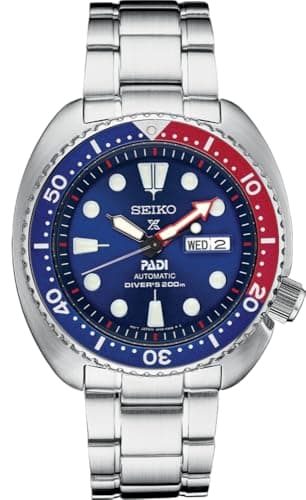
- The Kinetic diver. The 5M62 divers were diver’s watches in Seiko’s own manual, with a unidirectional bezel and a screw-lock crown, that never needed a battery. The Prospex Turtle SRPE99 is the mechanical answer: 200 m, ISO 6425, screw-down crown, the 4R36 that hand-winds and hacks. If you specifically want a quartz diver that charges itself, Seiko sells solar Prospex divers, and the dive roundup is where that decision lives.
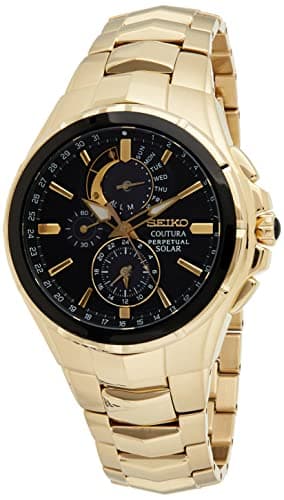
- The Kinetic Perpetual. The Coutura SSC700 is solar with a perpetual calendar correct to 2100, a six-month reserve from full charge, sapphire and a chronograph. It is the same no-battery, no-date-setting promise with light doing the charging.
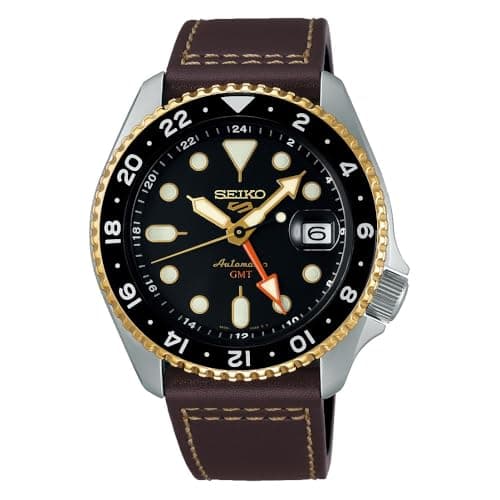
- The Kinetic GMT. The 5M85 put a 24-hour hand in a Kinetic diver. The 5 Sports SSK036 does it mechanically on the 4R34, with a rotating 24-hour bezel for a third zone.
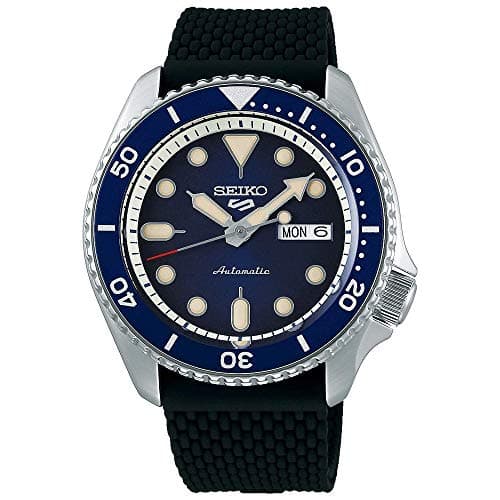
- The everyday Kinetic three-hander. The 5 Sports SRPD93 is the current entry point for a rotor you can see through the case back, this time winding a mainspring. If you would rather have quartz accuracy at that money, the battery Essentials in the quartz roundup cost less and ask for a cell every few years.
- Auto Relay’s “right when you pick it up.” The Coutura SSG021 gets there differently: solar charging plus a radio time signal that sets the time and date, daylight saving included. Outside transmitter range it is an ordinary solar quartz, which is still the lower-maintenance half of this page.
What we are not claiming
We have not opened, timed or serviced any Kinetic movement, and nothing above is a measured result. Every reserve and accuracy figure is transcribed from the Seiko instruction manual for the caliber named, with the manual linked at the point of use. The discontinuation section reports what Seiko’s catalog shows and what two named publications concluded; it does not quote a Seiko announcement, because we could not find one. The cell-life reports are attributed to their source and are reports, not a test.
The watches on this page
Specifications are transcribed from Seiko’s published documentation. Prices come from Amazon and carry the date they were verified. We have not handled these watches — here is what we did instead.
$575.0020% off
Price as of Sep 18, 2026. Prices move — Amazon's is the one that counts.
#ad · we may earn a commission from this link to Seiko Prospex Turtle SRPE99
Seiko Prospex Turtle SRPE99
SRPE99K1Best for: An actual dive watch you can also wear daily
A real 200 m ISO-rated diver with a screw-down crown, in the cushion case that wears far smaller than its 45 mm suggests.
- Spec completeness for the price
- 9.0
- Movement relative to bracket
- 8.5
- Case proportions
- 8.8
- Strap flexibility
- 9.5
- Availability
- 8.6
What it gets right
- Genuine ISO 6425 diver, not a diver-styled sports watch
- 47.7 mm lug-to-lug means it fits wrists that 45 mm suggests it should not
- Screw-down crown at 4 o'clock keeps it off the back of your hand
What it gets wrong
- Hardlex on a watch at this price is the recurring Seiko complaint
- The 45 mm figure scares people off before they try one
- PADI co-branding on the dial is not for everyone
Skip this one if: you have a wrist under about 6.5 inches. The lug-to-lug is forgiving but the case is still visually wide, and the smaller SRPG references exist for exactly this reason.
| Case diameter | 45.0 mm (cushion case) |
|---|---|
| Lug-to-lug | 47.7 mm |
| Thickness | 13.4 mm |
| Lug width | 22 mm |
| Crystal | Hardlex (hardened mineral) |
| Water resistance | 200 m, ISO 6425 rated for scuba diving |
| Crown | Screw-down, at 4 o'clock |
| Bezel | Unidirectional elapsed-timing bezel, PADI red and blue |
| Bracelet | Steel, three-fold clasp with push-button release |
| Caliber | Seiko 4R36 |
| Type | Automatic, hand-winding and hacking |
| Beat rate | 21,600 vph (6 beats/sec) |
| Jewels | 24 |
| Power reserve | Approx. 41 hours |
| Stated accuracy | -35 to +45 sec/day |
| Complications | Day and date |
Price as of Sep 18, 2026. Prices move — Amazon's is the one that counts.
#ad · we may earn a commission from this link to Seiko Coutura Solar Chronograph SSC700
Seiko Coutura Solar Chronograph SSC700
SSC700Best for: A quartz watch you charge with daylight and otherwise ignore
Sapphire, 100 m, a perpetual calendar and no battery to replace, in one watch. The most complete spec sheet in Seiko's quartz range at anything like this money.
- Spec completeness for the price
- 8.9
- Movement relative to bracket
- 8.6
- Case proportions
- 7.8
- Strap flexibility
- 8.0
- Availability
- 8.5
What it gets right
- Sapphire crystal at a price where Seiko normally fits Hardlex
- Solar — no battery change for the life of the capacitor
- Perpetual calendar means the date is right through February without you touching it
- Chronograph, alarm and a power-reserve indicator in one watch
What it gets wrong
- 44 mm is a large watch, and Seiko does not publish a lug-to-lug for it
- The gold-finish case is a styling commitment
Skip this one if: you want something mechanical or something small. This is a big light-powered quartz with a lot of functions, and that is the whole point of it.
| Case diameter | 44 mm |
|---|---|
| Thickness | 11.77 mm |
| Lug-to-lug | Not published by Seiko for this reference |
| Case material | Stainless steel with a gold finish |
| Crystal | Sapphire |
| Water resistance | 100 m (10 bar) |
| Caliber | Seiko V198 solar chronograph |
| Stated accuracy | ±15 sec/month |
| Power reserve | Approx. 6 months from full charge |
| Chronograph | 60 minutes, in 1/5-second increments, with split-time measurement |
| Calendar | Perpetual — leap year, month, day and date, to 2100 |
| Complications | Alarm, power reserve indicator, small seconds |
| Dial | Black |
| Bracelet | Stainless steel |
Price as of Sep 18, 2026. Prices move — Amazon's is the one that counts.
#ad · we may earn a commission from this link to Seiko 5 Sports SKX GMT SSK036
Seiko 5 Sports SKX GMT SSK036
SSK036Best for: A second time zone on a mechanical caliber
The SKX-shaped 4R34 GMT on a bi-color 24-hour bezel and brown leather. Mechanical two-zone timekeeping at Seiko 5 money.
- Spec completeness for the price
- 9.0
- Movement relative to bracket
- 9.2
- Case proportions
- 8.5
- Strap flexibility
- 9.5
- Availability
- 7.5
What it gets right
- A genuine mechanical GMT in the 5KX case, hand-winding and hacking
- Rotating 24-hour bezel adds a third zone on top of the GMT hand
- 22 mm lugs, so the whole 5KX strap aftermarket fits
What it gets wrong
- Caller GMT — the local hour hand does not jump
- Hardlex, and a date magnifier you cannot remove
- 100 m on leather is not a swim watch as delivered
- 13.6 mm thick
Skip this one if: you actually cross time zones with it. A caller GMT is built to track home from a desk; changing your local zone means resetting the watch. Traveler (flyer) GMTs, where the local hour hand jumps on its own, start much further up Seiko's range.
| Case diameter | 42.5 mm |
|---|---|
| Lug-to-lug | 46.0 mm |
| Thickness | 13.6 mm |
| Lug width | 22 mm |
| Crystal | Hardlex, with a magnifier over the date |
| Water resistance | 100 m (10 bar) |
| Bezel | Rotating 24-hour, gold, black and dark brown |
| Strap | Brown cow leather with contrast stitching |
| Display back | Yes — see-through screw case back |
| Lume | LumiBrite on hands and indexes |
| Caliber | Seiko 4R34 |
| Type | Automatic GMT, hand-winding and hacking |
| Beat rate | 21,600 vph (6 beats/sec) |
| Jewels | 24 |
| Power reserve | Approx. 41 hours |
| Stated accuracy | -35 to +45 sec/day |
| GMT type | Caller (office) GMT — the 24-hour hand is independent |
$350.0020% off
Price as of Sep 18, 2026. Prices move — Amazon's is the one that counts.
#ad · we may earn a commission from this link to Seiko 5 Sports SRPD93
Seiko 5 Sports SRPD93
SRPD93Best for: A first mechanical watch you will not outgrow
The 5KX case with a movement that hacks and hand-winds, in blue on a silicone strap. The default answer under $350, and the one most people should stop looking after.
- Spec completeness for the price
- 8.8
- Movement relative to bracket
- 8.5
- Case proportions
- 8.9
- Strap flexibility
- 9.5
- Availability
- 8.8
What it gets right
- Hacks and hand-winds — the SKX's biggest omission, fixed
- 22 mm lugs put the entire aftermarket strap catalog in play
- Day-date in a genuinely legible layout
- Case shape is the SKX profile people actually want
What it gets wrong
- Hardlex, not sapphire — it will scratch
- 100 m and no screw-down crown, so it is not an ISO 6425 diver despite the looks
- 13.4 mm thick under a shirt cuff
- Ships on a silicone strap rather than a bracelet
Skip this one if: you want an actual dive watch. The 100 m rating and the absence of a screw-down crown mean this is a dive-styled sports watch, not an ISO 6425 diver. The Turtle is the real one.
| Case diameter | 42.5 mm |
|---|---|
| Lug-to-lug | 46.0 mm |
| Thickness | 13.4 mm |
| Lug width | 22 mm |
| Crystal | Hardlex (hardened mineral) |
| Water resistance | 100 m — splash and swim, not scuba |
| Bezel | Blue unidirectional rotating |
| Dial | Blue sunray |
| Strap | Black silicone |
| Case back | See-through |
| Lume | LumiBrite |
| Caliber | Seiko 4R36 |
| Type | Automatic, hand-winding and hacking |
| Beat rate | 21,600 vph (6 beats/sec) |
| Jewels | 24 |
| Power reserve | Approx. 41 hours |
| Stated accuracy | -35 to +45 sec/day |
| Complications | Day and date |
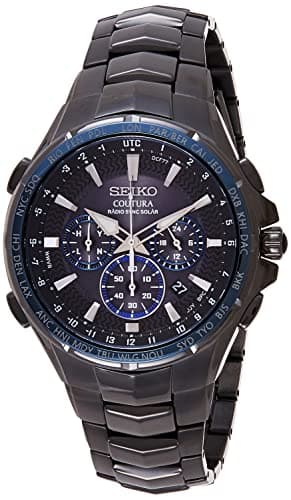
Price as of Sep 18, 2026. Prices move — Amazon's is the one that counts.
#ad · we may earn a commission from this link to Seiko Coutura Radio Sync Solar SSG021
Seiko Coutura Radio Sync Solar SSG021
SSG021Best for: A watch that is never wrong and never needs setting
It sets itself from a radio time signal and charges itself from daylight. Nothing else Seiko sells at this price asks less of its owner.
- Spec completeness for the price
- 8.6
- Movement relative to bracket
- 9.4
- Case proportions
- 7.2
- Strap flexibility
- 7.4
- Availability
- 8.5
What it gets right
- Radio sync means the time and date set themselves, including the daylight-saving change
- Solar as well, so it needs neither a battery nor setting
- Sapphire and a screw-down crown at a price where neither is guaranteed
- 25-zone world time on the bezel, which is genuinely usable rather than a dial marking
What it gets wrong
- 44.5 mm and busy — this is not a discreet watch
- Radio sync only works in range of a transmitter; outside coverage it is an ordinary quartz watch
- Seiko does not publish a free-running monthly rate for this reference
- The most expensive watch on this page by a wide margin
Skip this one if: you want something quiet on the wrist. The Coutura case is 44.5 mm with an ion-finished bezel and applied markings, and no amount of movement cleverness makes it subtle — the SSC376 is the same solar idea without the radio receiver.
| Case diameter | 44.5 mm |
|---|---|
| Thickness | 11.5 mm |
| Lug-to-lug | Not published by Seiko for this reference |
| Case material | Stainless steel, black ion finish |
| Crystal | Sapphire |
| Water resistance | 100 m (10 bar) |
| Caliber | Seiko 8B92 radio sync solar |
| Timekeeping | Radio-controlled — receives an official standard-frequency signal |
| Stated accuracy | Free-running rate not published by Seiko for this reference |
| Power reserve | Approx. 6 months from full charge |
| Chronograph | 60 minutes in 1/5-second increments, with split time |
| World time | 25 time zones, set from the bezel |
| Crown | Screw-down |
| Complications | Chronograph, world time, 24-hour indicator, date |
Questions
Is Seiko Kinetic still made?
Not as far as Seiko’s catalog shows. The US watch finder lists Automatic, Spring Drive, Solar and Quartz as movement types and no Kinetic, and no Kinetic watch resolved as purchasable new through our retail pipeline on 2026-09-17. Seiko has not published a discontinuation notice we can cite, so we describe it as no longer listed rather than formally discontinued.
Kinetic or automatic: which is better?
Kinetic keeps far better time, less than 15 seconds a month against -35 to +45 seconds a day for a 4R36, and runs for months on a charge instead of 41 hours. An automatic has a sweeping seconds hand, is still in production, and recovers from a stop with a minute of hand-winding, where a flat Kinetic needs hundreds of swings. If you want accuracy and reserve, Kinetic; if you want a mechanical watch you can buy new, automatic.
How long does a Seiko Kinetic hold its charge?
About six months from a full charge for the 5M62, 5M82 and 5M85 calibers, about five for the 7L22 chronograph and about a month for the 5D44 Direct Drive, all per Seiko’s manuals. The Auto Relay and Perpetual calibers stop their hands after 72 hours unworn and keep time internally for up to four years.
Does a Seiko Kinetic have a battery?
It has a rechargeable cell, which Seiko’s manuals call a rechargeable battery or a Kinetic E.S.U., charged by the rotor. It is not a disposable battery and must never be replaced with an ordinary silver-oxide cell, which Seiko warns may burst or catch fire.
Why does my Kinetic only run for a day or two?
Either it is not being worn enough to charge, since Seiko’s guidance is at least ten hours a day and about 250 swings per day of reserve, or the rechargeable cell has lost capacity, which Seiko’s manual says happens gradually and which is worse for cells left flat. The first is fixed by wearing it; the second is a cell replacement at service.
Is Kinetic the same as solar?
No. Both are quartz movements that charge a rechargeable cell instead of using a disposable battery, but Kinetic charges from wrist motion through a rotor and generator, while solar charges from light through the dial. Solar charges unworn; Kinetic does not, which is the main reason solar is the one Seiko still sells.
What replaced the Seiko Kinetic diver?
In the current catalog, the mechanical Prospex divers such as the Turtle SRPE99, and the solar Prospex divers. Both are 200 m ISO 6425 watches. The Turtle is the one we can price and specify from Seiko’s published figures, which is why it is the buy option on this page.
Sources
- Seiko — heritage timeline of technologies (A.G.S. 1988, Kinetic Perpetual 2005)
- Seiko — instruction manual, Kinetic Cal. 5M62/5M63
- Seiko — instruction manual, Kinetic Cal. 5M82
- Seiko — instruction manual, Kinetic GMT Cal. 5M85
- Seiko — instruction manual, Kinetic Auto Relay Cal. 5J22
- Seiko — instruction manual, Kinetic Perpetual Cal. 7D48
- Seiko — instruction manual, Kinetic Direct Drive Cal. 5D44
- Seiko — instruction manual, Kinetic Chronograph Cal. 7L22
- Seiko USA — watch finder, movement types (checked 2026-09-17)
- Time and Tide — The rise and apparent fall of the Seiko Kinetic range (Oct 2021)
- The Escapement Room — The Seiko Kinetic movement: how it works, and why does it exist? (May 2025)
- Seiko instruction manuals and caliber documentation
- Seiko Watch Corporation — US catalog and specifications
Specifications are transcribed from manufacturer documentation and published standards. Where a manufacturer does not publish a figure, this page says so rather than estimating one.
Read next
- Seiko solar calibersThe technology that replaced Kinetic: light into a rechargeable cell.
- Seiko 4R36 caliber referenceThe automatic on the other side of the Kinetic-or-automatic question.
- Best Seiko quartz watchesSolar and battery quartz ranked, for the buyer who wanted Kinetic's accuracy.
- Best Seiko automatic watchesThe mechanical alternative, ranked on published specs.
- Spring Drive vs quartzSeiko's other mechanical-electric hybrid, and why it is a different idea.
- How to wind a Seiko automaticThe routine that replaces swinging a Kinetic back to life.