Roundups
Best Seiko quartz watches
Battery, solar and radio sync are not three price points of the same thing. Pick the power source first and the shortlist writes itself.
By Stephen V. · Updated Aug 25, 2026
Quick picks
| # | Watch | Key spec | Score | Price |
|---|---|---|---|---|
| 1 | 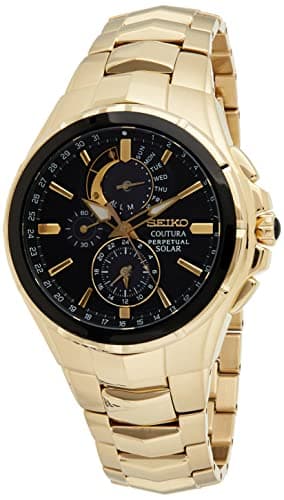 Seiko Coutura Solar Chronograph SSC700SSC700 Sapphire, 100 m, a perpetual calendar and no battery to replace, in one watch. The most complete spec sheet in Seiko's quartz range at anything like this money. | 44mm · solar chrono | 8.4out of 10, compiled from published specifications | |
| 2 | 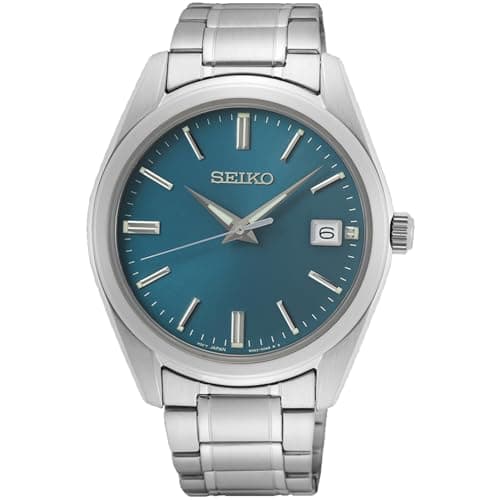 Seiko Essentials SUR525SUR525 The blue-dial Essentials. Same quiet quartz proposition as the SUR311 with a sunray dial that lifts it above 'plain'. | 40.2mm · quartz | 8.5out of 10, compiled from published specifications | |
| 3 | 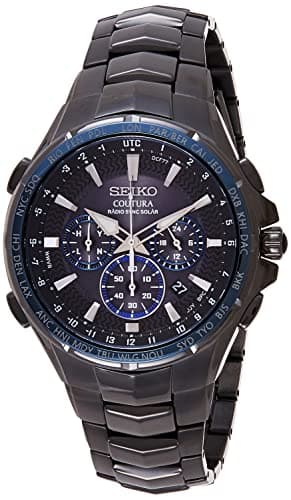 Seiko Coutura Radio Sync Solar SSG021SSG021 It sets itself from a radio time signal and charges itself from daylight. Nothing else Seiko sells at this price asks less of its owner. | 44.5mm · radio sync | 8.2out of 10, compiled from published specifications | |
| 4 | 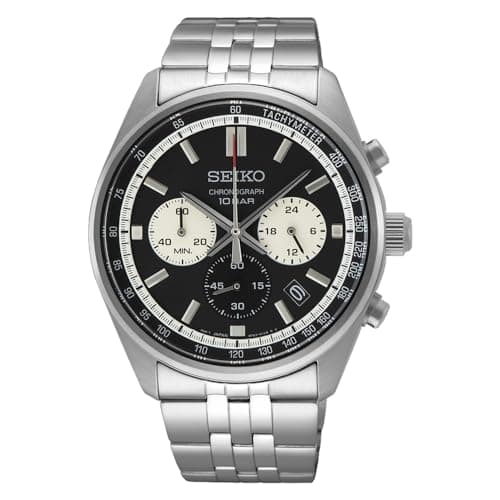 Seiko Essentials Chronograph SSB429SSB429 The cheap way into a Seiko chronograph: a quartz movement, a tachymeter ring and 100 m, on a steel bracelet. No sweeping seconds, and none of the price of a mechanical chrono. | 41.5mm · quartz chrono | 8.5out of 10, compiled from published specifications | |
| 5 | 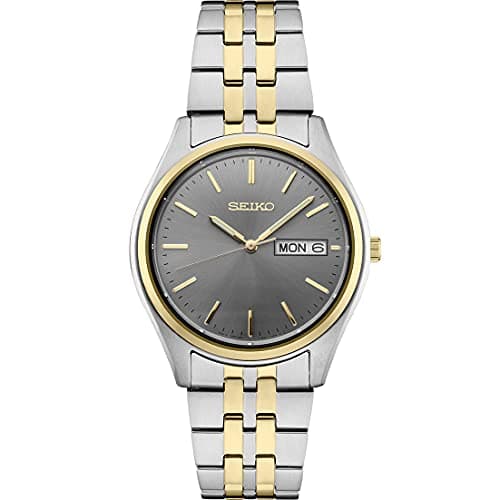 Seiko Essentials SUR432SUR432 A gray sunray dial on a two-tone bracelet, 8.83 mm thick and rated 100 m. The dressiest thing Seiko sells at this price and it does not pretend otherwise. | 36.9mm · quartz | 8.5out of 10, compiled from published specifications | |
| 6 | 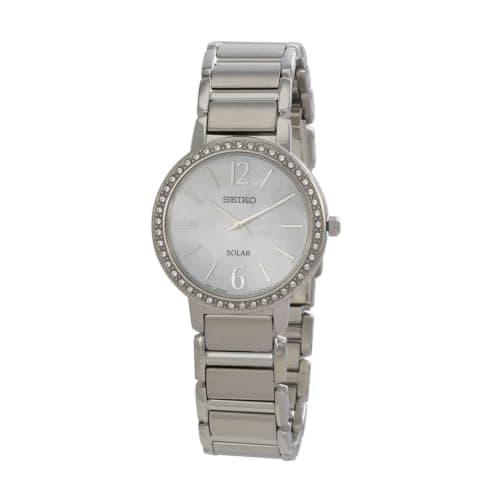 Seiko Women's Solar SUP467SUP467 A 30.5 mm solar dress watch that runs about a year on a full charge. No battery changes, no winding, quartz accuracy — the lowest-maintenance watch on this list. | 30.5mm · solar | 8.1out of 10, compiled from published specifications |
6 picks · Prices last verified October 23, 2026. Where no live price came back we show “Check price” rather than a number we cannot stand behind. How we pick.
Seiko is the company that put quartz into a wristwatch and sold it — the Astron arrived in 1969 and the rest of the industry spent the following decade reacting to it. Six decades later quartz is still the majority of what Seiko actually ships, and it is the part of the range enthusiast writing skips almost entirely, because a movement with no rotor to photograph is a harder story to tell.
That silence has a practical cost. “Seiko quartz” is not one thing. It covers a battery-powered movement in a sub-$200 Essentials, a light-powered solar caliber with a published monthly rate, and a radio-controlled solar chronograph that sets its own time and date from a broadcast signal. Those three are as different from each other as a 7S26 is from a 6R35, and the difference decides the purchase far more than the dial color does. This page separates them, then ranks inside each.
Three kinds of Seiko quartz
Every quartz watch on this page keeps time the same way — a quartz crystal oscillating at a fixed frequency, divided down to drive a stepping motor. What differs is where the electricity comes from and whether the watch is capable of correcting itself. Those two questions produce three families, and Seiko sells all three.
| Family | Power source | What you have to do |
|---|---|---|
| Battery quartz — Essentials | Disposable cell | Replace the cell every few years; set it yourself |
| Solar quartz — V-series | Light, stored in a rechargeable cell | Wear it in daylight; set it yourself |
| Radio sync solar — 8B-series | Light, plus a broadcast time signal | Nothing, in signal range |
The ladder is real but it is not a straight line of better and better. A battery quartz Essentials is the cheapest and the easiest to service anywhere in the world. A solar caliber removes the battery change and, usefully, comes with a published accuracy figure where the plain quartz does not. Radio sync removes the setting as well, and adds a case size and a price that not everyone wants. Each step buys a specific thing, and each step costs something.
What this page ranked on
The picks below were selected against the criteria in this order, before any of the prose around them was written. They are the same criteria the rest of the site uses, with one addition specific to quartz.
- Does Seiko publish a rate for it? The quartz-specific criterion. A caliber with a documented monthly rate is a caliber you can hold to a standard. Several Seiko quartz references have no published figure at all, and those cannot be ranked on accuracy however well they may actually run.
- Crystal. Sapphire or Hardlex, and no fudging. This is the biggest divider of long-term appearance in the price range these watches occupy, and Seiko fits both across it.
- Water resistance, as rated rather than as implied.100 m and 50 m are different watches. Neither is a diver — see what the ratings actually certify.
- Specification completeness. How much of the case Seiko publishes. Where it publishes nothing, this page says so instead of estimating, and the pick is marked down for it.
- Currently orderable. Every reference here was checked for a live, buyable offer before it was written in. Nothing is featured on the strength of having been available last year.
The accuracy gap is larger than most people expect
The interesting comparison is not quartz against quartz, it is quartz against the mechanical watches this site spends most of its time on. Seiko publishes a stated rate for the 4R36 of −35 to +45 seconds per day. It publishes a rate for the V157 solar caliber of less than 15 seconds per month, measured worn, between 5 and 35 °C.
Do the arithmetic and the scale becomes obvious: a 4R36 running at the edge of its stated tolerance drifts further in a single day than the V157 is permitted to drift in a month. That is not a criticism of the 4R36, which is a good movement doing a much harder job with a mainspring and an escapement. It is the reason quartz exists, and it is why the honest framing of this decision is that you buy mechanical for reasons that have nothing to do with timekeeping.
One caveat applies to every quartz figure, Seiko’s included: rate is temperature-dependent, which is why Seiko states a temperature band alongside the number. A watch left on a cold windowsill or a hot dashboard is outside the conditions the figure describes. Wear it and the number holds. Every Seiko ranked by its published rate, from radio sync down to the tightest mechanical, is on the most accurate Seiko watches.
Solar is not a battery, and that matters twice
A Seiko solar watch has a photovoltaic cell under the dial and a rechargeable cell behind the movement. Light charges the cell, the cell runs the watch, and there is no routine battery replacement for as long as the rechargeable cell holds a charge. Seiko’s own technical documentation for the V157 gives approximately 10 months of running from a full charge with no further light, which means a watch left in a drawer over a winter is still running in the spring. The full mechanism is in the solar caliber reference, and the light-powered references are ranked against each other on the solar roundup.
The part the marketing leaves out is that the rechargeable cell is itself a wear item. It is not a battery you swap every few years, but it is not eternal either, and eventually it holds less charge than it did. That is a service-center job rather than a jeweler’s-counter job, and it is the honest cost of the technology. It does not make solar a bad buy — it makes “never needs a battery” a claim with a footnote. If the Seiko in your drawer charges from a rotor rather than from light, that is Kinetic, which Seiko no longer lists; the same footnote applies to it, and more heavily, for the reasons on that page.
Radio sync, and exactly where it stops working
The SSG021 runs Seiko’s 8B92, which receives an official standard-frequency time signal and sets the time and calendar from it. Inside the coverage area of a transmitter the watch is correct because it is told the correct time, not because it kept it well. The daylight-saving change happens without you.
Outside coverage — and coverage is a real, mapped, finite thing rather than a global guarantee — a radio-sync watch is an ordinary quartz watch that you set by hand. Seiko does not publish a free-running monthly rate for this reference, so this page cannot tell you how well it holds time between receptions, and will not guess. If you live and travel outside signal range you are paying for a feature you will not use, and the SSC700 is the same solar proposition without it.
The quartz dive watch question
“Best Seiko quartz diver” is a query with an awkward honest answer. Seiko does make quartz divers — the solar Prospex references — but the examples currently listed at the US retailer are international-market references with no Seiko USA specification page behind them, at prices above what the automatic divers cost. This site does not publish specifications it cannot source from the manufacturer, and it does not rank a watch it would not buy at the price on the screen.
So no quartz diver is ranked here. If what you want is a watch with an ISO 6425 certification, the mechanical divers are cheaper and better documented right now — the dive roundup covers them and the under-$500 rung covers the entry point. If what you want is 100 m on a solar caliber you never have to wind or re-battery, the SSC700 on this page does that for less.
Where quartz wins, and where it does not
Quartz wins on accuracy, on thickness, on price for a given specification, and on the thing nobody lists: it is still running when you pick it up. A mechanical watch left for a week is a watch you have to reset before you can wear it, and for a second or third watch in a rotation that friction is the actual reason it stays in the box.
Quartz loses on the part that is not measurable. There is no rotor, no sweep, nothing to watch through a caseback, and no sense that the thing on your wrist is a machine. That is a real reason to spend more on an automatic, and it is a better reason than any accuracy argument, because the accuracy argument points the other way. Seiko’s own answer to the tension is worth reading too: the Spring Drive comparison is where the two approaches stop being opposites.
What Seiko does not publish about its quartz
Consistently less than it publishes about its mechanical watches, and the gaps are predictable. Lug-to-lug is missing across the Essentials line, so a 40 mm quartz Seiko is a case whose fit you cannot calculate before it arrives. Case diameter is missing for the SSB429 chronograph. A stated monthly rate is missing for the plain battery calibers on this page, which is why the two picks with published figures rank above them on that criterion and not on price.
Every one of those gaps is written as a gap on the pick below it. The alternative — filling in a plausible number — is what makes most spec tables on the internet useless, because a reader cannot tell which figures were transcribed and which were invented.
The picks in full
Specifications are transcribed from Seiko’s published documentation. Prices come from Amazon and carry the date they were verified. We have not handled these watches — here is what we did instead.
No buyable offer at the last check (October 23, 2026). We show nothing rather than a stale number.
#ad · we may earn a commission from this link to Seiko Coutura Solar Chronograph SSC700
Seiko Coutura Solar Chronograph SSC700
SSC700Best for: A quartz watch you charge with daylight and otherwise ignore
Sapphire, 100 m, a perpetual calendar and no battery to replace, in one watch. The most complete spec sheet in Seiko's quartz range at anything like this money.
- Spec completeness for the price
- 8.9
- Movement relative to bracket
- 8.6
- Case proportions
- 7.8
- Strap flexibility
- 8.0
- Availability
- 8.5
What it gets right
- Sapphire crystal at a price where Seiko normally fits Hardlex
- Solar — no battery change for the life of the capacitor
- Perpetual calendar means the date is right through February without you touching it
- Chronograph, alarm and a power-reserve indicator in one watch
What it gets wrong
- 44 mm is a large watch, and Seiko does not publish a lug-to-lug for it
- The gold-finish case is a styling commitment
Skip this one if: you want something mechanical or something small. This is a big light-powered quartz with a lot of functions, and that is the whole point of it.
| Case diameter | 44 mm |
|---|---|
| Thickness | 11.77 mm |
| Lug-to-lug | Not published by Seiko for this reference |
| Case material | Stainless steel with a gold finish |
| Crystal | Sapphire |
| Water resistance | 100 m (10 bar) |
| Caliber | Seiko V198 solar chronograph |
| Stated accuracy | ±15 sec/month |
| Power reserve | Approx. 6 months from full charge |
| Chronograph | 60 minutes, in 1/5-second increments, with split-time measurement |
| Calendar | Perpetual — leap year, month, day and date, to 2100 |
| Complications | Alarm, power reserve indicator, small seconds |
| Dial | Black |
| Bracelet | Stainless steel |
$265.0038% off
Price as of October 23, 2026. Prices move — Amazon's is the one that counts.
#ad · we may earn a commission from this link to Seiko Essentials SUR525
Seiko Essentials SUR525
SUR525Best for: A slim quartz watch with some dial interest
The blue-dial Essentials. Same quiet quartz proposition as the SUR311 with a sunray dial that lifts it above 'plain'.
- Spec completeness for the price
- 8.1
- Movement relative to bracket
- 8.0
- Case proportions
- 8.6
- Strap flexibility
- 9.2
- Availability
- 8.5
What it gets right
- Sunray blue dial
- 100 m
- Quartz accuracy
What it gets wrong
- Battery
- Hardlex
- Seiko does not publish a thickness figure for this reference
Skip this one if: thickness is a constraint. The SUR311 has a published 8.36 mm figure; this reference does not, and we are not guessing on your behalf.
| Case diameter | 40.2 mm |
|---|---|
| Lug-to-lug | Not published by Seiko for this reference |
| Thickness | Not published by Seiko for this reference |
| Lug width | 20 mm |
| Crystal | Hardlex |
| Water resistance | 100 m |
| Caliber | Seiko quartz, battery-powered |
No buyable offer at the last check (October 23, 2026). We show nothing rather than a stale number.
#ad · we may earn a commission from this link to Seiko Coutura Radio Sync Solar SSG021
Seiko Coutura Radio Sync Solar SSG021
SSG021Best for: A watch that is never wrong and never needs setting
It sets itself from a radio time signal and charges itself from daylight. Nothing else Seiko sells at this price asks less of its owner.
- Spec completeness for the price
- 8.6
- Movement relative to bracket
- 9.4
- Case proportions
- 7.2
- Strap flexibility
- 7.4
- Availability
- 8.5
What it gets right
- Radio sync means the time and date set themselves, including the daylight-saving change
- Solar as well, so it needs neither a battery nor setting
- Sapphire and a screw-down crown at a price where neither is guaranteed
- 25-zone world time on the bezel, which is genuinely usable rather than a dial marking
What it gets wrong
- 44.5 mm and busy — this is not a discreet watch
- Radio sync only works in range of a transmitter; outside coverage it is an ordinary quartz watch
- Seiko does not publish a free-running monthly rate for this reference
- The most expensive watch on this page by a wide margin
Skip this one if: you want something quiet on the wrist. The Coutura case is 44.5 mm with an ion-finished bezel and applied markings, and no amount of movement cleverness makes it subtle — the SSC376 is the same solar idea without the radio receiver.
| Case diameter | 44.5 mm |
|---|---|
| Thickness | 11.5 mm |
| Lug-to-lug | Not published by Seiko for this reference |
| Case material | Stainless steel, black ion finish |
| Crystal | Sapphire |
| Water resistance | 100 m (10 bar) |
| Caliber | Seiko 8B92 radio sync solar |
| Timekeeping | Radio-controlled — receives an official standard-frequency signal |
| Stated accuracy | Free-running rate not published by Seiko for this reference |
| Power reserve | Approx. 6 months from full charge |
| Chronograph | 60 minutes in 1/5-second increments, with split time |
| World time | 25 time zones, set from the bezel |
| Crown | Screw-down |
| Complications | Chronograph, world time, 24-hour indicator, date |
No buyable offer at the last check (October 23, 2026). We show nothing rather than a stale number.
#ad · we may earn a commission from this link to Seiko Essentials Chronograph SSB429
Seiko Essentials Chronograph SSB429
SSB429Best for: A working chronograph on the smallest budget
The cheap way into a Seiko chronograph: a quartz movement, a tachymeter ring and 100 m, on a steel bracelet. No sweeping seconds, and none of the price of a mechanical chrono.
- Spec completeness for the price
- 8.4
- Movement relative to bracket
- 7.8
- Case proportions
- 8.3
- Strap flexibility
- 9.5
- Availability
- 8.5
What it gets right
- A real chronograph at a price nothing mechanical comes close to
- 100 m, so it survives ordinary life
- Seiko publishes the full case dimensions for it, which it does not for every Essentials reference
What it gets wrong
- Battery quartz, so the seconds hand ticks and a cell needs replacing every few years
- Hardlex, not sapphire
- 22 mm lugs on a 41.5 mm case read wide
Skip this one if: you want the watch to charge itself. The solar Couturas cost more but never need a battery, and on a chronograph a dead cell is the usual reason one ends up in a drawer.
| Case diameter | 41.5 mm |
|---|---|
| Lug-to-lug | 46.5 mm |
| Thickness | 12.09 mm |
| Lug width | 22 mm |
| Case material | Stainless steel |
| Crystal | Hardlex |
| Water resistance | 100 m (10 bar) |
| Caliber | Seiko 8T63 quartz chronograph, battery-powered |
| Chronograph | 60 minutes, in 1/5-second increments |
| Complications | Tachymeter ring, 24-hour subdial, date |
| Dial | Black |
| Bracelet | Stainless steel |
$235.0020% off
Price as of October 23, 2026. Prices move — Amazon's is the one that counts.
#ad · we may earn a commission from this link to Seiko Essentials SUR432
Seiko Essentials SUR432
SUR432Best for: A cheap watch to wear with a jacket
A gray sunray dial on a two-tone bracelet, 8.83 mm thick and rated 100 m. The dressiest thing Seiko sells at this price and it does not pretend otherwise.
- Spec completeness for the price
- 8.3
- Movement relative to bracket
- 8.0
- Case proportions
- 8.5
- Strap flexibility
- 9.2
- Availability
- 8.4
What it gets right
- Reads considerably more expensive than it is
- 100 m, which is unusual for a dress-leaning watch at this money
- 8.83 mm thick — it actually fits under a cuff
What it gets wrong
- Hardlex, not sapphire
- Gold-tone finishes wear at the bracelet edges
- 36.9 mm reads small if you are used to a 40 mm sports watch
Skip this one if: you want one watch for everything. This is a dress-leaning quartz on a two-tone bracelet — it is the second watch in a two-watch collection, not the first.
| Case diameter | 36.9 mm |
|---|---|
| Lug-to-lug | Not published by Seiko for this reference |
| Thickness | 8.83 mm |
| Lug width | 18 mm |
| Case material | Two-tone stainless steel |
| Crystal | Hardlex |
| Water resistance | 100 m (10 bar) |
| Caliber | Seiko 6N43 quartz, battery-powered |
| Complications | Day and date |
| Dial | Gray |
| Bracelet | Two-tone stainless steel |
Price as of October 23, 2026. Prices move — Amazon's is the one that counts.
#ad · we may earn a commission from this link to Seiko Women's Solar SUP467
Seiko Women's Solar SUP467
SUP467Best for: A dress watch that never needs winding or a battery
A 30.5 mm solar dress watch that runs about a year on a full charge. No battery changes, no winding, quartz accuracy — the lowest-maintenance watch on this list.
- Spec completeness for the price
- 8.0
- Movement relative to bracket
- 8.2
- Case proportions
- 8.4
- Strap flexibility
- 7.5
- Availability
- 8.4
What it gets right
- Solar — no battery replacement for the life of the capacitor
- About 12 months of running from one full charge
- 6.8 mm thick and 30.5 mm across, so it sits flat under a cuff
What it gets wrong
- Seiko rates it splash resistant only, not 30 m or 50 m
- Quartz, so nothing mechanical to look at
- The capacitor is a wear item eventually, even though the watch never needs a battery
Skip this one if: the watch needs to go anywhere near water. Seiko rates this one splash resistant rather than to a depth, so it is a dress watch in the strict sense.
| Case diameter | 30.5 mm |
|---|---|
| Lug-to-lug | 37.7 mm |
| Thickness | 6.8 mm |
| Lug width | 12 mm |
| Case material | Stainless steel |
| Crystal | Curved Hardlex |
| Water resistance | Splash resistant, per Seiko — not rated for swimming |
| Caliber | Seiko V115 solar quartz |
| Stated accuracy | ±15 sec/month |
| Power reserve | Approx. 12 months from full charge |
| Magnetic resistance | 4,800 A/m |
| Weight | 75.0 g |
How to choose one
Pick the power source before anything else
This is the decision that removes the most options fastest. If you will wear the watch in daylight most weeks, solar removes a maintenance job permanently and comes with a better-documented movement. If the watch will live in a drawer and come out for occasions, a battery quartz is the more sensible buy — a solar watch that never sees light is a solar watch you will find stopped.
Sapphire is the upgrade worth paying for here
On a mechanical Seiko the money usually goes to the movement. On a quartz Seiko the movement differences are small and the crystal difference is not. Hardlex is hardened mineral glass and it scratches; sapphire does not, short of contact with something deliberately harder. Across a watch you intend to wear for a decade without thinking about it, that is the specification that decides how it looks at the end of it.
Do not pay for water resistance you will not use
100 m is generous for a watch that will see a shower and a sink, and it is not a dive rating. 50 m is splash resistance and nothing more. Neither figure survives a crown left unscrewed, and neither is a reason to choose between two watches you otherwise like — unless one of them is going swimming, in which case it is the only reason.
Check what Seiko publishes before you pay for a size
A case diameter on its own does not tell you whether a watch fits. Lug-to-lug does, and Seiko does not publish it for most of its quartz range. If wrist fit is your binding constraint, buy from the references where the figure exists, or buy somewhere with a return policy and treat the first week as the measurement.
The battery is not the argument against quartz
A cell change every few years is a small, cheap, universally available service, and the watch keeps better time between changes than any mechanical alternative in the price range. If you find yourself avoiding quartz over the battery, the real objection is usually the other one — that it is not a machine — and that is worth naming honestly, because it points at a different watch entirely.
Buy the chronograph only if you will press the buttons
A quartz chronograph is the cheapest way into the complication by a wide margin, and it is also the most commonly bought-and-never-used complication on any watch. If the sub-dials are decoration to you, a three-hand quartz with the same crystal and rating is cleaner, thinner and cheaper. The chronograph roundup covers the solar and mechanical options if the complication is genuinely the point.
Questions
What is the best Seiko quartz watch?
The Coutura SSC700, on published specification: a solar chronograph caliber, a sapphire crystal, 100 m of water resistance, a perpetual calendar and no battery to replace. Seiko rates it at ±15 seconds a month. If 44 mm is too much watch, the Essentials SUR525 is the cheaper three-hand answer at 40.2 mm.
Are Seiko quartz watches accurate?
Seiko publishes a rate of less than 15 seconds per month for the V157 solar caliber, measured worn between 5 and 35 °C. For comparison, Seiko’s 4R36 automatic is rated −35 to +45 seconds per day. Seiko publishes a monthly rate for some of its plain battery calibers and not others — the 6N52 in the Essentials SUR311 is rated ±15 seconds a month — so this site quotes one only where Seiko does.
How long does a Seiko quartz battery last?
Seiko states it per reference rather than as one figure for the range, so we will not print a number that covers all of them. What is published for the solar calibers is the run time from a full charge with no further light: approximately 10 months for the V157, approximately 6 months for the 8B92 radio-sync caliber.
Do Seiko solar watches ever need a battery?
Not a disposable one. Light charges a rechargeable cell and there is no routine battery change. That cell is still a wear item and will eventually hold less charge than it did new, at which point it is replaced at a service center rather than at a jeweler’s counter. “No battery change” is accurate; “nothing to replace ever” is not.
Is a Seiko solar watch a quartz watch?
Yes. Solar describes where the power comes from, not how the watch keeps time. A Seiko solar movement is a quartz movement with a photovoltaic cell and a rechargeable cell in place of a disposable battery, and its seconds hand steps once a second like any other quartz.
Does Seiko make a quartz dive watch?
Yes — the solar Prospex references. This page does not rank one, because the examples currently listed at the US retailer are international-market references with no Seiko USA specification page behind them, at prices above the automatic divers. The mechanical divers are the better-documented buy at present.
Is quartz or automatic better in a Seiko?
Quartz is more accurate, thinner, cheaper for a given specification, and still running when you pick it up. Automatic gives you a machine, a rotor and something to look at through a caseback. Neither is better in general; the useful question is whether you want a timekeeping instrument or a mechanical object, and the answer is not the same for everyone.
Sources
- Seiko USA — Coutura SSC700 published specifications
- Seiko USA — Coutura SSG021 published specifications
- Seiko technical guide — analogue solar Cal. V198A
- Seiko Watch Corporation — US catalog and specifications
- Seiko instruction manuals and caliber documentation
- ISO 22810 — Horology, water-resistant watches (standard listing)
- Seiko customer service — warranty and servicing
Specifications are transcribed from manufacturer documentation and published standards. Where a manufacturer does not publish a figure, this page says so rather than estimating one.
Read next
- Best Seiko automatic watchesThe other side of the same decision, ranked on the same criteria.
- Seiko solar calibersHow light-powered quartz works, and the one slow wear item in it.
- Seiko Kinetic explainedThe rotor-charged quartz Seiko stopped listing, and what replaces it.
- Best Seiko chronographsWhere the quartz chronograph sits against the solar and mechanical options.
- Spring Drive vs quartzWhat Seiko built when it stopped treating the two as opposites.
- Best Seiko watches under $200The bracket most of the battery-quartz range lives in.
- Seiko water resistance explainedWhy 100 m on a quartz Essentials is not a dive rating.