Roundups
Best Seiko chronographs
Seiko's affordable chronographs run on light or a battery, not a mainspring. That is the honest starting point, and it is mostly good news.
By Stephen V. · Updated Aug 25, 2026 · Published Aug 8, 2026
Quick picks
| # | Watch | Key spec | Score | Price |
|---|---|---|---|---|
| 1 | 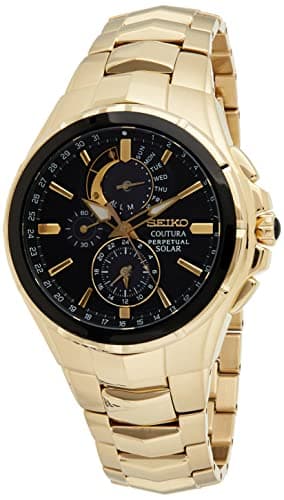 Seiko Coutura Solar Chronograph SSC700SSC700 Sapphire, 100 m, a perpetual calendar and no battery to replace, in one watch. The most complete spec sheet in Seiko's quartz range at anything like this money. | 44mm · solar chrono | 8.4out of 10, compiled from published specifications | |
| 2 | 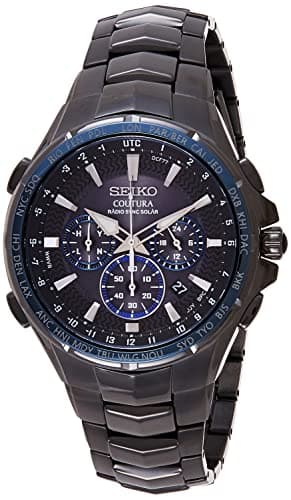 Seiko Coutura Radio Sync Solar SSG021SSG021 It sets itself from a radio time signal and charges itself from daylight. Nothing else Seiko sells at this price asks less of its owner. | 44.5mm · radio sync | 8.2out of 10, compiled from published specifications | |
| 3 | 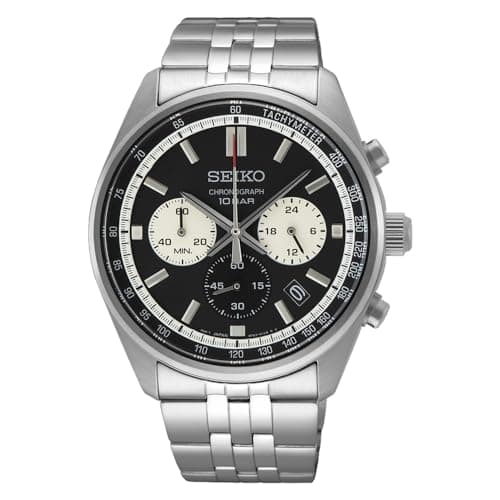 Seiko Essentials Chronograph SSB429SSB429 The cheap way into a Seiko chronograph: a quartz movement, a tachymeter ring and 100 m, on a steel bracelet. No sweeping seconds, and none of the price of a mechanical chrono. | 41.5mm · quartz chrono | 8.5out of 10, compiled from published specifications |
3 picks · Prices last verified October 23, 2026. Where no live price came back we show “Check price” rather than a number we cannot stand behind. How we pick.
The first thing to be honest about is that Seiko’s affordable chronographs are not mechanical. A mechanical chronograph — one where the stopwatch is driven by gears and levers off a wound spring — is one of the more complex things in watchmaking, and Seiko does build them, in the upper tiers and well beyond, at prices several times anything on this page. Everything in a sensible chronograph budget is quartz or solar, and pretending otherwise would be the sort of thing this site exists not to do.
That sounds like a limitation and mostly is not. A quartz chronograph is more accurate than a mechanical one, cheaper to own, and does not need the periodic service a mechanical chronograph’s intricate movement demands. A solar chronograph goes further and removes the battery changes too. What you give up is the sweep of a mechanical seconds hand and the mechanical thing itself — which, on a watch built to time intervals rather than to be admired through a caseback, is a trade most buyers should take gladly. The three picks here are really three answers to how much you want to spend and which dial you want to read.
One reference sits slightly outside the three picks below and is worth knowing about if size is your constraint: the Prospex Speedtimer SSC815 is a 39.0 mm solar chronograph under curved sapphire — the smallest case Seiko puts a chronograph module in, and the only one here with a power reserve indicator on the dial.
Solar versus quartz versus mechanical
The three movement types, and what each actually means for a chronograph:
| Type | Maintenance | The trade |
|---|---|---|
| Mechanical | Service every few years | Costs several times these picks; you get the seconds sweep |
| Quartz | A battery every few years | Accurate and cheap; the seconds hand ticks |
| Solar | None — light charges it | Accurate, no batteries; a capacitor ages eventually |
Two of the three picks here are solar and one is straight quartz, and that split is most of the price difference between them. None is mechanical, and if a mechanical chronograph is genuinely what you want, the honest advice is to save for one rather than buy a solar watch expecting to be satisfied — see how the lines stack up in the line hierarchy. The same battery-versus-solar split runs through the rest of the range, and the quartz roundup covers it outside the chronograph case.
There is one more chronograph family worth knowing about before you choose: Speedtimer, the Prospex timing line, which runs the same solar technology in a smaller Prospex case with a curved sapphire crystal and exists in a mechanical tier above it. Seiko Speedtimer explained sets out all three tiers and what Seiko publishes for each.
The solar Couturas
The SSC700 and SSG021 are the reason to be on this page rather than shopping battery quartz alone. Both are solar chronographs, both wear a sapphire crystal — a real step up from the Hardlex on most affordable Seikos — and both are rated 100 m. Solar means they charge from any light and never need a battery, and the movement will still be timing intervals in a decade when a battery-quartz equivalent might have been abandoned over a dead cell.
The difference between them is what the dial does, not the crystal or the rating. The SSC700 runs Seiko’s V198 and adds a perpetual calendar that is correct through 2100, an alarm and a power-reserve indicator, in a 44 mm case 11.77 mm thick. The SSG021 runs the 8B92 and adds radio synchronization — it sets itself from a broadcast time signal — plus world time across 25 zones, in a 44.5 mm case 11.5 mm thick. Both are large watches. Buy the SSC700 if you want the calendar and the alarm; buy the SSG021 if never setting the watch at all is the appeal.
The budget quartz
The SSB429 is the cheap way in, and it is honest about being exactly that. It is a battery-quartz chronograph with a tachymeter ring, a 41.5 mm steel case and bracelet, and a 100 m rating, at a price nothing mechanical comes within sight of. It does the core job — it times intervals accurately and reads clearly — without the sapphire or the solar charging. If a working chronograph on the smallest budget is the brief, this is the answer, and the compromises are the crystal and the battery rather than anything about how it performs.
Size and legibility
A chronograph lives or dies on legibility, because a stopwatch you cannot read at a glance is a decoration. The two solar Couturas are big watches — 44 mm and 44.5 mm — which is the category norm rather than an exception, though at 11.77 mm and 11.5 mm they are flatter than most chronographs and sit better under a cuff than the diameter suggests. The SSB429 is the compact one here at 41.5 mm, with a published 46.5 mm lug-to-lug. Across all three, the seconds hand ticks rather than sweeps, because that is what quartz and solar chronographs do; if you were picturing a gliding seconds hand, that is a mechanical trait and it is not present here at any price on this page.
Why quartz is the right answer here
It is worth saying plainly, because the hobby’s instinct is to treat mechanical as automatically superior. For a chronograph specifically, that instinct is weakest. A mechanical chronograph is expensive to buy, expensive to service, and its complication is the part most likely to need attention — you are paying the most for the thing most likely to cost you again. A solar chronograph inverts all of that: it is accurate, it is cheap to run, it needs no battery, and the stopwatch it drives is as reliable as the rest of the watch. Buying quartz here is not settling; for the money and the job, it is the better-engineered choice, and the only real reason to spend far more is that you specifically want the mechanical version as an object.
What the tachymeter and sub-dials actually do
Two features on these watches confuse first-time chronograph buyers, so they are worth a plain description. The tachymeter on the SSB429 is the scale around the outside: start the chronograph as something passes a marker, stop it a measured distance later, and the scale reads a speed — a motorsport-era feature that is mostly decorative now but harmless and occasionally useful. The sub-dials are the small counters that tally elapsed minutes and, on the Couturas, run the small seconds, while the large central hand times the interval you actually care about. None of it requires a manual once you have started and stopped the chronograph once.
What happened to the Speedtimers
Seiko’s Speedtimer solar chronographs — the 39 mm panda SSC911 and the 41.4 mm SSC927 this page used to rank — no longer have a live listing at our retail partner. We checked the whole family in September 2026: the SSC911, SSC927, SSC941 and SSC947 listings all came back “currently unavailable,” and Seiko’s own US store lists its remaining 39 mm Speedtimers as sold out. The only Speedtimers still orderable are Japan-market imports whose references Seiko does not publish a specification page for, so we do not rank them.
That is why the two solar picks above are Couturas rather than Speedtimers. They are the solar chronographs Seiko still sells here, they carry the same sapphire-and-100 m combination the Speedtimers did, and each adds a complication the Speedtimers did not have. If a Speedtimer specifically is what you want, it is worth waiting for stock rather than buying an import on an unpublished specification.
One specification on every watch here deserves its own explanation: the tachymeter ring, what it converts and how to read it, alongside the other bezels Seiko fits across the range, is covered in Seiko bezel types.
The picks in full
Specifications are transcribed from Seiko’s published documentation. Prices come from Amazon and carry the date they were verified. We have not handled these watches — here is what we did instead.
No buyable offer at the last check (October 23, 2026). We show nothing rather than a stale number.
#ad · we may earn a commission from this link to Seiko Coutura Solar Chronograph SSC700
Seiko Coutura Solar Chronograph SSC700
SSC700Best for: A quartz watch you charge with daylight and otherwise ignore
Sapphire, 100 m, a perpetual calendar and no battery to replace, in one watch. The most complete spec sheet in Seiko's quartz range at anything like this money.
- Spec completeness for the price
- 8.9
- Movement relative to bracket
- 8.6
- Case proportions
- 7.8
- Strap flexibility
- 8.0
- Availability
- 8.5
What it gets right
- Sapphire crystal at a price where Seiko normally fits Hardlex
- Solar — no battery change for the life of the capacitor
- Perpetual calendar means the date is right through February without you touching it
- Chronograph, alarm and a power-reserve indicator in one watch
What it gets wrong
- 44 mm is a large watch, and Seiko does not publish a lug-to-lug for it
- The gold-finish case is a styling commitment
Skip this one if: you want something mechanical or something small. This is a big light-powered quartz with a lot of functions, and that is the whole point of it.
| Case diameter | 44 mm |
|---|---|
| Thickness | 11.77 mm |
| Lug-to-lug | Not published by Seiko for this reference |
| Case material | Stainless steel with a gold finish |
| Crystal | Sapphire |
| Water resistance | 100 m (10 bar) |
| Caliber | Seiko V198 solar chronograph |
| Stated accuracy | ±15 sec/month |
| Power reserve | Approx. 6 months from full charge |
| Chronograph | 60 minutes, in 1/5-second increments, with split-time measurement |
| Calendar | Perpetual — leap year, month, day and date, to 2100 |
| Complications | Alarm, power reserve indicator, small seconds |
| Dial | Black |
| Bracelet | Stainless steel |
No buyable offer at the last check (October 23, 2026). We show nothing rather than a stale number.
#ad · we may earn a commission from this link to Seiko Coutura Radio Sync Solar SSG021
Seiko Coutura Radio Sync Solar SSG021
SSG021Best for: A watch that is never wrong and never needs setting
It sets itself from a radio time signal and charges itself from daylight. Nothing else Seiko sells at this price asks less of its owner.
- Spec completeness for the price
- 8.6
- Movement relative to bracket
- 9.4
- Case proportions
- 7.2
- Strap flexibility
- 7.4
- Availability
- 8.5
What it gets right
- Radio sync means the time and date set themselves, including the daylight-saving change
- Solar as well, so it needs neither a battery nor setting
- Sapphire and a screw-down crown at a price where neither is guaranteed
- 25-zone world time on the bezel, which is genuinely usable rather than a dial marking
What it gets wrong
- 44.5 mm and busy — this is not a discreet watch
- Radio sync only works in range of a transmitter; outside coverage it is an ordinary quartz watch
- Seiko does not publish a free-running monthly rate for this reference
- The most expensive watch on this page by a wide margin
Skip this one if: you want something quiet on the wrist. The Coutura case is 44.5 mm with an ion-finished bezel and applied markings, and no amount of movement cleverness makes it subtle — the SSC376 is the same solar idea without the radio receiver.
| Case diameter | 44.5 mm |
|---|---|
| Thickness | 11.5 mm |
| Lug-to-lug | Not published by Seiko for this reference |
| Case material | Stainless steel, black ion finish |
| Crystal | Sapphire |
| Water resistance | 100 m (10 bar) |
| Caliber | Seiko 8B92 radio sync solar |
| Timekeeping | Radio-controlled — receives an official standard-frequency signal |
| Stated accuracy | Free-running rate not published by Seiko for this reference |
| Power reserve | Approx. 6 months from full charge |
| Chronograph | 60 minutes in 1/5-second increments, with split time |
| World time | 25 time zones, set from the bezel |
| Crown | Screw-down |
| Complications | Chronograph, world time, 24-hour indicator, date |
No buyable offer at the last check (October 23, 2026). We show nothing rather than a stale number.
#ad · we may earn a commission from this link to Seiko Essentials Chronograph SSB429
Seiko Essentials Chronograph SSB429
SSB429Best for: A working chronograph on the smallest budget
The cheap way into a Seiko chronograph: a quartz movement, a tachymeter ring and 100 m, on a steel bracelet. No sweeping seconds, and none of the price of a mechanical chrono.
- Spec completeness for the price
- 8.4
- Movement relative to bracket
- 7.8
- Case proportions
- 8.3
- Strap flexibility
- 9.5
- Availability
- 8.5
What it gets right
- A real chronograph at a price nothing mechanical comes close to
- 100 m, so it survives ordinary life
- Seiko publishes the full case dimensions for it, which it does not for every Essentials reference
What it gets wrong
- Battery quartz, so the seconds hand ticks and a cell needs replacing every few years
- Hardlex, not sapphire
- 22 mm lugs on a 41.5 mm case read wide
Skip this one if: you want the watch to charge itself. The solar Couturas cost more but never need a battery, and on a chronograph a dead cell is the usual reason one ends up in a drawer.
| Case diameter | 41.5 mm |
|---|---|
| Lug-to-lug | 46.5 mm |
| Thickness | 12.09 mm |
| Lug width | 22 mm |
| Case material | Stainless steel |
| Crystal | Hardlex |
| Water resistance | 100 m (10 bar) |
| Caliber | Seiko 8T63 quartz chronograph, battery-powered |
| Chronograph | 60 minutes, in 1/5-second increments |
| Complications | Tachymeter ring, 24-hour subdial, date |
| Dial | Black |
| Bracelet | Stainless steel |
How to choose a Seiko chronograph
Settle the movement question first
Decide up front whether you actually need the chronograph to be mechanical, because that decision sets your budget more than any other. If the answer is no — and for most buyers, honestly, it is — solar or quartz gets you a more accurate, cheaper-to-own watch, and everything on this page is in play. If the answer is a firm yes, none of these is your watch and you should save toward a mechanical chronograph rather than buy a solar one and feel short-changed. The movements comparison covers what that step up involves.
Then choose solar over plain quartz if you can
Between the two non-mechanical options, solar is the upgrade worth reaching for. It removes battery changes entirely, which on a chronograph matters more than usual — a dead battery is the most common reason a cheap quartz chronograph ends up in a drawer. The solar Couturas also bring sapphire and a better-finished case, so the step up from the SSB429 buys more than just the charging method. If the budget stretches, it is the more satisfying long-term buy.
Prioritize the dial you can read
A chronograph is a tool for reading elapsed time at a glance, so dial contrast is not a cosmetic choice — it is the core function. The SSB429 is the most straightforward of the three, with a high-contrast dial and nothing extra on it; the SSC700 adds a perpetual calendar, an alarm and a power-reserve hand; the SSG021 adds a world-time ring and a 24-hour indicator, which is the most information of the three on one face. Buy the dial your eyes resolve fastest, and let looks break the tie only after legibility is satisfied.
Size it honestly, and mind the height
44 mm and 44.5 mm on the two Couturas is large, and worth trying on if you are used to a 40 mm watch — though at under 12 mm thick they are flatter than most chronographs and do not wear as tall as the diameter implies. The SSB429 is the smallest of the three at 41.5 mm, and Seiko publishes a 46.5 mm lug-to-lug for it. As a category, chronographs run tall; plan for it rather than being surprised by it.
Do not expect a sweeping seconds hand
Every watch here ticks. A gliding, sweeping seconds hand is a mechanical trait, and no quartz or solar chronograph has it, however good. If the sweep is what you are picturing when you imagine a chronograph, that picture is a mechanical one, and it is worth catching that expectation now rather than being disappointed by an otherwise excellent watch.
Match the watch to how you will use the stopwatch
Be realistic about whether you will use the chronograph function at all. If you will, legibility and a solar movement that is always ready earn their keep. If the stopwatch is really just a look you like, the cheaper SSB429 delivers that look for less, and there is no need to pay the solar premium for a complication you will admire more than operate. Either is fine; knowing which you are stops you overspending.
Charge and reserve, if you buy solar
A solar chronograph runs down its reserve faster when the chronograph is running, because driving the extra hands draws more power. In normal timekeeping both Couturas hold about a six-month reserve from a full charge, and a watch worn regularly or left near a window essentially never stops. If you plan to leave one in a drawer for months, give it a few hours of light before you need it, and know that a fully depleted solar watch takes a proper charge rather than a quick top-up to come back.
A chronograph is a busier dial by design
Even the most legible chronograph dial is busier than a three-hander, with extra hands, sub-dials and often a tachymeter ring competing for the same space. Most people adjust in a day, but if you value a clean, calm dial above all, be honest that a chronograph is the opposite of that by design. The SSB429 is the calmest of the three picks here; if even that feels cluttered to you, a chronograph may simply not be the watch you want, and there is no fixing that with a different dial color.
Where the chronograph sits against the rest of the range
A chronograph is a specialist, not an everyday all-rounder, and it is worth knowing that before it becomes your only watch. If you want one watch to do everything, a chronograph is rarely it — the broader under-$500 bracket has the versatile picks. Buy a chronograph because you want a chronograph, as a considered addition rather than a default, and it will be a watch you keep reaching for the stopwatch on rather than one you wish did something else.
Questions
Does Seiko make an affordable mechanical chronograph?
Not really — a mechanical chronograph is one of the more complex and expensive things in watchmaking, and Seiko’s start several times above anything in a sensible chronograph budget. Everything affordable is quartz or solar. That is not a knock: a quartz chronograph is more accurate and cheaper to own than a mechanical one.
What is the difference between the SSC700 and the SSG021?
What the dial does. Both are solar chronographs behind sapphire, rated 100 m. The SSC700 runs the V198 and adds a perpetual calendar correct through 2100, an alarm and a power-reserve hand, at 44 mm. The SSG021 runs the 8B92, sets itself from a radio time signal and adds world time across 25 zones, at 44.5 mm. Choose on which of those two features you will actually use.
What happened to the Seiko Speedtimer SSC911 and SSC927?
Neither has a live listing at our retail partner any more. We re-checked the family in September 2026 and the SSC911, SSC927, SSC941 and SSC947 listings all returned “currently unavailable,” while Seiko’s own US store shows its remaining 39 mm Speedtimers as sold out. The solar chronographs Seiko still sells here are the Coutura SSC700 and SSG021, which is what this page now ranks. We do not rank the Japan-market Speedtimer imports that remain orderable, because Seiko publishes no specification page for those references.
Is a solar chronograph better than a quartz one?
For most buyers, yes. Solar removes battery changes entirely, which matters more on a chronograph because a dead battery is the usual reason a cheap quartz chronograph gets abandoned. The solar Couturas also add sapphire and a better case over the battery-quartz SSB429, so the step up buys more than the charging method.
Why does the seconds hand tick instead of sweep?
Because these are quartz and solar movements, and ticking is what they do. A smooth, sweeping seconds hand is a mechanical trait, and no quartz or solar chronograph has it at any price. If the sweep is what you want, that is a reason to save for a mechanical chronograph rather than to buy on this page.
Are these Seiko chronographs big?
The two solar Couturas are 44 mm and 44.5 mm across, which is large, though at under 12 mm thick they sit flatter than most chronographs. Seiko does not publish a case a diameter for every Essentials reference, but it does for this one: the SSB429 is 41.5 mm with a 46.5 mm lug-to-lug, so it is the one to start with if size is a constraint.
Sources
- Seiko Prospex collection — official specifications
- Seiko Watch Corporation — US catalog and specifications
- Seiko instruction manuals and caliber documentation
- Seiko customer service — warranty and servicing
Specifications are transcribed from manufacturer documentation and published standards. Where a manufacturer does not publish a figure, this page says so rather than estimating one.
Read next
- Japanese vs Swiss movementsWhere solar and quartz sit against the mechanical calibers.
- Best Seiko watches under $500The versatile picks, if a chronograph is too specialized for one watch.
- Seiko line hierarchyWhere the Coutura and Essentials chronographs sit in the range.
- Best Seiko watches under $1000The bracket where the mechanical complications start to appear.
- Seiko solar calibersHow the solar movements behind these chronographs actually work.