Answers
Seiko Speedtimer, explained
Seiko's chronograph line runs from a solar module you can buy today to a mechanical movement costing several times as much. The difference is not subtle, and the catalog is unusually hard to read.
By Stephen V. · Updated Oct 15, 2026
Speedtimer is the chronograph line inside Prospex, and it exists in three tiers: the solar Caliber V192, the quartz 8A50 that times to a hundredth of a second, and the mechanical 8R chronographs that cost several times either. For a US buyer, the solar references are the accessible tier, and the 39 mm SSC815 is the one we can find with a reliable listing.
The Speedtimer name is the part of the Prospex collection that gets written about least and searched for steadily. Seiko launched the modern series in 2021, framing it in its own announcement as drawing on the company’s sports-timing tradition, and has extended it most years since. What makes it confusing is not the watches — they are straightforward — but the catalog: references rotate quickly, the Japan-market SBDL versions sit alongside the international SSC ones, and Seiko has withdrawn the individual specification pages for several references that are still being sold.
This guide sets out what Seiko actually publishes, tier by tier, and then says which references are buyable. Where Seiko does not publish a figure, this page says so rather than filling it in from a retailer listing.
The three tiers
| Tier | Caliber | Timing | Power | Published reserve |
|---|---|---|---|---|
| Solar | V192 | 60-minute chronograph, 24-hour hand | Light | ~6 months |
| Quartz | 8A50 | To 1/100 second, independent sub-dials | Battery | Not published here |
| Mechanical | 8R series | Column wheel, vertical clutch | Automatic | Not published here |
The solar tier is the one that matters for most buyers, and not only on price. A solar chronograph is the version of the complication with no maintenance attached: no winding, no battery appointment, and a power reserve indicator on the dial so you can see where you stand. Seiko publishes approximately six months of running from a full charge for the V192. The solar roundup covers the light-powered range more broadly, and the solar caliber page explains how the cell works.
The quartz 8A50 tier is the sports-timing one: Seiko describes a stopwatch measuring to a hundredth of a second with independent sub-dials for each unit. The mechanical tier is the collector one, and it is where the prices stop being comparable to anything else on this site.
What Seiko publishes for the solar references
Two launch sets account for most of what you will see for sale, and the figures below are Seiko’s, taken from its own announcements:
- SSC813 / SSC815 / SSC817 / SSC819 (2021). 39.0 mm across, 13.3 mm thick, 10 bar, curved sapphire with an anti-reflective coating on the inner surface, 4,800 A/m of magnetic resistance, stainless steel case and bracelet with a three-fold push-button clasp. Four sandblast dials at launch: white, navy, gold and black. Seiko listed them at USD 725 in November 2021.
- SSC911 / SSC913 / SSC915 (2022). 41.4 mm across and 13.0 mmthick — wider but slightly thinner than the 2021 set — with a two-tone aluminum tachymeter bezel, the same 10 bar and curved sapphire, LumiBrite on the hands and all twelve indexes, listed at USD 700 to 750.
Two rows are missing from both sets and we are not going to invent them: Seiko publishes no lug-to-lug and no lug width for these references, and it publishes no monthly accuracy rate for the V192. If precision is the thing you are buying, the accuracy roundup ranks the Seikos that do carry a published rate.
The one with a reliable listing: the SSC815
Of the Speedtimer references we can resolve, the SSC815 is the one that comes back in stock with a live price run after run. It is the navy dial from the 2021 set: 39.0 mm, curved sapphire, 10 bar, a 60-minute chronograph, an adjustable 24-hour hand and a power reserve indicator, on a steel bracelet. At 13.3 mmit wears taller than its diameter suggests — that is the honest mark against it, and it is the usual cost of putting a chronograph module under a curved crystal.
The specification it does not have is a dive rating. Ten bar is swimming and showering, not scuba, and the Speedtimer has no unidirectional bezel. The dive roundup is the right page if that is what you actually want, and the Prospex guide explains where Sky sits relative to Sea.
The alternative that is not a Speedtimer
If what you want is a solar chronograph rather than specifically a Speedtimer, the Coutura SSC700 is the other one this site tracks, and it is a different watch in almost every dimension: 44 mm rather than 39, sapphire, 100 m, a perpetual calendar that runs to 2100, an alarm, split timing, a published ±15 seconds a month — a figure the V192 does not carry — and the same approximately six-month reserve. It is also gold finished, which is a commitment. The chronograph roundup sets the two against the rest of the range.
The short version: the Speedtimer is the smaller, more restrained, more Prospex watch with a better crystal; the Coutura is the bigger one with more complications and a stated rate. Neither is a mistake.
The mechanical Speedtimers, and why they are not ranked here
Seiko builds mechanical Speedtimer chronographs on its 8R calibers, including Japan-market SBDC and SRQ references. They are real watches and they are genuinely desirable; they are also several times the price of the solar ones, mostly sold here as imports, and in several cases Seiko has withdrawn the specification pages. We do not rank a watch whose figures we cannot source from the manufacturer, so they are described here and ranked nowhere. If you are shopping that tier, where to buy JDM watches is the practical page, and JDM versus international covers what the import changes.
Reading a Speedtimer listing
- Check the prefix. SSC is the international solar chronograph, SBDL is its Japan-market equivalent, SFJ is the 8A50 quartz and SRQ or SBDC is mechanical. The prefix tells you the tier before any photograph does.
- Check the diameter against the set. 39.0 mm means the 2021 set; 41.4 mm means 2022. Listings routinely use the wrong photograph.
- Expect the crystal to be sapphire. Curved sapphire with inner anti-reflective coating is published across both solar sets. A Speedtimer listing claiming Hardlex deserves a second look.
- Treat a sold-out reference’s price as a seller’s opinion. Discontinued Speedtimers list above current ones routinely, which says more about supply than about the watch. Buying a Seiko on Amazon covers the checks.
The watches on this page
Specifications are transcribed from Seiko’s published documentation. Prices come from Amazon and carry the date they were verified. We have not handled these watches — here is what we did instead.
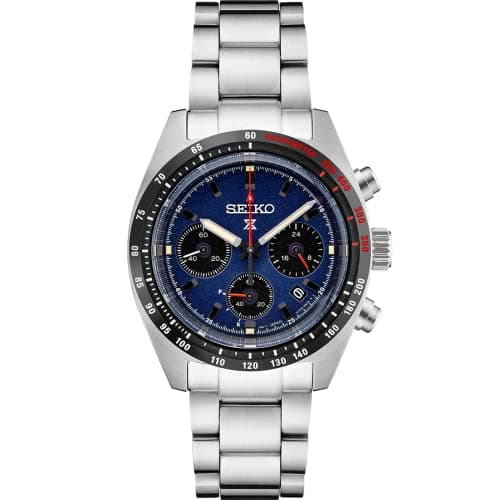
Price as of October 16, 2026. Prices move — Amazon's is the one that counts.
#ad · we may earn a commission from this link to Seiko Prospex Speedtimer Solar Chronograph SSC815
Seiko Prospex Speedtimer Solar Chronograph SSC815
SSC815Best for: A Seiko chronograph you charge with daylight
The Speedtimer specification at its smallest and cheapest: a 39 mm case, curved sapphire, and a chronograph that runs on light rather than on a battery.
- Spec completeness for the price
- 9.0
- Movement relative to bracket
- 8.8
- Case proportions
- 8.9
- Strap flexibility
- 7.8
- Availability
- 8.7
What it gets right
- Solar, so the chronograph never costs you a battery appointment
- Curved sapphire at a price where Seiko usually fits Hardlex
- 39.0 mm — the smallest case Seiko puts the V192 chronograph in
- A power reserve indicator, which most solar watches hide behind a button press
What it gets wrong
- 13.3 mm thick on a 39 mm case, so it wears taller than the diameter suggests
- Seiko does not publish a lug-to-lug or a lug width for this reference
- 10 bar, not a diver — the Speedtimer is a timing watch, not a Sea reference
- Seiko has withdrawn the individual catalog page, so the launch release is the only first-party spec sheet left
Skip this one if: you want a mechanical chronograph. Seiko builds one in this same line, the 8R-powered Speedtimer, and it costs several times this watch — a solar module and a column wheel are different purchases.
| Case diameter | 39.0 mm |
|---|---|
| Thickness | 13.3 mm |
| Lug-to-lug | Not published by Seiko for this reference |
| Lug width | Not published by Seiko for this reference |
| Case material | Stainless steel |
| Crystal | Curved sapphire with an anti-reflective coating on the inner surface |
| Water resistance | 100 m (10 bar) |
| Magnetic resistance | 4,800 A/m |
| Dial | Sandblast finish — Seiko published the launch set in white, navy, gold and black |
| Bracelet | Stainless steel, three-fold clasp with push-button release |
| Caliber | Seiko V192 solar chronograph |
| Functions | 60-minute chronograph, adjustable 24-hour hand, power reserve indicator |
| Power reserve | Approx. 6 months from a full charge (Seiko's published V192 figure) |
| Stated accuracy | Monthly rate not published by Seiko for this caliber |
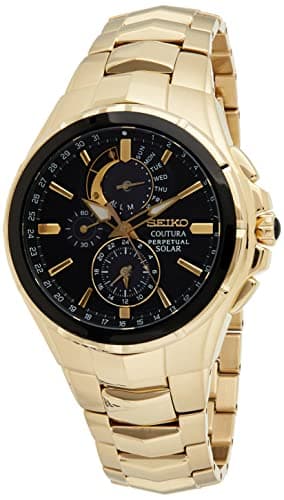
Price as of October 16, 2026. Prices move — Amazon's is the one that counts.
#ad · we may earn a commission from this link to Seiko Coutura Solar Chronograph SSC700
Seiko Coutura Solar Chronograph SSC700
SSC700Best for: A quartz watch you charge with daylight and otherwise ignore
Sapphire, 100 m, a perpetual calendar and no battery to replace, in one watch. The most complete spec sheet in Seiko's quartz range at anything like this money.
- Spec completeness for the price
- 8.9
- Movement relative to bracket
- 8.6
- Case proportions
- 7.8
- Strap flexibility
- 8.0
- Availability
- 8.5
What it gets right
- Sapphire crystal at a price where Seiko normally fits Hardlex
- Solar — no battery change for the life of the capacitor
- Perpetual calendar means the date is right through February without you touching it
- Chronograph, alarm and a power-reserve indicator in one watch
What it gets wrong
- 44 mm is a large watch, and Seiko does not publish a lug-to-lug for it
- The gold-finish case is a styling commitment
Skip this one if: you want something mechanical or something small. This is a big light-powered quartz with a lot of functions, and that is the whole point of it.
| Case diameter | 44 mm |
|---|---|
| Thickness | 11.77 mm |
| Lug-to-lug | Not published by Seiko for this reference |
| Case material | Stainless steel with a gold finish |
| Crystal | Sapphire |
| Water resistance | 100 m (10 bar) |
| Caliber | Seiko V198 solar chronograph |
| Stated accuracy | ±15 sec/month |
| Power reserve | Approx. 6 months from full charge |
| Chronograph | 60 minutes, in 1/5-second increments, with split-time measurement |
| Calendar | Perpetual — leap year, month, day and date, to 2100 |
| Complications | Alarm, power reserve indicator, small seconds |
| Dial | Black |
| Bracelet | Stainless steel |
How to choose
Solar or mechanical?
A solar chronograph costs less, weighs less, needs nothing from you and times accurately on demand. A mechanical chronograph is a different purchase made for different reasons, and it will cost several times as much in this line. Quartz versus automatic is the page to settle that on before you compare references.
39 mm or 41.4 mm?
The 2021 set is the smaller and slightly thicker one; the 2022 set is wider and a fraction thinner with a tachymeter bezel. Neither has a published lug-to-lug, so if your wrist is the constraint, the fit guide explains how to estimate from the figures that are published.
Does the chronograph matter to you?
Be honest about it. A chronograph adds thickness, pushers, and a dial with three sub-registers on it. If you will never time anything, a plain solar watchis thinner, cheaper and easier to read — and the everyday roundup is the right page.
What about the Japan-market SBDL references?
They are the same watches with a different prefix and a Japanese warranty, sold here by importers at import prices. Nothing is wrong with them; they are simply a different purchase, and this site ranks only what it can both source and price.
Questions
What is a Seiko Speedtimer?
It is Seiko’s chronograph line within the Prospex collection — sports timing watches rather than divers. The modern series launched in 2021 and now spans solar V192 chronographs, 8A50 quartz references that time to a hundredth of a second, and mechanical 8R chronographs.
Is the Seiko Speedtimer solar or battery powered?
The SSC references are solar: Caliber V192 charges from light and Seiko publishes approximately six months of running from a full charge. The SFJ references use the battery-powered 8A50. There is no user battery change on the solar ones.
How accurate is the Speedtimer?
Seiko does not publish a monthly rate for the V192, so we will not print one. Quartz movements in this class are generally specified in seconds per month rather than per day, but the published figure for this caliber is simply absent — which is itself worth knowing before you buy on accuracy.
Is the Speedtimer waterproof enough to swim in?
Yes for swimming, no for diving. Seiko publishes 10 bar for the solar Speedtimer references, which covers swimming and showering but is not a dive rating and carries no ISO 6425 certification. What the water ratings actually mean sets out the difference.
Which Speedtimer should I buy first?
The SSC815, on availability as much as on specification: it is 39.0 mm, curved sapphire, solar, and the reference we can consistently find with a live price. If you want the bigger case or the tachymeter bezel, the 2022 set is the one to watch for, and if you want a stated accuracy figure, the Coutura SSC700 above has one and the Speedtimer does not.
Sources
- Seiko — Prospex Speedtimer Solar Chronograph collection page
- Seiko — Speedtimer series launch announcement (SSC813/815/817/819, 2021)
- Seiko — Speedtimer solar chronograph announcement (SSC911/913/915, 2022)
- Seiko — Prospex Speedtimer Mechanical Chronograph collection page
- Seiko Prospex collection — official specifications
- Seiko instruction manuals and caliber documentation
Specifications are transcribed from manufacturer documentation and published standards. Where a manufacturer does not publish a figure, this page says so rather than estimating one.
Read next
- Seiko Prospex explainedWhere Sky sits against Land and Sea.
- Best Seiko chronographsThe Speedtimer against the rest of Seiko's chronograph range.
- Best Seiko solar watchesThe light-powered range, where the V192's six months is normal.
- Seiko solar calibersHow the cell and the capacitor actually work.
- Best Seiko Alpinist modelsThe Land branch of Prospex, built the same week as this page.
- Most accurate Seiko watchesThe references that do publish a rate, since the V192 does not.