Head-to-head
Seiko quartz vs automatic
At the same money Seiko sells both, and the quartz wins nearly every measurable row. That is exactly why the decision is not about the measurable rows.
By Stephen V. · Updated Sep 17, 2026
Quick picks
| # | Watch | Key spec | Score | Price |
|---|---|---|---|---|
| 1 | 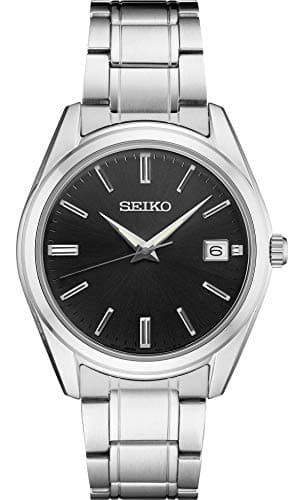 Seiko Essentials SUR311SUR311 A plain steel quartz watch that does exactly what it says. The cheapest sensible Seiko on this list and the right answer more often than people admit. | 40.2mm · quartz | 8.8out of 10, compiled from published specifications | |
| 2 | 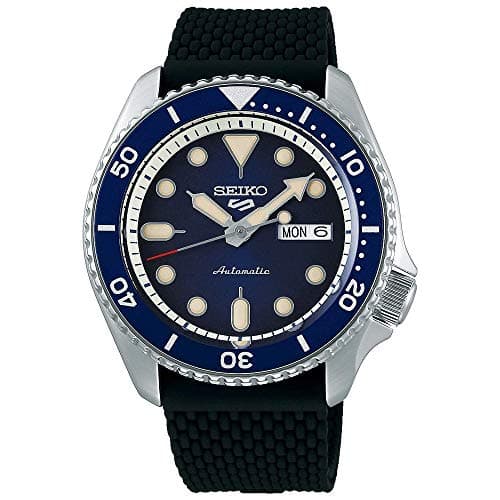 Seiko 5 Sports SRPD93SRPD93 The 5KX case with a movement that hacks and hand-winds, in blue on a silicone strap. The default answer under $350, and the one most people should stop looking after. | 42.5mm · 100m | 8.9out of 10, compiled from published specifications | |
| 3 | 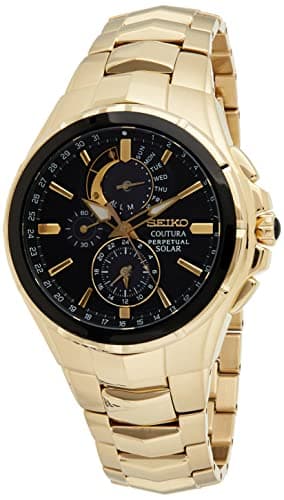 Seiko Coutura Solar Chronograph SSC700SSC700 Sapphire, 100 m, a perpetual calendar and no battery to replace, in one watch. The most complete spec sheet in Seiko's quartz range at anything like this money. | 44mm · solar chrono | 8.4out of 10, compiled from published specifications | |
| 4 | 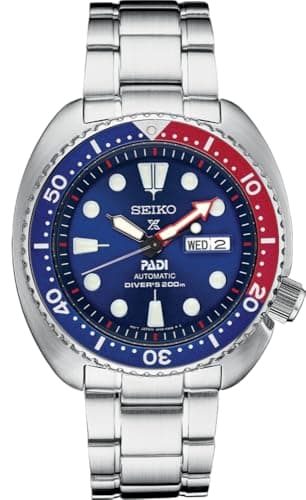 Seiko Prospex Turtle SRPE99SRPE99K1 A real 200 m ISO-rated diver with a screw-down crown, in the cushion case that wears far smaller than its 45 mm suggests. | 45mm · 200m ISO | 8.9out of 10, compiled from published specifications |
4 watches on this page · Prices last verified Sep 18, 2026. Where no live price came back we show “Check price” rather than a number we cannot stand behind. How we pick.
A Seiko quartz is more accurate, thinner and cheaper for a given specification: the 6N52 in the SUR311 is rated ±15 seconds a month, the 4R36 automatic +45 to −35 seconds a day. A Seiko automatic needs no battery and gives you a mechanical movement to own. Buy quartz for a tool, automatic for the machine.
The same-money pair, side by side
The cleanest way to see the difference is to hold everything else roughly equal. The Essentials SUR311 and the 5 Sports SRPD93 are the quartz and automatic Seikos people most often weigh against each other in the same bracket, and both are rated to 100 m. Here is everything Seiko publishes that differs:
| SUR311 (quartz) | SRPD93 (automatic) | |
|---|---|---|
| Caliber | 6N52 quartz | 4R36 automatic |
| Stated rate | ±15 s/month | +45 to −35 s/day |
| Power | Battery, approx. 3 years | Mainspring, approx. 41 h reserve |
| Case diameter | 40.2 mm | 42.5 mm |
| Thickness | 8.36 mm | 13.4 mm |
| Crystal | Sapphire | Hardlex |
| Water resistance | 100 m | 100 m |
| Display case back | No | Yes, see-through |
The rate and battery figures for the SUR311 come from Seiko’s product page; the 4R36 figures from Seiko’s 4R35/4R36 instruction manual; the case figures from Seiko USA’s pages for the SUR311 and SRPD93.
Accuracy is not close
Seiko states both rates for a watch worn on the wrist between 5 and 35 °C. At the edge of its tolerance, the 4R36 is allowed to gain 45 seconds a day; over a month, that is more than 22 minutes by our arithmetic. The 6N52 is allowed 15 seconds in the same month. Most 4R36 watches run well inside their window and a quartz watch left in the cold runs outside its, but the scale of the gap does not change: quartz is roughly two orders of magnitude more accurate. That is the reason quartz exists, and Seiko is the company that put it on a wrist — the Quartz Astron of 1969 was the world’s first quartz wristwatch.
If accuracy is the thing you care about, this page’s question has an answer and you can stop here; the most accurate Seikos are ranked on their own page.
Power: a battery, a mainspring, or light
The SUR311 runs on a battery Seiko rates at approximately three years, and a battery change is a small, widely available job. The SRPD93 has no battery at all: its rotor winds the mainspring as you wear it, you can also wind it by the crown, and a full wind lasts approximately 41 hours. That last figure is the one that bites. Take an automatic off on Friday night and it has stopped by Sunday, and you set it before you wear it again. The quartz is simply still running.
Seiko also sells the third answer: solar quartz, which charges from light and needs no routine battery change. The SSC700 on this page runs approximately six months from a full charge and is rated at the same ±15 seconds a month; the mechanism is on the solar caliber reference. The hybrid that tried to split the difference, a quartz watch charged by a rotor, was Kinetic, which Seiko no longer lists.
Size: the quartz is five millimeters thinner
The SUR311 is 8.36 mm thick; the SRPD93 is 13.4 mm. That is the difference between a watch that slides under a shirt cuff and one that catches on it, and it follows from what is inside: the 4R36 carries a rotor and a mainspring barrel, the 6N52 does not. The quartz is also the smaller watch across, at 40.2 mm against 42.5 mm. If fit and thickness are your binding constraints, that settles it before movement preference comes up.
What the automatic gives you that no table can
The case for the automatic is real, and it is not about timekeeping. It is a machine you can watch working: the SRPD93 has a see-through caseback, and its seconds hand moves six times a second at 21,600 vph where a quartz hand steps once. It needs nothing but motion to run. It hacks and hand-winds, so it sets to the second. For many people that is the entire point of owning a watch when a phone keeps better time than either, and it is a better reason to buy mechanical than any accuracy argument, because the accuracy argument points the other way.
The cost of the machine is service. A mechanical movement needs periodic servicing; a battery quartz needs its battery changed. What a Seiko service actually costs, and when it is worth doing, is on Seiko service cost.
“Seiko Prospex: quartz or automatic?”
Prospex sells both, which is where this question usually comes from. The automatic Prospex divers — the Turtle on this page, the Samurai — are ISO 6425 rated and are the ones this site ranks. Seiko’s quartz Prospex divers are solar references, and the ones listed at the US retailer we track have no Seiko US specification page behind them, so we do not rank one; the quartz roundup explains that, and the dive roundup covers the automatic side.
Buy the quartz if
- You want the watch to be right when you pick it up, every time.
- Thickness matters: 8.36 mm against 13.4 mm.
- It will be one of several watches, and will sit unworn for days at a time.
- You want sapphire at Seiko 5 money: the SUR311 has it and the SRPD93 does not.
Buy the automatic if
- The mechanism is the point, and you would look through the caseback.
- You never want to think about a battery.
- You want a dive-rated watch at this money: the Turtle is an automatic.
- You want a first mechanical watch — the automatic roundup ranks the options.
What we are not claiming
We have not timed either watch. The rates above are Seiko’s stated tolerances, not measurements of any example, and the monthly drift figure for the 4R36 is our arithmetic on Seiko’s number at the edge of its window, not a prediction of how any watch will run.
The watches on this page
Specifications are transcribed from Seiko’s published documentation. Prices come from Amazon and carry the date they were verified. We have not handled these watches — here is what we did instead.
$265.0039% off
Price as of Sep 18, 2026. Prices move — Amazon's is the one that counts.
#ad · we may earn a commission from this link to Seiko Essentials SUR311
Seiko Essentials SUR311
SUR311Best for: A no-fuss everyday watch under $200
A plain steel quartz watch that does exactly what it says. The cheapest sensible Seiko on this list and the right answer more often than people admit.
- Spec completeness for the price
- 8.7
- Movement relative to bracket
- 8.0
- Case proportions
- 9.2
- Strap flexibility
- 9.2
- Availability
- 8.9
What it gets right
- 8.36 mm thick — it disappears under a cuff
- 100 m on a dress-adjacent watch is unusually generous
- Sapphire at a price where Seiko normally fits Hardlex
What it gets wrong
- Battery replacement every few years
- No exhibition back and nothing mechanical to look at
Skip this one if: you want a mechanical watch. That is a legitimate reason to spend more, but be honest that it is the reason — this keeps better time than anything else on this list.
| Case diameter | 40.2 mm |
|---|---|
| Lug-to-lug | Not published by Seiko for this reference |
| Thickness | 8.36 mm |
| Lug width | 20 mm |
| Crystal | Sapphire |
| Water resistance | 100 m (10 bar) |
| Caliber | Seiko 6N52 quartz, battery-powered |
| Stated accuracy | ±15 sec/month |
| Battery life | Approx. 3 years |
| Dial | Black |
| Complications | Date |
$350.0020% off
Price as of Sep 18, 2026. Prices move — Amazon's is the one that counts.
#ad · we may earn a commission from this link to Seiko 5 Sports SRPD93
Seiko 5 Sports SRPD93
SRPD93Best for: A first mechanical watch you will not outgrow
The 5KX case with a movement that hacks and hand-winds, in blue on a silicone strap. The default answer under $350, and the one most people should stop looking after.
- Spec completeness for the price
- 8.8
- Movement relative to bracket
- 8.5
- Case proportions
- 8.9
- Strap flexibility
- 9.5
- Availability
- 8.8
What it gets right
- Hacks and hand-winds — the SKX's biggest omission, fixed
- 22 mm lugs put the entire aftermarket strap catalog in play
- Day-date in a genuinely legible layout
- Case shape is the SKX profile people actually want
What it gets wrong
- Hardlex, not sapphire — it will scratch
- 100 m and no screw-down crown, so it is not an ISO 6425 diver despite the looks
- 13.4 mm thick under a shirt cuff
- Ships on a silicone strap rather than a bracelet
Skip this one if: you want an actual dive watch. The 100 m rating and the absence of a screw-down crown mean this is a dive-styled sports watch, not an ISO 6425 diver. The Turtle is the real one.
| Case diameter | 42.5 mm |
|---|---|
| Lug-to-lug | 46.0 mm |
| Thickness | 13.4 mm |
| Lug width | 22 mm |
| Crystal | Hardlex (hardened mineral) |
| Water resistance | 100 m — splash and swim, not scuba |
| Bezel | Blue unidirectional rotating |
| Dial | Blue sunray |
| Strap | Black silicone |
| Case back | See-through |
| Lume | LumiBrite |
| Caliber | Seiko 4R36 |
| Type | Automatic, hand-winding and hacking |
| Beat rate | 21,600 vph (6 beats/sec) |
| Jewels | 24 |
| Power reserve | Approx. 41 hours |
| Stated accuracy | -35 to +45 sec/day |
| Complications | Day and date |
Price as of Sep 18, 2026. Prices move — Amazon's is the one that counts.
#ad · we may earn a commission from this link to Seiko Coutura Solar Chronograph SSC700
Seiko Coutura Solar Chronograph SSC700
SSC700Best for: A quartz watch you charge with daylight and otherwise ignore
Sapphire, 100 m, a perpetual calendar and no battery to replace, in one watch. The most complete spec sheet in Seiko's quartz range at anything like this money.
- Spec completeness for the price
- 8.9
- Movement relative to bracket
- 8.6
- Case proportions
- 7.8
- Strap flexibility
- 8.0
- Availability
- 8.5
What it gets right
- Sapphire crystal at a price where Seiko normally fits Hardlex
- Solar — no battery change for the life of the capacitor
- Perpetual calendar means the date is right through February without you touching it
- Chronograph, alarm and a power-reserve indicator in one watch
What it gets wrong
- 44 mm is a large watch, and Seiko does not publish a lug-to-lug for it
- The gold-finish case is a styling commitment
Skip this one if: you want something mechanical or something small. This is a big light-powered quartz with a lot of functions, and that is the whole point of it.
| Case diameter | 44 mm |
|---|---|
| Thickness | 11.77 mm |
| Lug-to-lug | Not published by Seiko for this reference |
| Case material | Stainless steel with a gold finish |
| Crystal | Sapphire |
| Water resistance | 100 m (10 bar) |
| Caliber | Seiko V198 solar chronograph |
| Stated accuracy | ±15 sec/month |
| Power reserve | Approx. 6 months from full charge |
| Chronograph | 60 minutes, in 1/5-second increments, with split-time measurement |
| Calendar | Perpetual — leap year, month, day and date, to 2100 |
| Complications | Alarm, power reserve indicator, small seconds |
| Dial | Black |
| Bracelet | Stainless steel |
$575.0020% off
Price as of Sep 18, 2026. Prices move — Amazon's is the one that counts.
#ad · we may earn a commission from this link to Seiko Prospex Turtle SRPE99
Seiko Prospex Turtle SRPE99
SRPE99K1Best for: An actual dive watch you can also wear daily
A real 200 m ISO-rated diver with a screw-down crown, in the cushion case that wears far smaller than its 45 mm suggests.
- Spec completeness for the price
- 9.0
- Movement relative to bracket
- 8.5
- Case proportions
- 8.8
- Strap flexibility
- 9.5
- Availability
- 8.6
What it gets right
- Genuine ISO 6425 diver, not a diver-styled sports watch
- 47.7 mm lug-to-lug means it fits wrists that 45 mm suggests it should not
- Screw-down crown at 4 o'clock keeps it off the back of your hand
What it gets wrong
- Hardlex on a watch at this price is the recurring Seiko complaint
- The 45 mm figure scares people off before they try one
- PADI co-branding on the dial is not for everyone
Skip this one if: you have a wrist under about 6.5 inches. The lug-to-lug is forgiving but the case is still visually wide, and the smaller SRPG references exist for exactly this reason.
| Case diameter | 45.0 mm (cushion case) |
|---|---|
| Lug-to-lug | 47.7 mm |
| Thickness | 13.4 mm |
| Lug width | 22 mm |
| Crystal | Hardlex (hardened mineral) |
| Water resistance | 200 m, ISO 6425 rated for scuba diving |
| Crown | Screw-down, at 4 o'clock |
| Bezel | Unidirectional elapsed-timing bezel, PADI red and blue |
| Bracelet | Steel, three-fold clasp with push-button release |
| Caliber | Seiko 4R36 |
| Type | Automatic, hand-winding and hacking |
| Beat rate | 21,600 vph (6 beats/sec) |
| Jewels | 24 |
| Power reserve | Approx. 41 hours |
| Stated accuracy | -35 to +45 sec/day |
| Complications | Day and date |
Questions
Is a Seiko quartz better than a Seiko automatic?
On every measurable row, usually yes: more accurate (±15 seconds a month for the 6N52 against +45 to −35 seconds a day for the 4R36), thinner, and still running when you pick it up. The automatic’s advantages are that it needs no battery and that it is a mechanical movement, which for many buyers is the reason to own a watch.
Do Seiko automatic watches need a battery?
No. A Seiko automatic is powered by a mainspring wound by the rotor as you wear it, and the 4R36 can also be wound by the crown. There is no battery in it.
How long does a Seiko automatic run when you take it off?
Approximately 41 hours from a full wind for the 4R35 and 4R36, and approximately 70 hours for the 6R35, per Seiko’s manuals. After that it stops and needs setting before you wear it again.
How long does a Seiko quartz battery last?
It varies by caliber. Seiko rates the battery in the 6N52 caliber (the Essentials SUR311) at approximately three years. Seiko’s solar quartz calibers use a rechargeable cell instead and need no routine battery change.
How can you tell a Seiko quartz from an automatic?
Watch the seconds hand. A quartz hand steps once a second; the 4R36’s moves six times a second at 21,600 vph, which reads as a near-sweep. A see-through caseback showing a rotor settles it.
Sources
- Seiko — Essentials SUR311 published specifications (rate, battery life)
- Seiko USA — SUR311 published specifications
- Seiko USA — 5 Sports SRPD93 published specifications
- Seiko — Cal. 4R35/4R36 instruction manual
- Seiko — Coutura SSC700 published specifications
- Seiko — heritage (Quartz Astron, 1969)
- Seiko instruction manuals and caliber documentation
Specifications are transcribed from manufacturer documentation and published standards. Where a manufacturer does not publish a figure, this page says so rather than estimating one.
Read next
- Best Seiko quartz watchesThe quartz side, ranked.
- Best Seiko automatic watchesThe automatic side, ranked.
- The most accurate Seiko watchesIf accuracy decided it, start here.
- Seiko Kinetic explainedThe rotor-charged quartz that tried to be both.
- Spring Drive vs quartzSeiko's other answer to the same question.
- Winding a Seiko automaticWhat owning the automatic involves day to day.