Roundups
Best Seiko solar watches
A solar watch is the one kind that asks nothing of you — no winding, no battery, no setting. Here is which Seiko does it best, and where Citizen still does it better.
By Stephen V. · Updated Oct 11, 2026
Quick picks
| # | Watch | Key spec | Score | Price |
|---|---|---|---|---|
| 1 | 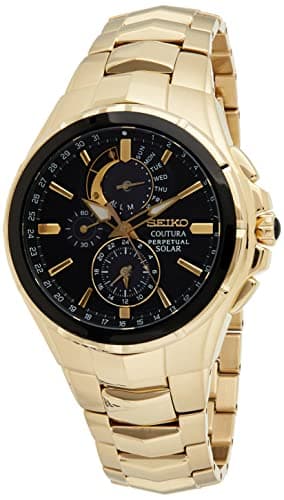 Seiko Coutura Solar Chronograph SSC700SSC700 Sapphire, 100 m, a perpetual calendar and no battery to replace, in one watch. The most complete spec sheet in Seiko's quartz range at anything like this money. | 44mm · solar chrono | 8.4out of 10, compiled from published specifications | |
| 2 | 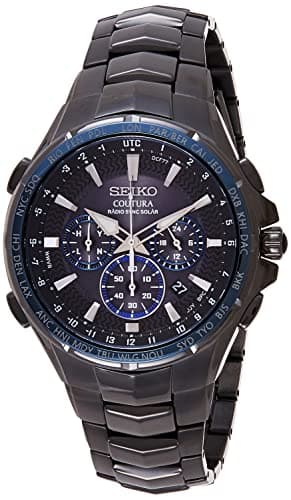 Seiko Coutura Radio Sync Solar SSG021SSG021 It sets itself from a radio time signal and charges itself from daylight. Nothing else Seiko sells at this price asks less of its owner. | 44.5mm · radio sync | 8.2out of 10, compiled from published specifications | |
| 3 | 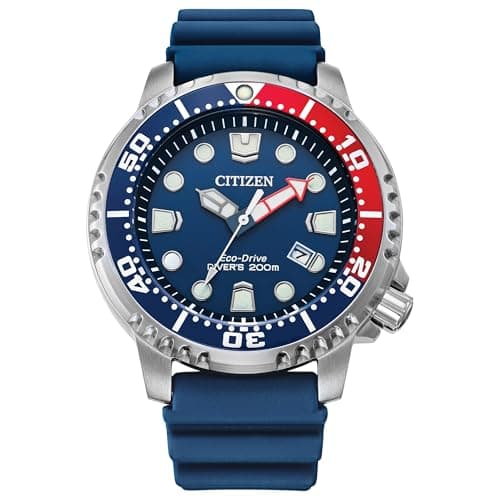 Citizen Promaster Dive Eco-DriveBN0168-06L The solar diver that most directly rivals Seiko's SNE line. Eco-Drive is the most mature light-powered platform anyone sells. | 200m · solar | 8.5out of 10, compiled from published specifications | |
| 4 | 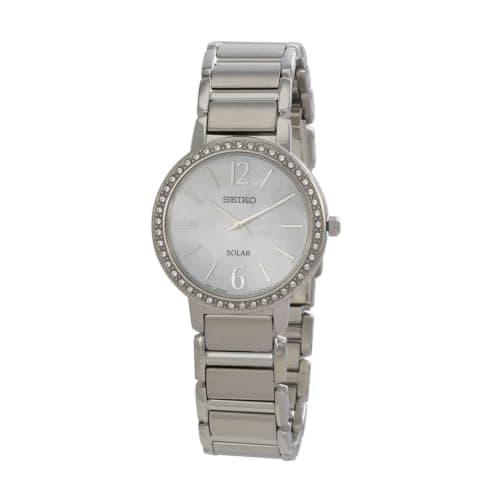 Seiko Women's Solar SUP467SUP467 A 30.5 mm solar dress watch that runs about a year on a full charge. No battery changes, no winding, quartz accuracy — the lowest-maintenance watch on this list. | 30.5mm · solar | 8.1out of 10, compiled from published specifications |
4 picks · Prices last verified October 10, 2026. Where no live price came back we show “Check price” rather than a number we cannot stand behind. How we pick.
The best Seiko solar watch is the Coutura SSC700: sapphire, 100 m, a perpetual calendar and a stated ±15 seconds a month, for less than any other sapphire solar Seiko here. Take the Coutura SSG021 instead if you want the time to set itself from a radio signal, the Citizen Promaster Eco-Drive if the watch has to be a 200 m ISO diver, or the SUP467 if it has to be small.
Solar is the most under-rated thing Seiko sells. A solar watch keeps quartz time, never needs winding, and never needs a battery changed — the cell under the dial is charged by any light that reaches it, including room light. For a watch that lives in a drawer between wearings, that combination beats a mechanical movement on every practical axis, and it usually costs less. The reason nobody writes about it is that it is not romantic.
Of the watches this site tracks, 5 are light-powered. That count is computed from our product registry, so it moves when the registry does. All of them have a live listing, and they are ranked above.
What solar actually buys you, in order
- No battery. A battery quartz Seiko such as the Essentials range needs a cell roughly every three years, and the cell costs less than the appointment. A solar watch removes the appointment.
- Months of reserve in the dark. Seiko publishes approximately six months from a full charge for both Coutura calibers here and approximately twelve for the SUP467’s V115. That is the figure that decides whether the watch is still running when you pick it up in spring.
- Quartz accuracy, stated. Three of these four publish ±15 seconds a month. The 4R36 automatic is specified at −35 to +45 seconds a day. That is not a close comparison, and it is the honest reason to buy one of these.
- Nothing to wind. An automatic that sits unworn stops, and resetting a day-date afterwards is a two-minute job every time. Solar removes it.
The honest limit: Seiko does not publish a capacitor life
Every solar watch stores its charge in a rechargeable cell, and that cell is a wear item. Seiko publishes no replacement interval, no cycle count and no expected service life for the capacitor in the V198, the 8B92 or the V115, so anyone quoting you “ten years” is guessing. What Seiko does publish is the service network that replaces it, which is the part you can plan around. Our service cost page has the published figures.
The second limit is this page’s own. Seiko’s SNE-series solar divers — the obvious answer to “solar and 200 m” — have no live listing in our registry, so we are not going to rank one off a catalog page. The 200 m solar slot here therefore goes to Citizen, and we say so rather than leaving the gap unexplained.
How the four compare
| Reference | Case | Crystal | Water resistance | Stated rate | Reserve |
|---|---|---|---|---|---|
| SSC700 | 44 mm | Sapphire | 100 m | ±15 s/month | ~6 months |
| SSG021 | 44.5 mm | Sapphire | 100 m | Radio-set | ~6 months |
| BN0168-06L | 44 mm | Mineral | 200 m ISO | ±15 s/month | ~6 months |
| SUP467 | 30.5 mm | Hardlex | Splash only | ±15 s/month | ~12 months |
Read that as four different watches rather than one watch in four finishes. Three are 44 mm or larger and one is 30.5 mm. One is a certified dive watch and one is not rated for swimming at all. Two carry sapphire and two do not. The only thing all four share is that none of them will ever need a battery.
Why the SSC700 leads
It is the cheapest sapphire solar watch on the page, and the specification underneath the crystal is the most complete thing in Seiko’s quartz range at the money: a 60-minute chronograph in fifth-second increments with split timing, an alarm, a power-reserve indicator, a small-seconds hand, and a perpetual calendar that handles leap years to 2100 without you touching the crown. At 11.77 mmthick it is also the flattest of the three big watches here, which matters more under a cuff than the 44 mm diameter suggests. Seiko does not publish a lug-to-lug for it, and we have left that row as “not published” rather than estimating it.
The gold finish is the commitment. If that is wrong for you, the gold and two-tone pagesets out where else Seiko puts it — and the SSG021 below is the same idea in a black ion case.
When the radio-sync SSG021 is the right answer
The 8B92 receives an official standard-frequency time signal and sets itself, including the daylight-saving change, which makes it the only watch here that is never wrong and never needs setting. It adds a screw-down crown and a 25-zone world time read from the bezel. Two caveats, both published: the receiver only works inside transmitter coverage, and outside it the watch is an ordinary solar quartz; and Seiko does not publish a free-running monthly rate for this reference, so we cannot tell you how it drifts when it cannot hear a signal. At 44.5 mm it is also the largest watch on the page, and busy with it.
Where Citizen is genuinely ahead
Eco-Drive is the older and more mature light-powered platform, and the Promaster Dive is the proof: a 200 m ISO-compliant rating with a screw-down crown, the same ±15 seconds a month, the same six-month reserve, for less money than either Coutura. It gives up sapphire for mineral and a steel bracelet for polyurethane, and it has no exhibition back — none of which a dive watch needs. If you came here for a solar watch you can actually dive, this is the pick, and the full Seiko solar versus Eco-Drive comparison sets the two platforms against each other on their own published numbers.
The small one
The SUP467 is 30.5 mm across, 37.7 mm lug to lug and 6.8 mmthick, on 12 mm lugs, and it runs about twelve months from a full charge — the longest reserve here by a factor of two. Seiko rates it splash resistant rather than to a depth, which is the one specification that rules it out of anything beyond a desk and a dinner. It is the lowest-maintenance watch on this site: no winding, no battery, no setting beyond the date. If the brief is a small watch rather than a solar one, the small-wrist page ranks on lug-to-lug across the whole range.
The picks in full
Specifications are transcribed from Seiko’s published documentation. Prices come from Amazon and carry the date they were verified. We have not handled these watches — here is what we did instead.
Price as of October 10, 2026. Prices move — Amazon's is the one that counts.
#ad · we may earn a commission from this link to Seiko Coutura Solar Chronograph SSC700
Seiko Coutura Solar Chronograph SSC700
SSC700Best for: A quartz watch you charge with daylight and otherwise ignore
Sapphire, 100 m, a perpetual calendar and no battery to replace, in one watch. The most complete spec sheet in Seiko's quartz range at anything like this money.
- Spec completeness for the price
- 8.9
- Movement relative to bracket
- 8.6
- Case proportions
- 7.8
- Strap flexibility
- 8.0
- Availability
- 8.5
What it gets right
- Sapphire crystal at a price where Seiko normally fits Hardlex
- Solar — no battery change for the life of the capacitor
- Perpetual calendar means the date is right through February without you touching it
- Chronograph, alarm and a power-reserve indicator in one watch
What it gets wrong
- 44 mm is a large watch, and Seiko does not publish a lug-to-lug for it
- The gold-finish case is a styling commitment
Skip this one if: you want something mechanical or something small. This is a big light-powered quartz with a lot of functions, and that is the whole point of it.
| Case diameter | 44 mm |
|---|---|
| Thickness | 11.77 mm |
| Lug-to-lug | Not published by Seiko for this reference |
| Case material | Stainless steel with a gold finish |
| Crystal | Sapphire |
| Water resistance | 100 m (10 bar) |
| Caliber | Seiko V198 solar chronograph |
| Stated accuracy | ±15 sec/month |
| Power reserve | Approx. 6 months from full charge |
| Chronograph | 60 minutes, in 1/5-second increments, with split-time measurement |
| Calendar | Perpetual — leap year, month, day and date, to 2100 |
| Complications | Alarm, power reserve indicator, small seconds |
| Dial | Black |
| Bracelet | Stainless steel |
$750.0020% off
Price as of October 10, 2026. Prices move — Amazon's is the one that counts.
#ad · we may earn a commission from this link to Seiko Coutura Radio Sync Solar SSG021
Seiko Coutura Radio Sync Solar SSG021
SSG021Best for: A watch that is never wrong and never needs setting
It sets itself from a radio time signal and charges itself from daylight. Nothing else Seiko sells at this price asks less of its owner.
- Spec completeness for the price
- 8.6
- Movement relative to bracket
- 9.4
- Case proportions
- 7.2
- Strap flexibility
- 7.4
- Availability
- 8.5
What it gets right
- Radio sync means the time and date set themselves, including the daylight-saving change
- Solar as well, so it needs neither a battery nor setting
- Sapphire and a screw-down crown at a price where neither is guaranteed
- 25-zone world time on the bezel, which is genuinely usable rather than a dial marking
What it gets wrong
- 44.5 mm and busy — this is not a discreet watch
- Radio sync only works in range of a transmitter; outside coverage it is an ordinary quartz watch
- Seiko does not publish a free-running monthly rate for this reference
- The most expensive watch on this page by a wide margin
Skip this one if: you want something quiet on the wrist. The Coutura case is 44.5 mm with an ion-finished bezel and applied markings, and no amount of movement cleverness makes it subtle — the SSC376 is the same solar idea without the radio receiver.
| Case diameter | 44.5 mm |
|---|---|
| Thickness | 11.5 mm |
| Lug-to-lug | Not published by Seiko for this reference |
| Case material | Stainless steel, black ion finish |
| Crystal | Sapphire |
| Water resistance | 100 m (10 bar) |
| Caliber | Seiko 8B92 radio sync solar |
| Timekeeping | Radio-controlled — receives an official standard-frequency signal |
| Stated accuracy | Free-running rate not published by Seiko for this reference |
| Power reserve | Approx. 6 months from full charge |
| Chronograph | 60 minutes in 1/5-second increments, with split time |
| World time | 25 time zones, set from the bezel |
| Crown | Screw-down |
| Complications | Chronograph, world time, 24-hour indicator, date |
$450.0030% off
Price as of October 10, 2026. Prices move — Amazon's is the one that counts.
#ad · we may earn a commission from this link to Citizen Promaster Dive Eco-Drive
Citizen Promaster Dive Eco-Drive
BN0168-06LBest for: A light-powered ISO diver you never service on a schedule
The solar diver that most directly rivals Seiko's SNE line. Eco-Drive is the most mature light-powered platform anyone sells.
- Spec completeness for the price
- 8.5
- Movement relative to bracket
- 8.6
- Case proportions
- 8.1
- Strap flexibility
- 8.4
- Availability
- 8.7
What it gets right
- Eco-Drive has a longer track record than any competing solar platform
- 200 m ISO-compliant rating
- No winding and no battery
What it gets wrong
- Quartz tick
- Polyurethane strap
- No exhibition back
Skip this one if: the movement being mechanical is the point of the purchase. This is the better watch on every measurable axis and the wrong watch if that is what you want.
| Brand | Citizen |
|---|---|
| Case diameter | 44 mm |
| Lug width | 20 mm |
| Crystal | Mineral |
| Water resistance | 200 m, ISO compliant, screw-down crown |
| Movement | Citizen Eco-Drive E168, light-powered quartz |
| Stated accuracy | ±15 sec/month |
| Power reserve | Approx. 6 months from full charge |
| Strap | Polyurethane |
| Charge | Runs on any light source; no battery replacement |
Price as of October 10, 2026. Prices move — Amazon's is the one that counts.
#ad · we may earn a commission from this link to Seiko Women's Solar SUP467
Seiko Women's Solar SUP467
SUP467Best for: A dress watch that never needs winding or a battery
A 30.5 mm solar dress watch that runs about a year on a full charge. No battery changes, no winding, quartz accuracy — the lowest-maintenance watch on this list.
- Spec completeness for the price
- 8.0
- Movement relative to bracket
- 8.2
- Case proportions
- 8.4
- Strap flexibility
- 7.5
- Availability
- 8.4
What it gets right
- Solar — no battery replacement for the life of the capacitor
- About 12 months of running from one full charge
- 6.8 mm thick and 30.5 mm across, so it sits flat under a cuff
What it gets wrong
- Seiko rates it splash resistant only, not 30 m or 50 m
- Quartz, so nothing mechanical to look at
- The capacitor is a wear item eventually, even though the watch never needs a battery
Skip this one if: the watch needs to go anywhere near water. Seiko rates this one splash resistant rather than to a depth, so it is a dress watch in the strict sense.
| Case diameter | 30.5 mm |
|---|---|
| Lug-to-lug | 37.7 mm |
| Thickness | 6.8 mm |
| Lug width | 12 mm |
| Case material | Stainless steel |
| Crystal | Curved Hardlex |
| Water resistance | Splash resistant, per Seiko — not rated for swimming |
| Caliber | Seiko V115 solar quartz |
| Stated accuracy | ±15 sec/month |
| Power reserve | Approx. 12 months from full charge |
| Magnetic resistance | 4,800 A/m |
| Weight | 75.0 g |
How to choose between them
Does it need to go in water?
If the answer is scuba, only the Citizen qualifies — a 200 m ISO rating is a tested standard, not a marketing number, and what the ratings actually certify explains the difference. If the answer is swimming and showers, the two Couturas at 100 m are fine. If the answer is no, the SUP467 opens up.
Does it need sapphire?
The SSC700 and SSG021 have it; the Citizen and the SUP467 do not. On a watch you intend to keep for fifteen years without a battery change, a crystal that does not scratch is worth more than it is on a watch you will replace. Hardlex versus sapphire has the hardness figures.
Solar, or just quartz?
If the watch will be worn constantly and you do not mind a cell every three years, a battery quartz costs less and comes in more sizes — the quartz roundup covers that range. Solar earns its premium on the watch that sits still, which is most watches in most collections.
Solar, or mechanical?
Different purchases. Solar wins on accuracy, maintenance and cost; a mechanical movement wins on being a mechanical movement. Settle it with Seiko quartz versus automatic before you compare individual watches, because the answer decides which page you should be reading.
What about Kinetic?
Kinetic is Seiko’s other no-battery system — a rotor charges a cell from wrist movement rather than from light. It solves the same problem less well, because a watch in a drawer gets no wrist movement but usually gets some light. The Kinetic page has the published reserve figures, and the solar caliber page covers the V-series and 8B movements in detail.
Questions
How long does a Seiko solar watch last on a full charge?
Seiko publishes approximately six months from full charge for the V198 in the SSC700 and the 8B92 in the SSG021, and approximately twelve months for the V115 in the SUP467. Those are the manufacturer’s figures for a fully charged cell with the watch in the dark. Charging happens in any light, including indoor light, so in normal wear the reserve is never the binding constraint.
Do Seiko solar watches need a battery change?
No. The rechargeable cell is not a user-replaceable battery and it is not on a replacement schedule. It is a wear item eventually, but Seiko publishes no interval for it — which is precisely why we are not going to print one. Our service cost page covers what Seiko does publish.
Is a Seiko solar more accurate than a Seiko automatic?
Yes, by an order of magnitude on the published specifications. Three of the four watches here are specified at ±15 seconds per month. The 4R36 automatic is specified at −35 to +45 seconds per day. If accuracy is the constraint, the accuracy roundupranks the whole range on Seiko’s own figures.
Does Seiko make a solar dive watch?
Seiko makes solar Prospex divers, but none has a live listing in our registry at the moment, so there is no Seiko solar diver ranked on this page — we will not rank a watch we cannot price. The 200 m ISO solar slot here is filled by the Citizen Promaster Dive Eco-Drive instead. For mechanical Seiko divers, the dive roundup is the right page.
Can you overcharge a solar watch?
Seiko’s instruction manuals warn against leaving a watch in direct sunlight on a hot surface — a car dashboard is the example they use — because the heat, not the light, is the problem. Normal indoor and outdoor light cannot overcharge the cell. The manual for your caliber states the handling limits for that specific movement.
What is the cheapest Seiko solar watch?
Of the Seiko light-powered references tracked here, the SUP467 is the least expensive — a 30.5 mm solar dress watch with a twelve-month reserve. The cheapest solar watch on the page outright is the Citizen Promaster Eco-Drive, which is also the only 200 m diver among them. Both live prices are in the table at the top of this page.
Sources
- Seiko USA — Coutura SSC700 published specifications
- Seiko USA — Coutura SSG021 published specifications
- Seiko USA — SUP467 published specifications
- Citizen — Promaster Dive Eco-Drive BN0168-06L specifications
- Seiko instruction manuals and caliber documentation
- Seiko customer service — warranty and servicing
- Seiko Watch Corporation — US catalog and specifications
Specifications are transcribed from manufacturer documentation and published standards. Where a manufacturer does not publish a figure, this page says so rather than estimating one.
Read next
- Seiko solar calibersThe V-series and 8B movements behind these four watches.
- Seiko solar vs Citizen Eco-DriveThe two light-powered platforms on their published numbers.
- Best Seiko quartz watchesWhere solar sits against battery and radio-sync quartz.
- Seiko Kinetic explainedSeiko's other no-battery system, and why solar beat it.
- Most accurate Seiko watchesWhy ±15 sec/month is the number that matters here.
- What Seiko servicing costsThe published figures for a capacitor Seiko will not date.