Answers
Why is my Seiko running fast or slow?
Most Seikos that people describe as broken are running inside the specification Seiko publishes. Here is how to tell which one you have.
By Stephen V. · Updated Oct 17, 2026
A mechanical Seiko gaining or losing up to about 30 seconds a day is almost certainly not broken. Seiko states −35 to +45 seconds a day for the 4R35 and 4R36, −20 to +40 for the older 7S26, and −15 to +25 for the 6R family. A watch inside those numbers is performing to specification, and no watchmaker will treat it as a fault. If yours is outside them, the usual cause is magnetization, and that is a ten-minute fix rather than a service.
This is the most common disappointment in watch ownership and it comes from a mismatch of expectations rather than a mechanical problem. People arrive at a mechanical watch from a phone, which is synchronized to an atomic clock, and from a quartz watch, which is specified in seconds per month. A mechanical Seiko is specified in seconds per day, and the window is wide. The first thing to do is not to search for a repair shop; it is to find out what your caliber is actually rated at.
A watch that has stopped rather than drifted is a different question with a different answer, and it is usually not a fault either: the power reserve guide works through what each caliber's published reserve means once the watch is off your wrist, and why an under-wound automatic looks exactly like a broken one.
What Seiko actually promises, by caliber
| Caliber family | Stated rate | Type | Also worth knowing |
|---|---|---|---|
| 4R35 / 4R36 | −35 to +45 sec/day | Automatic | Hacks and hand-winds; ~41 h reserve |
| 7S26 | −20 to +40 sec/day | Automatic | Narrower window than the 4R, but no hacking or hand-winding |
| 6R35 / 6R54 / 6R55 | −15 to +25 sec/day | Automatic | ~70–72 h reserve; the tightest mechanical window Seiko publishes here |
| 6N52 and the quartz lines | ±15 sec/month | Battery quartz | About three years per battery |
| V115 / V198 solar | ±15 sec/month | Solar quartz | No battery to change; charges in daylight |
Read the second row carefully, because it surprises everyone: Seiko states a narrower accuracy window for the old 7S26 than for the newer 4R36 that replaced it. The 4R36 is the better movement because it hacks and hand-winds, not because it keeps better time on paper. NH35 versus 7S26 and 4R36 versus 6R35 have both sets of datasheet figures in full.
One more thing about those numbers, and it is the part that explains most complaints: a stated rate is measured under defined conditions, not on your wrist. Your watch sees changes of temperature, a variable winding state, and whatever position it spends the night in — and position matters, because a balance wheel behaves differently lying dial-up than standing on its side. A watch that gains 15 seconds a day in the drawer and loses 5 on the wrist is one watch, not two.
How to measure it properly, over a week
Almost every “my Seiko is 40 seconds fast” report is one measurement, taken once, against a clock that may itself be wrong. Do this instead:
- Set it against something authoritative. A phone synchronized to network time. Set the seconds exactly if your caliber hacks; if you have a 7S26 it does not, so set the minute hand and note that your measurement carries a few seconds of error. Setting a Seiko has the procedure, including the hours in which you must not change the date.
- Wear it normally for seven days. Not in a drawer, not in a winder. The rate you care about is the rate it keeps on you, in the positions you actually put it in.
- Compare once, at the end, and divide by seven. That gives you seconds per day. A single-day reading has too much noise in it to mean anything.
- Then compare against the row above, not against your phone. If the number is inside Seiko’s window, the watch is working. You can still have it regulated tighter, but that is a preference, not a repair.
The four causes worth checking before you pay anyone
1. Magnetization — by far the most common, and the cheapest to fix
A magnetized hairspring has its coils stick together, which shortens the effective spring and makes the watch run fast— often dramatically so, tens of seconds or minutes a day appearing overnight. The sources are mundane and everywhere: speaker magnets, laptop and tablet lids, magnetic phone mounts, handbag clasps, induction hobs. The fix is a demagnetizer, which any watchmaker has and which costs very little to buy; it takes seconds and does not open the watch. If your Seiko was fine for a year and is suddenly minutes fast, check this before anything else. Seiko publishes a magnetic resistance figure of 4,800 A/mon several references in this registry, including the 5 Sports Field HDB006 and the women’s solar SUP467 — where that row exists it is a genuine specification, and where it does not, assume ordinary susceptibility.
2. Not enough winding — which makes a watch run slow, then stop
An automatic winds from wrist motion, and a desk job with a 41-hour reserve is a marginal combination. As the mainspring runs down the amplitude drops and the rate goes with it, so the classic pattern is a watch that keeps reasonable time all day and loses badly overnight. Hand-wind it 30 to 40 turns in the morning if your caliber allows it — the 4R and 6R families do, the 7S26 does not, which is the single most practical difference between them. Winding a Seiko automatic covers how far to go and when to stop.
3. Position overnight — free, and worth ten seconds a day
Because the rate changes with position, where you leave the watch at night changes the daily average. Try a week dial-up, then a week crown-down, and keep whichever one gets you closer. This is not a trick; it is the same principle a watchmaker uses when regulating, and for a watch that is 10 seconds fast it is often the whole solution.
4. A shock, or a service that is overdue
A hard knock can change the rate by disturbing the balance, and oil that has dried out after a decade will too. If the watch is outside Seiko’s window and it is not magnetized, this is where you are. Regulation — adjusting the balance so the rate sits where you want it inside its natural range — is a cheap bench job; a full service is not. What a Seiko service costs has the intervals and the money.
If the watch is quartz or solar
Different problem entirely. A quartz Seiko stated at ±15 seconds a month that is losing minutes is usually telling you the battery is nearly flat — many Seiko quartz movements move the seconds hand in two-second steps as an end-of-life warning, which is the clearest diagnostic signal in the whole range. A solar Seiko that runs slow or stops is undercharged: it needs daylight, not a drawer, and a few hours on a windowsill will often resolve it. Which Seikos need a battery and which do not sorts the range out, and the solar caliber page has the charge times.
The four watches below are included for one reason each: the tightest mechanical window Seiko publishes in this registry, the movement with the surprising datasheet, the quartz reference whose month-scale rate makes the comparison obvious, and the solar chronograph that never needs a battery at all.
The watches on this page
Specifications are transcribed from Seiko’s published documentation. Prices come from Amazon and carry the date they were verified. We have not handled these watches — here is what we did instead.
No buyable offer at the last check (October 23, 2026). We show nothing rather than a stale number.
#ad · we may earn a commission from this link to Seiko Prospex Alpinist SPB505
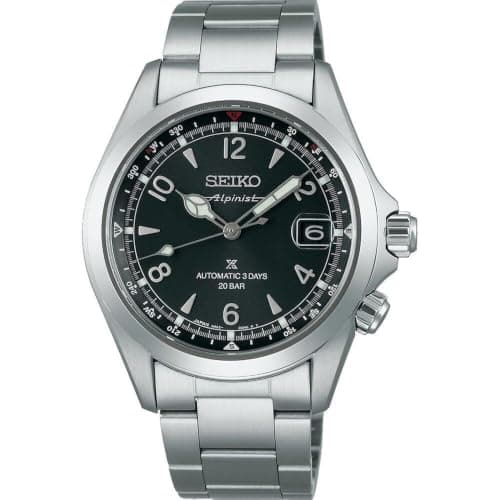
Seiko Prospex Alpinist SPB505
SPB505J1Best for: The Alpinist specification as Seiko currently builds it
The current Alpinist, and the only one of the three Seiko publishes that has a live US listing: 39.5 mm, sapphire with a magnifier, a rotating compass bezel and the three-day 6R55.
- Spec completeness for the price
- 8.7
- Movement relative to bracket
- 9.3
- Case proportions
- 9.4
- Strap flexibility
- 8.4
- Availability
- 8.6
What it gets right
- Three-day power reserve — put it down on Friday and it is still running Monday
- Sapphire with a magnifier, a screw-down crown and 200 m on a watch built for land
- 39.5 mm across a 46.4 mm lug-to-lug is the proportion the Alpinist has always traded on
- Seiko publishes a tighter rate for the 6R55 than for any 4R caliber
What it gets wrong
- The most expensive Seiko this site tracks, by some distance
- 147 g is heavy for a 39.5 mm watch
- Seiko does not publish the dial color or the band material on the specification page
- A compass bezel needs the sun, and a watch set to local time, to mean anything
Skip this one if: the compass bezel is decoration to you. It is most of what separates this from a field watch costing a quarter as much, and if you will never line it up on the sun, the Seiko 5 Sports field watch is the same idea without the fee.
| Case diameter | 39.5 mm |
|---|---|
| Lug-to-lug | 46.4 mm |
| Thickness | 12.7 mm |
| Lug width | 20 mm |
| Case material | Stainless steel with a super-hard coating |
| Crystal | Sapphire with a magnifier, anti-reflective coating on the inner surface |
| Water resistance | 200 m (20 bar) |
| Bezel | Rotating compass bezel |
| Crown | Screw-down |
| Case back | See-through screw case back |
| Lume | LumiBrite on hands and indexes |
| Magnetic resistance | 4,800 A/m |
| Weight | 147.0 g |
| Dial | Not published by Seiko for this reference |
| Caliber | Seiko 6R55 |
| Type | Automatic with manual winding and a stop-second function |
| Jewels | 24 |
| Power reserve | Approx. 72 hours (3 days) |
| Stated accuracy | +25 to -15 sec/day |
$359.009% off
Price as of October 23, 2026. Prices move — Amazon's is the one that counts.
#ad · we may earn a commission from this link to Seiko 5 SNK809
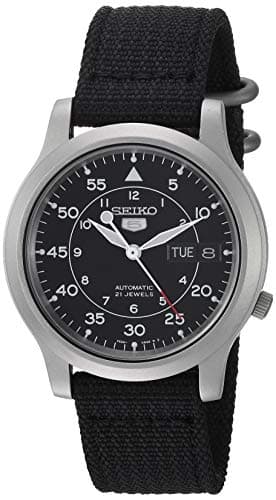
Seiko 5 SNK809
SNK809K2Best for: A genuinely small mechanical watch, if the remaining-stock price is still sensible
The classic small field Seiko: 37 mm, 7S26, canvas strap. It does not hack and it does not hand-wind. Now discontinued — the 7S26 went out of production in 2019 and Seiko's US catalog no longer lists it — so remaining stock is priced by scarcity, not by Seiko. Check the live price against a 4R36 reference before paying it.
- Spec completeness for the price
- 8.0
- Movement relative to bracket
- 7.4
- Case proportions
- 9.2
- Strap flexibility
- 7.8
- Availability
- 4.0
What it gets right
- 42 mm lug-to-lug fits genuinely small wrists
- Exhibition back on a watch at this price
- Legible 24-hour inner track
What it gets wrong
- 7S26 will not hand-wind and will not hack — you cannot set it to the second
- 30 m rating means keep it out of the shower
- 18 mm lugs are a narrower strap market than 20 or 22 mm
- Discontinued and sold from remaining stock — the price is whatever the seller asks, and it no longer tracks the bracket this watch defined
Skip this one if: the live price is at or above a 4R36 Seiko 5 Sports. This was the value pick of its bracket when Seiko still made it; sold from remaining stock it frequently is not, and the SRPD93 or the 36.4 mm SBSA199 give you hacking and hand-winding for the same money or less. Skip it too if setting the watch precisely matters to you — without hacking you cannot stop the seconds hand to sync it.
| Case diameter | 37.0 mm |
|---|---|
| Lug-to-lug | 42.0 mm |
| Thickness | 11.1 mm |
| Lug width | 18 mm |
| Crystal | Hardlex (hardened mineral) |
| Water resistance | 30 m — hand-washing only, not swimming |
| Display back | Yes — exhibition caseback |
| Caliber | Seiko 7S26 |
| Type | Automatic. No hand-winding, no hacking |
| Beat rate | 21,600 vph (6 beats/sec) |
| Jewels | 21 |
| Power reserve | Approx. 41 hours |
| Stated accuracy | -20 to +40 sec/day |
| Complications | Day and date |
$265.0019% off
Price as of October 23, 2026. Prices move — Amazon's is the one that counts.
#ad · we may earn a commission from this link to Seiko Essentials SUR311
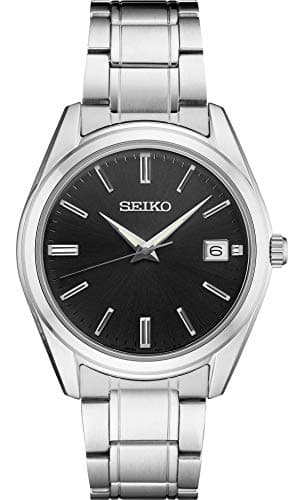
Seiko Essentials SUR311
SUR311Best for: A no-fuss everyday watch under $200
A plain steel quartz watch that does exactly what it says. The cheapest sensible Seiko on this list and the right answer more often than people admit.
- Spec completeness for the price
- 8.7
- Movement relative to bracket
- 8.0
- Case proportions
- 9.2
- Strap flexibility
- 9.2
- Availability
- 8.9
What it gets right
- 8.36 mm thick — it disappears under a cuff
- 100 m on a dress-adjacent watch is unusually generous
- Sapphire at a price where Seiko normally fits Hardlex
What it gets wrong
- Battery replacement every few years
- No exhibition back and nothing mechanical to look at
Skip this one if: you want a mechanical watch. That is a legitimate reason to spend more, but be honest that it is the reason — this keeps better time than anything else on this list.
| Case diameter | 40.2 mm |
|---|---|
| Lug-to-lug | Not published by Seiko for this reference |
| Thickness | 8.36 mm |
| Lug width | 20 mm |
| Crystal | Sapphire |
| Water resistance | 100 m (10 bar) |
| Caliber | Seiko 6N52 quartz, battery-powered |
| Stated accuracy | ±15 sec/month |
| Battery life | Approx. 3 years |
| Dial | Black |
| Complications | Date |
No buyable offer at the last check (October 23, 2026). We show nothing rather than a stale number.
#ad · we may earn a commission from this link to Seiko Coutura Solar Chronograph SSC700
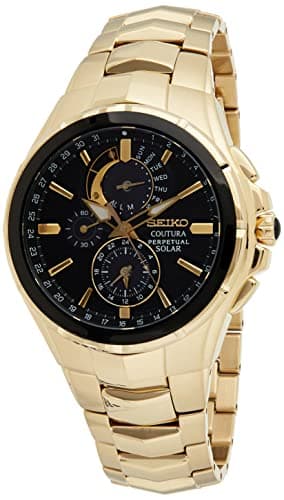
Seiko Coutura Solar Chronograph SSC700
SSC700Best for: A quartz watch you charge with daylight and otherwise ignore
Sapphire, 100 m, a perpetual calendar and no battery to replace, in one watch. The most complete spec sheet in Seiko's quartz range at anything like this money.
- Spec completeness for the price
- 8.9
- Movement relative to bracket
- 8.6
- Case proportions
- 7.8
- Strap flexibility
- 8.0
- Availability
- 8.5
What it gets right
- Sapphire crystal at a price where Seiko normally fits Hardlex
- Solar — no battery change for the life of the capacitor
- Perpetual calendar means the date is right through February without you touching it
- Chronograph, alarm and a power-reserve indicator in one watch
What it gets wrong
- 44 mm is a large watch, and Seiko does not publish a lug-to-lug for it
- The gold-finish case is a styling commitment
Skip this one if: you want something mechanical or something small. This is a big light-powered quartz with a lot of functions, and that is the whole point of it.
| Case diameter | 44 mm |
|---|---|
| Thickness | 11.77 mm |
| Lug-to-lug | Not published by Seiko for this reference |
| Case material | Stainless steel with a gold finish |
| Crystal | Sapphire |
| Water resistance | 100 m (10 bar) |
| Caliber | Seiko V198 solar chronograph |
| Stated accuracy | ±15 sec/month |
| Power reserve | Approx. 6 months from full charge |
| Chronograph | 60 minutes, in 1/5-second increments, with split-time measurement |
| Calendar | Perpetual — leap year, month, day and date, to 2100 |
| Complications | Alarm, power reserve indicator, small seconds |
| Dial | Black |
| Bracelet | Stainless steel |
Questions
Is 20 seconds a day normal for a Seiko?
For a mechanical Seiko, yes. Seiko states −35 to +45 seconds a day for the 4R35 and 4R36 and −20 to +40 for the 7S26, so 20 seconds a day is inside specification for every automatic in the range. It is poor for a quartz Seiko, which is specified at ±15 seconds a month.
Why did my Seiko suddenly start running minutes fast?
Magnetization, almost always. A magnetized hairspring runs fast, the change appears suddenly rather than gradually, and the cause is usually something ordinary like a laptop lid or a magnetic phone mount. A watchmaker can demagnetize it in under a minute without opening the case.
Can a Seiko be regulated to be more accurate?
Yes. Regulation adjusts where the rate sits inside the movement’s natural range, and a competent watchmaker can usually bring a healthy 4R or 6R movement well inside Seiko’s stated window. It is a bench adjustment rather than a repair, and it is priced accordingly. It cannot make a mechanical watch behave like a quartz one.
Why does my Seiko run slow at night?
Two reasons, often together: the mainspring is running down because the watch is off your wrist, and the position it is lying in has a slower rate than the positions it sees during the day. Hand-winding before bed fixes the first; trying a different resting position fixes the second.
How accurate is a Seiko compared to a Rolex?
On stated figures, a chronometer-certified Swiss movement is specified far tighter than a 4R36, and that gap is real. It is also a gap you pay ten to thirty times over for. The most accurate Seikos ranks the range on published rate, and the quartz and solar references at the top of it beat any mechanical watch at any price.
Does a watch winder improve accuracy?
It keeps an automatic wound so it is running and set when you pick it up, which is a convenience. It does not improve the rate, and it keeps the movement running — and therefore wearing — while you are not using it. For a single watch, hand-winding in the morning does the same job for nothing.
Sources
- Seiko instruction manuals and caliber documentation
- Seiko Watch Corporation — US catalog and specifications
- Seiko Instruments — movement division (NH-series manufacturer)
- Seiko customer service — warranty and servicing
Specifications are transcribed from manufacturer documentation and published standards. Where a manufacturer does not publish a figure, this page says so rather than estimating one.
Read next
- Most accurate Seiko watchesThe range ranked on published rate, when accuracy is the whole brief.
- 4R36 vs 6R35Both datasheets side by side — reserve, rate and what the price step buys.
- Winding a Seiko automaticThe fix for the watch that loses time overnight.
- What a Seiko service costsFor when it is not magnetization and not the winding.