Answers
Seiko power reserve, and how far it really gets you
Seiko publishes a reserve figure for every mechanical caliber it sells. Here is what each one means across a real week, and when the number should decide your purchase.
By Stephen V. · Updated Oct 22, 2026
Quick picks
| # | Watch | Key spec | Score | Price |
|---|---|---|---|---|
| 1 |  Seiko Prospex Sumo SPB103J1SPB103J1 The Sumo you can actually order: 45 mm, sapphire and the 70-hour 6R35 on 20 mm lugs. The upgrades are real, and so is the 52.6 mm lug-to-lug that pays for them. | 45mm · 70h | 8.0out of 10, compiled from published specifications | |
| 2 | 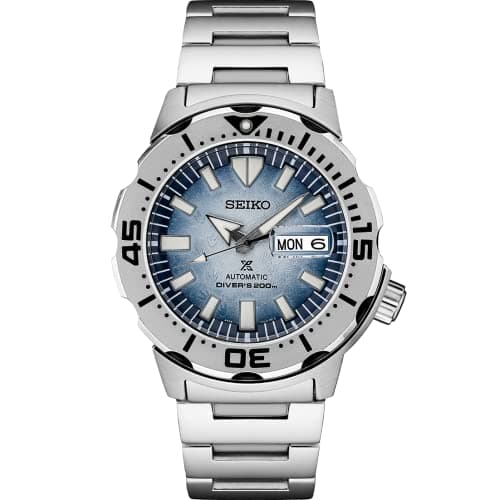 Seiko Prospex Diver SRPG57SRPG57K1 A 200 m Prospex automatic in the modern compact diver case. The one to look at if the Turtle and Samurai both feel too wide. | 42.4mm · 200m ISO | 8.6out of 10, compiled from published specifications | |
| 3 | 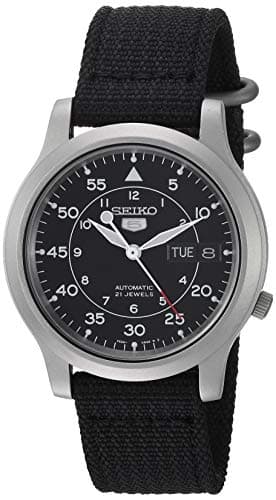 Seiko 5 SNK809SNK809K2 The classic small field Seiko: 37 mm, 7S26, canvas strap. It does not hack and it does not hand-wind. Now discontinued — the 7S26 went out of production in 2019 and Seiko's US catalog no longer lists it — so remaining stock is priced by scarcity, not by Seiko. Check the live price against a 4R36 reference before paying it. | 37mm · 30m | 7.3out of 10, compiled from published specifications | |
| 4 | 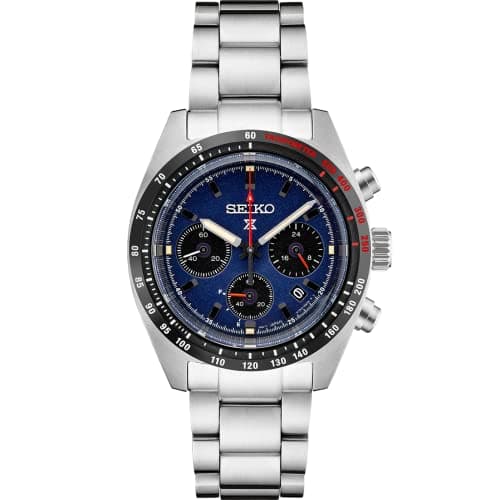 Seiko Prospex Speedtimer Solar Chronograph SSC815SSC815 The Speedtimer specification at its smallest and cheapest: a 39 mm case, curved sapphire, and a chronograph that runs on light rather than on a battery. | 39.0mm · solar chrono | 8.6out of 10, compiled from published specifications | |
| 5 | 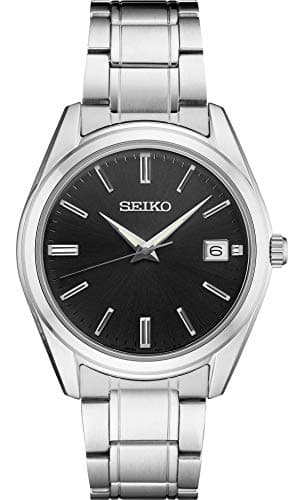 Seiko Essentials SUR311SUR311 A plain steel quartz watch that does exactly what it says. The cheapest sensible Seiko on this list and the right answer more often than people admit. | 40.2mm · quartz | 8.8out of 10, compiled from published specifications |
5 watches on this page · Prices last verified October 23, 2026. Where no live price came back we show “Check price” rather than a number we cannot stand behind. How we pick.
Power reserve is how long a watch keeps running after you stop wearing it. Seiko’s common mechanical calibers publish about 41 hours (the 4R and 7S families) or about 70 hours(the 6R35). Solar references publish months. Quartz references have no reserve at all — they have a battery life, usually about three years. The practical line is the weekend: 41 hours does not clear one, 70 hours does.
This is the number most often quoted and least often explained. A reserve figure is not a battery percentage and it is not a quality score. It is a published measurement of how long the mainspring, wound fully, keeps the movement running with nothing driving it. Every practical consequence follows from that one sentence — including the most common complaint about automatic Seikos, that they stop, which is almost never a fault.
The four systems, and the number that separates them
Seiko sells four different ways of powering a watch, and they are not points on one scale. They are different machines with different failure modes.
- Automatic, no hand-winding. The 7S26and its family. Wound only by the motion of your wrist. About 41 hours of reserve, and — this is the part that surprises people — you cannot top it up by hand. If it has stopped, you shake it or you wear it.
- Automatic, hand-winding and hacking. The 4R35 and 4R36. Same reserve, about 41 hours, but the crown winds it and the seconds hand stops when the crown is out. That turns a stopped watch into a thirty-second problem rather than an afternoon of wrist shaking.
- The three-day automatics. The 6R35 and the rest of the 6R family. About 70 hours, from a longer mainspring in a larger barrel. This is the tier where a watch survives a weekend in a drawer.
- Light-powered. Seiko’s solar calibers. The registry tracks 4references whose published reserve is counted in months or years rather than hours — a figure computed from our registry, not typed. The solar calibers page has the per-movement detail.
Quartz is the fifth case and the one that does not belong on the list, because a quartz Seiko has no reserve. It has a disposable cell with a published life — about three years on the 6N52 in the SUR311 — and when that runs out the watch stops dead rather than winding down. Which Seikos need a battery and which do not is the page that sorts a specific watch into the right bucket.
Every reserve figure we track, by caliber
This table is computed from the product registry at build time, so it cannot disagree with the individual caliber and reference pages. All figures are Seiko’s published values.
| Caliber | Published reserve | References here |
|---|---|---|
| Seiko 6R35 | 70 h | 3 |
| Seiko 4R34 | 41 h | 4 |
| Seiko 4R35 | 41 h | 11 |
| Seiko 4R36 | 41 h | 11 |
| Seiko 4R57 | 41 h | 1 |
| Seiko 7S26 | 41 h | 6 |
Two things are worth reading out of it. The first is how flat the middle of the range is: the 4R and 7S families have carried roughly the same 41-hour figure across wildly different watches, which means reserve is not something you shop for inside a price bracket — it is something that changes when you change movement tier. The second is that the step up to the 6R is the single largest specification difference between an entry-level Seiko automatic and the next one up, and it is rarely the reason people pay the difference.
What 41 hours means across a real week
Work the arithmetic through, because the arithmetic is the whole point of the number.
You wear a 4R automatic all week. Friday at 6 p.m. you take it off, fully wound, and put it on the dresser. Forty-one hours later is Sunday at 11 a.m., so by the time you reach for it on Monday morning it has been stopped for the better part of a day and you are resetting the time and the date. Every single time. Seventy hours from the same Friday evening gets you to Monday afternoon, which is why a three-day reserve is the specification that actually changes how a watch fits into a life with more than one watch in it.
There is a second-order problem the figure hides. A published reserve assumes a fullwind, and a day at a desk may not deliver one. A rotor needs motion, and typing is not motion. If your automatic consistently has less reserve than the specification suggests, under-winding is the first thing to rule out — how to wind a Seiko automatic is the procedure, and it takes roughly thirty turns from stopped.
“My Seiko keeps stopping”
This is the most common power-reserve complaint and it is usually not a fault. Rule the causes out in this order.
- It is not being wound enough. A desk-bound day on a 7S26 — which you cannot hand-wind — genuinely may not keep it topped up. Wear it on your dominant wrist, or hand-wind it if the caliber allows.
- It comes off every night and it has a 41-hour reserve. Two short days of wear in a row is not necessarily a full wind, and the shortfall compounds.
- It is running fast or slow rather than stopping. Different problem, different page: what Seiko’s stated rate specification allows lists the published windows, and magnetization is the usual culprit.
- It needs service. A reserve that has fallen well short of specification on a watch you know is being wound is the classic symptom of dried lubricant. What a Seiko service costs has the numbers before you commit to one.
A winder solves the symptom rather than the cause, and it is a reasonable option if you rotate several automatics — the automatic roundup covers the collection question that usually comes first.
Power reserve indicators
A reserve indicator is a hand or a sub-dial showing how much reserve is left, and it is a different thing from the reserve itself. Seiko builds them on both sides of the range: on mechanical Presage references, and on solar calibers like the V192 in the Speedtimer SSC815, where the indicator is genuinely useful because six months is too long to track by feel.
We are not going to list mechanical Presage references with indicators here, for one reason: this site only publishes specifications for references we can confirm are buyable and can source a published spec sheet for, and we do not currently have a live-listed Presage with a reserve indicator to put in front of you. That is an honest gap rather than an answer. If the indicator is the feature you are shopping for, Seiko’s own Presage catalog is where to start, and the line hierarchy explains where Presage sits.
So which number should decide the purchase?
For most buyers, none of them. If this is your only watch and you wear it daily, a 41-hour reserve is invisible — you will never see the watch stop. Reserve becomes the deciding specification in exactly three situations, and it is worth knowing whether you are in one.
- You own more than one watch and rotate them. Then 70 hours is worth real money and 41 is a weekly chore. The Sumo SPB103J1 is the cheapest 6R35 reference we can currently price.
- It comes off every night and you hate resetting a date. Same answer, or go light-powered and stop thinking about it.
- You want a watch you can leave in a drawer for a season. No mechanical Seiko does that. Solar does it on a published figure of about six months, and quartz does it for about three years.
Everyone else should buy on the numbers that are visible every day — lug-to-lug, thickness, crystal, rating — and treat reserve as a tiebreaker. The fit guide is where the measurements that actually matter live, and the SRPG57 reference page is a worked example of a 41-hour watch whose case numbers do the deciding instead.
The watches on this page
Specifications are transcribed from Seiko’s published documentation. Prices come from Amazon and carry the date they were verified. We have not handled these watches — here is what we did instead.
Price as of October 23, 2026. Prices move — Amazon's is the one that counts.
#ad · we may earn a commission from this link to Seiko Prospex Sumo SPB103J1
Seiko Prospex Sumo SPB103J1
SPB103J1Best for: Sapphire and a 70-hour reserve in a big 200 m ISO diver
The Sumo you can actually order: 45 mm, sapphire and the 70-hour 6R35 on 20 mm lugs. The upgrades are real, and so is the 52.6 mm lug-to-lug that pays for them.
- Spec completeness for the price
- 8.4
- Movement relative to bracket
- 8.6
- Case proportions
- 7.2
- Strap flexibility
- 8.8
- Availability
- 7.2
What it gets right
- Sapphire crystal where the Samurai and Turtle use Hardlex
- 70-hour 6R35 — off on Friday evening, still running on Monday morning
- 12.9 mm thick, only 0.6 mm taller than the far smaller 2024 Samurai
What it gets wrong
- 52.6 mm lug-to-lug — 4.9 mm longer than a Turtle, and the number that decides fit
- The 2019 reference: the 2022 SPB321/SPB323 add a ceramic insert and hard coating this one lacks
- 20 mm lugs read narrow against a 45 mm case
- Priced near the $1,000 line, a full bracket above the Samurai
Skip this one if: the flat top of your wrist measures less than 52.6 mm across. Lugs that overhang the wrist are the one thing no strap change fixes, and on this case the length, not the 12.9 mm height, is the constraint.
| Case diameter | 45.0 mm |
|---|---|
| Lug-to-lug | 52.6 mm |
| Thickness | 12.9 mm |
| Lug width | 20 mm |
| Crystal | Sapphire |
| Water resistance | 200 m, ISO 6425 rated |
| Crown | Screw-down |
| Case back | Screw-down |
| Bezel | Unidirectional rotating |
| Lume | LumiBrite on hands, indexes and bezel |
| Clasp | Three-fold, secure lock, push-button release, extender |
| Weight | 188.0 g |
| Caliber | Seiko 6R35 |
| Type | Automatic, hand-winding and hacking |
| Beat rate | 21,600 vph (6 beats/sec) |
| Jewels | 24 |
| Power reserve | Approx. 70 hours |
| Stated accuracy | -15 to +25 sec/day |
| Complications | Date |
$550.009% off
Price as of October 23, 2026. Prices move — Amazon's is the one that counts.
#ad · we may earn a commission from this link to Seiko Prospex Diver SRPG57
Seiko Prospex Diver SRPG57
SRPG57K1Best for: A 200 m Seiko diver in a smaller case
A 200 m Prospex automatic in the modern compact diver case. The one to look at if the Turtle and Samurai both feel too wide.
- Spec completeness for the price
- 8.4
- Movement relative to bracket
- 8.4
- Case proportions
- 8.8
- Strap flexibility
- 9.2
- Availability
- 8.2
What it gets right
- 12.3 mm is slim for a 200 m Seiko diver
- 20 mm lugs open up a wider strap market than 22 mm
- Full ISO 6425 rating
What it gets wrong
- Hardlex
- Date only
- Seiko does not publish a lug-to-lug figure for this reference
Skip this one if: lug-to-lug is your buying constraint. Seiko does not publish it here, and we are not going to invent a number for you — measure one in person or start with a reference where the figure is documented.
| Case diameter | 42.4 mm |
|---|---|
| Lug-to-lug | Not published by Seiko for this reference |
| Thickness | 12.3 mm |
| Lug width | 20 mm |
| Crystal | Hardlex (hardened mineral) |
| Water resistance | 200 m, ISO 6425 rated |
| Crown | Screw-down |
| Caliber | Seiko 4R35 |
| Type | Automatic, hand-winding and hacking |
| Beat rate | 21,600 vph (6 beats/sec) |
| Jewels | 23 |
| Power reserve | Approx. 41 hours |
| Stated accuracy | -35 to +45 sec/day |
| Complications | Date |
$359.009% off
Price as of October 23, 2026. Prices move — Amazon's is the one that counts.
#ad · we may earn a commission from this link to Seiko 5 SNK809
Seiko 5 SNK809
SNK809K2Best for: A genuinely small mechanical watch, if the remaining-stock price is still sensible
The classic small field Seiko: 37 mm, 7S26, canvas strap. It does not hack and it does not hand-wind. Now discontinued — the 7S26 went out of production in 2019 and Seiko's US catalog no longer lists it — so remaining stock is priced by scarcity, not by Seiko. Check the live price against a 4R36 reference before paying it.
- Spec completeness for the price
- 8.0
- Movement relative to bracket
- 7.4
- Case proportions
- 9.2
- Strap flexibility
- 7.8
- Availability
- 4.0
What it gets right
- 42 mm lug-to-lug fits genuinely small wrists
- Exhibition back on a watch at this price
- Legible 24-hour inner track
What it gets wrong
- 7S26 will not hand-wind and will not hack — you cannot set it to the second
- 30 m rating means keep it out of the shower
- 18 mm lugs are a narrower strap market than 20 or 22 mm
- Discontinued and sold from remaining stock — the price is whatever the seller asks, and it no longer tracks the bracket this watch defined
Skip this one if: the live price is at or above a 4R36 Seiko 5 Sports. This was the value pick of its bracket when Seiko still made it; sold from remaining stock it frequently is not, and the SRPD93 or the 36.4 mm SBSA199 give you hacking and hand-winding for the same money or less. Skip it too if setting the watch precisely matters to you — without hacking you cannot stop the seconds hand to sync it.
| Case diameter | 37.0 mm |
|---|---|
| Lug-to-lug | 42.0 mm |
| Thickness | 11.1 mm |
| Lug width | 18 mm |
| Crystal | Hardlex (hardened mineral) |
| Water resistance | 30 m — hand-washing only, not swimming |
| Display back | Yes — exhibition caseback |
| Caliber | Seiko 7S26 |
| Type | Automatic. No hand-winding, no hacking |
| Beat rate | 21,600 vph (6 beats/sec) |
| Jewels | 21 |
| Power reserve | Approx. 41 hours |
| Stated accuracy | -20 to +40 sec/day |
| Complications | Day and date |
Price as of October 23, 2026. Prices move — Amazon's is the one that counts.
#ad · we may earn a commission from this link to Seiko Prospex Speedtimer Solar Chronograph SSC815
Seiko Prospex Speedtimer Solar Chronograph SSC815
SSC815Best for: A Seiko chronograph you charge with daylight
The Speedtimer specification at its smallest and cheapest: a 39 mm case, curved sapphire, and a chronograph that runs on light rather than on a battery.
- Spec completeness for the price
- 9.0
- Movement relative to bracket
- 8.8
- Case proportions
- 8.9
- Strap flexibility
- 7.8
- Availability
- 8.7
What it gets right
- Solar, so the chronograph never costs you a battery appointment
- Curved sapphire at a price where Seiko usually fits Hardlex
- 39.0 mm — the smallest case Seiko puts the V192 chronograph in
- A power reserve indicator, which most solar watches hide behind a button press
What it gets wrong
- 13.3 mm thick on a 39 mm case, so it wears taller than the diameter suggests
- Seiko does not publish a lug-to-lug or a lug width for this reference
- 10 bar, not a diver — the Speedtimer is a timing watch, not a Sea reference
- Seiko has withdrawn the individual catalog page, so the launch release is the only first-party spec sheet left
Skip this one if: you want a mechanical chronograph. Seiko builds one in this same line, the 8R-powered Speedtimer, and it costs several times this watch — a solar module and a column wheel are different purchases.
| Case diameter | 39.0 mm |
|---|---|
| Thickness | 13.3 mm |
| Lug-to-lug | Not published by Seiko for this reference |
| Lug width | Not published by Seiko for this reference |
| Case material | Stainless steel |
| Crystal | Curved sapphire with an anti-reflective coating on the inner surface |
| Water resistance | 100 m (10 bar) |
| Magnetic resistance | 4,800 A/m |
| Dial | Sandblast finish — Seiko published the launch set in white, navy, gold and black |
| Bracelet | Stainless steel, three-fold clasp with push-button release |
| Caliber | Seiko V192 solar chronograph |
| Functions | 60-minute chronograph, adjustable 24-hour hand, power reserve indicator |
| Power reserve | Approx. 6 months from a full charge (Seiko's published V192 figure) |
| Stated accuracy | Monthly rate not published by Seiko for this caliber |
$265.0019% off
Price as of October 23, 2026. Prices move — Amazon's is the one that counts.
#ad · we may earn a commission from this link to Seiko Essentials SUR311
Seiko Essentials SUR311
SUR311Best for: A no-fuss everyday watch under $200
A plain steel quartz watch that does exactly what it says. The cheapest sensible Seiko on this list and the right answer more often than people admit.
- Spec completeness for the price
- 8.7
- Movement relative to bracket
- 8.0
- Case proportions
- 9.2
- Strap flexibility
- 9.2
- Availability
- 8.9
What it gets right
- 8.36 mm thick — it disappears under a cuff
- 100 m on a dress-adjacent watch is unusually generous
- Sapphire at a price where Seiko normally fits Hardlex
What it gets wrong
- Battery replacement every few years
- No exhibition back and nothing mechanical to look at
Skip this one if: you want a mechanical watch. That is a legitimate reason to spend more, but be honest that it is the reason — this keeps better time than anything else on this list.
| Case diameter | 40.2 mm |
|---|---|
| Lug-to-lug | Not published by Seiko for this reference |
| Thickness | 8.36 mm |
| Lug width | 20 mm |
| Crystal | Sapphire |
| Water resistance | 100 m (10 bar) |
| Caliber | Seiko 6N52 quartz, battery-powered |
| Stated accuracy | ±15 sec/month |
| Battery life | Approx. 3 years |
| Dial | Black |
| Complications | Date |
The short version, by situation
One watch, worn daily: ignore reserve entirely and buy on fit. A rotation of two or three: pay for the 6R and its roughly 70 hours. A watch for a drawer, a desk or a travel bag: solar, and read the indicator rather than guessing. And hand-winding matters more than the reserve figure itself on anything you will wear irregularly — which is the strongest practical argument for a 4R over a 7S26 at the same price.
Questions
What is the power reserve of a Seiko 5?
Which Seiko has the longest power reserve?
Among the mechanical calibers this site tracks, the 6R35at about 70 hours. Seiko’s solar references go well beyond that — the V192 publishes roughly six months from a full charge — but that is a different kind of number, from a cell rather than a mainspring.
Why does my Seiko stop overnight?
Most often because it was not fully wound when you took it off, not because anything is wrong. A published reserve assumes a full wind, and a sedentary day may not deliver one. If the caliber hand-winds, give it about thirty turns and start again from a known full state before concluding there is a fault.
Does a longer power reserve mean a better movement?
Not by itself, but it does track movement tier at Seiko. The 6R35 publishes both a longer reserve and a tighter rate window than the 4R family, so the two tend to arrive together — which means you are paying for a tier, not for the reserve on its own.
Can I overwind a Seiko automatic?
No. Seiko’s automatic calibers use a slipping clutch on the mainspring, so winding past full does not build damaging tension. On a hand-winding caliber the resistance changes as it reaches full and you should stop there anyway — the winding guide has the procedure.
Do solar Seikos have a power reserve?
Yes, and it is published in months rather than hours — about six months on the V192 in the SSC815. The reserve is held in a rechargeable secondary cell rather than a mainspring, and some references put an indicator on the dial so you can read it.
Sources
- Seiko Watch Corporation — US catalog and specifications
- Seiko instruction manuals and caliber documentation
- Seiko Instruments — movement division (NH-series manufacturer)
- Seiko Prospex collection — official specifications
- Seiko customer service — warranty and servicing
Specifications are transcribed from manufacturer documentation and published standards. Where a manufacturer does not publish a figure, this page says so rather than estimating one.