Reference pages
Seiko Essentials SUR311
8.36 mm thick, sapphire, 100 m, fifteen seconds a month — and a 47.0 mm lug-to-lug that only one of Seiko's two catalogs prints.
By Stephen V. · Updated Oct 29, 2026
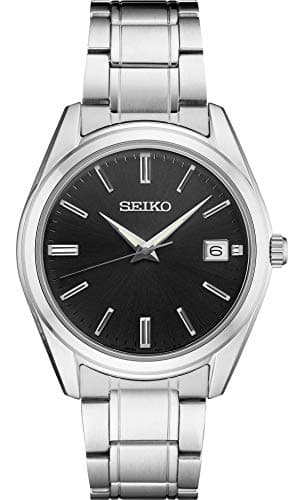
The SUR311 is a 40.2 mm Seiko Essentials quartz watch: 47.0 mm lug-to-lug, 8.36 mm thick, on 20 mm lugs, with a sapphire crystal, 100 m of water resistance and a 6N52 movement specified at plus or minus fifteen seconds a month on an approximately three-year cell. Of the 3 sub-10 mm references in our registry, it is one of only 1 with both sapphire and a 100 m rating.
This is the cheapest Seiko on this site that is genuinely hard to argue with, and it is also the one whose specification is hardest to find in one place — because Seiko publishes it in two halves, on two different catalogs, and neither half is complete.
Two catalogs, two different specifications
Seiko’s US retail page for the SUR311 publishes the caliber, the diameter, the thickness, the lug width, the crystal, the water resistance, the bracelet, the dial color and a $265 list price. It publishes no accuracy figure, no battery life and no lug-to-lug. The corporate catalog page for the same reference publishes all three of those — “Precision: ±15 seconds per month,” “Battery life: Approx. 3 years,” “Lug-to-lug:47.0mm” — plus a 113.0 g weight and LumiBrite on the hands and indexes, and it rounds the thickness to 8.4 mm.
| Row | US retail page | Corporate catalog page |
|---|---|---|
| Diameter | 40.2 mm | 40.2 mm |
| Thickness | 8.36 mm | 8.4 mm |
| Lug-to-lug | Not published | 47.0 mm |
| Precision | Not published | 15 sec/month |
| Battery life | Not published | Approx. 3 years |
| Weight | Not published | 113.0 g |
This matters beyond pedantry for two reasons. The first is that lug-to-lug is the number that decides fit, and a US buyer reading the US page is reading the one version of the specification that leaves it out — which is why our own entry for this reference carried “not published” in that row until today, and why it now carries 47.0 mm with the source attached. The second is that an accuracy figure and a cell life are the two things a quartz watch is bought for, and a page that omits both is selling a watch on its dial.
We keep the US page’s 8.36 mm, because it is the more precise of the two figures for the same case and because every other page on this site already uses it. The 8.4 mm on the corporate page is a rounding of the same measurement, not a disagreement about the watch. We have not measured either; the methodology page is explicit about what we do instead.
The four numbers
- 40.2 mm across. A full-size watch without being a large one, and close enough to the 40.5 mm Presage cases that a direct comparison is fair.
- 47.0 mm lug-to-lug. Long for the diameter, which is normal for a thin case with straight lugs: there is no curve to shorten the footprint. The practical consequence is that this takes up the wrist space of a larger watch and feels like a much slimmer one.
- 8.36 mm thick. The reason to buy it. Anything over about 13 mm fights a shirt cuff and 10 to 12 mm catches it; under 10 mm the watch stops being something you are aware of. The thickness ladderranks the whole registry on Seiko’s published figures, and the structural fact it is built on applies directly here: everything under 11 mm is quartz, because an automatic carries a winding rotor above the movement plate and that costs roughly three millimeters.
- 20 mm lugs. The well-supplied aftermarket size, which on a watch this cheap is a real feature — a $30 strap changes the character of a $200 watch far more than it does a $1,000 one.
Sapphire and 100 m, at this price
Take the two rows that usually separate a cheap watch from a mid-priced one. Seiko fits sapphire here, not Hardlex, and rates the case to 10 bar, which it publishes as 100 m. Those two rows together are what make this reference awkward for the watches above it: the 8 box-crystal Presage references we track, at several times the money, are all fitted with Hardlex, and most of them are rated 50 m.
Be precise about what the 100 m means. It is a water-resistance rating under ISO 22810, not a divers’ rating under ISO 6425, and the crown is push-pull; what each rating actually certifies sets out the difference. In practice, 100 m on a watch like this means swimming and showering are fine and diving is not the watch’s job. The sapphire roundup lists every reference here that gets the better crystal.
The 6N52, and what fifteen seconds a month means
Seiko specifies the 6N52 at 15 seconds a montheither way, with a battery life of approximately three years. Set that beside a mechanical Seiko and the gap is not a matter of degree. A 4R35 is specified at −35 to +45 seconds a day; at the top of its window that is about 1,350 seconds — some twenty-two minutes — over the same thirty days in which this movement is allowed fifteen.
Nobody should buy a mechanical watch for timekeeping, and this reference is the clearest demonstration on the site of why. What you give up is everything mechanical: there is a screw case back rather than a see-through one, so there is nothing to look at, and the seconds hand ticks rather than sweeps. Quartz versus automatic works the trade through properly, and which Seikos need batteries sorts the range into its four power systems — this one is the battery quartz, the only system that asks for a cell on a schedule.
113 grams, and why the figure is worth having
The corporate page publishes a 113.0 g weight. Weight is the specification people complain about after a purchase and never check before one, and on a steel bracelet it is mostly a function of the bracelet rather than of the case. For context, a thin steel watch on a full steel bracelet in this range is light enough to forget and heavy enough to feel solid; the references that generate complaints are the much heavier divers.
Where it sits
Every figure here is a published Seiko specification for the reference named, and all three listings were confirmed buyable on the day this page was written.
| Reference | Case | Lug-to-lug | Thick | Crystal | Water | Movement |
|---|---|---|---|---|---|---|
| SUR311 | 40.2 mm | 47.0 mm | 8.36 mm | Sapphire | 100 m | 6N52 quartz |
| SUR432 | 36.9 mm | Not published | 8.83 mm | Hardlex | 100 m | 6N43 quartz |
| SNK809 | 37.0 mm | 42.0 mm | 11.1 mm | Hardlex | 30 m | 7S26 automatic |
The SUR432 is the smaller, dressier two-tone version of the same idea, and the trade is explicit: a Hardlex crystal, 18 mm lugs and no published lug-to-lug in exchange for a 36.9 mm case. The SNK809 is the mechanical counter-argument, and the honest shape of it is a shrug: it is the thinnest automatic Seiko makes, and it is still 2.7 mm taller, rated 30 m, fitted with Hardlex, and running a 7S26 that neither hacks nor hand-winds. You buy it because you want a mechanical watch, which is a legitimate reason and not a specification argument.
Who should skip it
Skip the SUR311 if you want a mechanical movement, which is the only real reason to spend more here — just be honest that it is the reason. Skip it if you want an exhibition back or a sweeping seconds hand, because it has neither. Skip it if 47.0 mm is more length than your wrist carries, which on a 40.2 mm watch is a genuinely possible outcome and the whole reason the figure is worth printing. And skip it if you want a watch with a story attached: this is a plain steel quartz watch that keeps excellent time, and the absence of a story is most of the point.
The watches on this page
Specifications are transcribed from Seiko’s published documentation. Prices come from Amazon and carry the date they were verified. We have not handled these watches — here is what we did instead.
$265.0020% off
Price as of October 30, 2026. Prices move — Amazon's is the one that counts.
#ad · we may earn a commission from this link to Seiko Essentials SUR311
Seiko Essentials SUR311
SUR311Best for: A no-fuss everyday watch under $200
A plain steel quartz watch that does exactly what it says. The cheapest sensible Seiko on this list and the right answer more often than people admit.
- Spec completeness for the price
- 8.7
- Movement relative to bracket
- 8.0
- Case proportions
- 9.2
- Strap flexibility
- 9.2
- Availability
- 8.9
What it gets right
- 8.36 mm thick — it disappears under a cuff
- 100 m on a dress-adjacent watch is unusually generous
- Sapphire at a price where Seiko normally fits Hardlex
What it gets wrong
- Battery replacement every few years
- No exhibition back and nothing mechanical to look at
Skip this one if: you want a mechanical watch. That is a legitimate reason to spend more, but be honest that it is the reason — this keeps better time than anything else on this list.
| Case diameter | 40.2 mm |
|---|---|
| Lug-to-lug | 47.0 mm |
| Thickness | 8.36 mm |
| Lug width | 20 mm |
| Case material | Stainless steel |
| Crystal | Sapphire |
| Water resistance | 100 m (10 bar) |
| Weight | 113.0 g |
| LumiBrite | On the hands and indexes |
| Band | Stainless steel bracelet, three-fold clasp with push-button release |
| Case back | Screw case back |
| Caliber | Seiko 6N52 quartz, battery-powered |
| Stated accuracy | ±15 sec/month |
| Battery life | Approx. 3 years |
| Dial | Black |
| Complications | Date |
$235.0020% off
Price as of October 30, 2026. Prices move — Amazon's is the one that counts.
#ad · we may earn a commission from this link to Seiko Essentials SUR432
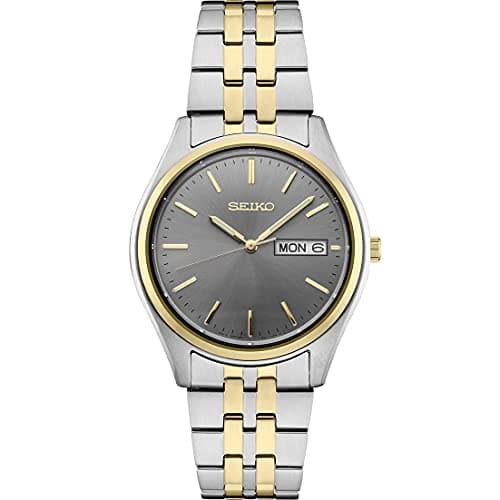
Seiko Essentials SUR432
SUR432Best for: A cheap watch to wear with a jacket
A gray sunray dial on a two-tone bracelet, 8.83 mm thick and rated 100 m. The dressiest thing Seiko sells at this price and it does not pretend otherwise.
- Spec completeness for the price
- 8.3
- Movement relative to bracket
- 8.0
- Case proportions
- 8.5
- Strap flexibility
- 9.2
- Availability
- 8.4
What it gets right
- Reads considerably more expensive than it is
- 100 m, which is unusual for a dress-leaning watch at this money
- 8.83 mm thick — it actually fits under a cuff
What it gets wrong
- Hardlex, not sapphire
- Gold-tone finishes wear at the bracelet edges
- 36.9 mm reads small if you are used to a 40 mm sports watch
Skip this one if: you want one watch for everything. This is a dress-leaning quartz on a two-tone bracelet — it is the second watch in a two-watch collection, not the first.
| Case diameter | 36.9 mm |
|---|---|
| Lug-to-lug | Not published by Seiko for this reference |
| Thickness | 8.83 mm |
| Lug width | 18 mm |
| Case material | Two-tone stainless steel |
| Crystal | Hardlex |
| Water resistance | 100 m (10 bar) |
| Caliber | Seiko 6N43 quartz, battery-powered |
| Complications | Day and date |
| Dial | Gray |
| Bracelet | Two-tone stainless steel |
$359.009% off
Price as of October 30, 2026. Prices move — Amazon's is the one that counts.
#ad · we may earn a commission from this link to Seiko 5 SNK809
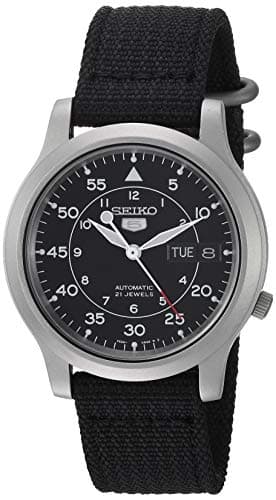
Seiko 5 SNK809
SNK809K2Best for: A genuinely small mechanical watch, if the remaining-stock price is still sensible
The classic small field Seiko: 37 mm, 7S26, canvas strap. It does not hack and it does not hand-wind. Now discontinued — the 7S26 went out of production in 2019 and Seiko's US catalog no longer lists it — so remaining stock is priced by scarcity, not by Seiko. Check the live price against a 4R36 reference before paying it.
- Spec completeness for the price
- 8.0
- Movement relative to bracket
- 7.4
- Case proportions
- 9.2
- Strap flexibility
- 7.8
- Availability
- 4.0
What it gets right
- 42 mm lug-to-lug fits genuinely small wrists
- Exhibition back on a watch at this price
- Legible 24-hour inner track
What it gets wrong
- 7S26 will not hand-wind and will not hack — you cannot set it to the second
- 30 m rating means keep it out of the shower
- 18 mm lugs are a narrower strap market than 20 or 22 mm
- Discontinued and sold from remaining stock — the price is whatever the seller asks, and it no longer tracks the bracket this watch defined
Skip this one if: the live price is at or above a 4R36 Seiko 5 Sports. This was the value pick of its bracket when Seiko still made it; sold from remaining stock it frequently is not, and the SRPD93 or the 36.4 mm SBSA199 give you hacking and hand-winding for the same money or less. Skip it too if setting the watch precisely matters to you — without hacking you cannot stop the seconds hand to sync it.
| Case diameter | 37.0 mm |
|---|---|
| Lug-to-lug | 42.0 mm |
| Thickness | 11.1 mm |
| Lug width | 18 mm |
| Crystal | Hardlex (hardened mineral) |
| Water resistance | 30 m — hand-washing only, not swimming |
| Display back | Yes — exhibition caseback |
| Caliber | Seiko 7S26 |
| Type | Automatic. No hand-winding, no hacking |
| Beat rate | 21,600 vph (6 beats/sec) |
| Jewels | 21 |
| Power reserve | Approx. 41 hours |
| Stated accuracy | -20 to +40 sec/day |
| Complications | Day and date |
Questions
What size is the Seiko SUR311?
40.2 mm across, 8.36 mm thick, 20 mm lugs, and a 47.0 mm lug-to-lug. The lug-to-lug is published on Seiko’s corporate catalog page and omitted from its US retail page, which is why it is hard to find.
Does the Seiko SUR311 have a sapphire crystal?
Yes. Seiko publishes “Sapphire crystal” for this reference on both of its catalogs, which is unusual at this price — the Presage dress range, at several times the money, is fitted with Hardlex.
How accurate is the SUR311, and how long does the battery last?
Seiko specifies the 6N52 at 15 seconds per month either way, with a battery life of approximately three years. A cell change is a routine, inexpensive job; Seiko’s own published price for servicing an analog battery-powered movement runs $100 to $135, which is a different and much larger job than a battery swap. How long a Seiko lasts works through the arithmetic for all four power systems.
Can you swim with a Seiko SUR311?
Yes, within reason. Seiko rates it at 10 bar / 100 m under the general water-resistance standard rather than the divers’ standard, and the crown is push-pull. Swimming and showering are fine; it is not a dive watch. Seiko water resistance explained covers what each rating certifies.
Is the SUR311 the thinnest Seiko?
It is the thinnest full-size Seiko this site tracks, at 8.36 mm. A smaller women’s solar reference is thinner still. The thickness ladder ranks the whole registry from Seiko’s published figures rather than from a typed list.
SUR311 or SUR525?
The SUR525 is the blue sunray version of the same proposition, and its published specification is thinner on detail: Hardlex rather than sapphire, and Seiko publishes neither a thickness nor a lug-to-lug for it. If the dial is what you want, that is a fair trade. If the numbers are, the SUR311 is the one that has them. The quartz roundup has both.
Sources
- Seiko USA — Essentials SUR311 retail listing and specifications
- Seiko Watch Corporation — SUR311 catalog specifications
- ISO 22810 — Horology, water-resistant watches (standard listing)
- Seiko Watch Corporation — US catalog and specifications
Specifications are transcribed from manufacturer documentation and published standards. Where a manufacturer does not publish a figure, this page says so rather than estimating one.
Read next
- The thinnest Seiko watchesThe whole registry ranked on published case thickness.
- Best Seiko quartz watchesThe bracket this reference leads, battery and solar both.
- Seiko SRPK46 referenceThe mechanical answer to the same brief, at more than twice the price.
- How long does a Seiko last?What a three-year cell actually commits you to, against the other three systems.