Answers
What is a Japanese movement in a watch?
Three companies make nearly every Japanese movement in circulation. Knowing which one is inside tells you more than the name on the dial.
By Stephen V. · Updated Oct 5, 2026
A Japanese movement is a watch movement manufactured by one of three Japanese companies: Seiko (and its movement arm, Seiko Instruments), Citizen (whose movement business is Miyota) or Seiko Epson. A dial marked Japan Mvtis a claim about the movement only — the case, dial and assembly may be from anywhere. Made in Japan is a different and stronger claim about the watch.
This question comes up because the phrase appears on thousands of cheap watches and nobody explains it. The honest version is narrow: the Japanese watch industry does something unusual in selling its movements to other brands, so a Japanese movement can turn up inside a watch from a company that makes nothing itself. That is a real engineering fact worth paying for, and it is also a marketing line worth reading carefully.
Who actually makes Japanese movements
| Company | Movement business | Calibers you will meet |
|---|---|---|
| Seiko | In-house, plus Seiko Instruments (SII / Time Module) | 4R35, 4R36, 6R35, 7S26 in Seikos; NH35 and NH36 sold to other brands |
| Citizen | Miyota | 8215 and 9015 automatics, plus quartz calibers |
| Seiko Epson | Epson, which also operates Orient | Orient's in-house automatics |
The split matters most on the Seiko side, and it is the single most useful thing on this page. Seiko’s own watches carry 4R and 6R calibers. The near-identical movement sold to other brands is the NH-series, made by Seiko Instruments. The NH35 and the 4R35 are the same architecture with different documentation and a different buyer, which is why a microbrand diver can be mechanically equivalent to a Seiko 5 and cost twice as much.
On the Citizen side the equivalent name is Miyota, and its two automatics are the ones you will meet constantly in third-party watches — the workhorse 8215 and the higher-beat 9015. Both are compared against the NH35 here, figure by figure, from the manufacturers’ own sheets. Orient is operated by Seiko Epson and builds its own automatics, which is why the Kamasu competes with Seiko on specification rather than on price alone.
Japan Mvt is not Made in Japan
These are two different claims and the gap between them is where most confusion lives.
- Japan Mvt / Japan Movt. The movement was made by a Japanese manufacturer. Nothing is being claimed about the case, the dial, the bracelet or where the watch was put together.
- Made in Japan. A claim about the watch rather than the movement. On Seikos this usually appears alongside a J suffix in the reference number, and Seiko sells both J-suffix and K-suffix versions of some references.
- Neither marking is a quality grade. A Japanese movement in a badly finished case is still a badly finished watch, and plenty of excellent watches are assembled outside Japan. The marking tells you the origin of one component.
The J-versus-K question has its own page, because on Seiko it is the single most-asked import question: JDM vs international explains what the suffix is commonly understood to mark and what it changes in practice, including the warranty. The two-tone SNKE04 on this page is a J-suffix reference, which is the main reason it costs more than its K-suffix siblings.
Is a Japanese movement good?
For the money, yes, and the reason is specific rather than patriotic. Seiko, Citizen and Epson each build movements at a scale no Swiss manufacturer approaches, and that volume buys two things: tolerances that hold at a low price, and parts availability that lasts decades. Against that, Japanese tolerances are published wide. Seiko states -35 to +45 seconds a day for the 4R calibers and -15 to +25for the 6R — honest numbers that a regulated example usually beats, but numbers a Swiss chronometer specification would not accept.
The fuller argument, with the figures side by side, is in Japanese vs Swiss movements. The short version: a Japanese movement is the cheapest reliable mechanical watch on earth, and nobody buys one for chronometric accuracy.
How to tell what is inside a watch
- Read the caseback. A modern Seiko prints the caliber and case code together, in the form 4R36-01J0. The caliber is the first half.
- Check the listing for a caliber number, not a country. “Japanese automatic movement” is marketing. “Seiko NH35A” or “Miyota 9015” is information, and it is checkable against the manufacturer’s own sheet.
- Match the behavior. An NH35 and a 4R35 hand-wind and hack; a 7S26 does neither. If a seller claims a caliber the watch does not behave like, the claim is wrong.
- Be suspicious of silence. A watch whose listing will not name its caliber is usually running the cheapest one available, and that is a legitimate reason to pay less.
The three watches below are the cleanest illustrations in our registry: a Seiko on its own 4R36, a J-suffix Seiko on the older 7S26, and an Orient on an Epson-group in-house automatic. Same country, three different movement businesses.
The watches on this page
Specifications are transcribed from Seiko’s published documentation. Prices come from Amazon and carry the date they were verified. We have not handled these watches — here is what we did instead.
$350.0020% off
Price as of October 5, 2026. Prices move — Amazon's is the one that counts.
#ad · we may earn a commission from this link to Seiko 5 Sports SRPD93
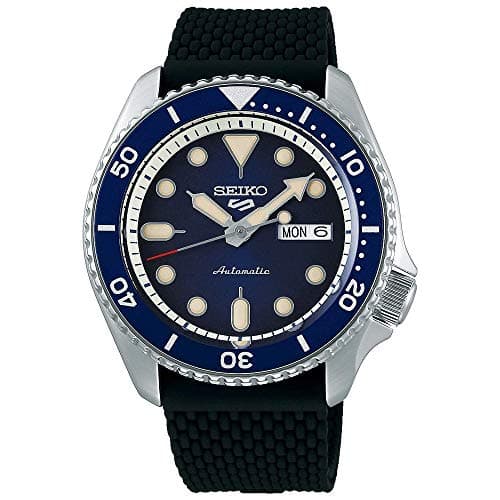
Seiko 5 Sports SRPD93
SRPD93Best for: A first mechanical watch you will not outgrow
The 5KX case with a movement that hacks and hand-winds, in blue on a silicone strap. The default answer under $350, and the one most people should stop looking after.
- Spec completeness for the price
- 8.8
- Movement relative to bracket
- 8.5
- Case proportions
- 8.9
- Strap flexibility
- 9.5
- Availability
- 8.8
What it gets right
- Hacks and hand-winds — the SKX's biggest omission, fixed
- 22 mm lugs put the entire aftermarket strap catalog in play
- Day-date in a genuinely legible layout
- Case shape is the SKX profile people actually want
What it gets wrong
- Hardlex, not sapphire — it will scratch
- 100 m and no screw-down crown, so it is not an ISO 6425 diver despite the looks
- 13.4 mm thick under a shirt cuff
- Ships on a silicone strap rather than a bracelet
Skip this one if: you want an actual dive watch. The 100 m rating and the absence of a screw-down crown mean this is a dive-styled sports watch, not an ISO 6425 diver. The Turtle is the real one.
| Case diameter | 42.5 mm |
|---|---|
| Lug-to-lug | 46.0 mm |
| Thickness | 13.4 mm |
| Lug width | 22 mm |
| Crystal | Hardlex (hardened mineral) |
| Water resistance | 100 m — splash and swim, not scuba |
| Bezel | Blue unidirectional rotating |
| Dial | Blue sunray |
| Strap | Black silicone |
| Case back | See-through |
| Lume | LumiBrite |
| Caliber | Seiko 4R36 |
| Type | Automatic, hand-winding and hacking |
| Beat rate | 21,600 vph (6 beats/sec) |
| Jewels | 24 |
| Power reserve | Approx. 41 hours |
| Stated accuracy | -35 to +45 sec/day |
| Complications | Day and date |
$263.308% off
Price as of October 5, 2026. Prices move — Amazon's is the one that counts.
#ad · we may earn a commission from this link to Seiko 5 SNKE04
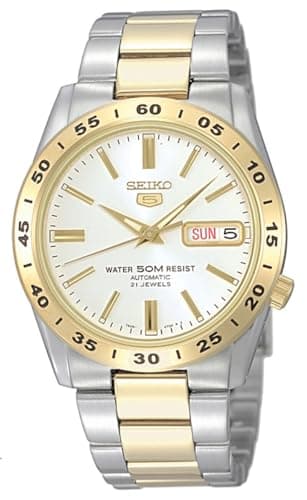
Seiko 5 SNKE04
SNKE04J1Best for: Buyers who care about J-suffix Japan assembly
A Japan-assembled Seiko 5 on a two-tone bracelet. The J suffix is the entire reason to pick this over its K-suffix twin.
- Spec completeness for the price
- 7.5
- Movement relative to bracket
- 7.4
- Case proportions
- 8.8
- Strap flexibility
- 7.6
- Availability
- 7.6
What it gets right
- J-suffix assembly
- Two-tone bracelet included
- 37 mm case
What it gets wrong
- 7S26 does not hack or hand-wind
- 50 m — swimming at a push, not diving
- Seiko does not publish full case dimensions for this reference
Skip this one if: the J suffix is not something you care about. The functional difference between J and K references is, by Seiko's own specification, nil — see our JDM guide.
| Case diameter | 37 mm |
|---|---|
| Lug-to-lug | Not published by Seiko for this reference |
| Thickness | Not published by Seiko for this reference |
| Lug width | Not published by Seiko for this reference |
| Crystal | Hardlex (hardened mineral) |
| Water resistance | 50 m (5 bar) |
| Dial | Champagne |
| Case and bracelet | Two-tone stainless steel |
| Market | J-suffix reference — Japan-assembled |
| Caliber | Seiko 7S26 |
| Type | Automatic. No hand-winding, no hacking |
| Beat rate | 21,600 vph (6 beats/sec) |
| Jewels | 21 |
| Power reserve | Approx. 41 hours |
| Stated accuracy | -20 to +40 sec/day |
| Complications | Day and date |
Price as of October 5, 2026. Prices move — Amazon's is the one that counts.
#ad · we may earn a commission from this link to Orient Kamasu
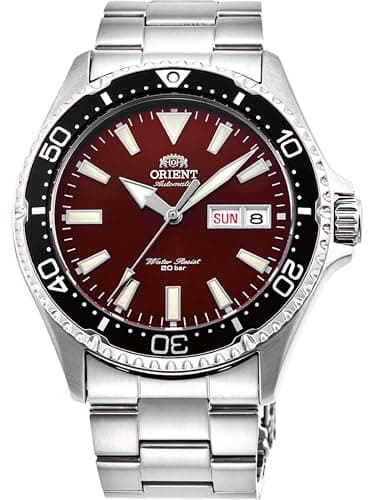
Orient Kamasu
RA-AA0003R39BBest for: Sapphire on a 200 m diver at the lowest price
Sapphire and a 200 m rating at a price where Seiko still fits Hardlex. On paper, the single strongest argument against buying a Seiko diver.
- Spec completeness for the price
- 9.4
- Movement relative to bracket
- 8.8
- Case proportions
- 8.7
- Strap flexibility
- 9.0
- Availability
- 8.5
What it gets right
- Sapphire crystal, which the equivalently priced Seikos do not have
- Hacks and hand-winds
- 200 m with a screw-down crown
What it gets wrong
- Orient's resale and brand recognition are well below Seiko's
- Bracelet quality is the usual criticism
- Fewer aftermarket parts than the Seiko ecosystem
Skip this one if: you want the modding ecosystem. Almost every aftermarket dial, hand set and bezel insert is cut for Seiko cases and NH-series movements, not for Orient.
| Brand | Orient (owned by Seiko Epson) |
|---|---|
| Case diameter | 41.8 mm |
| Crystal | Sapphire |
| Water resistance | 200 m |
| Movement | Orient F6922 automatic, hacking and hand-winding |
| Complications | Day and date |
Questions
What does Japan Mvt mean on a watch dial?
That the movement was manufactured by a Japanese company — in practice Seiko Instruments, Miyota or Epson. It says nothing about where the case, dial or bracelet were made, or where the watch was assembled. “Made in Japan” is the stronger claim.
Are Japanese movement watches good?
They are the most reliable mechanical movements available at low prices, because the three Japanese makers build them in volumes that keep tolerances and parts supply manageable. Their published accuracy windows are wide — Seiko states -35 to +45 seconds a day for the 4R calibers — so they are bought for durability rather than precision.
Who makes the NH35 movement?
Seiko Instruments, the Seiko group’s movement business, which sells it to other watch brands. It shares its architecture with Seiko’s own 4R35, which is why so many microbrand watches are mechanically equivalent to a Seiko 5 — see NH35 vs 4R35.
Is Miyota the same as Citizen?
Miyota is Citizen’s movement business, so a Miyota caliber is a Citizen-group movement sold to other brands. It is the direct equivalent of Seiko Instruments on the Seiko side.
Do Japanese movement watches need batteries?
Only the quartz ones. Japanese makers produce both: mechanical automatics that run on a wound mainspring and need no battery at all, battery quartz calibers, and solar quartz calibers that charge from light instead of a disposable cell. Which one a watch uses is a caliber fact, not a country fact.
Is a Japanese movement better than a Swiss one?
Cheaper and more robust for the money; less accurate on published specification. A 4R36 and a Swiss ETA 2824 are both reliable automatics, and the ETA is held to a tighter stated rate. The comparison is laid out in NH35 vs ETA 2824.
Sources
- Seiko Instruments — movement division (NH-series manufacturer)
- Seiko instruction manuals and caliber documentation
- Seiko Watch Corporation — US catalog and specifications
- Seiko USA — 5 Sports SRPD93 published specifications
- Orient Watch — company and collections
Specifications are transcribed from manufacturer documentation and published standards. Where a manufacturer does not publish a figure, this page says so rather than estimating one.
Read next
- Japanese vs Swiss movementsThe published figures, side by side.
- NH35 vs 4R35The same movement under two names, and who buys each.
- Japanese watch brandsWhich company owns which name on the dial.
- Is Seiko Japanese?Where Seikos are actually assembled, reference by reference.
- JDM vs internationalWhat the J and K suffixes change, including the warranty.
- Best Japanese watches under $200Where Japanese movement economics show up most clearly.