Movements
Seiko 4R57 caliber reference
The 4R with two extra hands. Same beat, same reserve, same regulation as a 4R35 — and 2.6 mm more watch.
By Stephen V. · Updated Nov 5, 2026
The Seiko 4R57 is an automatic movement running at 21,600 vph with a 41-hour power reserve and 29 jewels. It hacks and hand-winds, and it drives five hands: hours, minutes, seconds, a date hand and a power reserve indicator. Seiko states its rate as +45 to -35 seconds a day. Mechanically it is a 4R35 with two extra displays, and the watches it goes into are 2.6 mm taller because of them.
Published specification
Every row below is transcribed from Seiko’s own English instruction manual for this caliber. Nothing here is measured, and nothing is inferred from a sibling movement.
| Specification | Value |
|---|---|
| Type | Automatic winding with manual winding mechanism |
| Beat rate | 21,600 vibrations/hour (6 vibrations/sec) |
| Jewels | 29 |
| Power reserve | Approx. 41 hours |
| Stated accuracy | +45 to -35 sec/day |
| Accuracy conditions | Worn on the wrist, 5°C to 35°C |
| Hacking | Yes — stop second hand function |
| Hand-winding | Yes |
| Hands driven | 5 — hour, minute, second, date, power reserve |
| Complications | Date hand and power reserve indicator |
Seiko’s specification page for Cal. 4R57 gives the features as “5 hands (Time display (Hour, minute and seconds hands), date hand and power reserve indicator),” the beat as “21,600 vibrations/hour (6 vibrations/sec),” the rate as “+45 to -35 seconds at normal temperature range” with the note “only if worn on the wrist in a temperature range of 5°C to 35°C,” the driving system as “Automatic winding type with manual winding mechanism,” the duration as “Approx. 41 hours” and the jewel count as “29 jewels.” The same page adds the caveat worth repeating: that figure is factory-adjusted, and your example’s real daily rate depends on how long it is worn, the temperature, arm movement and whether the mainspring is fully wound.
The 29 jewels are the tell
Jewel count is the most over-read number in a movement specification, but here it does carry information. The 4R35 uses 23 and the 4R36uses 24. The 4R57 uses 29, and the difference is not quality — it is the extra bearing surfaces the two additional displays need. More wheels, more pivots, more jewels.
What a jewel count does nottell you is how well a movement runs. All three of these calibers carry the identical stated rate, so on Seiko’s own numbers the 29-jewel 4R57 is specified to keep time exactly as well as the 23-jewel 4R35 and no better. If you are choosing between them, the question is which displays you want, not which movement is more accurate. What that rate window means day to dayis worked out separately, because “+45 to -35” sounds much worse than it usually behaves.
What a power reserve indicator is actually for
An automatic winds itself from your wrist and stops when it runs out. The reserve indicator is a fuel gauge for that: a small sub-hand that climbs as the mainspring winds and falls as it unwinds, so you can see how much running time is left without taking the watch off, shaking it, or finding out the hard way on Monday morning.
On a 41-hour movement that matters more than it does on a 70-hour one. The reserve guidedoes the arithmetic in full, and the short version is this: 41 hours from six o’clock on a Friday evening is exhausted before midday on Sunday. A 4R57 cannot fix that — it holds the same 41 hours as every other 4R — but it does tell you about it in advance, which is the entire argument for the complication. If you own one watch and wear it daily, the gauge is decoration. If you rotate between several, it is the difference between picking up a running watch and picking up a stopped one.
The indicator is also the reason this caliber hands you a date hand rather than a date window. With a reserve sub-dial occupying one part of the dial, Seiko drives the date with a fourth central hand pointing at a printed ring instead of cutting an aperture. It is a legibility trade: easier to read at a glance across the whole dial, harder to read precisely than a number in a window.
The 2.6 mm the complication costs
This is the part most 4R57 coverage leaves out, and it is the only figure that should change anyone’s mind. Seiko publishes the same 40.5 mm Presage case for both the 4R35 and the 4R57 versions of its Cocktail Time dials. The heights are not the same.
| Reference | Caliber | Diameter | Thickness |
|---|---|---|---|
| Cocktail Time SRPB43 | 4R35 | 40.5 mm | 11.8 mm |
| Cocktail Time SRPE15 | 4R35 | 40.5 mm | 11.8 mm |
| Cocktail Time SSA343 | 4R57 | 40.5 mm | 14.4 mm |
| Cocktail Time SSA347 | 4R57 | 40.5 mm | 14.4 mm |
| Presage SSA459 | 4R57 | 40.5 mm | 14.4 mm |
14.4 mm against 11.8 mm is a 2.6 mm penalty, on a watch whose whole purpose is to go under a shirt cuff. For scale, 2.6 mm is roughly the gap between a dress watch and a 100 m sports watch in this catalog, and it is more height than the exhibition caseback costs. Every 4R57 reference in our registry is 14.4 mm thick — a figure taken from 3entries rather than typed — so this is a property of the movement, not of one unlucky case design.
That is the honest trade. You are buying two extra displays and paying for them in height, not in accuracy, reserve or beat rate. Someone who wants the slimmest Cocktail Time should buy a 4R35; someone who wants to see the state of wind should accept 14.4 mm and stop reading comparisons. The thinnest references we track are ranked separately, and no 4R57 appears on that page.
4R57 against the rest of the 4R family
The 4R calibers are one architecture with different top plates, which is why 33 of the references in this registry run one. Set them side by side and the family resemblance is the point.
| Caliber | Jewels | Reserve | Stated rate | What it displays |
|---|---|---|---|---|
| 4R35 | 23 | 41 h | -35/+45 s/day | Date window |
| 4R36 | 24 | 41 h | -35/+45 s/day | Day and date windows |
| 4R34 | 24 | 41 h | -35/+45 s/day | Date, 24-hour GMT hand |
| 4R57 | 29 | 41 h | -35/+45 s/day | Date hand, power reserve |
Identical beat, identical reserve, identical stated regulation. Four columns the same and one different, and the one that differs is the display — which is exactly how to read the 4R range. 4R57 vs 4R35: the 4R57 adds a reserve indicator and swaps the date window for a date hand, and costs 2.6 mm of case height. 4R57 vs 4R36: the 4R36 gives you a day-of-week window instead of the reserve gauge, in a slimmer case, and is the one Seiko fits to its 5 Sports range. Neither swap buys you a better engine.
Step outside the 4R family and the trade changes shape. The 6R35is the caliber that actually solves the weekend problem, with a published 70-hour reserve and a tighter -15 to +25 stated rate — and no reserve indicator on most of the references that use it. Choosing between a 4R57 and a 6R35 is choosing between being told you are about to run out and not running out; the 4R-versus-6R comparison has the rest of that argument.
Is there an NH equivalent?
Not one that turns up in the wild. Seiko Instruments sells several 4R calibers externally under NH numbers — the NH35 for the 4R35, the NH34for the 4R34 — which is why microbrands can ship a mechanical GMT at all. We have found no equivalent third-party listing for a power-reserve-plus-date-hand NH movement in the same family, and we are not going to invent a part number. If you want this specific set of displays in a mechanical watch at this money, the 4R57 references below are effectively the whole market.
Watches that use it
All 3 of the 4R57 references in this registry are Presage dress watches, all three were verified live and priced on 2026-11-05 before this page was written, and all three share the same published case: 40.5 mm across, 14.4 mm thick, 20 mm lugs, box-shaped Hardlex, 50 m, exhibition caseback.
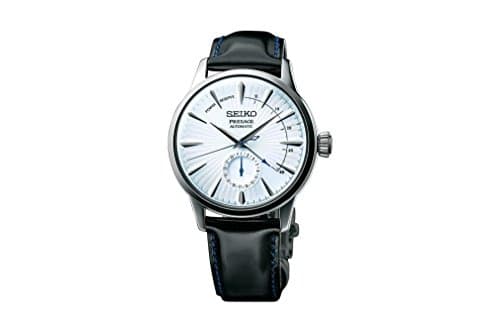
- SSA343 — the ice-blue “Sky Diving” dial, on cow leather with a three-fold clasp, and the cheapest of the three. The only one for which Seiko publishes a weight (84.0 g). The reference page has the full specification.
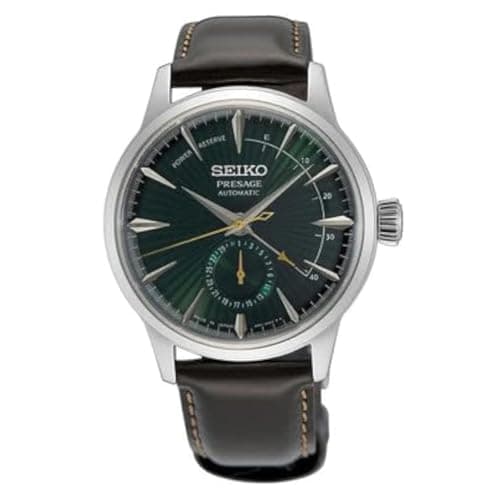
- SSA459— the rich green pressed-pattern dial, on leather, and the only 4R57 here for which Seiko publishes a lug-to-lug: 47.5 mm. If fit is your constraint, this is the one with the number you need.
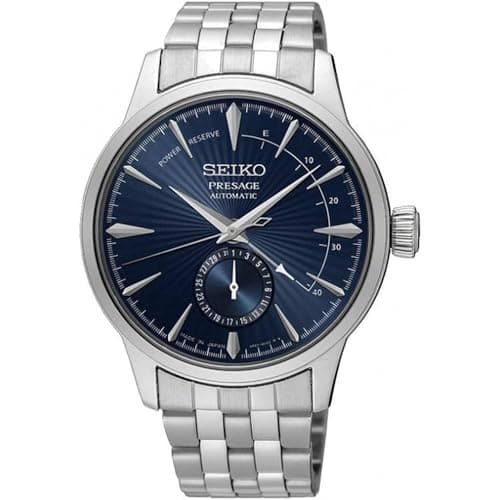
- SSA347— the “Blue Moon” dial on a deployment clasp, and the most expensive. Seiko publishes neither a band material nor a weight nor a lug-to-lug for it, which is worth knowing before you spend the extra.
Two of those three omit the lug-to-lug, and across the whole registry only 35 of 69 entries have one published at all. That is why the fit guide teaches the measurement rather than handing out a table: on a 4R57 you will often be working from diameter and thickness alone.
What is not on this page
We have not opened, timed or regulated a 4R57. There is no measured accuracy figure here, no timegrapher trace and no amplitude number, because producing those needs equipment we do not have. The methodology page states exactly what that does and does not let us claim. Seiko does not publish a movement diameter or height for this caliber the way Seiko Instruments does for its NH range, so those two rows do not appear above rather than appearing as estimates.
The watches on this page
Specifications are transcribed from Seiko’s published documentation. Prices come from Amazon and carry the date they were verified. We have not handled these watches — here is what we did instead.
Price as of November 23, 2026. Prices move — Amazon's is the one that counts.
#ad · we may earn a commission from this link to Seiko Presage Cocktail Time SSA343
Seiko Presage Cocktail Time SSA343
SSA343J1Best for: Seeing how much wind is left without taking the watch off
The Cocktail Time with the power reserve hand: the 'Sky Diving' ice-blue dial, a 4R57 instead of a 4R35, and 14.4 mm of case to pay for it.
- Spec completeness for the price
- 7.8
- Movement relative to bracket
- 8.8
- Case proportions
- 7.4
- Strap flexibility
- 9.2
- Availability
- 8.4
What it gets right
- A power reserve indicator and a date hand, on a watch that still costs less than most 70-hour automatics
- The same ice-blue 'Sky Diving' dial and box crystal as the cheaper SRPB43
- 84.0 g is light for a 40.5 mm steel case, because the strap is leather
What it gets wrong
- 14.4 mm thick — 2.6 mm taller than the 4R35 version of the same dial
- Hardlex, not sapphire
- Seiko publishes no lug-to-lug for this reference and has no US catalog page for it
Skip this one if: you want the thinnest version of this dial. The SRPB43 is the same 'Sky Diving' Cocktail Time at 11.8 mm — you give up the power reserve hand and get a 2.6 mm slimmer watch for less money.
| Case diameter | 40.5 mm |
|---|---|
| Lug-to-lug | Not published by Seiko for this reference |
| Thickness | 14.4 mm |
| Lug width | 20 mm |
| Crystal | Box-shaped Hardlex |
| Water resistance | 50 m (5 bar) |
| Caliber | Seiko 4R57 |
| Type | Automatic, hand-winding and hacking |
| Beat rate | 21,600 vph (6 beats/sec) |
| Jewels | 29 |
| Power reserve | Approx. 41 hours |
| Stated accuracy | -35 to +45 sec/day |
| Complications | Date hand and power reserve indicator |
| Dial | Ice blue, pressed pattern — Seiko's 'Sky Diving' cocktail dial |
| Case material | Stainless steel |
| Band | Cow leather, three-fold clasp with push-button release |
| Weight | 84.0 g |
| Display back | Yes — see-through screw caseback |
$499.805% off
Price as of November 23, 2026. Prices move — Amazon's is the one that counts.
#ad · we may earn a commission from this link to Seiko Presage SSA459
Seiko Presage SSA459
SSA459J1Best for: A green dress dial with texture rather than a flat sunburst
A green patterned-dial Presage Cocktail Time with a power reserve hand, on leather. The most interesting dial in Seiko's mid-range dress catalog right now.
- Spec completeness for the price
- 8.2
- Movement relative to bracket
- 8.3
- Case proportions
- 8.0
- Strap flexibility
- 9.2
- Availability
- 7.9
What it gets right
- Distinctive textured green dial under a box-shaped crystal
- 4R57 adds a power reserve hand and a date hand the plain 4R35 does not have
- 47.5 mm lug-to-lug on a 40.5 mm case
What it gets wrong
- 50 m
- 14.4 mm thick, which is tall for a dress watch
- Hardlex, not sapphire, at this price
Skip this one if: you wanted a bracelet. This reference ships on cow leather, and at 14.4 mm it is a thick watch to put under a cuff whatever you strap it to.
| Case diameter | 40.5 mm |
|---|---|
| Lug-to-lug | 47.5 mm |
| Thickness | 14.4 mm |
| Lug width | 20 mm |
| Crystal | Box-shaped Hardlex |
| Water resistance | 50 m (5 bar) |
| Caliber | Seiko 4R57 |
| Type | Automatic, hand-winding and hacking |
| Beat rate | 21,600 vph (6 beats/sec) |
| Jewels | 29 |
| Power reserve | Approx. 41 hours |
| Stated accuracy | -35 to +45 sec/day |
| Complications | Date hand and power reserve indicator |
| Dial | Rich green with a pressed pattern and gloss finish |
| Band | Cow leather, three-fold clasp with push-button release |
| Display back | Yes — see-through screw caseback |
Price as of November 23, 2026. Prices move — Amazon's is the one that counts.
#ad · we may earn a commission from this link to Seiko Presage Cocktail Time SSA347
Seiko Presage Cocktail Time SSA347
SSA347J1Best for: The blue version of the power-reserve Cocktail Time
The 'Blue Moon' power-reserve Cocktail Time. Same case and 4R57 as the SSA343, a deployment clasp instead of a three-fold one, and the thinnest specification sheet of the three.
- Spec completeness for the price
- 7.2
- Movement relative to bracket
- 8.8
- Case proportions
- 7.4
- Strap flexibility
- 9.0
- Availability
- 8.2
What it gets right
- The only blue power-reserve Cocktail Time with a live US listing
- Identical published case and movement to the SSA343
- Deployment clasp rather than a buckle
What it gets wrong
- The most expensive of the three 4R57 references here, for the same specification
- Seiko publishes no band material, no weight and no lug-to-lug for it
- 14.4 mm, Hardlex, 50 m — same three compromises as its siblings
Skip this one if: the dial color is not the deciding factor. The SSA343 is the same watch to the millimeter with a fuller specification sheet and a lower price; buy this one because you want 'Blue Moon', not because you expect more watch.
| Case diameter | 40.5 mm |
|---|---|
| Lug-to-lug | Not published by Seiko for this reference |
| Thickness | 14.4 mm |
| Lug width | 20 mm |
| Crystal | Box-shaped Hardlex |
| Water resistance | 50 m (5 bar) |
| Caliber | Seiko 4R57 |
| Type | Automatic, hand-winding and hacking |
| Beat rate | 21,600 vph (6 beats/sec) |
| Jewels | 29 |
| Power reserve | Approx. 41 hours |
| Stated accuracy | -35 to +45 sec/day |
| Complications | Date hand and power reserve indicator |
| Dial | Seiko's 'Blue Moon' cocktail dial |
| Case material | Stainless steel |
| Clasp | Deployment clasp with push-button release |
| Display back | Yes — see-through screw caseback |
Buy a 4R57 for one reason: you want to see the state of wind on the dial. It is not more accurate than a 4R35, it does not run longer, and it makes the watch meaningfully thicker. If that sounds like a bad deal, it is — right up until you own three watches and are tired of shaking one awake.
- Rotating a collection? The gauge earns its 2.6 mm. You can see at a glance whether the watch you picked up on Thursday is still running.
- One watch, worn daily? Skip it. A daily-worn automatic is always near full and the indicator never tells you anything. Buy the slimmer 4R35 version of the same dial and spend the difference on a better strap.
- Shirt cuffs matter? 14.4 mm is a genuine problem under a slim cuff. Measure before you commit.
- Want the reserve problem solved rather than displayed? That is a 6R35, not a 4R57.
Questions
Is the Seiko 4R57 a good movement?
It is the same 4R architecture Seiko fits across its mid-range: 21,600 vph, a 41-hour reserve, hacking, hand-winding, and a stated +45 to -35 seconds a day. Judged as an engine it is neither better nor worse than the 4R35 or 4R36, because Seiko specifies all three identically. What it adds is a date hand and a power reserve indicator.
What is the difference between the 4R57 and the 4R35?
Displays and case height, not performance. The 4R57 drives five hands including a power reserve indicator and a date hand; the 4R35 drives three plus a date window. Both run at 21,600 vph with a 41-hour reserve and the same stated rate. Every 4R57 Presage in our registry is 14.4 mm thick against 11.8 mm for the 4R35 version of the same case.
How accurate is the Seiko 4R57?
Seiko states +45 to -35 seconds per day, and qualifies it: that window applies when the watch is worn on the wrist in a temperature range of 5°C to 35°C, and it is a factory adjustment rather than a guarantee about your example. It is a production tolerance, not a chronometer certification measured in multiple positions.
How many jewels does the 4R57 have?
29, per Seiko’s specification page for the caliber. That is more than the 4R35’s 23 and the 4R36’s 24, and the extra ones are bearing surfaces for the date hand and reserve indicator rather than a sign of better finishing.
Which Seiko watches use the 4R57?
In the current US market, Presage dress references: the SSA343, the SSA459 and the SSA347, all three of them 40.5 mm, 14.4 mm, box-shaped Hardlex and 50 m. All three were live and priced when this page was published. Seiko has used the caliber across a wider range of Presage references over the years; these are the ones we can price and specify today.
Can you hand-wind a 4R57?
Yes. Seiko lists the driving system as “automatic winding type with manual winding mechanism,” and the caliber also has a stop second hand function, so it hacks. Winding it by hand is the fastest way to push the reserve indicator to full — the winding guide covers how far to take it.
Sources
- Seiko — specifications, Cal. 4R57 (instruction manual, checked 2026-11-05)
- Seiko Watch Corporation — Presage SSA343J1 specifications (checked 2026-11-05)
- Seiko Watch Corporation — Presage SSA347J1 specifications (checked 2026-11-05)
- Seiko Watch Corporation — Presage SSA459J1 specifications
- Seiko instruction manuals and caliber documentation
- Seiko Presage collection — official specifications
- Seiko Watch Corporation — US catalog and specifications
Specifications are transcribed from manufacturer documentation and published standards. Where a manufacturer does not publish a figure, this page says so rather than estimating one.
Read next
- Seiko Presage SSA343The cheapest live 4R57, with the fullest published specification of the three.
- Seiko 4R35 caliber referenceThe same movement without the two extra hands, in a 2.6 mm slimmer case.
- Seiko 4R36 caliber referenceThe day-date sibling, and the 4R most Seiko 5 Sports references run.
- Seiko power reserve, explainedWhat 41 hours means off the wrist, across all four of Seiko's power systems.
- Seiko 6R35 caliber reference70 hours and a tighter stated rate — the caliber that solves the problem instead of displaying it.
- Best Seiko Cocktail Time watchesThe dial family all three 4R57 references belong to, ranked.